Your Plumbing Business Has 11,000 Followers. Google Has Never Heard of You.
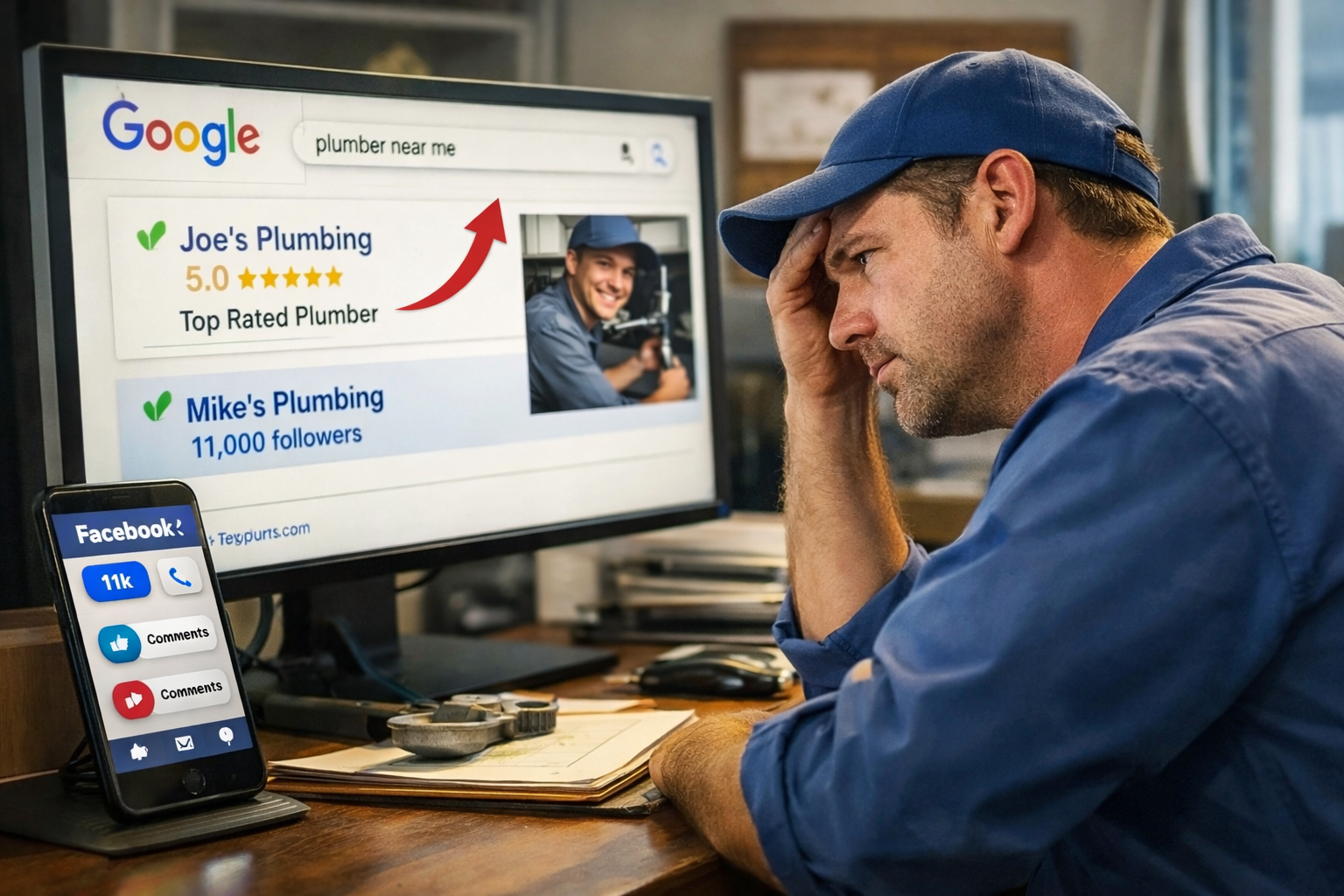
It happens more than you'd think. A home services business — let's say a plumbing company — has built a genuinely impressive social media presence. Eleven thousand followers on Facebook. Posts getting shared around the community. Comments, likes, the occasional viral video of a gnarly pipe job that somehow found its way into three local neighborhood groups. The owner is proud of it, and they should be. That kind of following doesn't happen by accident. It takes consistency, personality, and real effort over time.
Then someone in their town types "plumber near me" into Google and they don't show up. Not on the first page. Not on the second. Maybe not at all.
How is that possible? How does a business with 11,000 people paying attention to it online not exist in Google's eyes? How does a company with more followers than most local news stations have readers rank below a competitor with a barebones website and 200 Facebook fans?
The answer gets at something fundamental about how different platforms work — and why conflating social media presence with search visibility is one of the most common, most costly, and most emotionally confusing mistakes small businesses make.
Two Different Internets
Most people experience the internet as one thing. You open your phone, you tap around, and it all feels connected. Facebook, Google, Instagram, Yelp — it's all just "being online." That feeling of seamlessness creates a natural but incorrect assumption: that doing well in one place means you're doing well everywhere.
The reality is that these platforms operate as almost entirely separate ecosystems, each with its own index of content, its own algorithm for surfacing that content, and its own definition of what makes something relevant or trustworthy.
Facebook's world is built around social graphs — who you know, what you've engaged with, what people like you tend to respond to. Its algorithm surfaces content based on relationships and behavioral signals within its own platform. When someone follows your plumbing business on Facebook, they're entering into a relationship that exists inside Facebook's ecosystem. That relationship is real and potentially valuable — but it's invisible to Google.
Google's world is built around crawlable web content. Its job is to index pages on the open web and surface the most relevant, trustworthy answer to any given search query. When someone types "emergency plumber Cherry Hill NJ" into Google, it searches its index of web pages, business profiles, and directory listings — not social media followings — to determine who deserves to appear at the top.
Your 11,000 Facebook followers represent real people who opted into your content inside Facebook's closed system. They didn't create any signal that Google can see, measure, or use to decide that your plumbing business is the most relevant result for someone searching in your area. As far as Google's ranking algorithm is concerned, those 11,000 people don't exist.
What Google Is Actually Looking At
To understand why follower counts don't matter for search rankings, it helps to understand — specifically — what Google does use.
For local businesses like plumbers, HVAC companies, electricians, and landscapers, Google's local ranking algorithm prioritizes three things: relevance, distance, and prominence.
Relevance is whether your business matches what the searcher is looking for. If someone searches "drain cleaning" and your Google Business Profile and website don't clearly indicate that you offer drain cleaning services, Google has no basis for showing you. This sounds obvious but it's a genuine problem for businesses whose online presence is vague, outdated, or spread across social platforms rather than concentrated on their own web infrastructure.
Distance is straightforward — how close is your business to the searcher, or to the location specified in the search query. This is largely outside your control, though your service area settings and location signals across your online presence affect how Google interprets your geographic footprint.
Prominence is where most of the actionable SEO work lives, and it's worth dwelling on. Prominence is Google's assessment of how well-known and trusted your business is based on signals it can actually measure. Those signals include the completeness and activity of your Google Business Profile, the number and recency of your Google reviews and how you respond to them, the quality and optimization of your website, the consistency of your business information across directories and citation sources, the number of other websites that link to yours, and the volume of branded searches for your business name.
Notice what's not on that list. Your Facebook follower count. Your Instagram engagement rate. Your TikTok views. The number of shares your last post got. These signals live entirely inside closed platforms that Google doesn't have meaningful access to and doesn't incorporate into its local ranking decisions.
The Closed Garden Problem
It's worth going a little deeper on why social media platforms are essentially invisible to Google, because the technical reality explains a lot.
When Google crawls the web, it follows links from page to page, indexing the content it finds. Most social media platforms severely restrict this process. Facebook's content — your posts, your photos, your follower count, your engagement metrics — is largely locked behind authentication walls. Google can see that your Facebook business page exists at a public URL, but it can't meaningfully crawl the content within it, can't verify your follower count, can't read your post history, and can't use any of it as a ranking signal.
Instagram is even more closed. Twitter/X has historically allowed some crawling but the signal value for local business rankings is minimal. TikTok is effectively a black box from Google's perspective.
What this means practically is that years of content creation on these platforms, thousands of followers built over time, and hundreds of posts documenting your work and building your reputation — none of it registers in the index that determines whether you show up when someone needs a plumber at 11pm on a Tuesday.
This isn't a flaw in the system. It's just how separate these ecosystems are. The problem arises when business owners treat social media activity as a substitute for building web presence, when in reality they're building equity in a platform they don't own and can't port to the place where their highest-value prospects are actively searching.
Followers Are an Audience. Rankings Are Infrastructure.
This is probably the most important distinction in this entire piece, and it's worth sitting with.
Your social media following is an audience — a group of people who have opted into receiving your content inside a specific platform. That audience has real value. When you post, there's a mechanism to put that content in front of people who've already expressed interest in your business. For past customers, referral generation, community presence, and brand warmth, a strong social following is genuinely useful.
But an audience is passive by nature. It reaches people who are already in the platform, already following you, and receptive to what you're sharing. It does nothing for the person who has never heard of your company, isn't on Facebook in that moment, and is typing a search query into Google because they woke up to a flooded basement.
Search rankings are infrastructure. They determine whether your business is visible to complete strangers who are actively looking for what you do, right now, with intent to hire. Those strangers aren't scrolling your Facebook feed. They're not going to discover your 11,000 followers. They're on Google with a specific problem, a sense of urgency, and probably a phone in their hand ready to call whoever looks credible and nearby.
The fundamental difference is push vs. pull. Social media is push — you create content and distribute it to an existing audience. Search is pull — potential customers come looking for something and either find you or don't. The pull moment, when someone is actively searching for your service, is often the highest-value prospect interaction you'll ever have. And it has nothing to do with how many people follow you on Facebook.
The Competitor With 200 Followers Who Keeps Outranking You
Here's where this gets personal for a lot of business owners.
Your competitor — the one whose truck you keep seeing in the neighborhood, the one whose name keeps coming up when you search for your own category — might have a fraction of your social following. Their Facebook page might be an afterthought. Their last Instagram post might be from eight months ago. They might not even be on TikTok.
But they show up every time someone in your town searches for a plumber. They're in the local pack. They're in the organic results. Their phone rings from Google searches that should be coming to you.
Why? Because somewhere along the way they — or an agency working for them — did the unglamorous work of building actual search infrastructure. They claimed and fully optimized their Google Business Profile. They built a real website with service-specific pages that clearly communicate what they do and where they do it. They systematically asked satisfied customers for Google reviews and now have 90 of them, most from the last six months. Their business name, address, and phone number appear consistently across every directory Google checks. They might even have a few blog posts targeting the questions their customers type into Google before calling a plumber.
None of that shows up on Facebook. None of it generates likes or shares. None of it grows a following. But all of it works — every single day, every time someone in your service area needs a plumber — in a way that your follower count simply cannot replicate.
Why This Confusion Persists
It's worth asking why so many business owners fall into this trap, because it's not a stupidity problem. Smart, hardworking people with successful businesses consistently overinvest in social media and underinvest in search infrastructure. There are real psychological reasons for this.
Social media feedback is immediate and visible. You post something, and within hours you can see likes, comments, shares, and new followers. That feedback loop is emotionally satisfying in a way that SEO simply isn't. Optimizing a Google Business Profile doesn't generate a notification. Publishing a well-structured service page doesn't produce a dopamine hit. The work happens invisibly and the results arrive slowly.
Follower counts feel like a scoreboard. Ten thousand followers feels like success because it's a big number and other people can see it. Position 3 in Google's local pack for "plumber [city]" is less visible but worth ten times as much in practice.
Social media is easier to understand intuitively. Most business owners get the idea of building an audience because it maps to concepts they already understand — word of mouth, community reputation, being known around town. SEO involves technical concepts and a platform you don't control, which makes it feel less tangible and harder to connect to business outcomes.
Agencies sometimes make it worse. Social media management is easier to package, price, and show activity on than SEO. Monthly reports full of engagement metrics and follower growth look productive even when they're not moving the business needle. It's harder to explain why a Google Business Profile optimization and three new service pages are worth more than a month of daily posts.
None of this makes social media bad. It makes it misunderstood — specifically, misunderstood as a driver of search visibility when it isn't.
What Actually Moves the Needle on Google
Let's be concrete about where the work actually happens if you want to show up when someone in your area searches for what you do.
Your Google Business Profile is the single most important asset you control for local search. It needs to be fully built out with the right primary and secondary categories, complete service descriptions that use the language your customers search for, real photos of your team, your vehicles, your work, and your location, and a steady cadence of new Google reviews with genuine responses. Google treats an active, well-maintained GBP as a strong signal of a legitimate, relevant, trustworthy local business. An incomplete or stale one sends the opposite signal.
Your website needs to earn its place in the index. A website that exists but has no service-specific pages, no mention of your service areas, no location-relevant content, and hasn't been updated in years is close to invisible. You need pages that clearly communicate every service you offer, every area you serve, and enough content to give Google something to evaluate for relevance. A plumber serving five towns needs pages that speak to each of those towns — not a single homepage that mentions the region vaguely.
Reviews are a ranking signal, not just a reputation tool. The volume, recency, and quality of your Google reviews directly influences your local pack ranking. A business with 20 reviews from 18 months ago is at a meaningful disadvantage compared to a competitor with 85 reviews, 40 of them from the last 90 days, all receiving thoughtful owner responses. Getting reviews needs to be a systematic, ongoing process — asking every satisfied customer, making it easy with a direct link, and following up without being pushy.
Citations and directory consistency matter more than most people realize. Your business name, address, and phone number need to appear correctly and consistently across every directory Google cross-references — Google itself, Yelp, Angi, the Better Business Bureau, local chamber listings, Apple Maps, Bing Places, and dozens of others. Inconsistent information — different phone numbers, old addresses, slight variations in your business name — erodes the trust signals Google uses to validate that your business is legitimate and located where it claims to be. Cleaning up citation inconsistencies is one of the least glamorous and most impactful things a local business can do for its search presence.
Content that matches how your customers actually search. Beyond your service pages, there's real value in creating content that answers the questions your customers type into Google before they're ready to call. "How much does it cost to replace a water heater in [city]?" "What causes low water pressure in older homes?" "Do I need a permit for a bathroom remodel in [county]?" These are real searches from real people at the beginning of a buying journey. Being the business that answers them well puts you in front of prospects before they've even started comparing options.
The Referral Trap
There's another version of this problem worth naming, because it's related. Some home services businesses have built their entire customer acquisition model on referrals — past customers recommending them to neighbors, word of mouth spreading through community Facebook groups, reputation built over years of good work.
Referrals are wonderful. But they have a ceiling, and that ceiling becomes visible when the business tries to grow beyond its existing network or when a few key referral sources dry up.
More importantly, even referred prospects Google you before they call. Someone gets your name from a neighbor, types your business name into Google, and what they find — or don't find — determines whether they follow through. A business with no Google presence, few reviews, and a website that looks like it was built in 2012 loses referrals it earned through years of great work, simply because the digital infrastructure doesn't back up the reputation.
Social media following has the same ceiling problem. Your 11,000 followers represent people who are already inside your orbit. Growing that number doesn't necessarily expand your orbit — it deepens engagement with people who already know you. Search infrastructure expands your orbit by making you visible to people who have never heard of you and are actively looking for someone exactly like you.
Both matter. But if you're trying to grow, the constraint is almost always reach — and reach comes from search, not from followers.
What Social Media Is Actually Good For
None of this is an argument for abandoning social media. It's an argument for understanding what it's actually good at and deploying it accordingly.
Social media is excellent for staying top of mind with past customers who might hire you again or refer you. It's good for building the kind of human, personality-driven brand presence that makes your business feel trustworthy before someone has ever worked with you. It's useful for community presence — being visible in local groups, participating in neighborhood conversations, showing up as a business that's genuinely part of the area it serves. It can generate direct inquiries from people who discover you through a friend's share or a community recommendation. It can support your Google rankings indirectly by driving branded searches, which are a signal Google pays attention to.
What it cannot do is replace the infrastructure that makes you discoverable to strangers in search. Those are different jobs. Treating social media as a search strategy is like treating a loyal customer base as a substitute for advertising — the loyalty is real and valuable, but it doesn't reach the people who haven't found you yet.
The Number That Actually Matters
Eleven thousand followers is a real accomplishment. It represents real relationships, real community investment, and real consistency over time. You should be proud of it.
But here's the question that actually determines whether your business grows: how many times this month did a complete stranger in your service area search for a plumber and find you?
Not someone who already knew your name. Not someone who saw your post in a neighborhood group. A stranger with a plumbing problem, no prior knowledge of your business, typing a query into Google and either finding you or finding your competitor.
If the answer is rarely or never, the 11,000 followers aren't the problem — and they aren't the solution. The solution is building the infrastructure that makes you visible in the moment that matters most: when someone who needs exactly what you do goes looking for it.
That infrastructure doesn't generate likes. It generates calls.
At Ritner Digital, we help home services businesses build the search presence that turns strangers into customers — not just the social presence that impresses people who already know you exist. Get in touch to talk about what's actually driving calls to your business and what isn't.
FAQs
Does having a Facebook business page help my Google ranking at all?
Marginally, and not in the way most people assume. Google can see that your Facebook business page exists as a public URL, and a verified, active business presence across multiple platforms does contribute loosely to the overall picture of a legitimate business. But the follower count, post engagement, shares, and content within your Facebook page carry no meaningful weight in Google's local ranking algorithm. The presence of the page itself — essentially just confirming your business exists and has a name and address — is about as far as the benefit goes. If you're hoping that growing your Facebook following will eventually translate into better Google rankings, that's not how the connection works.
What if my Facebook posts get shared in local community groups — does that help SEO?
It can help your business indirectly, but it doesn't help your Google ranking directly. A post that spreads through a local neighborhood group might drive people to Google your business name, and branded search volume is a signal Google pays some attention to. It might also drive people to your website, and increased traffic from real users can be a mild positive signal. But the share itself, and the engagement it generates inside Facebook, doesn't translate into any ranking factor Google uses. The SEO benefit, if any, is several steps removed and not something you can count on consistently.
My business has been around for 20 years and everyone knows us locally. Why don't we show up on Google?
Longevity and local reputation are genuinely valuable — but Google can't see them unless they're reflected in signals it can actually measure. Two decades of great work, word-of-mouth referrals, and community relationships don't register in Google's index unless they show up somewhere crawlable. That means Google reviews documenting your reputation, a website that communicates your history and expertise, citations across directories that confirm your business information, and a Google Business Profile that reflects your actual presence. Google doesn't know your reputation exists unless you've given it a place to find it. The good news is that a business with a real track record and genuine community trust can build that infrastructure relatively quickly once the work starts.
How many Google reviews do I actually need to compete in local search?
There's no universal threshold, but context matters enormously. In a smaller market with less competition, 30 to 40 well-distributed recent reviews might put you in a strong position. In a competitive metro area going up against established competitors with hundreds of reviews, you need more — and more importantly, you need recency. A business with 200 reviews, most of them from three years ago, can be outranked by a competitor with 60 reviews from the last six months. Google treats review recency as a signal of an active, currently operating business. The goal isn't just to accumulate a big number — it's to maintain a steady flow of new reviews so your profile always looks current.
If I stop posting on social media and focus on SEO instead, will I lose customers?
Probably not the customers SEO is designed to reach, which are strangers searching for your service with immediate intent. Those people aren't finding you through social media anyway — they're either finding you through Google or finding your competitor. The customers you might affect by reducing social activity are the ones in your existing audience: past customers, followers who've engaged with your content, people who check in on your page occasionally. Those relationships have value worth maintaining, but they're a separate segment from the high-intent search traffic that SEO captures. The smarter move isn't to abandon social — it's to stop treating it as your primary growth channel and invest in the infrastructure that actually reaches new customers.
Can social media content help my SEO at all if I link back to my website?
Indirectly and modestly. Links from Facebook and most social platforms are "nofollow," meaning they don't pass the kind of link authority that directly improves your search rankings. However, social content that drives real traffic to your website — people clicking through from a post to read something useful — can produce engagement signals that Google picks up on. More importantly, content that gets shared widely sometimes earns attention from people who then link to it from their own websites, blogs, or publications, and those links do carry ranking value. Think of social media as a potential distribution channel for content that earns real links, rather than a direct SEO tactic in itself.
What's the fastest way to start showing up in Google searches for my area?
The highest-leverage starting point for most home services businesses is a fully optimized Google Business Profile combined with a systematic push to generate recent Google reviews. These two factors have the most direct and measurable impact on local pack rankings — the map results that appear at the top of local searches — and they can start producing movement faster than most other SEO investments. Beyond that, making sure your website has clear, properly structured service pages and that your business information is consistent across major directories addresses the foundational issues that hold most local businesses back. None of this is instantaneous, but a business starting from zero with a solid GBP and 40 recent reviews will outperform a competitor with a massive social following and a neglected Google presence almost every time.
Does it hurt my SEO if my website just links to my Facebook page instead of having real content?
Yes, significantly. A website that exists primarily as a landing page pointing people to social media gives Google almost nothing to evaluate. There's no content to index for relevant search queries, no service pages to establish topical relevance, no location signals to compete in local results, and no reason for Google to consider the site authoritative or useful. Some businesses go even further and use their Facebook page as their primary web presence entirely, forgoing a real website. This is one of the most damaging things a local business can do for its long-term search visibility. A real website — even a modest one with well-written service and location pages — is not optional infrastructure. It's the foundation everything else is built on.
We get a ton of leads from Facebook already. Why should we care about Google?
Because Facebook leads and Google leads are fundamentally different types of demand, and relying entirely on one source is a fragile strategy. Facebook leads are generally generated through content or ads reaching people who weren't necessarily looking for your service at that moment — they were scrolling and something caught their attention. Google leads come from people who were actively searching for exactly what you do, right now, with intent to hire. The conversion rate and close rate on high-intent search traffic tends to be significantly higher because the prospect is already in buying mode before they ever find you. Beyond conversion quality, algorithm changes, platform policy shifts, and rising ad costs can all affect your Facebook lead flow overnight. Search infrastructure is more stable and more owned — a well-ranked website and GBP don't disappear when Facebook changes its algorithm.
Is there any type of social media that actually helps Google rankings more directly?
YouTube is the clearest exception to the general rule, and it's worth mentioning. Google owns YouTube, and video content hosted there can appear directly in Google search results — meaning a well-optimized YouTube video about a plumbing topic can actually rank on Google and drive search traffic in a way that a Facebook post never could. For home services businesses willing to invest in video content, YouTube represents a legitimate SEO channel rather than just a social one. Beyond YouTube, a well-maintained LinkedIn presence can contribute to entity recognition for B2B companies, and consistent NAP information across all public social profiles contributes modestly to citation consistency. But for local home services businesses, the honest answer is that time spent on most social platforms is better spent on Google Business Profile, website content, and review generation if search visibility is the goal.