Your Website Is Your Digital Front Door — and SEO and AI Search Decide How Many People Walk Through It
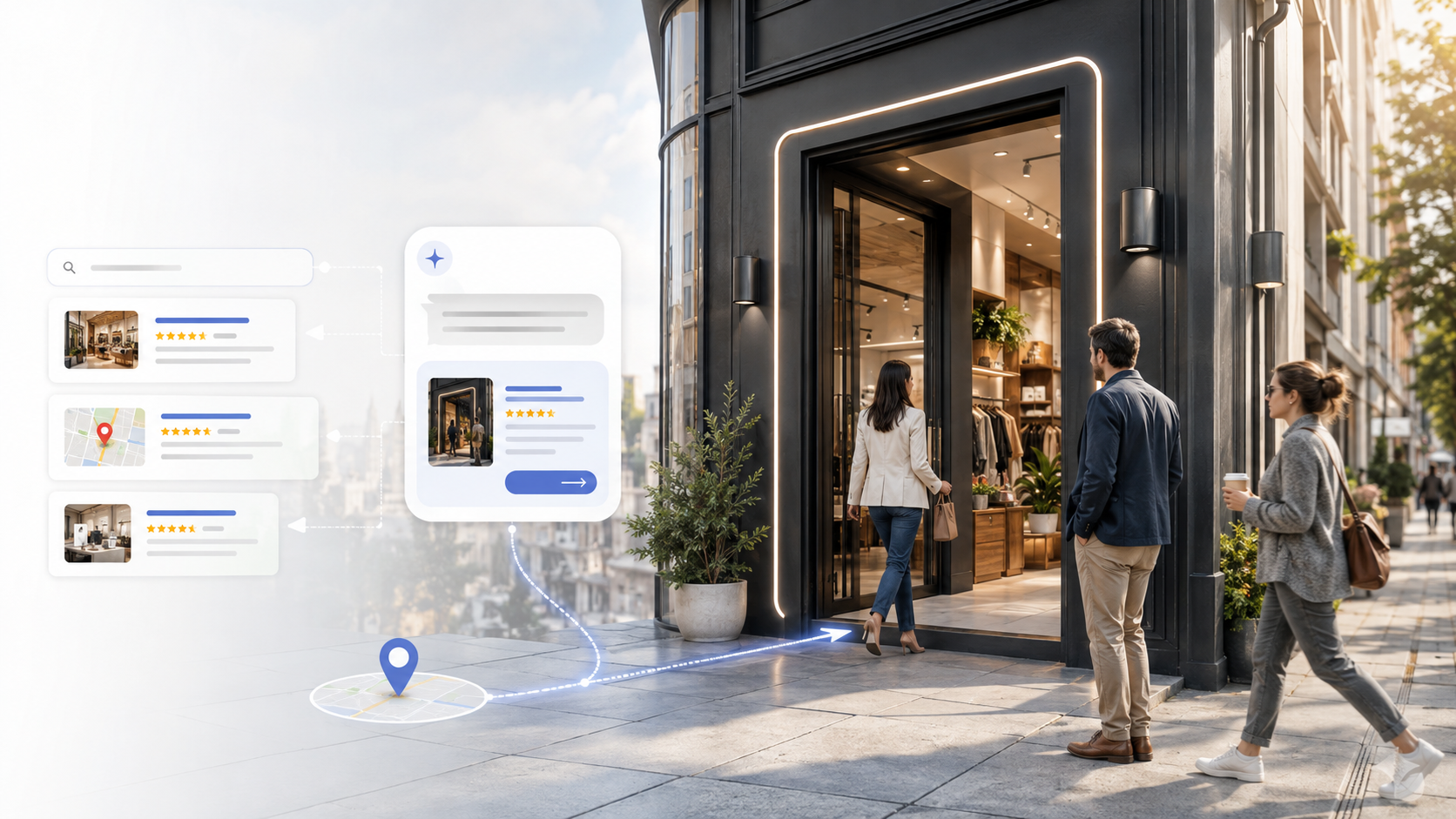
Imagine you own a storefront on the busiest street in your city. Great signage. Beautiful window display. Warm lighting. The door is propped open.
Now imagine that street is invisible to 98% of the people looking for what you sell.
That's what it's like to run a business in 2026 without a real search strategy. Your website is your digital front door — the place where nearly every customer relationship now begins. But a front door only matters if people can find the street it's on. And today, that street runs through two places: traditional search engines like Google, and AI answer engines like ChatGPT, Perplexity, Gemini, and Google's AI Overviews.
SEO and AI search optimization aren't abstract marketing acronyms. They are, quite literally, the disciplines of getting more people to walk in your digital front door — ideally with a need and the intent to buy, but sometimes just to grab a free sample, scope the place out, and come back later when they're ready.
This post breaks down how that foot traffic actually works, why it's changing faster than at any point in the last twenty years, and what your business needs to do about it.
Every Customer Journey Now Starts on a Digital Street
Let's start with the scale of the thing.
According to BrightEdge research, 68% of online experiences begin with a search engine, and organic search drives roughly 53% of all trackable website traffic — more than paid ads, social media, and email combined. For local businesses, the numbers are even more striking: 98% of consumers now search online to find information about local businesses, up from 90% in 2019, and 80% of U.S. consumers do so on a weekly basis.
Think about what that means in front-door terms. Before anyone calls your office, books a consultation, walks into your practice, or adds a product to a cart, they almost certainly passed through a search results page or an AI-generated answer first. That results page is the sidewalk in front of your store. Your ranking — or your presence in an AI answer — determines whether people even see your door.
And here's the part most business owners underestimate: the people walking down that digital street are not casual window-shoppers. They typed a query because they have a problem, a question, or a need. Search is the only marketing channel where the customer raises their hand first. Nobody searches "emergency dentist near me" or "kitchen remodel cost Philadelphia" for entertainment.
That's why SEO-generated leads close at roughly 14.6%, compared to about 1.7% for outbound methods like cold calls and direct mail. When someone walks through your front door because they went looking for you, the entire sales conversation changes.
Not Everyone Walks In to Buy — and That's Exactly How It Should Work
Here's where the front-door metaphor gets useful, because it captures something most marketing dashboards miss: not every visitor is ready to hand you money, and the ones who aren't still matter enormously.
Picture the foot traffic in a well-run retail store on a Saturday. You'll see three kinds of people:
1. The buyers. They came in with a need and a wallet. In search terms, these are the high-intent, bottom-of-funnel queries: "Invisalign consultation near me," "commercial roofing contractor South Jersey," "buy [product] online." These searches convert fast. Google's own data shows that 76% of people who search for something "near me" on their smartphone visit a related business within 24 hours, and 28% of those local searches end in a purchase. Local search compresses the entire buying journey — discovery, evaluation, and action — into a single day.
2. The samplers. They came in for the free cheese cube on a toothpick. Online, that's your blog content, your calculators, your guides, your FAQ pages — the "does Invisalign hurt," "how much does a bathroom remodel cost," "what's the difference between SEO and GEO" queries. These visitors take real value from you and leave without buying anything. Good. That free sample is doing its job: it's the first trust deposit in a relationship that often converts weeks or months later. Educational content is precisely how a business earns the right to be remembered when the need becomes urgent.
3. The scouts. They're scoping the place out. Comparing you to the shop down the street. Reading your reviews, checking your prices, seeing whether your website looks like it was built this decade or in 2013. 97% of people check out a company's online presence before visiting a location or making a purchase, and BrightLocal's research consistently shows the overwhelming majority of consumers read reviews before choosing a local business. The scouts may not talk to you at all on this visit — but they're deciding whether you make the shortlist.
A healthy digital front door serves all three. If your website only speaks to buyers, you're invisible during the 90% of the journey when people are sampling and scouting. If it only publishes educational content, you'll attract crowds who never find a clear path to purchase. The businesses that win build for the full spectrum of intent — service pages engineered for the buyers, content built for the samplers, and trust signals arranged for the scouts.
The Classic Front Door: Why Traditional SEO Still Carries the Most Foot Traffic
With all the noise about AI, it's worth stating plainly: Google is still, by a wide margin, the biggest street in town.Google processes billions of searches per day, and organic search remains the single largest source of website traffic across nearly every industry. Reports of SEO's death have been greatly exaggerated — what's actually happening is that SEO's job description is expanding.
Traditional SEO is the discipline of making sure that when someone searches for what you do, your door appears — prominently, credibly, and above your competitors'. It breaks down into a few interlocking layers:
Technical SEO is the foundation of the building. Crawlability, site speed, mobile performance, schema markup, clean architecture. If Google can't efficiently read your site, nothing else matters — you've built a beautiful store behind a locked gate. This is why serious SEO programs start with the technical infrastructure before touching a single blog post.
On-page SEO is your signage. Title tags, headings, internal linking, and content optimization tell both search engines and humans exactly what's behind the door. The stakes here are brutal: Ahrefs found that over 90% of pages get zero organic traffic from Google, and the top handful of organic results capture the majority of all clicks. Page two of Google is where foot traffic goes to die — fewer than 1% of searchers ever click a second-page result.
Content strategy is your inventory and your sample tray combined. Keyword research and topic clustering map out every question your customers ask at every stage of their journey, so there's a page waiting for each of them.
Authority building is your reputation on the street. Backlinks from relevant, credible sites are still among Google's strongest ranking signals — and, as we'll see, they've become the currency of AI visibility too.
None of these layers works in isolation, which is why bolting "some SEO" onto a website as an afterthought so rarely moves the needle. The businesses that dominate their categories treat search, content, and web design as one connected system — the site architecture is built around the keywords from day one, not retrofitted a year later.
Local Search: The Highest-Intent Foot Traffic in All of Marketing
If your business serves a geographic area — a dental practice, a med spa, a contractor, a law firm, a restaurant — local search deserves its own section, because the intent behind local queries is unlike anything else in digital marketing.
Consider the numbers. Roughly 46% of all Google searches carry local intent. Google's research shows 76% of "near me" mobile searches lead to a business visit within 24 hours, and 88% of consumers who perform a local search on their phone call or visit a business within a week. These are not people casually browsing. These are people standing on your street, actively looking for a door to walk through — today.
The map pack (the top three local listings Google shows for local queries) is the prime real estate on that street. Research from SOCi found that businesses appearing in the local 3-pack receive 126% more traffic and 93% more actions — calls, clicks, direction requests — than businesses ranked just below it. The difference between position three and position four in local search isn't incremental. It's the difference between a door on Main Street and a door in the alley.
Winning that real estate takes a coordinated effort: Google Business Profile optimization, consistent citations, review velocity, localized content, and location pages that prove to Google you actually serve the areas you claim. It's the exact playbook we run for clients across Philadelphia, South Jersey, and beyond — and it's the reason a general contractor can rank on page one for their money keywords within months instead of years.
And reviews deserve special mention, because they function as the crowd gathered outside your door. A line out the door of a restaurant tells passersby everything they need to know before reading the menu. Online, reviews play the same role: the Spiegel Research Center found that displaying reviews can lift conversion rates by up to 270%, and BrightLocal's annual survey consistently finds that most consumers won't seriously consider a business rated below four stars. Your review profile isn't a vanity metric — it directly affects local rankings, ad performance, AI citations, and whether the scouts scoping you out ever come back.
The New Front Door: AI Search Has Changed Where the Street Runs
Now for the part of the map that's being redrawn in real time.
A rapidly growing share of searches — especially research-heavy, comparison-style, and recommendation queries — no longer happen in a traditional search bar at all. They happen in a chat window. Someone asks ChatGPT "what's the best med spa near Marlton for lip filler," or asks Perplexity to "compare digital marketing agencies in Philadelphia," or simply reads the AI Overview that Google now places above the classic blue links. The AI synthesizes an answer, names a handful of businesses, and the customer's shortlist is formed before they ever see a traditional search result.
The scale of this shift is hard to overstate:
ChatGPT reached roughly 900 million weekly active users by early 2026 — more than double its count a year earlier.
Google's AI Overviews now reach over 2 billion users, appearing on a large and growing share of queries — Semrush tracking has measured them on anywhere from 6% to nearly 25% of searches depending on the month and category.
Gartner projects traditional search engine volume will drop 25% by 2026 as query behavior migrates to AI assistants.
In B2B, 6sense found that 94% of buyers used generative AI tools somewhere in their purchase process.
Even in local, the shift is dramatic: recent consumer research shows the share of consumers using AI tools for local business recommendations jumped from single digits to roughly 45% in about a year.
Here's the uncomfortable truth this creates for business owners: if your business isn't in the AI's answer, you don't exist for that customer. There is no page two of ChatGPT. There's no "maybe they'll scroll down." The AI names three or four options, and the conversation moves on.
The discipline of earning those mentions is called Generative Engine Optimization (GEO) — sometimes called AI search optimization or answer engine optimization. It's related to SEO but not identical to it. Where SEO optimizes for a ranking algorithm, GEO optimizes for how large language models discover, trust, retrieve, and cite sources: clean structured content, direct-answer formatting, schema markup, verifiable claims, and — critically — your brand's presence across the third-party sources AI models actually trust. Muck Rack's 2026 analysis found that 84% of AI citations come from earned editorial coverage on third-party publications, not from brands' own pages. Your website alone can't win AI search. Your entire digital footprint has to.
The Zero-Click Reality: Sometimes People Look Through the Window Without Walking In
There's a legitimate concern buried in all this, and it deserves an honest treatment rather than a hand-wave.
AI answers keep some visitors on the sidewalk. SparkToro and Similarweb research found that nearly 60% of U.S. Google searches now end without a click to any website, and Pew Research measured that when an AI summary appears, users click through to a website only about 8% of the time, versus 15% when no summary appears. A 2026 randomized field experiment measured an approximately 38% drop in organic clicks when AI summaries were present.
So yes — some of the people who used to walk in your door for a quick question now get that question answered on the street. If your entire strategy was ranking for shallow informational queries and monetizing pageviews, that's a genuine problem.
But for most businesses — service businesses, local businesses, e-commerce brands, B2B companies — the picture is very different, for two reasons.
First, the visits you lose to zero-click were mostly your lowest-intent traffic. The person who just wanted to know "what is a dental crown" and bounced was never your customer this month. The person researching "best dental implant dentist near me who takes my insurance" still needs to walk through a door — yours or a competitor's.
Second — and this is the finding that should reshape your strategy — the visitors AI does send are dramatically more valuable. Because the AI has already educated, filtered, and pre-qualified them, they arrive at your door further down the funnel than any traffic source we've ever measured:
Seer Interactive documented ChatGPT referral traffic converting at 15.9% versus 1.76% for Google organic — roughly a 9x gap.
Read those last two together and you see the strategic window: AI referral volume is small today, growing explosively, and converting at rates that make it the most commercially efficient traffic in existence. The businesses that build AI visibility now — while most of their competitors are still debating whether it matters — are positioning themselves at the front of a street that's about to get very crowded.
In front-door terms: fewer people may wander in to browse, but the ones who walk in were sent to you by a trusted advisor and arrive ready to talk. Any business owner would take that trade.
SEO and GEO Aren't Competing Strategies — They're One Front Door
A question we hear constantly: "Should I invest in SEO or AI search optimization?"
It's the wrong question, because the two share most of the same foundation. Multiple studies show heavy overlap between what ranks in traditional search and what gets cited by AI: BrightEdge and Ahrefs analyses have found that a majority of AI Overview citations come from pages already ranking in the top organic results, and SE Ranking's research shows domain authority correlates strongly with AI citation likelihood. The AI engines learned what to trust largely from the same signals Google spent twenty years refining: authoritative content, clean structure, strong backlink profiles, consistent entity information, and real reviews.
That means the work compounds. The technical foundation that helps Google crawl your site is the same clean structure that helps an LLM retrieve and cite it. The procedure page that ranks for "how long do dental implants last" is the same content ChatGPT quotes when a patient asks that question. The earned media and review profile that lift your map pack rankings are the same trust signals that get you named when someone asks Perplexity for a recommendation. Strong SEO makes GEO easier, and strong GEO reinforces SEO — which is exactly why treating them as separate line items from separate vendors is how budgets get wasted.
This is also why the "front door" isn't really one door anymore. It's a storefront with multiple entrances — Google Search, Google Maps, AI Overviews, ChatGPT, Perplexity, Instagram, and your website itself — and every entrance feeds the others. A patient might discover a dental practice through an AI recommendation, verify it on Google Maps, scout the reviews, browse the Instagram, and finally book through the website. Which channel "gets credit"? All of them. Which channel could have lost the patient? Any of them. That's the case for running every channel as one coordinated systemrather than a pile of disconnected tactics.
Getting Them Through the Door Is Half the Job — What They Find Inside Is the Other Half
Here's a scenario that plays out thousands of times a day: a business finally earns the click. The searcher — high intent, credit card mentally in hand — lands on the website. And the site takes six seconds to load, the phone number is buried, the service pages are thin, there's no online booking, and the design screams 2015.
The visitor walked in your front door, looked around, and walked right back out. Worse: your competitor's door is one tap away.
This is why search strategy and website strategy are inseparable. Your website is not a brochure — it's the conversion engine at the center of everything. A few non-negotiables:
Speed and mobile experience. The majority of local searches happen on phones, and mobile visitors are ruthless. Slow pages don't just lose visitors; Core Web Vitals are a ranking factor, so slow pages lose rankings too.
A clear path for every intent level. Buyers need prominent calls-to-action, click-to-call, and online booking. Samplers need genuinely useful content, not thin SEO filler. Scouts need reviews, credentials, real photography, and proof of work — case studies, before-and-afters, portfolios.
Pages that match the promise. When someone searches "Botox near me" and lands on a generic homepage, you've broken the scent trail. High-performing sites give every service its own dedicated, conversion-optimized page — which is simultaneously what Google and AI engines need to understand and cite you for that service.
Structured trust signals. Schema markup, consistent NAP data, visible reviews, and clear authorship aren't just SEO hygiene anymore — they're the machine-readable credibility that AI engines use to decide whether you're safe to recommend.
The compounding effect is real. When the same strategy shapes the site architecture, the content, the SEO, and the ads, every page is designed with conversion in mind from the start — and every dollar you spend driving foot traffic works harder because the store itself is built to sell.
The Free Sample Strategy: Why Content for Non-Buyers Is a Revenue Strategy
Let's return to the sampler — the visitor who takes the free cheese cube and leaves — because this is where a lot of businesses quietly give up. "We published blog posts and nobody bought anything."
Right. Not yet. That's not what the sample is for.
Consider how buying decisions actually unfold in considered-purchase categories. Families researching schools spend months comparing options online before ever scheduling a tour. Homeowners planning a renovation research for weeks — 82% of homeowners and property managers search online before ever calling a contractor. Patients read about procedures, recovery times, and costs long before booking a consultation. In every one of these journeys, there's a stretch — often the longest stretch — where the customer wants information, not a sales pitch.
The business that provides that information earns three things the others don't:
First, the visit itself. Informational queries vastly outnumber transactional ones. Content is how you show up dozens of times during a customer's research instead of once at the end — if you show up at the end at all.
Second, the trust. The practice whose article honestly answered "does Invisalign hurt" has made a deposit no ad can match. When the sampler becomes a buyer — and in categories with real purchase intent, many do — they disproportionately return to the doors they already know.
Third — and this is new — the citations. Every well-structured, genuinely useful piece of content is now also a candidate source for AI answers. When ChatGPT explains implant recovery timelines to a patient in your city and cites your page, your free sample just got handed out by the most trusted advisor in the room. The same educational content that builds trust with humans is what earns visibility with machines.
The free sample isn't charity. It's the cheapest customer acquisition you'll ever do — you make it once and it hands itself out for years.
How to Tell If Your Front Door Is Actually Working
A quick word on measurement, because the front-door metaphor helps here too. A retail owner doesn't just count register transactions — they watch foot traffic, dwell time, and how many browsers come back. Your digital front door deserves the same instrumentation:
Foot traffic: organic sessions, Google Business Profile views, branded search volume (a rising tide of people searching your name is often AI influence showing up in disguise — when an AI recommends you and someone Googles your brand three days later, analytics credits the search, not the AI).
Which doors they used: organic vs. maps vs. AI referrals vs. paid. AI referral traffic is still a small share of sessions for most sites, but it's the fastest-growing and highest-converting slice — segment it so you can watch it compound.
What they did inside: calls, form fills, bookings, purchases — with call tracking and attribution so you know which pages and channels produce customers, not just visitors.
Whether the AI knows you exist: regular checks of what ChatGPT, Perplexity, Gemini, and AI Overviews actually say when asked about your category in your market. If the answer doesn't include you, that's not a curiosity — it's a leak in your pipeline you can now see and fix.
If your current reporting can't tell you these things in plain language, you're running a store with the lights off.
Where to Start If All of This Feels Like a Lot
If you're a business owner reading this and thinking "I don't have time to become a search engineer," that's the correct reaction — you shouldn't have to. But there is a logical order of operations, and knowing it helps you evaluate any plan put in front of you, including ours.
Start with an honest audit. Before spending a dollar, you need to know what the street actually looks like from a customer's point of view. Search your own category the way a stranger would — on Google, on Maps, and in ChatGPT — and see who shows up. If it isn't you, note who it is and why: better reviews, stronger content, more coverage, a faster site. That gap analysis is the strategy; everything else is execution.
Fix the door before driving traffic to it. If your website is slow, thin, or hard to act on, more visibility just means more people bouncing. Foundation first: speed, mobile experience, dedicated service pages, clear calls-to-action, and clean technical structure that both Google and AI engines can read.
Claim the highest-intent ground first. For most businesses that means local: your Google Business Profile, your review engine, and the service-plus-location pages that capture the "near me" searches that convert within 24 hours. This is where the buyers are, and it's usually the fastest path from investment to booked revenue.
Then build the sample tray and the reputation. Content that answers real customer questions, and earned visibility on the third-party sources AI engines trust. This is the longer game — and the moat, because it compounds monthly and can't be copied overnight.
The order matters because each layer makes the next one cheaper. And the whole sequence works best when one team runs it, because the audit informs the website, the website shapes the SEO, and the SEO feeds the AI visibility — a loop, not a checklist.
The Street Is Being Repaved. The Businesses That Move First Win the Corner Lot.
Step back and the picture is clear. The fundamentals haven't changed: customers have needs, they go looking for solutions, and they walk through the most visible, most trustworthy door they find. What's changed — dramatically, and in the span of about two years — is where they look and who does the recommending.
Search didn't die. It multiplied. Your front door now opens onto Google Search, Google Maps, AI Overviews, ChatGPT, Perplexity, and every feed your customers scroll — and the signals that win one surface increasingly win them all. The businesses treating this moment as a threat are watching their old traffic erode. The businesses treating it as a land grab are earning citations, rankings, and map-pack positions their competitors will spend years trying to claw back.
Every day your business is absent from a search result or an AI answer, customers with real intent are walking through someone else's door. Some were ready to buy. Some just wanted a sample. Some were scouting for next quarter. All of them were yours to lose.
Ready to find out how much foot traffic your digital front door is missing? Ritner Digital builds integrated SEO, GEO, web design, and paid media systems that get your business found everywhere your customers are looking — and turn that visibility into booked appointments, signed contracts, and revenue you can measure.
👉🏼 Get your free audit and strategy consultation →
We'll show you exactly where you're visible, where you're invisible, and what it would take to own your corner of the street — in plain language, with no obligation.
Frequently Asked Questions
What does "digital front door" mean in marketing?
Your digital front door is the entry point where customers first encounter your business online — most often through a Google search result, a Google Maps listing, an AI-generated answer, or your website itself. Just like a physical storefront, it's where foot traffic either walks in or walks past. SEO, local search optimization, and AI search optimization (GEO) are the disciplines that determine how visible that door is and how many people come through it — some ready to buy, some to browse your content, and some to scope you out before deciding.
What's the difference between SEO and GEO (Generative Engine Optimization)?
SEO (search engine optimization) is the practice of earning visibility in traditional search results — Google's organic listings and map pack. GEO (generative engine optimization) is the practice of earning citations and mentions in AI-generated answers from tools like ChatGPT, Perplexity, Gemini, and Google's AI Overviews. They overlap heavily: both reward authoritative content, clean technical structure, strong reviews, and credible third-party coverage. The difference is the target — SEO optimizes for a ranking algorithm, while GEO optimizes for how AI models retrieve and cite trustworthy sources. The best results come from running them as one coordinated strategy, since strong SEO makes GEO easier and vice versa.
Is SEO still worth it now that people use ChatGPT to search?
Yes — arguably more than ever. Google still processes billions of searches daily and organic search remains the largest single source of website traffic, so abandoning SEO means abandoning the busiest street in town. What's changed is that SEO's foundation now does double duty: the same authoritative content, structured data, and domain authority that earn Google rankings are what AI engines use to decide who to cite. Studies consistently show that most AI Overview citations come from pages already ranking in top organic positions. SEO isn't being replaced by AI search — it's become the prerequisite for it.
How do I get my business mentioned in ChatGPT and AI Overviews?
AI visibility comes from a combination of factors: well-structured website content with clear, direct answers and schema markup; strong topical authority in your category; consistent business information across the web; a healthy review profile; and — most importantly — earned coverage on the third-party sites AI models trust. Muck Rack's research found that 84% of AI citations come from earned editorial coverage, not brand-owned pages, which means your presence across the broader web matters as much as your own site. It's a compounding effort, which is why businesses that start building AI visibility now hold an advantage that's hard for late movers to close.
Why does my website get traffic but no leads or customers?
Usually one of two problems — or both. Either you're attracting the wrong intent (lots of samplers reading informational content, with no clear path from that content to a next step), or your site itself is leaking visitors: slow load times, buried contact info, no online booking, thin service pages, or weak trust signals like missing reviews and outdated design. Remember that 97% of consumers evaluate a business's online presence before taking action — getting someone through the door is only half the job. A conversion-focused website with clear calls-to-action for buyers, useful content for researchers, and visible proof for scouts turns traffic into revenue.
How long does it take for SEO and AI search optimization to work?
It depends on your starting point, your market's competitiveness, and the scope of the work. Local SEO improvements — Google Business Profile optimization, review generation, service-area pages — often produce measurable movement within two to four months. Competitive organic rankings and meaningful AI citation presence typically build over six to twelve months, then compound. The important mindset shift: search visibility is an asset you build, not a bill you pay. Unlike paid ads, which stop the moment the budget does, rankings and citations keep sending high-intent visitors through your door month after month — which is why businesses investing in SEO consistently report some of the highest ROI of any marketing channel.
Should local businesses care about AI search yet?
Yes, and the window is closing faster than most owners realize. Consumer research shows the share of people using AI tools for local business recommendations jumped from single digits to roughly 45% in about a year, and AI-referred visitors convert at dramatically higher rates than any other traffic source. AI referral volume is still a small slice of total traffic today — which is exactly why it's an opportunity. Your competitors likely aren't optimizing for it yet, and the trust signals that earn AI citations (reviews, authority, coverage, structured content) take time to build. The local businesses that establish AI visibility now will be the default recommendations when the behavior becomes universal.
Sources: BrightEdge, Think with Google, BrightLocal Local Consumer Review Survey, SOCi Consumer Behavior Index, Spiegel Research Center (Northwestern), OpenAI, Google, Semrush, Gartner, 6sense Buyer Experience Report, Pew Research Center, Adobe Analytics, Seer Interactive, Conductor, Muck Rack, SparkToro, SE Ranking, Ahrefs, Backlinko, HubSpot, Similarweb.