What's the Minimum Sessions Per Month You Need to Hook Up Google AdSense to Your Website?
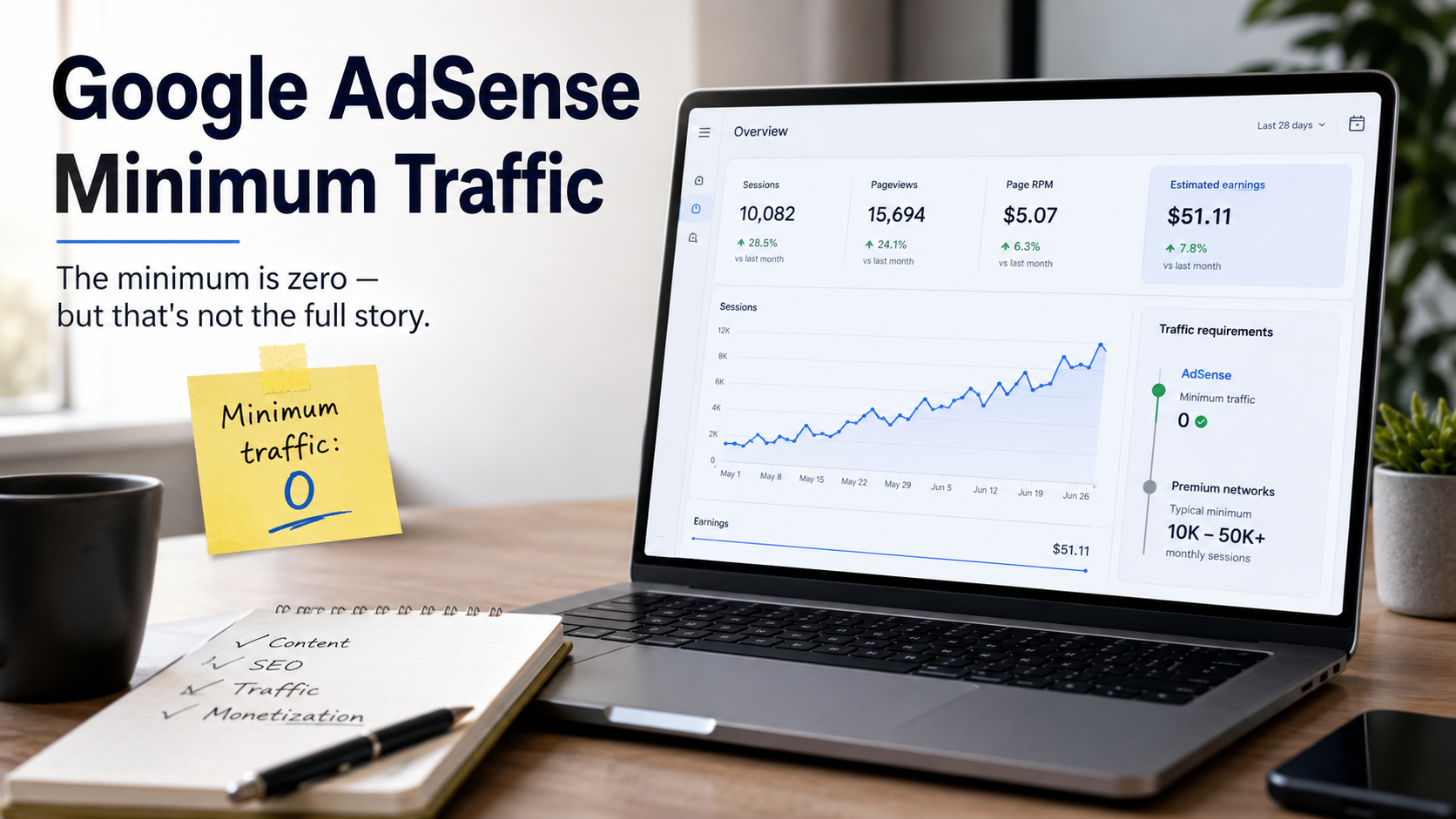
Here's the short answer, because it surprises almost everyone who asks: zero.
Google AdSense has no official minimum traffic requirement. Not 100 sessions a month. Not 1,000. Not 10,000. Google does not publish any minimum traffic threshold for AdSense approval — a brand-new website with a handful of daily visitors can apply and get approved, provided it meets Google's content and policy requirements.
But if you stopped reading there, you'd be walking away with the least useful version of the truth. Because the real question hiding inside "what's the minimum for AdSense?" is almost always one of these:
How much traffic do I need before AdSense will actually approve me?
How much traffic do I need before AdSense makes real money?
Should my website be running AdSense at all?
Those three questions have three very different answers — and for a lot of business owners, the answer to the third one is the most valuable thing in this post. Let's take them in order.
Google's Actual AdSense Eligibility Requirements (And What's Not on the List)
Strip away the forum myths and "guaranteed approval" checklists, and Google's official eligibility requirements come down to a short list:
You must be at least 18 years old. If you're younger, a parent or guardian can create the account under their own name and receive the payments.
You must own or control the website. You need the ability to add AdSense code to your site's HTML, and the site has to be yours to monetize.
Your content must be original, high-quality, and useful. This is the requirement that actually decides most applications. Google reviews the whole site for substance — thin pages, scraped or duplicated content, and sites that exist purely to hold ads get rejected.
Your site must comply with the AdSense Program Policies. No prohibited content, no deceptive layouts, no copyright violations, and — increasingly emphasized in recent reviews — no mass-published, unedited AI content. Google's policies don't ban AI-assisted content outright, but they do ban thin and low-value content, which is where raw AI output usually lands.
You need the standard trust pages. A privacy policy is effectively required — Google's publisher policies mandate that you disclose data collection, cookies, and ad personalization — and About and Contact pages, while not officially mandated, strongly correlate with approval because they signal a legitimate operation.
In some countries, your domain must be at least six months old. This age requirement applies in select markets (including India and Pakistan) but not in the United States.
Notice what's not on the list: sessions, pageviews, unique visitors, posting frequency, word counts, or domain authority. Google explicitly does not require your traffic to come from Google search, either — sites approved with mostly Pinterest or social traffic are common.
So officially: the minimum is zero. Now for the caveats that actually matter.
"No Minimum" Doesn't Mean "Apply With No Traffic"
While Google doesn't publish a traffic number, experienced publishers consistently report that some genuine audience activity improves approval odds — and more importantly, the things that generate traffic are the same things reviewers are checking for.
Think about it from the reviewer's side. A site with 15–25 substantive, original articles, clear navigation, real authorship, and a trickle of genuine visitors looks like a publication. A three-week-old domain with six 400-word posts and no visitors looks like a site built to farm ad revenue — because it usually is. Community data and practitioner guides converge on the same practical baseline: roughly 15–20 quality posts of 800–1,000+ words each, the trust pages in place, and a site that's been live long enough to be crawled and evaluated.
A reasonable rule of thumb: you don't need a traffic number to apply, but you need a site that looks like it deserves traffic. If you're getting even a few hundred organic sessions a month, that's evidence Google's own search systems already consider your content useful — which is about the strongest approval signal there is.
One more practical note: if you get rejected, wait three to four weeks and fix the actual issue before reapplying. Rapid-fire reapplications with no changes are how sites end up in rejection loops.
The Question You Should Actually Be Asking: How Many Sessions Until AdSense Pays Anything?
Here's where the "zero minimum" answer stops being good news. AdSense will happily approve a low-traffic site — because it costs Google nothing and pays you almost nothing.
AdSense revenue is measured in RPM — revenue per 1,000 pageviews, combining what you earn from ad impressions and clicks. Across industry data, AdSense RPMs typically land between $2 and $12 per 1,000 pageviews, depending enormously on your niche and where your audience lives. Finance and business content earns multiples of what gaming or entertainment content earns, and traffic from outside the US, UK, Canada, and Australia typically earns 50–80% less.
Now run the math at a middle-of-the-road $5 RPM:
1,000 sessions/month ≈ $5/month. A coffee.
5,000 sessions/month ≈ $25/month. A pizza night.
10,000 sessions/month ≈ $50/month. Covers your hosting.
50,000 sessions/month ≈ $250/month. Now it's a phone bill.
100,000 sessions/month ≈ $500/month. Real money — and you're now eligible for networks that would pay you 3–5x more for the same traffic.
That last line matters. One published estimate puts it starkly: at typical AdSense rates, you'd need roughly 111,000 monthly pageviews to earn $1,000 — while a premium network at a $20 RPM gets there on about 17,000. AdSense's superpower is accessibility, not payout.
So the honest framing is this: the minimum sessions to connect AdSense is zero; the minimum sessions for AdSense to be worth the pixels it occupies is somewhere north of 10,000 a month — and the traffic level where display ads become a legitimate income stream is 50,000+.
The Traffic Milestones That Actually Change Your Monetization Options
If you're building a content site, it helps to know the ladder — because AdSense is the bottom rung, not the destination. Here's what unlocks as your sessions grow, based on current network requirements:
0 sessions — Google AdSense. No traffic minimum. The entry point. Typical RPM: $2–12.
~1,000 sessions/month — Mediavine's Journey program. Mediavine's entry tier accepts sites starting around 1,000 monthly sessions, bringing managed ad optimization to small publishers at RPMs generally above AdSense but below full Mediavine.
~5,000–10,000 sessions/month — mid-tier managed networks. Options like Newor Media (around 5,000 monthly visitors) and Ezoic-style platforms (roughly 10,000 sessions) typically deliver RPMs in the $8–20 range through header bidding.
~25,000 pageviews/month — Raptive. Formerly AdThrive, Raptive cut its minimum from 100,000 to 25,000 pageviews in late 2025, opening premium-tier RPMs — commonly reported in the $15–50 range — to mid-sized sites.
~50,000 sessions/month — full Mediavine. The classic premium threshold: 50,000 monthly sessions (or $5,000+ in annual ad revenue), with publisher-reported RPMs of $15–40, spiking higher in Q4.
The pattern is unmistakable: every meaningful monetization upgrade is unlocked by traffic growth, not by ad-network tinkering. Which brings us to the strategic point most articles on this topic never make.
Wait — Should Your Website Even Be Running AdSense?
This is where we have to split the audience in two, because the right answer depends entirely on what your website is for.
If you run a content/media site — a blog, a niche publication, a recipe site, a how-to resource — where the content isthe product, then display ads are a legitimate revenue model, and the milestone ladder above is your roadmap. Your job is to grow sessions, because sessions are literally your inventory.
If you run a business website — a dental practice, a med spa, a contracting company, a law firm, an e-commerce brand, an agency — then hooking up AdSense is very often a mistake, and the math proves it.
Think back to the digital front door: every session on your site is a potential customer walking into your store. Now ask what that session is worth in each scenario.
As an ad impression, a session is worth about half a cent at typical AdSense rates.
As a potential lead, that same session is worth... run your own numbers. If your website converts even 2% of visitors into inquiries, and a new customer is worth $500 — modest for most service businesses, laughably low for a dental practice where an implant patient represents thousands or a contractor where one job is five figures — then each session is worth roughly $10 in expected lead value versus $0.005 in ad revenue. A two-thousand-fold difference.
And AdSense doesn't just fail to add meaningful revenue to a business site — it actively subtracts from the revenue you already generate:
Ads send your hard-won visitors to someone else. Frequently your competitors, since ad networks target ads by page topic. You paid for SEO or ads to get a visitor to your plumbing site, and the banner at the top offers them a different plumber. That's not monetization; that's selling your foot traffic out your own front door for pennies.
Ads slow your site down. Ad scripts are among the heaviest things you can load, and speed is both a conversion factor and a Core Web Vitals ranking factor. Degrading the performance of a conversion-focused website to earn cents per visitor is a trade no business should make.
Ads erode trust. 97% of consumers evaluate a business's online presence before buying, and a professional services site cluttered with third-party banners reads as amateur — to the scouts checking you out, and arguably to the AI engines now deciding which businesses to cite as credible recommendations.
The rule of thumb: if your website exists to generate customers, every pixel should serve that goal. AdSense belongs on sites where content is the business — not on sites where the business is the business.
Either Way, the Real Bottleneck Is the Same: Sessions
Here's the thread that ties both audiences together. Whether you're a content site chasing the 50,000-session Mediavine threshold or a business site where every session is a potential $500+ customer, the constraint is identical: you need more qualified people walking in your digital front door.
And the playbook for growing sessions is the same discipline in both cases:
Search-first content strategy. Keyword research, topic clusters, and content mapped to what your audience actually searches — the difference between publishing and publishing things that get found. Remember that over 90% of pages get zero organic traffic from Google; traffic goes to sites built deliberately, not sites built hopefully.
Technical foundation. Fast, crawlable, mobile-first, properly structured. This is table stakes for rankings, for user experience, and — if you're a content site — for the site quality reviews that networks like Mediavine and Raptive perform before accepting you.
Authority and trust signals. Backlinks, reviews, real authorship, and earned coverage — the signals that drive traditional rankings and, increasingly, citations in AI answers, which now function as a traffic and trust source of their own.
Local visibility, if you serve an area. For business sites, 46% of Google searches carry local intent and 76% of "near me" searches convert to a visit within 24 hours — the highest-value sessions your site can possibly attract.
The uncomfortable truth about "how do I hook up AdSense?" is that for sites small enough to be asking, the ad code is the easy part and the irrelevant part. A site earning $15 a month from ads doesn't have an ad-network problem. It has a traffic problem — and traffic problems are solvable, with a strategy.
Frequently Asked Questions
What is the minimum traffic required for Google AdSense?
There is no minimum. Google does not publish any traffic threshold for AdSense eligibility — sites can apply and be approved with very little or even no traffic. Approval is based on content quality, originality, site ownership, policy compliance, and being at least 18 years old (with a roughly six-month domain-age requirement in certain countries like India and Pakistan). That said, a site with some genuine audience activity and 15–20 substantial, original articles has meaningfully better approval odds than a thin, brand-new site.
How many sessions do I need for AdSense to make real money?
As a practical matter, plan on 10,000+ monthly sessions before AdSense earnings exceed pocket change, and 50,000–100,000+ before display advertising becomes a legitimate income stream. At typical AdSense RPMs of $2–12 per 1,000 pageviews, 10,000 monthly sessions earns roughly $20–120 per month depending on your niche and audience geography. High-value niches (finance, business, legal) and US/UK/Canada/Australia traffic earn substantially more than entertainment niches and international traffic.
How much traffic do I need for Mediavine or Raptive instead of AdSense?
The premium networks lowered their bars recently. Mediavine's Journey entry tier accepts sites starting around 1,000 monthly sessions, while full Mediavine requires 50,000 monthly sessions or $5,000+ in annual ad revenue. Raptive (formerly AdThrive) reduced its minimum from 100,000 to 25,000 monthly pageviews in late 2025. These networks typically pay $15–50 RPM — roughly 3–5x AdSense rates — which is why growing traffic to those thresholds matters far more than optimizing AdSense placements.
Can I get AdSense approved with a brand-new website?
Yes, if the site is substantive. Google approves new sites that have enough original, useful content to evaluate — practitioner consensus suggests 15–25 quality posts of 800+ words, clear navigation, and privacy/about/contact pages in place. In the U.S. there's no domain-age requirement. What gets new sites rejected isn't newness; it's thin content, duplicated or unedited AI-generated content, missing trust pages, and policy violations. If rejected, fix the underlying issue and wait several weeks before reapplying.
Should a small business website use Google AdSense?
Almost never. For a business that sells services or products, each website visitor is worth far more as a potential customer than as an ad impression — often thousands of times more. Running display ads on a business site sends your visitors to other companies (frequently competitors), slows your site down, and undermines the professional credibility that converts visitors into leads. AdSense makes sense for content publishers whose traffic is their product. Business websites should monetize sessions by converting them into customers, not renting them out.
Does AdSense approval depend on where my traffic comes from?
No. Google does not require organic search traffic for approval — sites with primarily Pinterest, social, or direct traffic get approved regularly, as long as the traffic is genuine. What will get you rejected (or banned after approval) is purchased traffic, bots, click exchanges, or any scheme that generates artificial impressions or clicks. Google's invalid-traffic systems are aggressive, and AdSense bans are effectively permanent — you're allowed one account for life, so it's never worth gaming.
What's the fastest way to grow my sessions to the point where monetization matters?
Search. Organic search remains the largest and most durable traffic source for most websites — BrightEdge data attributes over half of all trackable website traffic to organic search — and it compounds, unlike social spikes. The playbook: a technically sound, fast site; keyword-driven content strategy targeting queries your audience actually searches; internal linking and structured data; and authority built through earned links and coverage. That same foundation now also earns visibility in AI search results, which sends smaller but dramatically higher-converting traffic.
The Bottom Line: The Minimum Is Zero. The Strategy Is Everything.
You can hook up Google AdSense today with whatever traffic you have — Google won't stop you. But "can" and "should" are different questions, and the sessions number you asked about is really a fork in the road:
If you're building a content site, AdSense is a fine starter engine — but treat it as the on-ramp, not the highway. Your real goal is the traffic growth that unlocks premium networks paying 3–5x more, and that growth comes from search strategy, not ad placement.
If you're running a business site, skip the ad code entirely. Your sessions are worth orders of magnitude more as customers than as impressions — and your energy belongs in getting more of the right people through your digital front door, then converting them when they arrive.
Either way, the bottleneck isn't the ad network. It's visibility.
That's the part we build. Ritner Digital creates the SEO, content, AI search visibility, and conversion-focused web design that turn a trickle of sessions into a pipeline — whether your goal is a content site that clears the 50,000-session premium threshold or a business site where every visitor is a potential customer.
👉🏼 Get your free traffic and visibility audit →
We'll show you exactly where your traffic stands, where it's leaking, and the fastest realistic path to the session numbers that actually change your bottom line.
Sources: Google AdSense Help Center, BrightEdge, Think with Google, BrightLocal, Ahrefs, Blogerhub, ZeroClickGrowth, Newor Media, MonetizePros, ToolSignal publisher RPM data, Caesar Cipher ad revenue calculator, Mediavine.