1 Follower to 250,000: How Many LinkedIn Followers Do You Actually Need Before You Start Your Own Business?
There's a framework floating around in the creator and entrepreneur space that goes something like this.
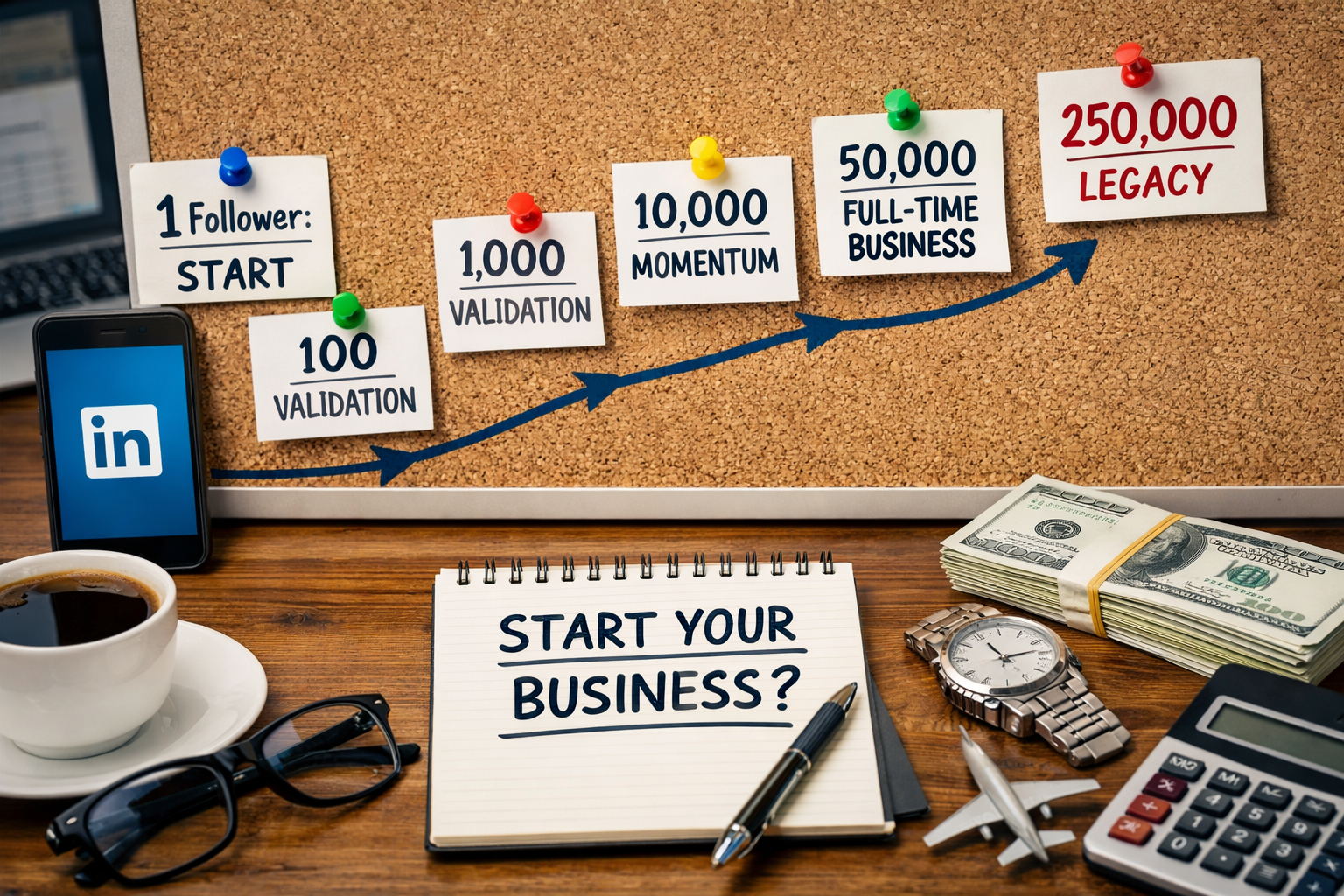
1 follower is your start. 100 followers is validation. 1,000 followers is momentum. 10,000 followers is a side hustle. 50,000 followers is a full-time business. 250,000 followers is your lasting legacy.
It's clean. It's satisfying. It gives people a roadmap where there wasn't one before. And it gets shared constantly on LinkedIn by people who are either living it, aspiring to it, or selling courses about it.
It's also — if we're being honest — only partially true. And the part that isn't true can lead people to make one of two very expensive mistakes: either waiting far too long to take a leap that was ready to be taken, or jumping far too early based on a follower count that hasn't actually been tested against a real business model.
Let's actually think through this framework. What do those numbers really mean? When do followers translate into a business and when do they just translate into an audience? And how many LinkedIn followers does someone actually need before making the leap — if followers are even the right metric at all?
First, Let's Acknowledge What the Framework Gets Right
Before we complicate it, the framework deserves credit for capturing something real.
Building an audience before you build a business is genuinely good advice. The era of "build it and they will come" is over. Distribution is the hard part of any business, and an audience — even a small one — is a head start on distribution that most businesses don't have. A person with 10,000 engaged LinkedIn followers who decides to launch a consulting practice, a course, a service business, or a product has something genuinely valuable that a person with zero audience does not.
The framework also captures the psychological arc of audience building in a way that's useful. One follower really is just a start. One hundred really does feel like validation — like the thing you're saying is resonating with someone beyond your immediate circle. One thousand does create a different feeling than 100 — a sense that something is building, that the content is finding its people, that the flywheel has begun to turn.
The ladder is real. The milestones are real. The question is whether the business thresholds attached to them are real — or whether they're aspirational numbers that fit a narrative more than they fit reality.
The Problem With Using Follower Count as the Primary Business Metric
Here's what the framework doesn't account for: follower counts are a proxy metric. They're correlated with business viability in some cases and completely decoupled from it in others. And the gap between correlation and causation here is where the expensive mistakes get made.
Consider two people, both with 10,000 LinkedIn followers.
Person A has built their audience by posting about general career advice, productivity hacks, and motivational content. Their posts get good engagement — lots of likes, encouraging comments, "this resonated with me" replies. Their audience is broad, warm, and largely untested for commercial intent. Nobody has ever paid them for anything.
Person B has built their audience by posting specific, expert content about a narrow problem in a specific industry. Their posts get fewer likes but deeper engagement — comments from people asking how they can work together, direct messages from potential clients, invitations to speak or consult. Several people have already paid them informally for advice or early versions of their service.
Both have 10,000 followers. The framework says both are at "side hustle" level. But Person B has a business. Person A has an audience that may or may not ever convert into one — and the only way to find out is to try to sell something, which the follower count metric tells you nothing about.
This is the central limitation of follower count as a business readiness indicator: it measures attention, not intent. And attention without commercial intent is not a business.
What the Numbers Actually Mean at Each Stage
Let's go through the framework honestly — keeping what's true and adding what's missing.
1 Follower: Your Start
True. And worth sitting with longer than most people do.
The first follower — the first person who sees what you're putting out there and decides to follow along — is the proof of concept that you exist and that someone other than you thinks what you're saying is worth paying attention to. That's not nothing. That's the seed of everything.
What the framework doesn't say is that the quality of your start matters as much as the fact of it. Starting with clear positioning — a specific perspective, a specific area of expertise, a specific audience in mind — gives those first followers something coherent to respond to. Starting without that clarity means the first hundred followers are a random sample of the internet with no commercial coherence.
The work you do at one follower shapes the audience you have at 10,000. Don't skip this stage.
100 Followers: Validation
Partially true — with an important caveat.
One hundred followers is validation that people are willing to follow you. It is not validation that people are willing to pay you. Those are different things and the distance between them varies enormously depending on what you're building and who your audience is.
The more honest version of this milestone is: 100 followers is validation that your content resonates with someone. Whether it resonates with the right someone — the person who has the problem you solve and the budget to pay for the solution — is a completely separate question.
The right exercise at 100 followers isn't to celebrate the milestone and move forward. It's to look at who those 100 people are and ask whether they represent the audience you're trying to build, or a different one that happened to find you.
1,000 Followers: Momentum
True. And this is genuinely an important milestone — not because of the number itself but because of what you've learned to get there.
Getting from 0 to 1,000 LinkedIn followers with intentional, consistent content means you've figured out at least a rough version of what resonates with your target audience. You've developed a publishing cadence. You've gotten comfortable putting your perspective out publicly and handling the mix of engagement and indifference that comes back. You've identified the topics that land and the ones that don't.
That's real. The momentum is real.
What's not yet validated at 1,000 followers: whether anyone in that audience will pay for anything. The business question is still completely open.
10,000 Followers: Side Hustle
Here's where the framework starts to get genuinely complicated — and where a lot of people either take the wrong leap or wait when they shouldn't.
10,000 LinkedIn followers can absolutely support a side hustle. But the nature of the side hustle depends almost entirely on what kind of audience those 10,000 people are and whether you've tested any commercial offer with them.
If you've been building an audience of B2B decision-makers in a specific industry by posting specific, expert content about a specific problem — and several of those people have already reached out to ask how they can work with you — 10,000 followers might be enough to support a meaningful consulting practice or service business right now. Not a side hustle. A real business.
If you've been building a general professional development audience by posting about mindset and productivity — 10,000 followers might not be enough to support any consistent revenue at all, depending on how you try to monetize.
The number isn't the story. The commercial intent of the audience is the story.
50,000 Followers: A Full-Time Business
This is where the framework is most seductive and most potentially dangerous.
The implication is that if you build to 50,000 followers, the business will be there waiting for you. That's not how it works. 50,000 followers is a meaningful audience. It is not a guaranteed income. The business model still has to exist, still has to be tested, and still has to be capable of generating the revenue you need to replace whatever you're walking away from.
There are people with 50,000 LinkedIn followers making very little money from their audience because they've never clearly articulated an offer or built a business model around what they know. There are people with 8,000 LinkedIn followers running multiple-six-figure consulting practices because every post they publish speaks directly to the specific pain of a specific buyer with budget.
If you're waiting to hit 50,000 followers before making the leap, ask yourself honestly: have you tested any commercial offer with your current audience? Do you know that the people following you have the problem you solve and the budget to pay for the solution? Is there evidence — actual revenue, even informal — that the business model works? If the answers are no, 50,000 followers won't change that. It'll just be a bigger audience for an untested offer.
250,000 Followers: Your Lasting Legacy
At this level, the framework is probably accurate — with the caveat that getting to 250,000 followers on LinkedIn with a focused, professional audience usually means you've already built something real, because the content that generates that kind of sustained growth is usually content that's already demonstrating expertise and creating commercial relationships along the way.
But it's also worth noting: 250,000 followers is a byproduct of a great career, not a prerequisite for one. Some of the most successful business builders who use LinkedIn effectively have audiences a fraction of this size because they're targeting a narrow, high-value professional niche where 5,000 highly relevant followers converts into more business than 250,000 broadly interested ones.
Legacy is built through work, results, and relationships. Follower count is a reflection of that — not a substitute for it.
The Real Question: When Are You Actually Ready?
So if follower count isn't the right primary metric for deciding when to make the leap, what is?
Here's the framework we'd actually use.
Have you tested the offer? Before you leave anything, you should have evidence that someone will pay you for what you're selling. Not a hundred people. One or two. A consulting engagement, a project, a retainer, a course purchase — some form of actual revenue from actual people who found you through your content or your reputation. That's the test that follower count can't replace.
Do you understand your conversion rate? If you have 5,000 followers and two of them have become paying clients in the last six months, you have a rough sense of what your audience converts at. Scale that math to your revenue target. How many followers do you need to generate the clients you need to hit the income you need? This is a much more useful exercise than benchmarking against milestone numbers.
Is the audience commercially coherent? Who are your followers? Are they the people who have the problem you solve? Are they decision-makers with budget? Are they the right buyers for whatever you're building? A thousand followers who are exactly the right people is worth more than fifty thousand who aren't.
Do you have enough runway? The leap doesn't have to be all-or-nothing. Most successful LinkedIn-to-business transitions happen gradually — side hustle income grows while full-time income continues, until the math flips and the leap is more of a step. If you have financial runway to build before revenue is consistent, the follower count question becomes less urgent. If you have no runway, the question is more urgent — and the answer should be more conservative.
Are clients coming to you or are you going to them? The clearest signal that you're ready is inbound. When people who found you through your LinkedIn content are reaching out to ask how they can work with you — not sporadically, but regularly — the audience has demonstrated commercial intent. That's the signal the follower framework can't give you. That's what you're actually waiting for.
The Leap Isn't About Followers. It's About Evidence.
Here's the honest conclusion.
The follower framework is a useful motivational tool. It gives people a progression to work toward and milestones to feel good about. Those things have real value in a journey that can feel endless and invisible for a long time.
But the decision to make the leap — to leave a stable income, to go all-in on building something from your audience — shouldn't be driven by hitting a follower milestone. It should be driven by evidence that the business model works.
Evidence looks like: someone paid you. Multiple someones paid you. The conversion from content to client is happening, even if slowly, even if informally. The offer resonates with the specific audience you've built. The revenue, even if small, is real and growing.
With that evidence, you could make the leap at 3,000 followers and be fine. Without it, you could hit 50,000 followers and still not have a business — just a bigger audience for an offer that hasn't been tested.
Build the audience. But test the offer. Don't wait for a number to tell you you're ready when the evidence will tell you long before the number gets there.
Building a personal brand on LinkedIn and thinking about what comes next?
Ritner Digital works with founders, operators, and growing businesses to build the kind of digital presence that turns expertise into visibility and visibility into real commercial opportunity — on LinkedIn and across every channel that matters. If you want to think through what that looks like for where you are right now, let's have that conversation.
👉🏼 Get in Touch at ritnerdigital.com
Frequently Asked Questions
Is the follower framework actually a reliable roadmap for building a business on LinkedIn?
It's a useful motivational framework — and a genuinely incomplete business roadmap. The progression from 1 follower to 250,000 captures something real about the psychological arc of audience building and the compounding nature of growing a public presence. What it doesn't capture is the difference between an audience and a business. Follower count measures attention. It doesn't measure commercial intent, offer-market fit, or whether anyone in that audience will ever pay you for anything. Used as motivation to keep building, the framework is valuable. Used as the primary signal for when to make a major career or business decision, it can lead you to wait too long or leap too early based on a number that doesn't tell the whole story.
What is the most important thing to test before making the leap from employee to LinkedIn-based business owner?
Whether someone will pay you. Not whether your content gets likes. Not whether your follower count has crossed a threshold. Whether an actual person — ideally more than one — has exchanged actual money for whatever you're selling. A consulting engagement, a project, a retainer, a product purchase, even an informal advisory arrangement that generated real revenue. That evidence is worth more than any follower milestone because it validates the commercial premise of the business, not just the content strategy. You can have 100,000 followers and no paying clients. You can have 2,000 followers and a full pipeline. The revenue evidence is the signal you're actually looking for.
Can someone build a full-time business with fewer than 50,000 LinkedIn followers?
Absolutely — and many of the most successful LinkedIn-to-business conversions happen well below that threshold. The relevant variable isn't total follower count, it's the commercial coherence of the audience. A person with 6,000 followers who are all decision-makers in a specific industry with a specific problem and real budget can build a meaningful consulting or service business from that audience. A person with 60,000 followers who are broadly interested general professionals with no particular commercial intent toward what that person offers has a much harder path to revenue regardless of the number. The quality, specificity, and commercial intent of the audience matters far more than the size of it.
What does "commercially coherent audience" mean and how do I know if I have one?
A commercially coherent audience is one where the people following you have the problem you solve, the budget to pay for the solution, and the authority to make the purchasing decision. The test is relatively simple. Look at who is engaging with your content most consistently. Are they the people you'd want as clients? Are they in the industries, roles, and situations you're targeting? Have any of them ever reached out to ask how they can work with you? If the answer to those questions is yes — even for a small percentage of your audience — you have commercial coherence. If your most engaged followers are other content creators, aspiring entrepreneurs, and people who like motivational posts but have no particular need for what you offer commercially, the audience may be warm but it isn't commercially coherent.
What is the difference between inbound interest and just good engagement on LinkedIn?
Inbound interest is when someone who found you through your content reaches out specifically because they want to work with you or buy something from you. Good engagement is when people like, comment, and share your content because it resonates with them. Both are valuable — but only one is a business signal. Comments that say "this really resonated" or "great post" are engagement. A direct message that says "I've been following your content and I think you could help us with X — can we talk?" is inbound interest. The latter is what you're waiting for. When it starts happening regularly — not once every few months, but consistently enough to represent a real pipeline — that's the clearest signal available that the audience has reached commercial utility.
How do I calculate how many followers I actually need based on my specific revenue target?
Start with the math. Estimate your conversion rate — what percentage of your LinkedIn audience do you think will become paying clients in a given year based on any evidence you have, however rough. Estimate your average client value. Then work backward from your revenue target. If your average client engagement is worth $5,000 and you need $120,000 in annual revenue, you need 24 clients. If your content converts at roughly 0.5% of your audience to clients annually, you need an audience of around 4,800 people. That's a simplified model and the real numbers will vary — but it's a far more useful exercise than waiting to hit an arbitrary milestone. The follower count you actually need is the one that generates enough conversion volume at your specific conversion rate to hit your specific revenue target.
Is it better to build a large general audience or a smaller niche audience on LinkedIn before starting a business?
For most business models, a smaller niche audience is significantly more valuable than a larger general one. A general audience built around broad professional content — productivity, mindset, career growth — is large, warm, and commercially diffuse. A niche audience built around specific expertise in a specific domain attracts the specific people who have the specific problem you solve, which means a much higher proportion of followers who might actually become clients. The exception is businesses built on advertising revenue, sponsorships, or broad consumer products where total reach matters more than commercial specificity. For consulting, professional services, B2B offerings, and most expertise-based businesses, niche depth beats general scale almost every time.
Should I wait until I have a certain number of followers before I start trying to sell something?
No — and waiting is one of the most common and costly mistakes people make in the LinkedIn audience-to-business journey. Testing your offer early — even informally, even at a small scale, even before you feel "ready" — gives you the most important information available: whether anyone will pay for what you're building. That information shapes everything about how you continue to build the audience, what content you create, and how you position what you offer. People who wait until they hit a follower milestone to test their offer often discover at that point that the offer doesn't quite land — and then have to iterate from a standing start with a large audience watching. People who test early discover what works while the stakes are lower and the audience is smaller.
What does the transition from LinkedIn audience to full-time business actually look like in practice?
For most people it's gradual rather than a single dramatic leap — and that's usually the right way to do it. Side hustle revenue grows while full-time income continues. One client becomes two becomes five. The math eventually flips — the business is generating enough that the full-time income is no longer necessary to maintain the lifestyle. At that point the leap is more of a step than a jump because the landing is already visible. The people who make dramatic cold-turkey leaps based on a follower milestone without tested revenue often spend the first year in survival mode trying to convert an untested audience into an income. The people who build the revenue before they need it make the transition from a position of confidence rather than necessity.
Does this framework apply to platforms other than LinkedIn or is it LinkedIn-specific?
The framework originated in the LinkedIn creator context but the underlying principles apply across any platform where audience building precedes business building — Instagram, TikTok, YouTube, X, newsletters, podcasts. The specific follower numbers that correspond to each milestone vary significantly by platform because conversion rates and audience commercial intent differ dramatically across different content environments. LinkedIn audiences tend to convert to B2B commercial relationships at higher rates than most other platforms because the platform is explicitly professional and the content is explicitly expertise-oriented. The meta-principle — that follower count is a proxy metric and commercial intent is the real signal — applies everywhere regardless of platform.
How can Ritner Digital help someone building a personal brand or business presence on LinkedIn?
Ritner Digital works with founders, operators, and growing businesses on the full picture of digital presence — including how LinkedIn fits into a broader content and visibility strategy that converts expertise into commercial opportunity. That means thinking through not just what to post but how the content strategy connects to the business model, how the audience being built maps to the clients being targeted, and how LinkedIn presence integrates with website, SEO, and other channels to create a complete digital footprint that works together. If you're building something and want to think through the strategy behind it, we're happy to have that conversation.