AIO and GEO: Why AI Optimization Is About Citation Coverage, Not Keyword Coverage
There's a conversation happening in digital marketing right now that most businesses aren't part of yet — and the ones that get into it early are going to have a meaningful head start on everyone else.
You're probably familiar with the idea of keyword coverage in traditional SEO. The goal is to show up in search results for as many relevant queries as possible — expanding the range of searches where your business is visible and capturing potential customers at every stage of their buying journey. More keywords, more coverage, more entry points, more leads. That's the model most businesses have been operating on for the past decade.
AI optimization works differently. And understanding the difference isn't just an academic exercise — it changes what you should be building, what you should be measuring, and what success actually looks like in the era of AI-powered search.
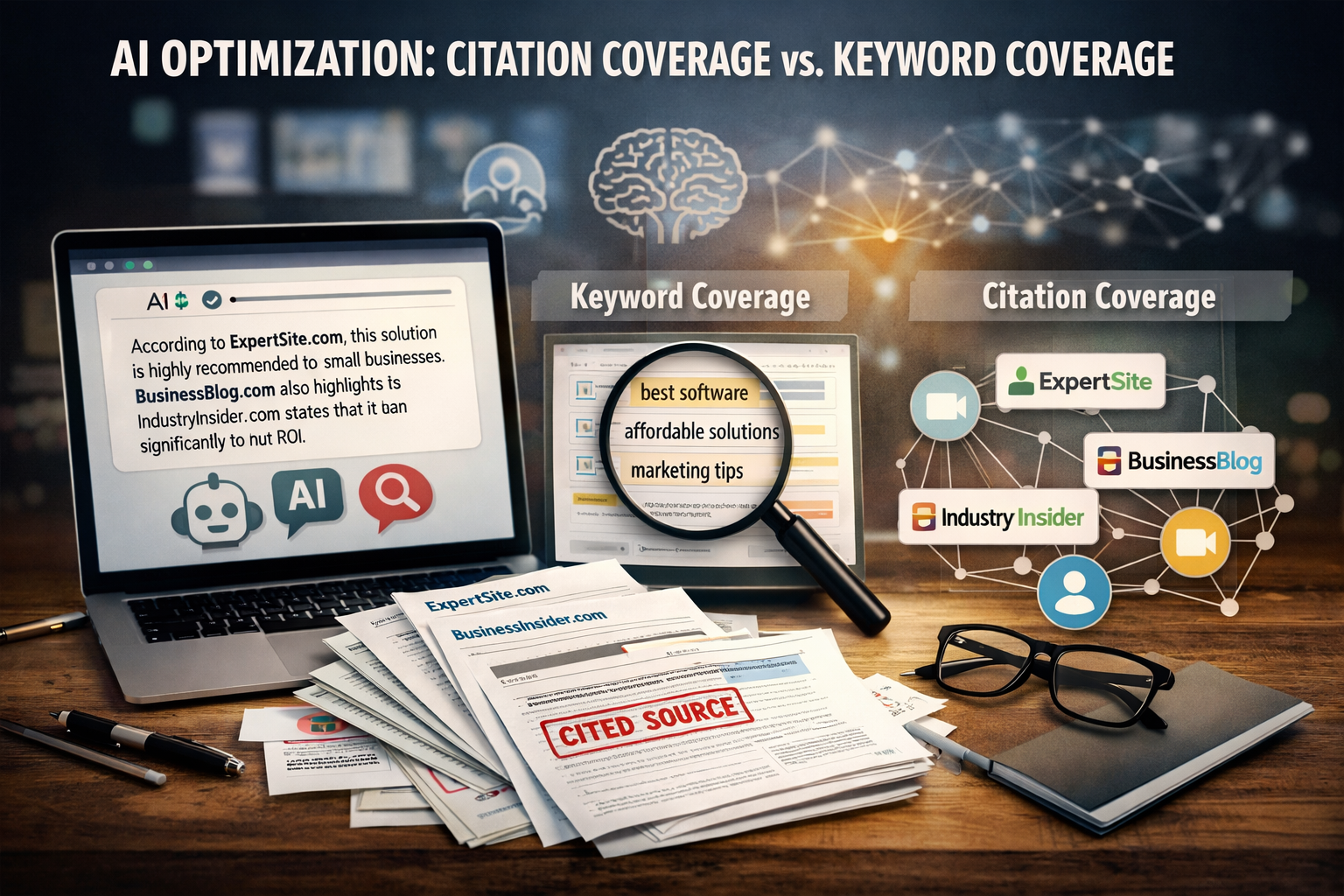
The shift is this: traditional SEO is about expanding keyword coverage. AI optimization — sometimes called AIO, or Generative Engine Optimization, or GEO — is about expanding citation coverage.
Let's unpack what that means and why it matters.
How Traditional SEO Works: The Keyword Coverage Model
In traditional SEO, the fundamental unit of success is the keyword ranking. Your website ranks for a search term. Someone types that term into Google. Your page appears in the results. They click. They visit. Some of them convert into leads or customers.
The goal of SEO strategy in this model is to expand the number of keywords your website ranks for — through content creation, technical optimization, link building, and local signals — so that more searches lead to more visits lead to more opportunities.
It's a relatively linear model. Keyword in, ranking out, traffic in, leads out. And while the execution is genuinely complex, the conceptual framework is straightforward enough that most business owners can understand what their agency is working toward.
Keyword coverage is measurable. You can track rankings for specific terms. You can see which queries are driving traffic in Google Search Console. You can identify gaps and opportunities. You can watch your coverage expand over time as new content ranks and new terms are captured.
That model isn't dead. Traditional SEO still matters enormously and keyword coverage is still a critical investment. But it's no longer the only game in town — and for a growing share of how buyers actually find and evaluate businesses, it's not even the primary one.
How AI Search Works: The Citation Coverage Model
When someone uses an AI-powered tool to research a business question — whether that's Google's AI Overviews, ChatGPT, Perplexity, Claude, Gemini, or any of the other AI systems increasingly embedded in how people find information — something fundamentally different is happening.
The AI isn't matching a keyword to a ranked page and presenting a list of blue links. It's synthesizing information from across its training data and real-time sources to generate a direct answer. And critically — it's deciding whose information, whose perspective, and whose business to include in that answer.
That decision is based on citation signals. Who does the AI have enough information about to confidently reference? Whose content has been widely cited, linked to, and referenced across the web? Whose expertise has been validated by enough third-party sources that the AI treats it as authoritative? Whose business has a clear, consistent, well-documented presence that AI systems can understand and represent accurately?
In this model, the fundamental unit of success isn't the keyword ranking. It's the citation — the mention, the reference, the recommendation that an AI system makes when a user asks a relevant question.
And just as traditional SEO is about expanding keyword coverage — the range of search queries your website ranks for — AI optimization is about expanding citation coverage — the range of AI-generated answers, recommendations, and responses where your business gets mentioned, referenced, or recommended.
What Citation Coverage Actually Means
Citation coverage in the AI optimization context is broader than the traditional SEO use of the word citation — which typically refers to directory listings and NAP consistency.
In the AI optimization context, citation coverage refers to the overall breadth and depth of your presence in the information ecosystem that AI systems draw from. It includes several distinct but related dimensions.
Content Citations
AI systems learn from and reference content across the web. When your business has produced genuinely authoritative, well-structured content that gets linked to, referenced, and quoted by other sources, AI systems are more likely to treat your business as an authoritative source on relevant topics and reference it when generating answers.
This is why thought leadership content — content that takes genuine positions, offers original insights, and provides information that other sources reference — is more valuable in the AI optimization model than generic, keyword-optimized content that covers the same ground as a hundred other websites. AI systems are looking for sources worth citing. Not sources that have successfully targeted a keyword.
Brand Citations
How many places across the web mention your business by name in a meaningful context? Not just directory listings — actual references in articles, blog posts, forum discussions, review platforms, industry publications, and other credible sources.
AI systems build their understanding of businesses from these distributed mentions. A business that's mentioned frequently, in diverse credible contexts, across a wide range of sources is one that AI systems have a rich, confident picture of. A business with a thin web presence — even a well-optimized website — is one that AI systems have limited information about and therefore limited confidence in recommending.
Brand citation coverage is about the breadth and quality of your mentions across the entire web — not just your own properties.
Expert Citations
AI systems increasingly try to attribute expertise to specific people and organizations. When your team members are quoted in publications, referenced as sources, cited as experts in their field, or have established public profiles that AI systems can recognize as authoritative — your business builds what might be called expert citation coverage.
This is the AI optimization equivalent of building domain authority in traditional SEO. Just as domain authority comes from other websites treating your site as a credible source worth linking to, expert citation coverage comes from other sources treating your people as credible experts worth referencing.
Review and Reputation Citations
Review platforms, testimonials, and reputation signals are a significant part of what AI systems use to evaluate and describe businesses when making recommendations. The quantity, quality, recency, and specificity of reviews across Google, industry platforms, and other review sources all contribute to citation coverage in the AI sense.
When someone asks an AI tool to recommend a local marketing agency or a reliable contractor in South Jersey, the AI is drawing on aggregated reputation signals to assess which businesses are worth recommending confidently. A rich, well-distributed review and reputation profile expands your citation coverage in this dimension.
Structured Data Citations
Schema markup and structured data on your website explicitly communicate key information about your business to AI systems in a format they can read and reference directly. This structured information — business category, service area, specific offerings, expertise signals — contributes to how completely and accurately AI systems can represent your business when generating answers.
The Strategic Implication: What You Should Be Building
If traditional SEO is about creating content that ranks for keywords, AI optimization is about creating a presence that gets cited by AI systems. Those two goals overlap significantly in some areas and diverge meaningfully in others.
Where they overlap: technical website health, genuine content quality, and authoritative local signals all contribute to both keyword rankings and AI citation coverage. A business that has invested seriously in traditional SEO fundamentals is not starting from zero on AI optimization.
Where they diverge: AI optimization places significantly higher value on distributed third-party presence — the breadth of your mentions across the web — than traditional SEO does. A website that ranks well for keywords but has a thin presence in the broader information ecosystem is well-optimized for the old model but poorly positioned for the new one.
The strategic implication is that AI optimization requires investing in the information ecosystem around your business, not just the website that represents it. That means a few specific things.
Earn Mentions, Not Just Links
Traditional SEO values links — inbound connections from other websites to yours. AI optimization values mentions — references to your business, your expertise, and your perspective across the web, whether or not they include a clickable link.
Getting your business mentioned in local publications, industry blogs, community resources, and credible third-party sources builds citation coverage that AI systems draw from. This is where PR-adjacent activities and digital marketing strategy genuinely converge in the AI optimization era — earned media coverage isn't just a reputation tactic, it's a citation coverage strategy.
Build Distributed Expertise Signals
AI systems are trying to identify who the authoritative voices in any given category are. Contributing bylined content to industry publications, appearing on podcasts, participating in credible online communities, having team members quoted as sources in relevant articles — all of these build the distributed expertise signals that AI citation coverage depends on.
This isn't about gaming a system. It's about genuinely participating in the information ecosystem of your industry and your market in ways that establish real expertise. AI systems are reasonably good at distinguishing between authentic authority and manufactured presence.
Optimize for Being Quoted, Not Just Ranked
One of the practical differences between keyword optimization and citation optimization is the type of content that performs best. Content optimized for keyword rankings tends to be comprehensive, structured around search intent, and designed to be the best result for a specific query.
Content optimized for AI citation tends to be quotable — it contains specific, well-articulated positions, clear insights, original data, and the kind of direct, authoritative statements that AI systems can reference when synthesizing answers. Short, clear, direct answers to specific questions. Original frameworks and perspectives. Specific data and concrete examples.
If an AI system is generating an answer about local SEO strategy and your content contains a particularly clear, direct, well-articulated explanation of a relevant concept, that content is more likely to get cited than a comprehensive guide that covers everything but says nothing particularly quotable.
Treat Review Generation as Citation Building
Every detailed, specific review your business earns is a citation in the AI optimization sense — a third-party reference to your business's quality, expertise, and relevance that AI systems can draw from when making recommendations. Review generation isn't just a local SEO tactic anymore. It's a core component of building the citation coverage that AI-powered search relies on.
Specifically, reviews that mention your business's specific services, specific geographic relevance, and specific areas of expertise are more valuable citation signals than generic positive reviews — because they give AI systems concrete, specific information to associate with your business.
Measuring Citation Coverage
One of the practical challenges of AI optimization is that citation coverage is harder to measure than keyword coverage. You can't pull up a dashboard that shows you exactly how many AI-generated answers mentioned your business this month the way you can track keyword rankings.
But there are meaningful proxies. Brand mention monitoring — tracking how often your business is mentioned across the web — gives you a picture of your overall citation presence. Tracking whether your business appears in AI Overview results for relevant queries in your category tells you about your AI search visibility. Monitoring your presence in AI tool responses when you ask relevant questions in your category gives directional insight into your citation coverage. The number and quality of high-authority external mentions, publications featuring your expertise, and review volume across platforms all contribute to a picture of citation coverage health.
This is a measurement discipline that's still developing — the tools and frameworks for tracking AI citation coverage are less mature than traditional SEO analytics. But the directional investment strategy is clear even without perfect measurement: build distributed, authoritative, authentic presence across the information ecosystem your buyers and AI systems draw from.
This Isn't Either/Or — It's Sequential and Integrated
If this is making traditional SEO sound obsolete, that's not the intent. For most local businesses right now, traditional SEO — keyword coverage, local search ranking, Google Business Profile optimization — is still the primary driver of search-generated lead flow. The majority of commercial searches still happen through traditional search interfaces, and keyword coverage is still the right primary investment for most local businesses at most stages.
What AI optimization adds is a second, increasingly important layer — one that's growing in relevance every quarter as AI search tools capture more of the research journey. The businesses investing in citation coverage now are building an asset that will matter more next year than it does today, and more the year after that than the year before.
The integrated approach — building keyword coverage through traditional SEO while simultaneously building citation coverage through AI optimization — is the full-spectrum digital presence strategy that positions a business to be visible wherever its buyers are searching, whatever tools they're using, and however AI continues to reshape the search landscape.
Want to build a digital presence that performs in both traditional search and the AI-powered search that's reshaping how buyers find businesses?
Ritner Digital builds integrated search strategies that cover both the keyword coverage fundamentals of traditional SEO and the citation coverage building blocks of AI optimization — designed for where search is today and where it's going. If you want to understand what that looks like for your specific business, let's have that conversation.
👉🏼 Get in Touch at ritnerdigital.com
Frequently Asked Questions
What is the difference between AIO, GEO, and traditional SEO?
Traditional SEO is focused on keyword coverage — getting your website to rank for relevant search queries in Google and other search engines so that people find you when they search for what you offer. AIO (AI Optimization) and GEO (Generative Engine Optimization) are focused on citation coverage — building the kind of distributed, authoritative presence across the web that AI systems draw from when generating answers, recommendations, and summaries. Traditional SEO asks: what keywords does my website rank for? AI optimization asks: when AI systems are generating answers about my category, do they have enough information about my business to confidently mention, reference, or recommend it?
Why do AI systems cite some businesses and not others?
AI systems build their understanding of businesses from the information available to them across the web — content, mentions, reviews, expert references, structured data, and third-party coverage. A business that appears frequently in credible, diverse contexts across the web is one that AI systems have a rich, confident picture of and are more likely to reference when generating relevant answers. A business with a thin web presence — even a well-optimized website — is one that AI systems have limited information about and therefore limited confidence in recommending. Citation coverage is essentially the breadth and quality of your presence in the information ecosystem AI systems learn from and draw on.
Does traditional SEO still matter if AI search is growing?
Absolutely — and for most local businesses right now, traditional SEO is still the primary driver of search-generated lead flow. The majority of commercial searches still happen through traditional search interfaces, and keyword coverage remains the right primary investment for most businesses at most stages. What AI optimization adds is a second, increasingly important layer that's growing in relevance every quarter as AI tools capture more of the research journey. The integrated approach — building keyword coverage through traditional SEO while simultaneously building citation coverage through AI optimization — is the full-spectrum strategy that positions a business to be visible wherever its buyers are searching, whatever tools they're using.
What does "citation coverage" actually mean in the context of AI optimization?
In traditional local SEO, citations refer specifically to directory listings and NAP consistency. In AI optimization, citation coverage is a broader concept — it refers to the overall breadth and depth of your presence in the information ecosystem that AI systems draw from. That includes content citations where your material is referenced by other sources, brand citations where your business is mentioned across credible web properties, expert citations where your team members are quoted or recognized as authoritative voices, review and reputation citations across platforms, and structured data that helps AI systems understand your business clearly. Together these dimensions determine how confidently and how often AI systems reference your business when generating relevant answers.
How is content strategy different for AI optimization versus traditional SEO?
Traditional SEO content is optimized for keyword rankings — it's comprehensive, structured around search intent, and designed to be the best result for a specific query. AI optimization content is optimized to be cited — it contains specific, well-articulated positions, clear original insights, quotable statements, and direct answers to specific questions that AI systems can reference when synthesizing answers. The practical difference is that AI-optimized content tends to be more opinionated, more direct, and more focused on saying something genuinely distinctive rather than covering everything comprehensively. AI systems are looking for sources worth quoting. Content that takes clear positions and offers original perspective performs better in this model than content that covers all angles without saying anything particularly memorable.
How do online reviews contribute to AI citation coverage?
Every detailed, specific review your business earns is a citation in the AI optimization sense — a third-party reference to your business's quality, expertise, and relevance that AI systems can draw from when making recommendations. Reviews that mention specific services, specific geographic relevance, and specific areas of expertise are more valuable citation signals than generic positive reviews because they give AI systems concrete, specific information to associate with your business. Review generation isn't just a local SEO tactic in the AI era — it's a core component of building the citation coverage that AI-powered search relies on when deciding which businesses to recommend with confidence.
What is the AI optimization equivalent of building domain authority in traditional SEO?
In traditional SEO, domain authority comes from other websites treating your site as a credible source worth linking to. The AI optimization equivalent is what might be called expert citation coverage — other sources treating your people and your business as credible authorities worth referencing. This comes from team members being quoted in publications, contributing bylined content to industry outlets, appearing on podcasts, being cited as sources in relevant articles, and building public profiles that AI systems recognize as authoritative. Just as domain authority signals that the web trusts your website, expert citation coverage signals that the broader information ecosystem trusts your expertise.
How do I know if my business has good citation coverage for AI search?
There are meaningful proxies even without perfect measurement tools. Track how often your business is mentioned across the web using brand mention monitoring. Search for relevant questions in your category using AI tools like ChatGPT, Perplexity, and Google's AI Overviews and see whether your business appears in the responses. Monitor whether your content gets referenced or quoted by other sources. Look at the volume and quality of your reviews across platforms, the number of credible external sources that mention your business, and whether your team members have any kind of recognized public expertise profile. The measurement discipline for AI citation coverage is still developing, but these proxies give a directional picture of where your coverage is strong and where it has gaps.
Is earning mentions without links valuable for AI optimization even if it doesn't help traditional SEO?
Yes — and this is one of the meaningful divergences between the two models. Traditional SEO places most of its value on links — clickable connections from other websites to yours. AI optimization values mentions — references to your business, your expertise, and your perspective across the web, whether or not they include a clickable link. An article in a local publication that describes your business as a leading South Jersey marketing agency without linking to your website still contributes to your citation coverage in the AI optimization sense because it's a credible third-party reference that AI systems can draw from. This is where PR strategy and digital marketing strategy genuinely converge — earned media coverage that generates brand mentions builds AI citation coverage regardless of whether it drives direct referral traffic.
How should a local South Jersey business prioritize between traditional SEO and AI optimization right now?
For most local businesses at most stages, traditional SEO fundamentals — local keyword coverage, Google Business Profile optimization, review generation, technical website health — should still be the primary investment because they're the most direct driver of lead flow from search right now. AI optimization should be thought of as a parallel investment that builds in importance over time — starting the citation coverage building work now so that the compounding effects are meaningful as AI search captures more of the buyer research journey. The businesses that treat these as competing priorities are making a false choice. The ones that build both simultaneously — keyword coverage for today's search landscape and citation coverage for tomorrow's — are the ones building the most durable digital presence.
How does Ritner Digital approach AI optimization alongside traditional SEO for its clients?
Ritner Digital builds integrated search strategies that address both the keyword coverage fundamentals of traditional SEO and the citation coverage building blocks of AI optimization. That means local SEO foundations — GBP optimization, technical health, keyword-targeted content, review strategy — combined with the distributed presence building that AI optimization requires — thought leadership content designed to be cited, brand mention strategy, structured data implementation, and reputation signals across platforms. We think about search visibility in terms of where your buyers are researching today and where they're going to be researching tomorrow, and we build strategies designed to perform across both. If you want to understand what that integrated approach looks like for your specific business, let's have that conversation.