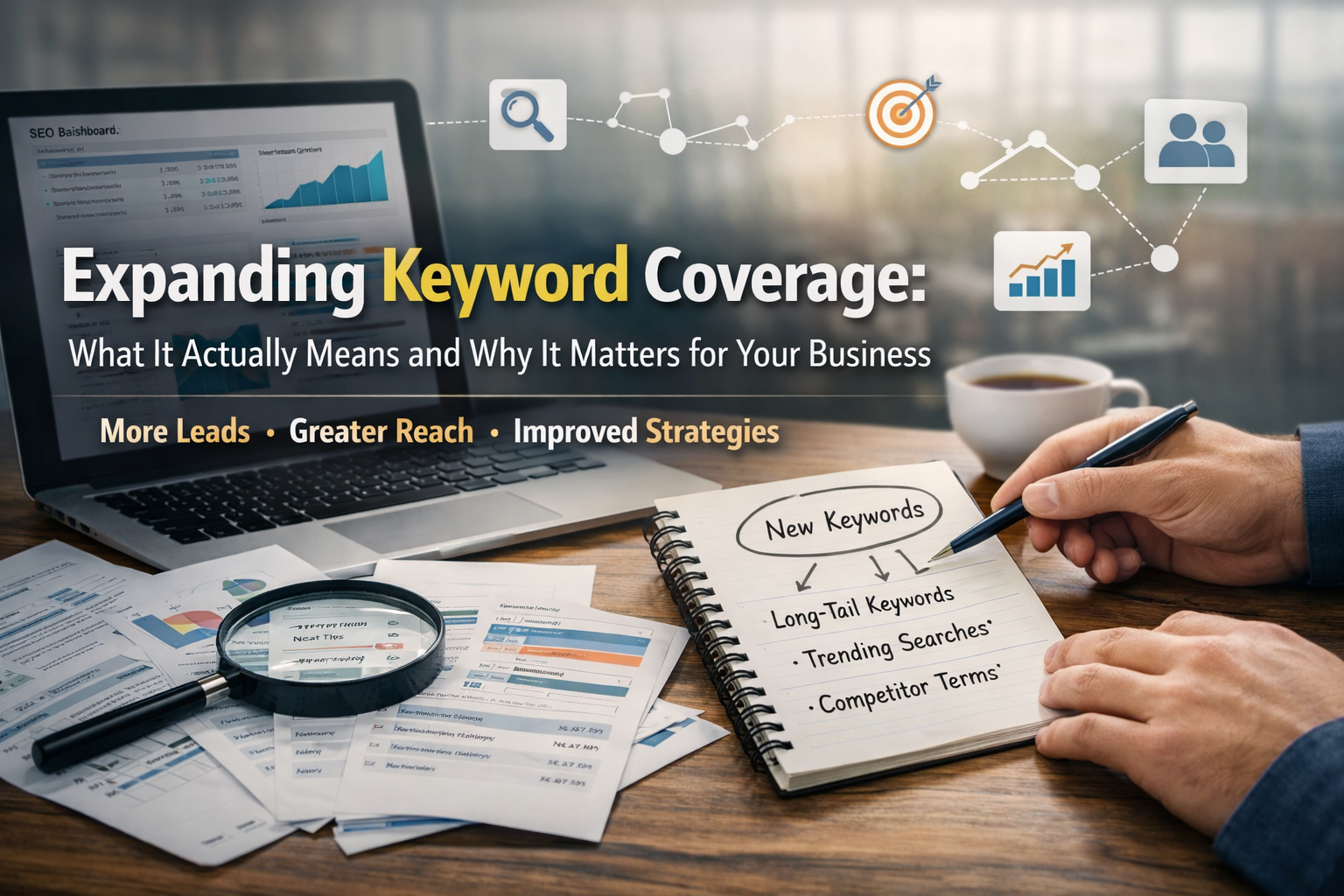
"Expanding Keyword Coverage" — What It Actually Means and Why It Matters for Your Business
If you've ever worked with a digital marketing agency or sat through an SEO report, you've probably heard some version of this line.
"We're expanding your keyword coverage."
"We're targeting new queries."
"We're going after additional search terms in your category."
It sounds like progress. It sounds like growth. It sounds like the kind of thing that should be happening. But if you've ever nodded along without fully understanding what it means or why it should matter to you as a business owner, you're not alone — and it's worth actually understanding, because done right, it's one of the most valuable things an SEO strategy can do for a local business.
Done wrong — or done without a clear connection to business outcomes — it's just activity that looks good in a report.
Here's the honest explanation.
Start Here: What Is a Keyword, Really?
Before we get into coverage and expansion, let's make sure the foundation is clear.
In SEO, a keyword isn't necessarily a single word. It's any word, phrase, or question that someone types into a search engine. "Plumber" is a keyword. "Emergency plumber Gloucester County" is a keyword. "Why is my water heater making a knocking sound" is a keyword. "Best local marketing agency South Jersey" is a keyword.
Every search query that gets typed into Google is a keyword — and Google's job is to figure out which websites best answer that query and serve them up in the results.
Your website currently ranks for some of those keywords. For some queries, you show up on page one and people find you. For others, you show up on page three where nobody looks. For many others — potentially thousands of them — you don't show up at all.
Keyword coverage refers to the breadth of relevant search queries your website is visible for. And expanding keyword coverage means systematically increasing the number of relevant searches where your business shows up in results.
The Iceberg Problem: Most Businesses Are Only Visible for a Tiny Fraction of Relevant Searches
Here's the insight that makes keyword expansion make sense.
Most local businesses think about SEO in terms of a handful of obvious, high-intent terms. A landscaping company in South Jersey might think about ranking for "landscaping company Gloucester County" or "lawn care Deptford NJ." A law firm might think about "personal injury attorney South Jersey" or "divorce lawyer Gloucester County."
Those terms matter. But they represent the tip of the iceberg.
Beneath those obvious high-intent terms is a massive volume of related searches happening every single day — searches that represent potential customers at various stages of their buying journey, asking questions that are directly relevant to what your business offers.
The landscaping company's potential customers are also searching for "how often should I fertilize my lawn in New Jersey," "why does my grass turn brown in summer," "best grass seed for South Jersey clay soil," "how much does it cost to redo a backyard in South Jersey," and hundreds of other queries. Each of those is a real person with a real need — and many of them are on a path that leads to hiring a landscaping company.
The law firm's potential clients are also searching for "what to do after a car accident in New Jersey," "how long does a personal injury case take," "do I need a lawyer for a fender bender," "how is fault determined in a NJ car accident," and dozens of other research-phase questions. Each of those is a potential client doing exactly the kind of research that leads to hiring an attorney.
The businesses showing up for these broader, research-phase queries aren't just getting more traffic. They're getting in front of potential customers earlier in the decision-making process — before those customers have formed strong preferences about who to hire. That's an enormous strategic advantage.
The Two Types of Keywords Worth Understanding
Not all keywords are equal — and understanding the difference between the two main types changes how you think about coverage and why expanding it matters.
High-Intent, Transactional Keywords
These are the searches where someone is ready to act. They know what they need and they're looking for who to hire or where to buy.
"Roof repair contractor Washington Township NJ"
"Emergency HVAC repair Sewell"
"Marketing agency Gloucester County"
These searches have clear commercial intent. The person typing them is close to a decision. Ranking for these terms is valuable and often competitive — which is why most businesses already focus on them.
But here's the limitation: these are a relatively small fraction of the total search activity happening in your category. The people typing these queries have already completed most of their research journey. They already know what they need. You're competing for their attention at the finish line.
Informational and Research-Phase Keywords
These are the searches where someone is learning, exploring, and forming opinions — before they're ready to make a decision.
"How do I know if my roof needs to be replaced"
"What size HVAC unit do I need for a 2000 square foot house"
"How much does digital marketing cost for a small business"
These searches represent people earlier in their journey. They're not ready to hire yet. But they're on the path — and the businesses that show up and provide genuinely useful answers during this research phase earn something extremely valuable: familiarity and trust, before any competitor conversation has even started.
When that same person is ready to hire two weeks later and types a high-intent transactional query, they're more likely to click on the business they already encountered during their research. Not because of any overt sales pitch — but because of the trust and familiarity that was built by showing up helpfully when they were learning.
This is why expanding keyword coverage into research-phase terms isn't just a traffic strategy. It's a buyer journey strategy.
What "Expanding Keyword Coverage" Actually Involves in Practice
When an agency says they're expanding your keyword coverage, they should be doing specific, identifiable things — not just using language that sounds good in a report.
Here's what legitimate keyword expansion work actually looks like.
Keyword Research and Gap Analysis
The first step is understanding which relevant searches your website currently ranks for, which ones it ranks poorly for, and which ones it doesn't appear for at all. This is keyword gap analysis — mapping the universe of relevant searches in your category and identifying where your visibility is weakest relative to what's possible.
This research should be specific to your business, your geography, and your competitive landscape. Generic keyword research that could apply to any business in your category is a starting point, not a strategy. Real keyword expansion work identifies the specific searches your specific ideal customers in your specific market are conducting — and prioritizes them by potential business impact.
Content Creation Targeting New Query Clusters
The primary mechanism for expanding keyword coverage is content. New pages, blog posts, service area pages, FAQs, guides — content specifically created to target the query clusters identified in keyword research.
This is why agencies talk about content strategy and keyword strategy in the same breath. They're not separate activities. Content is how you rank for keywords. Every new piece of content targeting a relevant cluster of searches is an expansion of your keyword coverage — a new entry point into your website from search.
Good keyword expansion content isn't keyword-stuffed filler. It's genuinely useful, well-written content that happens to be built around the specific searches your potential customers are conducting. The dual goal is to rank in search and to actually be useful to the person who finds it — because one without the other either doesn't rank or doesn't convert.
Optimizing Existing Pages for Additional Related Terms
Sometimes keyword expansion doesn't require creating new pages — it requires improving existing ones. A service page that currently ranks for one or two primary terms might be expandable to capture a cluster of related terms with some strategic optimization. Adding relevant content, improving structure, answering related questions — these optimizations can significantly expand the query coverage of existing pages without the full investment of creating new content from scratch.
Local and Geographic Expansion
For local businesses, keyword expansion often has a geographic dimension. A business that currently ranks well in one part of its service area might expand coverage by creating content that speaks specifically to additional communities it serves.
A South Jersey business that ranks well for queries in Woodbury might expand coverage with content specifically targeting Deptford, Washington Township, Sewell, and Mullica Hill — capturing local search intent in communities that have the same needs but where the business currently has lower visibility. Service area pages, locally relevant blog content, and community-specific landing pages all contribute to this type of geographic keyword expansion.
Long-Tail Keyword Targeting
Long-tail keywords are specific, multi-word phrases that individually have lower search volume than broad head terms but collectively represent a massive share of total search activity. "Best landscaping company South Jersey" is a head term. "How much does it cost to install a paver patio in Gloucester County NJ" is a long-tail keyword.
Long-tail terms are typically less competitive than head terms, convert at higher rates because the searcher's intent is more specific, and collectively add up to more search volume than the head terms most businesses focus on. Expanding into long-tail coverage is one of the most reliable ways to generate meaningful new organic traffic without competing for the most contested terms in a category.
Why This Is Good for Your Business — Specifically
Let's bring this back to business outcomes, because keywords and rankings are means to an end — not the end itself.
More entry points into your website means more potential customers finding you. Every new keyword your site ranks for is a new pathway for a potential customer to discover your business. A website that ranks for 50 relevant queries gets found by a fundamentally different volume of potential customers than one that ranks for 500 relevant queries — and the compounding effect of expanding that coverage over time is significant.
Research-phase visibility shapes buyer preference before competitors get a chance to. Showing up during the research journey — before someone is ready to hire — means you're building familiarity and trust before any competitor conversation has started. That head start translates into higher conversion rates on inbound leads, less price resistance, and prospects who arrive already predisposed to choose you.
Keyword coverage is a compounding asset. Unlike paid advertising that stops the moment you stop spending, organic keyword coverage — once earned — keeps generating traffic and leads over time. Every new piece of content that ranks for a new cluster of queries is a permanent addition to your business's digital asset base. The coverage you build this year keeps working for you next year and the year after.
It reduces dependency on a small number of high-competition terms. A business whose entire organic visibility is concentrated in two or three primary keywords is vulnerable — one algorithm update or one aggressive competitor can significantly impact lead flow. Broad keyword coverage distributes that risk across hundreds or thousands of terms, making the overall search presence much more stable and resilient.
What to Ask Your Agency About Keyword Expansion
If your agency is talking about expanding keyword coverage, here are the questions worth asking to make sure it's substantive strategy and not just activity.
What specific queries are we targeting and why? There should be a clear answer grounded in research — specific terms, search volume data, competitive context, and a rationale for why these particular queries represent meaningful business opportunity.
What content are we creating to target them? Keyword expansion without content is just intention. Ask what's actually being produced, when, and how it connects to the target queries.
How will we know if it's working? New keyword rankings, organic traffic growth from new query clusters, and ultimately lead flow from organic search are the metrics that matter. Ask how performance will be tracked and reported.
How does this connect to our buyer journey? The best keyword expansion work is built around how your specific customers research and decide — not just around what has search volume. Ask how the targeted queries map to the stages of your buyer journey and what role each piece of content plays in guiding potential customers toward conversion.
If your agency can answer all of those questions clearly and specifically, keyword expansion is probably being handled well. If the answers are vague, generic, or mostly about impressions and rankings without clear business context — that's worth pushing on.
The Bottom Line
Expanding keyword coverage is one of the most valuable long-term investments in an SEO strategy — when it's done with genuine strategic intent, connected to real buyer behavior, and executed with content that's actually useful to the people searching for it.
It's not magic and it's not instant. Building meaningful coverage across a broad range of relevant queries takes consistent content investment over months and years. But the compounding returns — more entry points, more buyer journey presence, more organic leads, more resilient search visibility — make it one of the most durable competitive advantages available to a local business investing in its digital presence.
The businesses that understand this and invest in it consistently are the ones that look back in two years and realize their organic search presence has become one of their most valuable business assets. The ones that don't are the ones wondering why their competitors keep showing up everywhere.
Want to understand what keyword coverage expansion could look like for your specific business?
Ritner Digital builds SEO strategies grounded in real buyer behavior and real business outcomes — not just rankings for rankings' sake. If you want to understand where your current keyword coverage has gaps and what closing them could mean for your lead flow, let's have that conversation.
👉🏼 Get in Touch at ritnerdigital.com
Frequently Asked Questions
What is keyword coverage and why does it matter for my business?
Keyword coverage refers to the breadth of relevant search queries your website is visible for in search results. It matters because every search query your business doesn't show up for is a potential customer finding a competitor instead. Most local businesses are only visible for a small fraction of the searches happening in their category every day — the obvious, high-intent terms they've always focused on. Expanding that coverage means systematically increasing the number of relevant searches where your business shows up, which means more potential customers finding you at more stages of their buying journey.
What is the difference between a high-intent keyword and a research-phase keyword?
A high-intent keyword is one where the searcher is ready to act — they know what they need and they're looking for who to hire or where to buy. "Emergency plumber Gloucester County" is a high-intent keyword. A research-phase keyword is one where the searcher is learning and forming opinions before they're ready to make a decision. "How do I know if my pipes need to be replaced" is a research-phase keyword. Both matter — but they serve different strategic purposes. High-intent keywords capture buyers at the finish line. Research-phase keywords put you in front of buyers earlier in their journey, before they've formed strong preferences, which builds the familiarity and trust that influences who they ultimately hire.
How does expanding keyword coverage actually generate more leads?
More keyword coverage means more entry points into your website from search — more pathways for potential customers to discover your business. A website that ranks for 500 relevant queries reaches a fundamentally different volume of potential customers than one that ranks for 50. Beyond the volume impact, research-phase keyword coverage puts your business in front of buyers during the part of their journey where preferences are being formed — building trust and familiarity before any competitor conversation has started. When that same buyer is ready to hire, they're more likely to choose the business they encountered and found helpful during their research. More coverage means more leads, and more pre-sold leads at that.
What are long-tail keywords and why should my business care about them?
Long-tail keywords are specific, multi-word search phrases that individually have lower search volume than broad head terms but collectively represent a massive share of total search activity. "Marketing agency" is a head term. "How much does digital marketing cost for a small business in South Jersey" is a long-tail keyword. Long-tail terms are typically less competitive than head terms, convert at higher rates because the searcher's intent is more specific, and add up collectively to more search volume than the broad terms most businesses focus on. Targeting long-tail keywords is one of the most reliable ways to expand coverage and generate meaningful new organic traffic without competing for the most contested terms in your category.
How does content relate to keyword coverage?
Content is the primary mechanism through which keyword coverage is built. Every new piece of content — a blog post, a service page, a FAQ, a local landing page, a resource guide — is an opportunity to target a new cluster of relevant searches and expand the range of queries your website ranks for. There is no keyword expansion without content creation. This is why agencies talk about content strategy and keyword strategy as interconnected rather than separate activities. Good keyword expansion content serves two goals simultaneously — it ranks in search because it targets the right queries, and it converts because it's genuinely useful to the person who finds it.
How long does it take to see results from expanding keyword coverage?
It depends on the competitiveness of the terms being targeted and the quality of the content created to target them. Long-tail and research-phase keywords in less competitive categories can start ranking within weeks to a couple of months. More competitive terms in crowded categories take longer — sometimes six months or more before meaningful ranking movement occurs. The important thing to understand is that keyword coverage is a compounding asset. Content that ranks for new queries this month keeps generating traffic and leads next month and the month after, without additional spend. The returns build over time, which is why consistent, sustained investment produces dramatically better long-term results than sporadic bursts of content activity.
What is a keyword gap analysis and should my business have one done?
A keyword gap analysis maps the universe of relevant searches in your category and identifies where your website's visibility is weakest relative to what's possible — the queries your competitors rank for that you don't, the research-phase questions your potential customers are asking that your website doesn't address, and the geographic and long-tail opportunities your current content isn't capturing. For most local businesses, a thorough keyword gap analysis reveals a significantly larger opportunity than they realized existed. It's the foundation of any serious keyword expansion strategy because it replaces guesswork with specific, prioritized targets grounded in real search data.
Is keyword expansion different from just adding more pages to my website?
It's related but not the same thing. Adding pages without a clear keyword strategy — without understanding what specific searches those pages are designed to rank for and why — is just creating content volume without strategic direction. True keyword expansion starts with research: identifying specific query clusters that represent real buyer intent, real search volume, and real business opportunity. The content that gets created is built to target those specific queries — structured, written, and optimized with a clear understanding of what searcher intent it's serving and where it fits in the buyer journey. Adding pages purposefully is keyword expansion. Adding pages randomly is just a bigger website.
How does geographic keyword expansion work for a local business?
Geographic keyword expansion involves creating content that speaks specifically to the different communities within your service area — not just the broad market you serve. A South Jersey business that ranks well for searches in one community might expand coverage with content specifically targeting the other towns and neighborhoods it serves. Service area pages, locally relevant blog content, and community-specific landing pages all capture local search intent in areas where the business currently has lower visibility. This type of expansion is particularly valuable because local search queries are often highly specific to community — someone in Mullica Hill searching for a service is more likely to use Mullica Hill in their query than a broad county or regional term.
How do I know if my current agency is doing keyword expansion well or just talking about it?
Ask specific questions and expect specific answers. What exact queries are being targeted and why were they prioritized? What search volume and competitive data supports those choices? What specific content is being created to target them and when will it be published? How will new keyword rankings and traffic from those queries be tracked and reported? How does the targeted content connect to your specific buyer journey? A good agency answers all of these questions clearly and specifically — with data, with documented strategy, and with a transparent connection between the work being done and the business outcomes it's designed to produce. Vague answers about impressions and coverage without specific query targets and content plans are a signal that the strategy is thinner than the language describing it.
How can Ritner Digital help my business expand its keyword coverage strategically?
Ritner Digital starts every SEO engagement with a thorough keyword gap analysis — mapping the full landscape of relevant searches in your category, identifying where your current coverage is weakest, and building a prioritized expansion strategy grounded in real buyer behavior and real business opportunity. From there we develop and execute the content strategy that builds that coverage systematically over time — targeted, useful content designed to rank for the right queries and convert the right buyers. We track performance at the query level, report on what's moving, and continuously refine the strategy based on what the data shows. If you want to understand where your keyword coverage gaps are and what closing them could mean for your lead flow, let's start with a conversation.