Email Marketing for Home Services: How to Turn One-Time Jobs Into Repeat Customers
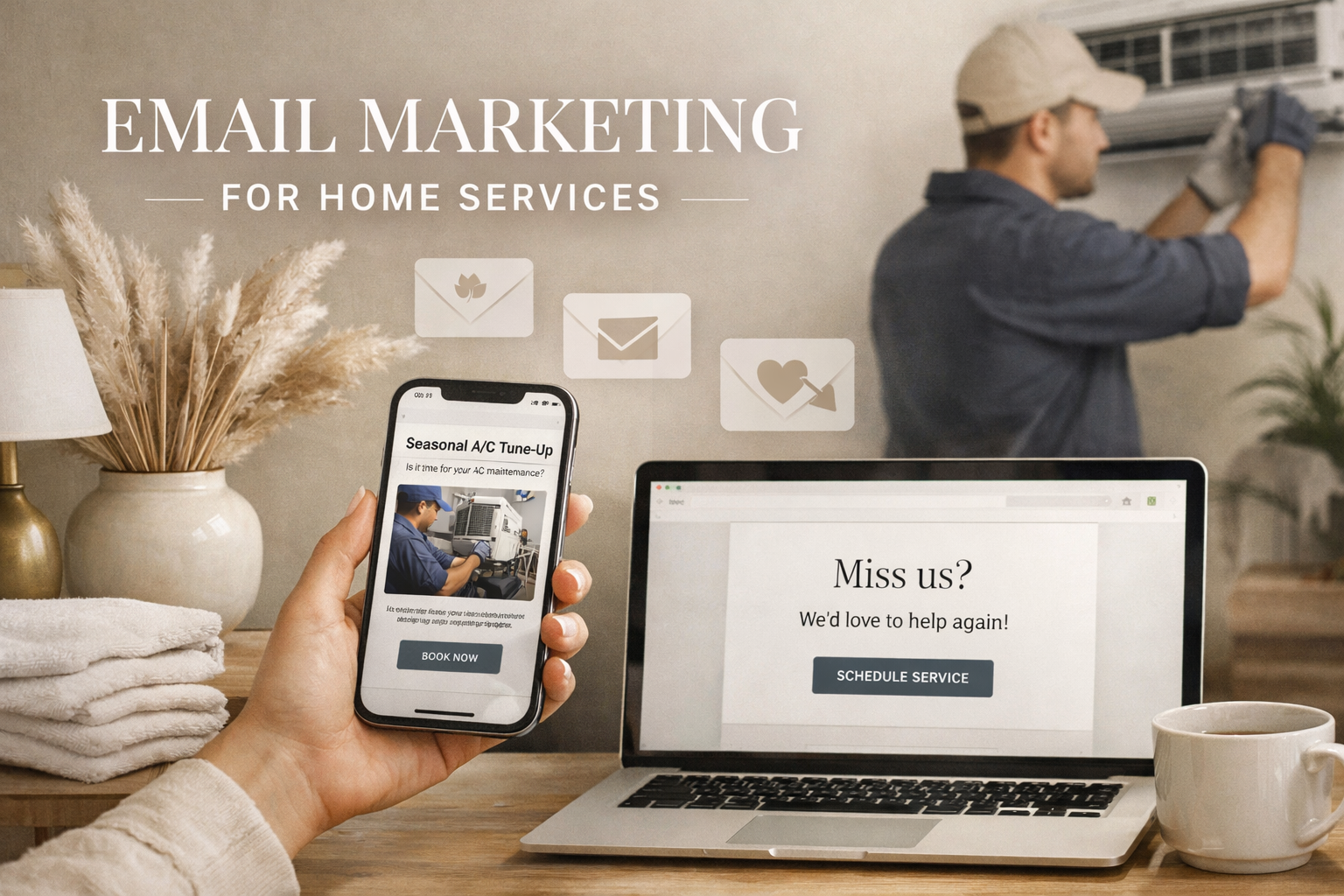
You fixed the leak. You replaced the unit. You cleared the nest. The customer paid, left a decent review, and disappeared.
Sound familiar?
Most home services businesses — HVAC companies, plumbers, roofers, electricians, pest control operators, landscapers, cleaning services — are built on a cycle of acquiring new customers over and over again. Every month, you're spending on ads, SEO, and lead gen to fill the schedule. And every month, you're essentially starting from scratch.
The problem isn't your service. It's what happens after the job is done: nothing.
Email marketing fixes that. Not the "blast a coupon to your whole list" kind. The kind that's automated, segmented, and designed to keep your business in front of past customers at exactly the right time — so when they need you again, there's no decision to make.
Here's how it works and why it matters more than most home services owners realize.
The Real Cost of Ignoring Past Customers
Acquiring a new customer costs five to seven times more than retaining an existing one. In home services, where the average cost per lead through Google Ads can run anywhere from $30 to $200 depending on the trade, that math gets painful fast.
Now think about your existing customer list. Every person who's ever booked a job with you has already done the hardest part — they trusted you once. They let you into their home. They paid you. That's a relationship most businesses would kill for, and most home services companies let it go cold the moment the invoice is sent.
Email marketing is how you keep that relationship warm without adding work to your plate. Done right, it runs in the background and brings customers back when they're ready — not when you're desperate.
Why Email Works Especially Well for Home Services
Home services have a built-in advantage that most industries don't: predictable, recurring need.
HVAC systems need seasonal maintenance. Plumbing problems don't fix themselves permanently. Pest control is cyclical. Gutters need cleaning. Lawns need care. Filters need replacing. Every trade has a natural rhythm of repeat service, and email is the simplest way to show up right when that need resurfaces.
On top of that, home services decisions are local and trust-driven. Homeowners don't want to research a new provider every time something breaks — they want to call someone they've already used and liked. Email keeps your name, your number, and your offer in their inbox so they don't have to think twice.
The Automated Flows Every Home Services Business Should Be Running
This is where email goes from "nice to have" to a system that generates revenue on autopilot. These aren't mass blasts. They're triggered sequences that send the right message to the right customer at the right time — without anyone on your team touching a button.
1. The Post-Job Follow-Up
Trigger: Job is marked complete in your CRM or scheduling software.
This is the most neglected email in home services. Within 24 to 48 hours of completing a job, the customer should receive a thank-you email that confirms what was done, offers a direct line for any questions, and asks for a Google review. That last part alone can transform your online reputation over time.
A second email three to five days later can include a brief maintenance tip related to the work you just performed. This builds trust, positions you as an expert, and gives the customer a reason to remember you beyond the invoice.
2. The Seasonal Maintenance Reminder
Trigger: Date-based, aligned to your trade's calendar.
This is the highest-ROI flow for most home services businesses. Examples include reminders to schedule a furnace tune-up before winter for HVAC, a spring pest inspection for pest control, gutter cleaning before fall for exterior services, or a sprinkler blowout before the first freeze for landscaping companies.
These emails don't need to be complicated. A short message reminding the customer it's time, a clear call to action to book, and maybe an early-bird incentive if they schedule within a window. The key is timing — send it two to four weeks before the season hits, when they're thinking about it but haven't acted yet.
3. The Membership or Service Plan Drip
Trigger: Post-job, targeting customers who haven't signed up for a recurring plan.
If your business offers a maintenance agreement, service club, or annual plan — and it should — email is the most effective way to sell it. A short three- to four-email sequence after a completed job can walk the customer through the value of a plan, what's included, what they'll save compared to one-off visits, and a simple link to sign up or call.
This turns a one-time $200 service call into a $400 to $600 annual contract — and dramatically increases lifetime customer value.
4. The Re-Engagement Sequence
Trigger: No booking or interaction in 12 to 18 months.
Customers go quiet. It doesn't mean they're unhappy — they just forgot about you. A re-engagement sequence targets dormant customers with a "we haven't seen you in a while" message, a reminder of what you offer, and sometimes a small incentive to rebook.
This is low-effort, high-return. You're not spending a dime on ads to reach these people. They're already in your database, they already know your work, and a well-timed email can pull them back in.
5. The Review and Referral Request
Trigger: 7 to 14 days post-job, after the follow-up sequence.
Reviews drive local SEO rankings and influence buying decisions. Referrals are the cheapest leads you'll ever get. Yet most home services businesses rely on hoping customers will leave reviews or mention them to neighbors.
An automated email asking for a Google review — with a direct link that takes them straight to the review form — dramatically increases your review volume. A follow-up asking if they know anyone who could use your services, paired with a small referral credit, turns happy customers into a lead generation channel.
Segmentation: Why One List Isn't Enough
Here's where most home services email efforts fall apart. They treat every customer the same — one list, one message, one blast. That's not email marketing. That's noise.
Effective email for home services requires segmentation. At a minimum, you should be segmenting by service type (the customer who called you for a drain cleaning doesn't need roofing emails), by recency (a customer from last month is in a different place than one from two years ago), by customer value (a $15,000 HVAC install customer should be treated differently than a $99 tune-up customer), and by geography if you serve a wide area.
The more relevant your emails are, the higher your open rates, click rates, and booking rates. The less relevant they are, the faster people unsubscribe — or worse, stop opening altogether while staying on your list and dragging down your deliverability.
What This Looks Like in Practice
Let's say you're a plumbing company doing $2M in annual revenue. You've completed 3,000 jobs over the past three years. That's 3,000 customers sitting in your database who've already paid you.
Without email, you're hoping they remember you next time. With a basic automated system in place — post-job follow-up, seasonal reminders, a service plan drip, and a re-engagement sequence — you could realistically pull 5 to 10% of that list back into a booking each quarter without spending a dollar on advertising.
At an average ticket of $300, that's $45,000 to $90,000 in recovered revenue per quarter from people who were already your customers. The only cost is the email platform and the time to set it up once.
The Tech Doesn't Need to Be Complicated
You don't need an enterprise marketing stack to make this work. Most home services businesses can build an effective email system with a platform like Mailchimp, ActiveCampaign, or HubSpot, a CRM or field service software that captures customer data and job history, and basic integrations that pass job completion data into your email platform to trigger automations.
The real work isn't technical — it's strategic. It's deciding which flows to build, what the messaging should say, how to segment your list, and how to measure what's actually driving bookings. That's where most DIY efforts stall out and where having a system designed by someone who understands both email architecture and home services makes the difference.
Stop Paying to Find Customers You've Already Won
The leads are expensive. The competition is fierce. And every home services business is fighting for the same pool of new customers on Google and social media. But most are sitting on a database of past customers that could be generating revenue every single month with almost zero acquisition cost.
Email marketing isn't glamorous. It doesn't trend on social media. But for home services businesses doing $1M to $5M, it's one of the highest-leverage moves you can make — and almost nobody in your market is doing it well.
At Ritner Digital, we build email systems that are automated, segmented, and connected to how your business actually operates. From flow architecture and list strategy to template design and deliverability, we handle the infrastructure so it runs in the background and books jobs while you're out running them.
Ready to turn your customer list into a revenue channel?
Let's talk about what email can do for your business →
Frequently Asked Questions
Do I need a big email list for this to work?
No. Most home services businesses have a bigger list than they think — it's just scattered across invoices, CRM records, scheduling software, and spreadsheets. Even a list of 500 past customers is enough to generate meaningful revenue with the right automated flows in place. The size of the list matters less than the relevance of what you send and when you send it.
What email platform should a home services business use?
It depends on the complexity of your operation and what tools you're already running. Mailchimp works well for businesses getting started. ActiveCampaign is strong for automation-heavy setups. HubSpot is a good fit if you want email, CRM, and reporting in one place. The platform matters less than how it's configured — a well-built system on a simple tool will outperform a disorganized setup on an expensive one every time.
How often should I email my customers?
Most home services businesses are better off emailing less frequently but more relevantly than blasting weekly. For automated flows — post-job follow-ups, seasonal reminders, re-engagement — the system handles timing based on triggers, not a set calendar. For campaign-style emails like promotions or company updates, once or twice a month is usually the sweet spot. Enough to stay visible without wearing out your welcome.
Won't my customers just unsubscribe or ignore the emails?
Some will, and that's fine. The customers who unsubscribe were unlikely to book again anyway, and a smaller, engaged list is more valuable than a bloated one full of people who never open. The key is relevance. A homeowner who had their furnace serviced in October isn't going to be annoyed by a spring AC tune-up reminder in April — they'll appreciate it. People ignore generic blasts. They respond to emails that feel timely and useful.
What kind of results can I expect from email marketing?
Results vary by list quality, trade, and how well the system is built, but home services businesses with solid automated flows typically see open rates between 30 and 50% and click rates between 3 and 8% — well above industry averages. More importantly, the metric that matters is bookings. Even a modest 5 to 10% rebook rate from your existing customer base each quarter translates to significant recovered revenue at zero acquisition cost.
Can I do this myself or do I need an agency?
You can absolutely set up basic email on your own, especially if you're comfortable with your email platform and have clean customer data. Where most home services businesses hit a wall is in flow architecture, segmentation logic, CRM integration, and deliverability — the backend work that determines whether emails actually reach inboxes and drive action. If you have the time and technical comfort, start simple. If you want a system that's built right from the beginning and runs without your involvement, that's where working with a team like ours makes sense.
How does email marketing connect to my other marketing efforts?
Email doesn't replace SEO, ads, or social — it multiplies them. Your paid campaigns and SEO bring in new customers. Email keeps those customers coming back without additional ad spend. It also supports your review generation, which feeds local SEO. And when you run a promotion through ads, reinforcing it via email to your existing list gives you two channels working the same offer simultaneously. The businesses that grow fastest aren't choosing between channels — they're connecting them into one system.
What's the difference between email blasts and automated flows?
Email blasts are one-time sends to your full list or a segment — things like holiday promotions, company announcements, or seasonal offers. Automated flows are triggered sequences that fire based on a specific event or condition — a job being completed, a customer going dormant, a new subscriber joining your list. Blasts require ongoing effort each time. Flows are built once and run continuously in the background. Both have a role, but flows are where the compounding value lives for home services.
How long does it take to set up an email system like this?
A basic system with two to three core automated flows, list segmentation, and template design can typically be built and launched within three to four weeks. More complex setups involving CRM integrations, multiple service-line segmentation, and advanced reporting may take six to eight weeks. The important thing is that once it's built, it runs — the upfront investment in setup pays back month after month without rebuilding.
What if my customer data is messy or spread across multiple systems?
That's more common than you'd think, and it's not a dealbreaker. Part of building an email system is cleaning and consolidating your data — deduplicating contacts, standardizing service tags, and connecting your scheduling or CRM tools to your email platform. It takes some upfront work, but once the data is clean and flowing properly, everything downstream works better.
Let's build an email system that brings your customers back →
Related Reads
〰️
Related Reads 〰️
Email Flows That Actually Drive Revenue: The 5 Automations Every Ecommerce Brand Needs in 2026
Most ecommerce brands are still sending campaigns. The smart ones are building revenue engines. In this post, we break down the five essential email automations that convert subscribers, recover lost sales, increase LTV, and drive predictable revenue in 2026.
The Home Services Marketing Playbook: How HVAC and Plumbing Companies Should Spend Their First $5K/Month
If you’re an HVAC or plumbing company with a $5K/month marketing budget, you don’t need branding fluff — you need booked jobs. This playbook breaks down exactly how to allocate your spend across Google Ads, Local Services Ads, and retargeting to drive predictable local leads.
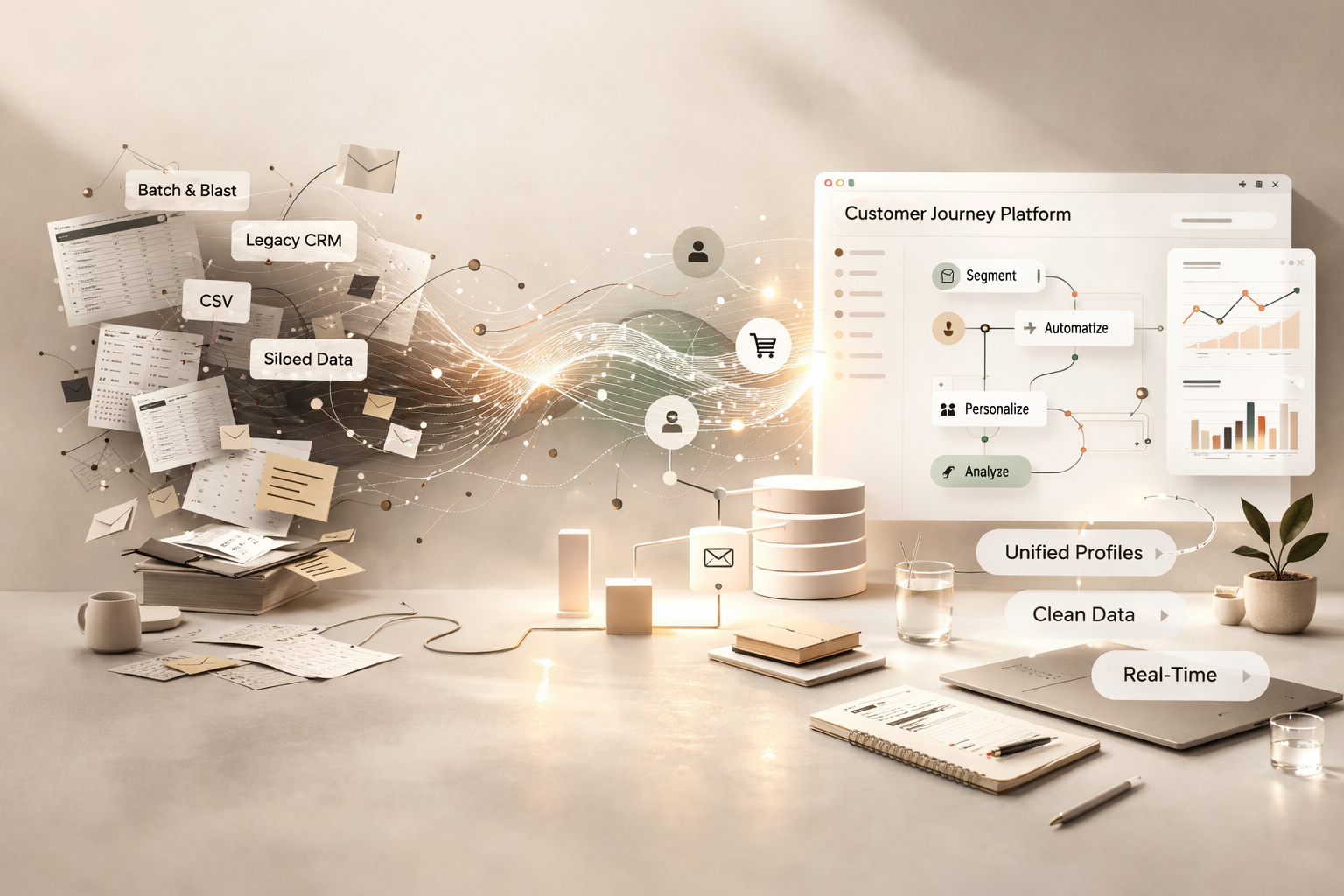
Migrating from Batch-and-Blast Email to a Customer Journey Platform — And Who Actually Handles the Data Migration
The gap between a batch-and-blast tool and a customer journey platform isn't just a feature gap — it's a data architecture gap. If nobody bridges it properly during migration, you end up with a shiny new platform running the same lazy emails with a more expensive subscription. Here's what the migration actually involves and who should handle it.