Golden State of Mind: The Biggest Brands Born in California and What the World's Fifth-Largest Economy Is Buying
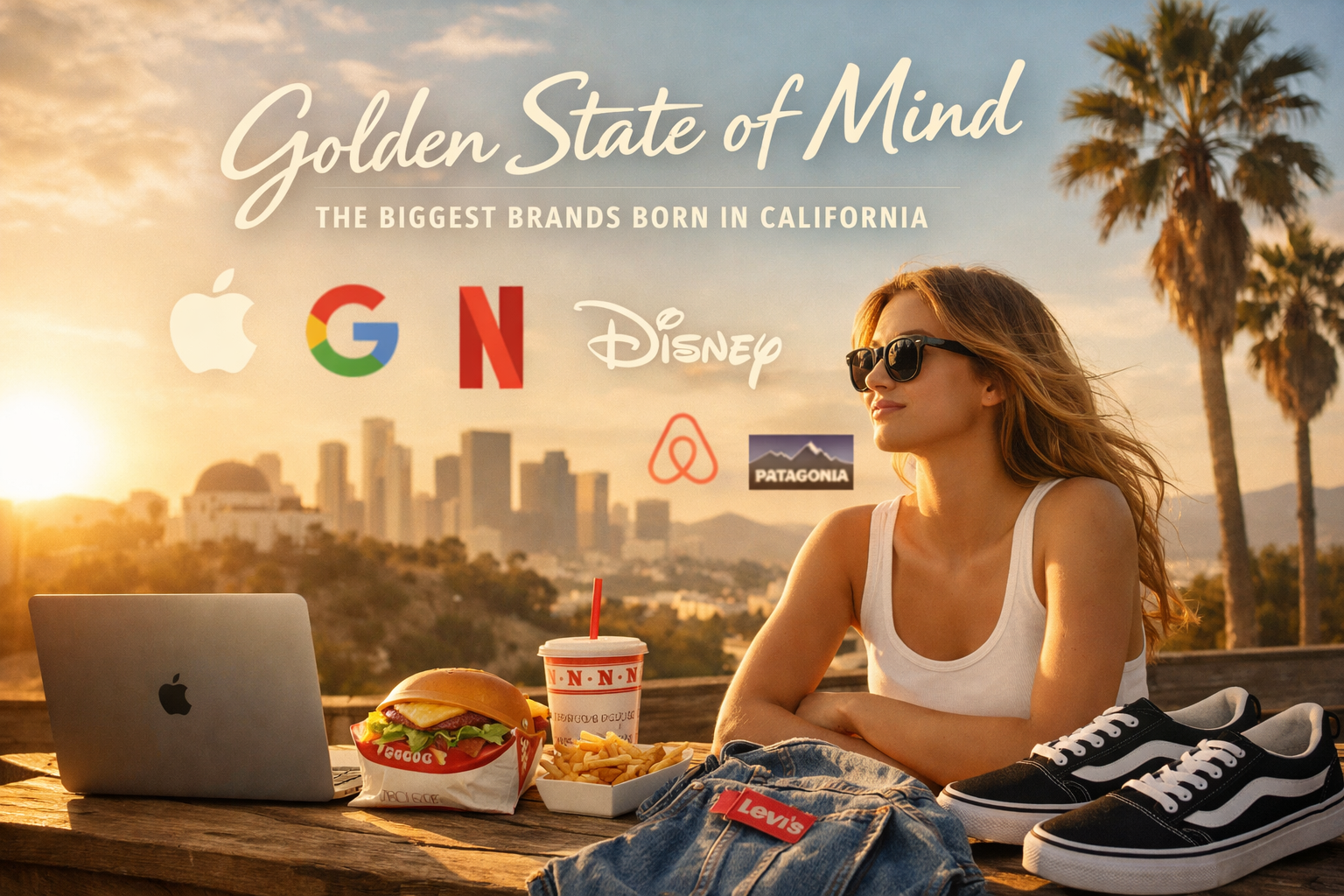
Every state in this series has surprised us in some way. New Jersey gave us Campbell's Soup and M&Ms. Maryland gave us Old Bay and Under Armour. Utah gave us Crumbl Cookies and Skullcandy. But California is different. California doesn't sneak up on you with a surprise — it arrives with a list so long, so globally dominant, so deeply woven into the fabric of modern life that the real challenge isn't finding the brands. It's deciding which ones to focus on.
Apple. Google. Disney. Netflix. Levi's. In-N-Out. Patagonia. Vans. Airbnb. Instagram. The Gap. Wells Fargo. Chevron. Bank of America. Mattel. These aren't brands that happen to be from California. They are, in many ways, California — packaged and exported to the entire planet.
This is the fourth entry in Ritner Digital's State by State Brand Series. Welcome to the Golden State. Hold on.
The Scale of What California Has Built
Before we get into individual brands, let's frame the scope of what we're dealing with. California is the fifth-largest economy in the world — not the fifth-largest state economy, but the fifth-largest economy on Earth, ahead of the United Kingdom, India, and France. The brands that have emerged from California's soil have collectively shaped American consumer culture, global technology, entertainment, fashion, food, sustainability, and the way the entire world spends its time online.
It would be impossible to be comprehensive. So instead, we've organized California's brand output by the themes that define the state — because the brands that come from California don't just sell products. They sell a way of living.
The Brands That Defined California — and America
Apple — Cupertino, CA (Est. 1976)
There is no brand in American history that has more completely redefined what a company can be than Apple. Founded by Steve Jobs and Steve Wozniak in 1976, Apple set new benchmarks in product innovation, user-centric functionality, aesthetics and design, and multiproduct integration. Apple created the first commercially successful personal computer and was the first to bring the graphical user interface into mass adoption. The company is headquartered in Cupertino, California. Britannica
Apple branded its products as part of an upscale lifestyle — or "iLife" — by emphasizing sleek, minimalist, and aesthetically pleasing designs that looked more like modern art than machinery. Britannica That design philosophy didn't just sell computers and phones. It created an entirely new relationship between humans and technology, and set the aesthetic standard that virtually every consumer product company has been chasing ever since.
Apple's California roots matter because they're inseparable from the state's core creative identity: the belief that form and function are not opposites, that the best product is also the most beautiful one, and that technology should feel human. That is a distinctly California idea, born in the garages and campuses of Silicon Valley, and it has defined the last fifty years of consumer technology globally.
Levi's — San Francisco, CA (Est. 1853)
The granddaddy of jeans makers started in the mid-1850s when Levi Strauss migrated west to San Francisco, not to pan for gold but to turn pants into gold by outfitting the miners. It has grown into an apparel industry icon, dressing men, women and children from jeans to casual workwear. WWD
Levi's is arguably the oldest American lifestyle brand still operating at global scale. The 501 jean didn't just clothe the Gold Rush — it clothed rock and roll, counterculture, Hollywood, and every generation of American youth that followed. The fact that it started in California during one of the most consequential migrations in American history is no accident. California has always been a place where people arrive to build something new, and Levi Strauss arrived to clothe them while they did it.
In-N-Out Burger — Baldwin Park, CA (Est. 1948)
No fast food brand generates the kind of passionate, near-religious loyalty that In-N-Out does — and it has done so without franchising, without a public stock offering, without a loyalty app, and without meaningfully expanding outside the western United States. In-N-Out is a California institution that has stayed California on purpose, and that restraint is a significant part of what makes it so coveted. When an In-N-Out opens in a new city, it makes the news. That's a brand story most chains spend billions trying to manufacture and never achieve.
The Double-Double, Animal Style, the secret menu — these are cultural touchstones for California consumers and aspiration objects for everyone else. In-N-Out is the rare brand that's simultaneously hyper-regional and nationally beloved.
Patagonia — Ventura, CA (Est. 1973)
Founded in 1973 in Ventura, California, Patagonia began selling climbing gear and later expanded to selling outdoor apparel and accessories. Even with Patagonia's expansion, founder Yvon Chouinard remained focused on making products sustainably, treating employees well, and engaging in corporate responsibility. MarcomCentral
In September 2022, Chouinard transferred ownership of Patagonia to the Patagonia Purpose Trust, with his stated goal being for profits to be used to address climate change and protect land. Wikipedia That move — giving away a multi-billion dollar company rather than selling it — became one of the most significant brand moments of the decade. It wasn't a PR stunt. It was the logical endpoint of a brand philosophy that had been consistent since the very beginning.
Patagonia is the brand that proved purpose-driven business was not a marketing strategy but a business model. Its campaigns — including the famous "Don't Buy This Jacket" initiative — solidified its position as a brand that prioritizes sustainability over consumption. With a commitment to using recycled materials and pledging 1% of sales to environmental causes, Patagonia made environmental responsibility a core part of its identity. MarcomCentralCalifornia didn't just create Patagonia — California created the cultural conditions in which Patagonia's approach to business could become the most admired brand model in the world.
Disney — Burbank, CA (Est. 1923)
Founded in a Burbank studio apartment, Disney didn't just create entertainment — it created modern brand mythology. Characters, worlds, emotional experiences, generational touchstones — Disney's brand architecture is the most sophisticated in consumer history, and it was born in Southern California's creative ecosystem. Today, Disney's influence extends to streaming (Disney+), theme parks, Marvel, Star Wars, Pixar, and ESPN — a portfolio of brands that touches virtually every demographic on Earth.
Vans — Anaheim, CA (Est. 1966)
The iconic shoe brand popular with skaters the world over got its start in Anaheim. In 1966, the Van Doren brothers and their partners started the Van Doren Rubber Company, which manufactured shoes to order for the public. Uci Vans wasn't born from a marketing strategy. It was born from California's skate and surf culture — a scene that valued authenticity, individuality, and self-expression over polish and prestige. The checkerboard slip-on became a cultural symbol for that ethos, adopted first by skaters, then punk musicians, then the entire world.
Gap — San Francisco, CA (Est. 1969)
Gap was born in San Francisco in 1969 as a store selling Levi's jeans and records. It grew into one of the defining American retail brands of the late 20th century — building a middle-class clothing identity that was clean, accessible, and unmistakably Californian in its casual optimism. At its peak, the Gap khaki and white T-shirt defined a generation of American workplace dressing.
Dr. Bronner's — Escondido, CA (Est. 1948)
Entrepreneur Emanuel Heilbronner was born into a prestigious family of German-Jewish soap makers. Heilbronner emigrated from Germany to the United States in 1929, bringing his vast knowledge of soaps and chemistry with him. San Diego Magazine Dr. Bronner's became a California cult institution decades before the wellness and clean-beauty movements made such products mainstream. The text-covered label, the all-purpose soap, the radical transparency about ingredients — Dr. Bronner's was practicing clean brand values before the vocabulary existed. It remains one of the most authentic wellness brands in America.
Airbnb — San Francisco, CA (Est. 2008)
Founded in San Francisco during the 2008 financial crisis by two roommates who couldn't make rent and started renting air mattresses in their apartment, Airbnb reimagined an entire industry and redefined what hospitality could mean. The brand's California DNA — scrappy, optimistic, community-oriented, disruptive — is embedded in every aspect of its identity. It didn't just build a platform. It built a philosophy of belonging.
The California Lifestyle Brands That Set the National Agenda
California doesn't just produce companies — it produces cultural movements that then get turned into brands. The surf and skate culture of SoCal gave the world Vans, Quiksilver, and a dozen other brands built around a physical lifestyle that California invented. The wellness and organic food movement that now dominates grocery store conversations globally has deep California roots — in the farmers markets of the Bay Area, the health food stores of LA, and the environmental consciousness that runs through the state's cultural DNA.
The West USA leads nationally with a 6.9% compound annual growth rate in organic, vegan, and functional-nutrition categories, driven by strong adoption across California, Washington, and Oregon. Consumers regularly seek reduced-sugar and fortified packaged foods positioned for digestive health or high protein intake. Fitness-centric lifestyles and a large base of early adopters enable quick acceptance of emerging nutritional trends including adaptogens, superfoods, and regenerative agriculture-sourced products. Future Market Insights
California consumers didn't follow the wellness trend. They created it.
What California Consumers Are Actually Buying
The World's Most Influential Consumer Market
With nearly 40 million residents and an economy the size of a major nation, California's consumer market is impossible to generalize in the way that smaller states can be. But there are patterns — and they're patterns that often become national and then global trends within five years.
Organic and Health Food: California Leads the Nation
The organic industry hit a record $76.6 billion in 2025, with younger consumers from Gen Z's youngest to millennials' oldest driving organic growth. They represent the fastest-growing segment of the organic buyer base, and their priorities increasingly determine organic's performance. Transparency stands as paramount for many of them — they demand to know what's in their food, where it comes from and what it's doing to the planet. New Hope
California is at the center of this movement — both as a producer and a consumer. The state grows a significant portion of America's organic produce, and its consumers buy it at rates that consistently outpace national averages. Whole Foods, Sprouts, Erewhon, Trader Joe's (founded in Pasadena, CA), and dozens of regional chains compete vigorously for California's health-conscious grocery dollar. 63% of all CPG growth in 2025 came from natural products Food Navigator, and California's consumer base is the engine behind much of that growth.
Erewhon deserves particular mention. The Los Angeles luxury grocery chain has become a cultural phenomenon in its own right — a brand that California consumers visit not just to buy food but to be seen, to participate in a wellness identity, and to discover what's emerging before it hits mainstream shelves. Erewhon smoothies go viral on TikTok. Celebrities are photographed in its parking lot. It is, perhaps more than any other single store, the distilled essence of California's relationship with wellness as status.
Sustainability as a Purchase Driver
California consumers don't just prefer sustainable products — they've helped create the regulatory and cultural environment that makes sustainability a baseline requirement for brands operating in the state. California's strict environmental regulations, combined with a consumer base that votes with its wallet on environmental issues, have made the state the single most important proving ground for any brand with sustainability ambitions.
92% of consumers say that sustainability is important when choosing a brand. In the grocery store, products with claims like "organic" are more popular than ever, while new and emerging claims around regenerative agriculture, carbon footprint, water footprint, and responsibly sourced are emerging and growing rapidly. NielsenIQ California consumers are not just early adopters of these claims — they're the audience that forces brands to substantiate them. Greenwashing gets called out loudly and publicly here.
Technology Spending
California is home to both the companies that make consumer technology and the consumers who adopt it first. Apple, Google, Meta, and Netflix — all California companies — shape what technology products Californians buy, how they consume content, and how they interact with brands digitally. The state has one of the highest smartphone penetration rates in the country and consistently leads in app adoption, streaming subscriptions, and digital commerce.
The LA vs. SF Consumer Divide
Just as Maryland has its Baltimore-DC split and New Jersey has its North-South divide, California has arguably the most culturally significant intrastate consumer divide in the country: Los Angeles versus San Francisco.
The LA consumer is aspirational, fashion-forward, image-conscious, and wellness-obsessed in a very visual, social-media-native way. The brands that thrive in LA — Reformation, Erewhon, Glossier (which opened its first non-NYC store in LA), streetwear brands, luxury sneakers — are built around identity, aesthetics, and the curated self. LA consumers spend significantly on appearance, experience, and the products that signal who they are.
The SF consumer is more tech-driven, utility-focused, and intellectually curious about brand values. San Francisco rewards brands that can demonstrate genuine impact — environmental, social, technological. The brand that wins in San Francisco is the one that's building something that actually matters, and can prove it. Patagonia's "Don't Buy This Jacket" campaign resonated most powerfully with exactly this consumer.
These aren't absolute rules — both cities contain multitudes — but they represent real divergences in purchase motivation that brands regularly underestimate when they think of "California" as a single market.
The In-N-Out Effect: California's Fierce Loyalty to Local Institutions
California consumers are deeply loyal to what they consider authentically California — and deeply skeptical of anything that tries to fake it. In-N-Out has never needed to advertise heavily because its California authenticity does the work. Trader Joe's, originally from Pasadena, built a national cult following on the same principle: a quirky, California-inflected personality that felt real because it was.
This loyalty dynamic means that brands entering California need to earn their place by understanding the culture, not just slapping a palm tree on their packaging. Californians are experienced consumers who have seen every brand strategy tried in their backyard. What gets through isn't the most expensive campaign — it's the most honest one.
What Makes California's Brand Ecosystem Unique
Scale creates its own gravity. California's consumer market is so large that brands can build national companies without leaving the state. The success of In-N-Out, limited almost entirely to the western US, is proof. The attention of California's market — particularly LA and San Francisco — generates media, influencer content, and cultural momentum that reaches the entire country organically.
California sets the agenda. The organic food movement, the sustainability brand movement, the DTC startup revolution, the creator economy, the wellness industry — all of these emerged from California's consumer culture and then spread nationally and globally. Brands that understand California tend to understand where the rest of the country is going in three to five years.
The creative industry amplifies everything. No other state has Hollywood. The entertainment industry doesn't just create content — it creates brand placements, celebrity endorsements, cultural moments, and trend cycles that touch every product category. A brand that breaks through in California often does so with the amplification of the entertainment and media ecosystem that only exists here.
Values drive purchase in a way unlike almost any other market. Wellness is a top priority for 82% of U.S. consumers, and 90% of consumers born between 1981 and 2012 prioritize spending on healthy food even in times of economic crisis. Capital One Shopping In California, these numbers are even more pronounced. Brands that ignore the values dimension of their product — environmental, social, health — are not just missing a marketing opportunity. They're missing a core purchase driver for the state's most influential and highest-spending consumer segments.
The Marketing Takeaway for Brands in California
California is not one market. It's the world's fifth-largest economy expressed through dozens of distinct consumer communities — each with its own brand affinities, spending behaviors, cultural codes, and expectations. The LA consumer, the SF consumer, the Central Valley consumer, the San Diego consumer — these are different people with different purchase motivations, and treating them as one audience is one of the most common and costly mistakes brands make when targeting this state.
What all California consumers share, however, is a high bar for authenticity. This is a state that has been marketed to relentlessly for a century — by Hollywood, by Silicon Valley, by the wellness industry, by political campaigns, by every brand that has ever wanted to signal cool or progressive or innovative or healthy. California consumers are the most practiced audience in the world at detecting the gap between what a brand says and what it does.
The brands that win here — Apple, Patagonia, In-N-Out, Airbnb, Trader Joe's — win because they closed that gap. They built something real, they communicated it honestly, and they let California's culture carry them from there.
That is the California brand formula. And every brand that has ever cracked it has gone on to shape the world.
Ritner Digital helps brands build smarter, more targeted marketing strategies at the local, regional, and national level. Ready to talk about what your brand could look like in the Golden State? Let's connect.
Sources: Britannica, MarcomCentral, Highsnobiety, Patagonia Company History, 24/7 Wall St., UCI Beall Applied Innovation, Future Market Insights, New Hope Network, NIQ, Capital One Shopping Research, OTA, Mintel
Frequently Asked Questions
Why does California produce so many globally dominant brands compared to other states?
A combination of forces that compound on each other over time. Silicon Valley created the world's most concentrated startup and venture capital ecosystem, producing the infrastructure — funding, talent, networks, legal frameworks — that allows companies to scale from garage to global faster than anywhere else. Hollywood created a media and entertainment industry that amplifies brands to global audiences at no marginal cost. The state's sheer population size gives brands a proving ground large enough to validate a product before they ever leave California. And the cultural identity of the state — optimistic, innovative, lifestyle-forward, values-driven — has consistently produced founders with something to say. Put all of that together over several decades and you get Apple, Disney, Google, Levi's, Patagonia, Airbnb, and In-N-Out in the same state. It's not luck. It's infrastructure.
How different are LA and San Francisco as consumer markets, really?
Significantly different in ways that matter for brand strategy. The LA consumer is more aspirational, image-driven, and aesthetic-focused — heavily influenced by entertainment, celebrity, and the visual culture of social media. Brands that succeed in LA tend to win on identity: who does buying this product say I am? The SF consumer is more intellectually driven, skeptical of surface-level branding, and deeply attuned to values and impact. Brands that succeed in San Francisco tend to win on substance: what does this company actually do, and does it match what it says? A campaign built for one city often falls flat in the other. The smartest California brand strategies treat these as separate markets with shared geography — which is exactly what they are.
How does In-N-Out maintain such intense loyalty without traditional advertising?
By doing almost everything traditional marketing wisdom says not to do — and doing it consistently for over 75 years. No franchising. No public offering. No loyalty app. No major ad campaigns. Limited geographic expansion. A menu that barely changes. These constraints, which look like limitations from the outside, are the source of the brand's power. Scarcity and consistency create desire. The fact that you can only get In-N-Out in the western US means that every new market entry is an event. The fact that the menu hasn't changed means every bite confirms what you expected. Loyalty is built on trust, and In-N-Out has never broken the promise. That's a lesson in brand strategy that no advertising budget can replicate.
Is California really the most influential consumer market in the country for trend-setting?
For most categories, yes — particularly in wellness, sustainability, food, technology, and lifestyle. The organic food movement, the plant-based revolution, the DTC startup model, the creator economy, the clean beauty category — all of these emerged from California's consumer culture and became national trends within a few years. There's a well-documented pattern: something becomes mainstream in California, spreads to New York and other coastal cities, and then diffuses across the country over the following three to five years. Brands that crack California early tend to have a meaningful head start on national competitors. For that reason, California is often where the smartest brands go first, even if the volume doesn't yet justify it.
What does it mean that Patagonia gave itself away, and why does it matter for brand strategy?
It matters enormously because it was the most extreme possible expression of brand values alignment — and it worked. When Yvon Chouinard transferred ownership of Patagonia to an environmental trust in 2022, it wasn't a PR move. It was the logical conclusion of a brand philosophy that had been consistent since 1973. What it proved for brand strategists is that when your values are genuinely embedded in your business model — not just your marketing — consumers notice, trust deepens, and the brand becomes nearly immune to competitive attack. You can't outcompete Patagonia on sustainability because sustainability isn't a feature of the product. It's the ownership structure of the company. That's a level of values integration that virtually no other brand has achieved.
How has California's regulatory environment shaped its consumer market?
More than most people outside the state realize. California has consistently passed consumer protection, environmental, and privacy regulations years ahead of the rest of the country — CPRA for data privacy, strict emissions standards, plastic bag bans, organic certification requirements, Proposition 65 chemical disclosures. These regulations don't just affect how companies operate in California. They often become de facto national standards, because it's not cost-effective for most brands to maintain separate California and non-California product lines. When California regulates something, the whole country eventually feels it. For brands, this means California's regulatory environment is simultaneously the hardest market to enter and the most important one to get right — because getting it right here often means getting it right everywhere.
What is Erewhon and why does it matter beyond being a grocery store?
Erewhon is a Los Angeles luxury grocery chain that has become one of the most culturally significant brand phenomena in California retail. It functions simultaneously as a food store, a wellness authority, a celebrity destination, and a social media content engine. Its signature smoothies — some priced at $20 or more, often developed in collaboration with celebrities — go viral on TikTok with regularity. Being photographed at or associated with Erewhon has become a status signal in LA consumer culture. For marketers, Erewhon matters because it represents the full expression of California's wellness-as-identity consumer behavior — where what you buy and where you buy it is a statement about who you are. Brands that land shelf space at Erewhon gain a credibility and cultural cachet that no traditional advertising can replicate.
What's the single biggest mistake brands make when marketing to California consumers?
Treating California as a monolith while simultaneously stereotyping it. Brands either assume all California consumers share the same wellness-obsessed, sustainability-forward, tech-savvy profile — and build one campaign around that — or they lean into California clichés like surf culture, palm trees, and "chill vibes" that land as shallow and condescending to people who actually live there. The reality is that California contains the most economically and culturally diverse consumer population in the country, spanning more than 39 million people across dramatically different regions, income levels, ethnicities, and cultural orientations. The Central Valley agricultural community, the LA entertainment industry, the SF tech corridor, the San Diego military and biotech population — these are not the same consumer. The brands that do best in California are the ones that pick their specific California and go deep, rather than trying to appeal to an imaginary average Californian who doesn't exist.
Why does the sustainability message work so much better in California than in other states?
Because in California, sustainability is not a marketing position — it's a baseline expectation with decades of cultural reinforcement behind it. California consumers have been engaging with environmental values since the 1960s and '70s, when figures like Yvon Chouinard and movements like the Sierra Club shaped the state's relationship with the natural world. The regulatory environment has reinforced those values with real policy teeth. And the concentration of tech workers, creative professionals, and highly educated consumers in the state's major metros means a large proportion of the population is both informed about environmental issues and financially positioned to act on them. In other markets, sustainability is a premium differentiator. In California, the absence of sustainability credibility is increasingly a disqualifier.