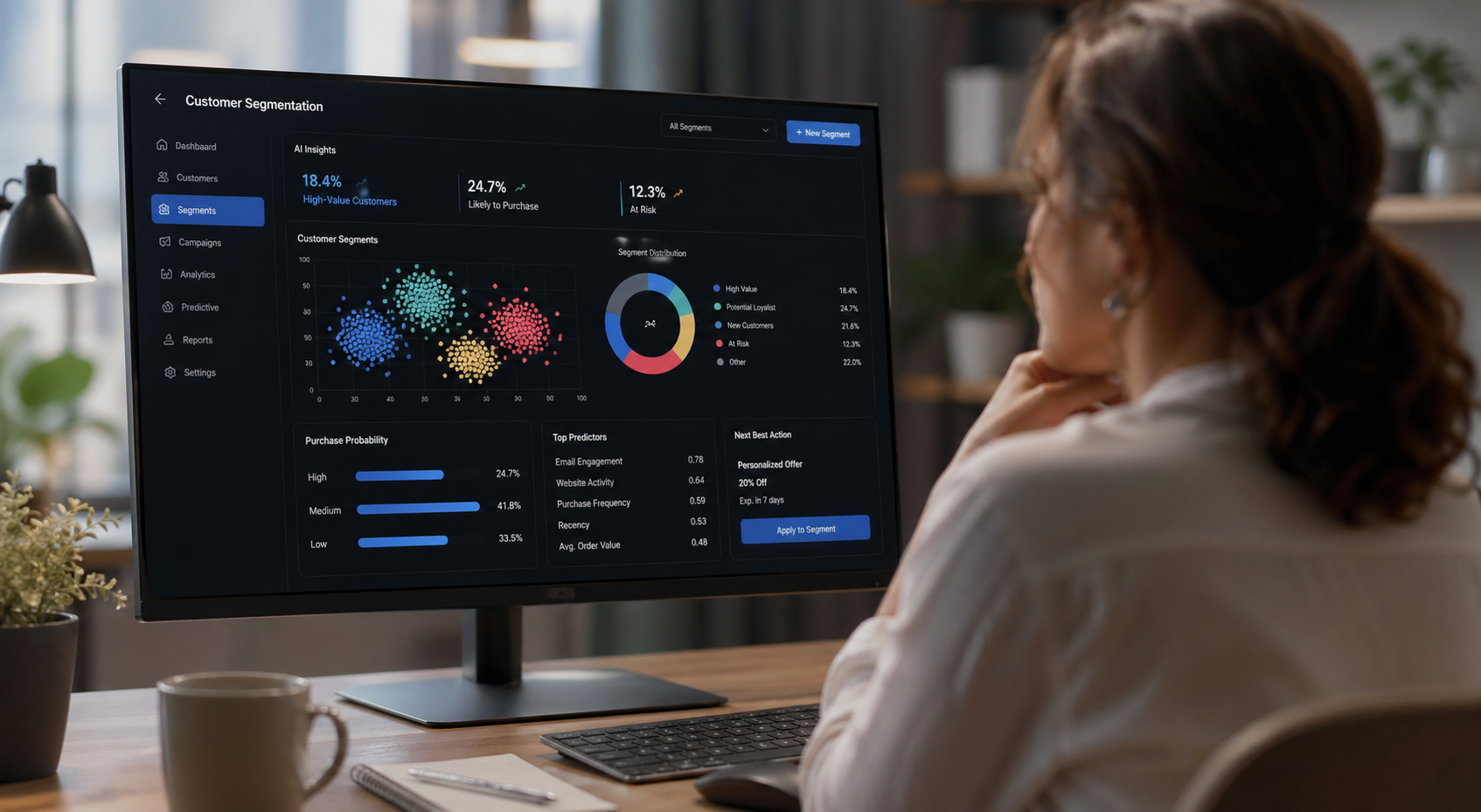
Most businesses think they know their customer. They've built a profile — maybe even a detailed persona with a name and a stock photo — and they market to that person religiously. The 35-to-55-year-old decision maker in the mid-Atlantic. The small business owner in the service industry. The e-commerce buyer who purchases twice a year.
And then they wonder why their marketing feels like it's leaving money on the table.
The uncomfortable truth is that your most valuable future customers might not look anything like your current ones. They're in your data right now — browsing your site at midnight, reading your emails but never clicking, making one purchase per year worth ten times the average. Traditional segmentation has always been too blunt to find them. AI segmentation was built specifically to.
What Traditional Segmentation Gets Wrong
Customer segmentation has been a marketing staple for decades, and it's not going away. But the way most businesses have practiced it is fundamentally limited — not because the concept is flawed, but because the execution has been stuck in a world of manual rules, static spreadsheets, and quarterly refreshes.
Manual rules and quarterly segment refreshes can't keep up with constantly changing customer behavior. High-value customers can slip through generic journeys, churn risks can hide in broad lists, and whole pockets of opportunity stay buried in the data. Braze
The core problem with traditional segmentation is that it's hypothesis-driven. A marketer looks at their customer base, makes an educated guess about what characteristics matter — age, geography, purchase history, job title — and draws lines accordingly. It works for broad targeting. It fails completely at nuance.
The reality is that customers do not fit neatly into predefined categories. Their behaviors shift based on mood, context, season, and even the device they are using. Treating them as static groups is similar to navigating with outdated maps. Tredence
Traditional segmentation assumes a human can look at a list of attributes, understand them, write the right conditions, and keep them updated. That worked when you had 20 fields. It does not work when you have 500 — or when customer behavior changes faster than your segments can keep up. Treasuredata
The result is a marketing approach that serves the customers you've already figured out while systematically ignoring the ones you haven't. That gap — between who you're targeting and who you could be targeting — is exactly where AI segmentation operates.
What AI Customer Segmentation Actually Is
AI customer segmentation isn't just a faster version of what marketers already do. It's a fundamentally different approach to understanding who your customers are and who your future customers should be.
AI customer segmentation uses machine learning models to group customers based on how they behave, who they are, and what they're likely to do next. Instead of hand-picking a few traits and building fixed lists, the models scan large volumes of data — clicks, purchases, sessions, and more — to find patterns that relate directly to customer engagement and revenue, so segmentation is grounded in real behavior rather than static assumptions. Braze
The key distinction is what the models are looking at. A human marketer working with traditional tools might segment on five to ten variables. Machine learning models analyze dozens or hundreds of signals at once — things like visit frequency, category mix, discount sensitivity, device type, and content preferences — and group customers based on how those signals interact, instead of just a few visible traits. Braze
This is how AI finds buyers that traditional methods miss. Not by being smarter than your marketing team, but by being able to see patterns across combinations of signals that no human could process at scale.
The Hidden Segments Living in Your Data Right Now
This is the part that tends to surprise business owners the most. The customers you're missing aren't necessarily new people you've never reached. Many of them are already in your database. They've interacted with your brand. They've bought from you, visited your site, or opened your emails. But because they don't match the profile you've built in your head, they've been underserved — or ignored entirely.
AI-powered segmentation can help brands discover "hidden" segments within their customer populations — segments that weren't immediately obvious from a human perspective but that the algorithm spotted while analyzing customer data and determined are worth personalizing content for. For example, in a segment defined by customers living in the Pacific Northwest, AI analysis might reveal that men in a narrow age bracket within that segment visit a particular blog post on surfing — and adjust personalized content suggestions accordingly, showing them products that are likely to convert. Contentful
One cluster might contain frequent, promotion-responsive buyers; another might be low-frequency, high-value customers who respond better to early access than discounts. These clusters update over time as people interact with your brand, so audiences stay aligned with current behavior. Braze
The business impact of surfacing these hidden segments is significant. According to a study by McKinsey, companies that leverage AI-powered personalization can see a 20–30% increase in sales and a 10–20% increase in customer satisfaction. SuperAGI And companies using AI-powered customer segmentation experience an average increase of 25% in sales and a 30% increase in customer satisfaction. Articsledge
How AI Finds Buyers Who Look Like Your Best Customers
One of the most powerful applications of AI segmentation isn't just understanding who your current customers are — it's using that understanding to find more of them.
Given a high-value customer segment, AI identifies the attributes and behavioral patterns that define it, then finds other customers who share those patterns but haven't converted yet. This moves prospecting from guesswork to data-driven expansion. Treasuredata
The most profitable customers are not lost; they are simply hidden in plain sight, obscured by the noise of averages and the limitations of broad categorizations. dotData AI changes the paradigm from searching for the right customer to building a system that attracts them — because you now understand, precisely, what they look like before they convert.
Think about what that means in practice for a service business. You have a handful of clients who are exceptionally profitable — they close fast, have a high lifetime value, rarely churn, and send referrals. Traditional segmentation might describe them as "mid-sized companies in a specific industry." AI segmentation would tell you that they all exhibited three specific behavioral patterns before they became clients: they visited your case studies page multiple times, they engaged with long-form content rather than quick tips, and they came in through a specific referral channel. That's the profile you optimize your marketing around. That's the next buyer you go find.
Segments That Update Themselves in Real Time
One of the biggest practical advantages of AI segmentation over traditional methods is that it doesn't freeze your understanding of your audience at a single point in time.
Unlike traditional static segmentation methods, AI-driven automation allows brands to move from manual audience management to segments that update continuously as customer behavior changes. A coffee customer might begin in a "curious browser" segment after visiting a website multiple times. After making a purchase, they automatically move into a "first-time buyer" segment. If they subscribe within 30 days, they shift to "new subscriber," and if they pause their subscription after several months, they move into an "at-risk subscriber" segment. These transitions happen automatically based on behavioral triggers, ensuring customers receive targeted messaging without manual list management. Shopify
This matters enormously for finding buyers at the right moment. AI can calculate the likelihood of customers who are expected to purchase within a specified period, allowing organizations to target high-value customers beforehand with special marketing campaigns and achieve greater customer lifetime value. M1-project
The traditional approach waits for a customer to signal buying intent through an obvious action — like filling out a contact form. AI segmentation identifies the subtler behavioral patterns that precede that action and triggers outreach before your competitor does.
Predictive Segmentation: Marketing to Who Your Customer Is Becoming
Beyond understanding who your customers are today, advanced AI segmentation can model who they're likely to become — and what they're likely to need before they know they need it.
By analyzing historical data — such as purchase frequency, product preferences, and engagement cycles — AI models can estimate future behavior and help you shift from reactive marketing to proactive outreach. Predictive models can also surface early churn signals — such as skipped deliveries or reduced engagement — allowing a brand to intervene before customers leave. Shopify
Predictive analytics forecasts future actions using historical data. A telecom company can flag customers likely to churn based on usage drops or service complaints. Tredence The same logic applies to any service or product business: the signals of disengagement are in the data long before the customer stops buying.
This is perhaps the most direct answer to the question of finding buyers you never knew you had. Some of those buyers aren't new customers — they're existing customers you're about to lose, who would have stayed and grown had you known to intervene. AI segmentation finds them first.
Real-World Results: What This Looks Like in Practice
The business case for AI segmentation isn't theoretical. The companies that have moved earliest and most aggressively have seen measurable results across industries.
Amazon's recommendation engine generates 35% of total revenue through AI-powered segmentation. The technology segments customers based on browsing behavior, purchase history, product reviews, wish list items, and even items they've viewed but never purchased. Articsledge
Netflix uses AI to personalize recommendations, optimize thumbnail images for individual preferences, and determine which content to promote to specific viewers. Content recommendations drive 80% of viewing activity. Articsledge
Beyond the household names, Uber has seen a 10% increase in conversion rates after implementing AI-powered segmentation, while Walmart has reported a 25% increase in customer retention. SuperAGI
These aren't anomalies. They're the compounding returns of a system that continuously gets better at knowing who wants what, and when.
What It Takes to Do This Well
AI segmentation doesn't work on bad data or in isolation from the rest of your marketing strategy. There are a few foundational requirements that separate businesses that see transformative results from those that just add a new tool to their stack and wonder why nothing changed.
Unified data. AI segmentation requires unified, real-time customer data to be effective. A customer data platform provides this foundation by combining data from all touchpoints — web, mobile, email, in-store, support — into a single profile. Without unified data, AI models train on incomplete information and produce incomplete segments. Treasuredata
Clear business goals. Start with a well-defined goal. Whether it is reducing churn, increasing lifetime value, improving reactivation, or lowering acquisition costs, clarity on what success looks like will guide every decision from which data to collect to how results are measured. Tredence
Integration with your stack. A brilliant segmentation model that doesn't connect to your CRM, email platform, or ad accounts creates intelligence without action. The value of AI segmentation is realized when insights automatically trigger the right message to the right person at the right time — not when they sit in a dashboard nobody checks.
Compliance. Strong segmentation depends on strong data. Ensure your systems can capture behavioral signals in real time, store them in a structured format, and make them accessible across teams — and confirm that your data collection methods comply with regulations like GDPR and CCPA. Tredence
The Competitive Gap Is Widening
Here's the urgency behind all of this. AI-powered segmentation isn't a future capability anymore — it's a present advantage that some of your competitors are already using. The gap between businesses with dynamic, AI-driven audience intelligence and those still running quarterly segment reviews is growing fast.
Sophisticated segmentation typically delivers 2–5x higher conversion rates than generic targeting. UpGrowth That's not a marginal advantage. That's the difference between a marketing budget that generates pipeline and one that generates impressions.
Companies with faster growth rates derive 40% more of their revenue from personalization than their slower-growing counterparts. Tredence The businesses winning on personalization aren't just spending more on marketing — they're spending smarter, because they know more precisely who they're talking to and what those people actually want to hear.
The buyers you never knew you had are in your data right now. The only question is whether you build the system to find them before someone else does.
Ready to build a smarter audience strategy that finds the buyers hiding in your data?
Let's talk at ritnerdigital.com/#contact
Ritner Digital is a digital marketing agency helping businesses build, grow, and optimize their online presence with strategy-first thinking and data-backed execution.
Frequently Asked Questions
What is the difference between AI customer segmentation and traditional segmentation?
Traditional segmentation is built on human assumptions. A marketer decides which characteristics matter — age, location, purchase frequency — and manually draws lines between groups. Those groups stay fixed until someone updates them, which might happen once a quarter. AI segmentation works the opposite way. Instead of a human deciding what patterns to look for, machine learning models scan hundreds of behavioral signals simultaneously, discover patterns on their own, and update segments automatically as customer behavior changes. The result is a living, dynamic picture of your audience rather than a snapshot that's already outdated by the time it's built.
Does my business need to be a large enterprise to use AI customer segmentation?
No, and this is one of the biggest misconceptions holding small and mid-sized businesses back. While companies like Amazon and Netflix get most of the press around AI segmentation, the underlying technology is now embedded in many of the marketing platforms small businesses already use — including email tools, CRMs, and ad platforms. You don't need a data science team or a custom-built machine learning system. You need clean data, a clear goal, and the right setup. The businesses seeing the biggest relative gains from AI segmentation right now are often smaller ones, precisely because they have more to gain from finding and converting buyers they've been overlooking.
What kind of data does AI segmentation actually need to work?
The more behavioral data you have, the better — but you don't need to start with everything. The most valuable inputs are website interaction data like pages visited, time on site, and return visits; email engagement metrics like open rates, click behavior, and ignored campaigns; purchase history including frequency, recency, and average order value; and CRM data like sales stage, deal size, and close time. Social media engagement, support interactions, and app usage data add further depth when available. The critical requirement is that these data sources are connected into a unified customer profile rather than sitting in disconnected silos. Fragmented data produces fragmented segments.
How does AI segmentation help find buyers who haven't purchased yet?
This is one of its most powerful applications. AI models trained on your best existing customers — the ones who close fast, spend more, and stay longer — identify the specific combination of behavioral signals that preceded their conversion. Then those same models scan your broader audience, including website visitors, email subscribers, and past prospects, to find people exhibiting those same patterns before they've made a buying decision. Instead of waiting for someone to raise their hand by filling out a form, you're identifying intent earlier in the journey, when outreach is more effective and less competitive.
What is a micro-segment and why does it matter for my marketing?
A micro-segment is a small, highly specific group of customers defined by a precise combination of behavioral traits — not broad demographics. Think "customers who browse on mobile in the evenings but purchase on desktop within 48 hours and only respond to free shipping offers" rather than "women aged 25–44." Micro-segments matter because they allow you to craft messaging that feels uncannily relevant to the person receiving it, which drives dramatically higher conversion rates than generic campaigns. Traditional segmentation can't create or maintain micro-segments at scale because there are too many variables for a human to manage manually. AI handles it automatically.
How quickly can AI segmentation impact revenue?
It depends on how mature your data infrastructure is and how quickly your team can activate on insights. Businesses with clean, unified customer data and connected marketing tools can start seeing meaningful shifts in campaign performance within weeks of implementing AI-driven segments — particularly in email engagement, paid ad efficiency, and lead conversion rates. The longer-term compounding effect — where models improve as they process more data and segments get more precise over time — typically becomes significant at the three-to-six-month mark. The businesses that see the fastest results are the ones with a clear goal going in, rather than implementing AI segmentation as a general improvement with no specific metric to move.
Will AI segmentation replace my marketing team?
No. AI segmentation handles the data-processing work that humans can't do efficiently at scale — scanning hundreds of behavioral signals, updating segments in real time, and surfacing patterns that would be invisible in a spreadsheet. What it doesn't do is make strategic decisions, write compelling messaging, understand your brand voice, or build the relationships that convert enterprise clients. The businesses seeing the best results from AI segmentation use it to give their marketing teams better intelligence, not to reduce the human judgment and creativity that makes marketing actually work. Think of it as a research analyst that never sleeps and never misses a pattern — your team still decides what to do with the findings.
How does Ritner Digital help businesses implement AI-driven segmentation?
We build the strategy and the infrastructure behind it — starting with an audit of your existing customer data, identifying what's unified and what's siloed, and establishing clear goals for what segmentation needs to accomplish. From there we help you select and configure the right tools for your stack, build the initial segment framework, and connect those segments to your actual marketing channels so insights translate into action. Whether you're starting from scratch or trying to get more out of tools you already have, we make sure AI segmentation is working as a revenue driver, not just a data exercise.