How Auto Dealerships Can Stop Losing Leads to CarGurus and Carvana

You have the cars. You have the lot. You have salespeople ready to work.
But an increasing share of potential buyers never make it to your website — let alone your showroom. They’re finding their next vehicle on CarGurus, Carvana, AutoTrader, or Cars.com, and by the time they contact you (if they contact you at all), they’ve already been conditioned to treat your inventory as a commodity and your dealership as interchangeable.
This isn’t a future problem. It’s happening right now.
Third-party listing platforms have positioned themselves between your dealership and your customers, and every lead you generate through them comes with a cost — not just the subscription fee, but margin compression, price transparency that turns every deal into a race to the bottom, and the reality that the customer’s relationship is with the platform, not with you.
The dealerships winning right now aren’t the ones spending the most on third-party listings.
They’re the ones building a direct acquisition strategy that makes those platforms less necessary over time.
The Real Problem Isn’t the Platforms — It’s the Dependency
CarGurus and Carvana aren’t inherently bad for your business. They drive traffic, put your inventory in front of buyers, and for many dealerships they’re a major lead source.
The problem is when they become the primary source — when your dealership can’t generate meaningful traffic or leads without them.
That dependency creates three compounding issues:
You’re paying for access to your own customers.
The buyer searching “used Honda Civic near me” might be five miles from your lot — but you’re being charged by a platform for the privilege of being listed.You lose control of the customer experience.
The platform decides how your inventory is displayed, how pricing is framed, and which competitors appear alongside you.You’re building someone else’s brand instead of your own.
Every dollar spent on listing fees strengthens the platform’s market position and weakens your ability to compete independently over time.
The goal isn’t to abandon these platforms overnight.
It’s to build a parallel acquisition channel — your website, your search visibility, your direct relationship with buyers — so third-party leads become a supplement rather than a lifeline.
Your Website Needs to Compete Like a Platform
Here’s the uncomfortable truth: most dealership websites can’t compete with CarGurus because they aren’t built to.
They’re slow, cluttered, and designed around what the dealership wants to say — not what the buyer wants to do.
A buyer on CarGurus can:
Filter by make, model, year, price, and mileage
Compare options quickly
See clear photos
Read reviews
Contact the dealer in a few clicks
Then they land on your site and find:
Rotating banners
Buried inventory search
Stock photos of cars you don’t sell
A pop-up asking them to chat before they’ve seen a single vehicle
Your website has one job:
Make it faster and easier to find, research, and inquire about a vehicle than it is on any third-party platform.
That means:
Fast load times
A prominent, intuitive inventory search
High-quality real photos of your actual vehicles
Clear pricing (no decoding required)
Frictionless next steps: schedule a test drive, trade-in estimate, start financing
If your website can’t do these things as well as CarGurus does, buyers have no reason to use it — and you have no leverage to reduce platform dependency.
SEO Is How You Intercept Buyers Before the Platforms Do
Search queries like:
“used trucks for sale near me”
“certified pre-owned Toyota Camry [city]”
…are dominated by CarGurus, AutoTrader, Cars.com, and Carvana. Dealership sites rarely show up on page one for high-volume inventory terms.
That feels impossible to overcome. It isn’t — especially locally.
Platforms win nationally.
But for location-specific searches, a well-optimized dealership site can compete because Google favors local relevance, and your dealership is physically in the market the buyer is searching.
The key is building content that matches how buyers actually search.
Not just “used cars [city]” — but the full range of high-intent searches, like:
“best used SUVs under $25,000”
“used Honda CR-V vs Toyota RAV4”
“how much should I pay for a used F-150 with 50,000 miles”
“buy here pay here dealerships in [county]”
Most dealerships have zero content targeting these searches.
Each of those queries is a page on your website:
A comparison page
A buying guide
A model-specific landing page
A page for each major category of inventory you carry
This content:
Gives Google a reason to rank you
Gives buyers a reason to stay on your site
Dealerships outranking platforms locally didn’t get there by accident. They invested in content — consistently — over time.
Vehicle Detail Pages Are Your Biggest Missed Opportunity
Most dealership sites treat VDPs as auto-generated listings:
VIN
Mileage
Price
A few photos
A generic contact form
That’s it.
These pages are the most valuable SEO asset a dealership has — and almost nobody optimizes them.
When someone searches:
“2022 Toyota Tacoma TRD Off-Road for sale”
They want a page with everything needed to decide:
Detailed descriptions
Full photo gallery (not four blurry images)
Feature highlights
Vehicle history context
A compelling reason to inquire
CarGurus understands this. Their pages are designed to answer every question before “contact dealer.”
Your pages should do the same thing — but better, because you actually own the car.
Write unique descriptions for your most desirable vehicles. Highlight what makes each one worth seeing. Include the features that matter for that exact model.
It’s tedious.
Most dealers won’t do it.
That’s why it works for the ones who will.
Google Business Profile Is Your Most Underused Asset
For local visibility, your Google Business Profile is arguably more important than your website.
When someone searches:
“car dealership near me”
“used cars [city]”
…the map pack appears above organic results. That’s where buying decisions start.
Most dealerships treat GBP as set-and-forget:
Outdated description
Old photos
Reviews unanswered for months
A fully optimized GBP includes:
Accurate, keyword-rich business description
Correct categories (not just “car dealer” but “used car dealer,” “truck dealer,” etc.)
Regularly updated photos (new inventory, showroom, service bay, team)
Posts at least twice a month (new arrivals, specials, promotions)
An active review management system
Reviews matter even more in auto because it’s a high-dollar, high-anxiety purchase.
A dealership with 400 reviews and a 4.6 will often outrank one with 80 reviews and a 4.8.
Volume matters. Recency matters. Responses matter.
Build review requests into your post-sale workflow. A text with a direct Google review link sent the day the customer drives off the lot is the most effective approach.
Don’t ask for five stars. Ask them to share their experience. Detailed, authentic reviews carry more weight than a wall of generic ratings.
Paid Search Should Protect Your Brand and Capture Ready Buyers
Many dealerships run Google Ads the wrong way — bidding on broad inventory terms where CarGurus and AutoTrader have a massive budget advantage.
A smarter approach focuses on three areas:
1. Brand Protection
If someone searches your dealership name and a platform is bidding above your organic result, you’re losing clicks to a site that will send buyers to competitors.
Bid on your own brand name. It’s cheap and stops leakage.
2. High-Intent Local Queries
Examples:
“used trucks for sale in [city]”
“buy used SUV [county]”
“dealership near [neighborhood]”
Geographic intent gives you an edge.
3. Specific Model and Price Queries
Examples:
“used Honda Accord under $20,000”
“certified pre-owned Jeep Wrangler [city]”
These attract buyers who are ready to act.
Track conversions end-to-end:
Form submissions
Phone calls
Chat initiations
Tie them back to keywords and campaigns.
If campaigns aren’t generating leads that become sold units, restructure or cut them. Many dealerships burn budget because nobody tracks the funnel beyond clicks.
Email and CRM Are How You Own the Relationship
When a lead comes through CarGurus, the platform owns that relationship until you convert it — and it’s sending the same buyer to other dealerships at the same time.
When a lead comes through your website, you own it.
Dealerships that capitalize on that advantage have one thing in common:
They respond faster and follow up longer than everyone else.
Speed matters in auto more than almost any industry.
Respond to web leads within five minutes — not an hour, not the next morning.
An automated text or email buys time, but real follow-up has to happen fast.
Beyond the first response, your CRM should run a structured sequence:
Email + text + phone
Multiple touches over 7–14 days
Most buyers don’t convert on first contact. They compare options, check budgets, talk to their spouse.
The dealership that stays in front of them wins.
And don’t ignore your sold customer list. Every buyer is:
A future buyer
A service customer
A referral source
Quarterly emails with inventory highlights, service specials, and trade-in updates keep you top of mind — and keep customers out of the platform funnel next time.
Content Marketing Builds the Brand Platforms Can’t Replicate
CarGurus can list your cars.
They can’t replicate your dealership’s identity, expertise, or connection to the community.
Content builds differentiation.
Publish:
Buying guides
Model comparisons
Financing explainers
Local market insights
Examples:
“best used cars for new drivers”
“how to get approved for an auto loan with no credit history”
“should I buy or lease a new truck”
These are conversations your sales team has every day. Turn them into content and you create a library that ranks, builds trust, and gives buyers a reason to choose you over a platform.
Video Is a Dealership Advantage
Walk-arounds, showroom tours, testimonials, and behind-the-scenes content build trust platforms can’t offer.
And YouTube is the second-largest search engine — buyers use it heavily during research.
A dealership with 50 walk-around videos has an organic visibility advantage that no amount of platform spending can replicate.
This content fuels:
SEO
Social
Email
Paid ads
AI search visibility
It compounds over time.
The Bottom Line
CarGurus and Carvana aren’t going away.
But your dependence on them can shrink — and it should.
Every lead you generate directly through your website, your Google presence, and your content is a lead you don’t have to share, pay a platform fee for, or compete with three other dealerships to convert.
The dealerships that thrive in the next five years will build their own acquisition engine:
A fast, conversion-optimized website
Strong local SEO
An active Google Business Profile
Disciplined paid search
A CRM that follows up faster than anyone else
A content strategy that makes the dealership the go-to resource in the market
The platforms sell access.
You need to build ownership.
If you want to see how your dealership’s digital presence stacks up — where you’re losing leads to platforms, where the SEO gaps are, and what to prioritize first — that’s exactly what our free audit is built for.
Frequently Asked Questions
Should I Cancel My CarGurus or AutoTrader Subscription?
Not immediately.
Third-party platforms are a legitimate lead source. Cutting them before you’ve built a strong direct acquisition channel creates a pipeline gap.
The goal is reducing dependency over time by investing in your website, SEO, and content strategy so platform leads become a smaller percentage of your total.
As direct traffic grows, you can scale back strategically.
How Long Does It Take for a Dealership to Rank Organically?
It depends on:
Current site authority
Market competition
Content investment level
Less competitive local keywords (model + location combinations) can show results in 2–4 months.
More competitive terms like “used cars [major city]” often take 6–12 months of consistent work.
Start now. Every month you wait is a month competitors compound authority.
Is It Worth Writing Unique Descriptions for Every Vehicle?
Not for every unit — inventory turns too fast.
But for your highest-margin and most desirable vehicles, yes.
Unique descriptions with:
Detailed features
Condition notes
Compelling framing
…outperform auto-generated specs.
Prioritize:
Featured vehicles
Certified pre-owned
Models likely to attract search traffic
How Many Google Reviews Does a Dealership Need?
There’s no fixed number.
What matters:
Volume
Recency
Consistency
Responses
In many markets, 200+ recent reviews with a 4.5+ rating will dominate the map pack.
Focus on the system:
Every sold customer gets a request
Every review gets a response
That’s how you build an advantage competitors struggle to copy.
What Kind of Content Should a Dealership Publish?
Publish what buyers ask and what your sales team explains daily:
Model comparisons
Category buying guides
Financing + credit explainers
Trade-in value content
Local market insights
Video performs especially well:
Inventory walk-arounds
Customer testimonials
Showroom tours
Content should serve the buyer’s decision-making — not just promote inventory.
Can a Dealership Outrank CarGurus?
For broad national queries, it’s extremely difficult.
CarGurus has massive authority and invests heavily in SEO.
But for local and hyper-specific searches, dealerships absolutely can outrank platforms.
Examples:
“used trucks for sale in [specific town]”
“certified pre-owned Toyota dealer [county]”
“buy here pay here [city]”
Compete where your geographic advantage matters most — not where platforms dominate nationally.
How Important Is Website Speed for a Dealership?
Critical.
Dealership sites are often slow due to:
Inventory plugins
Chat widgets
Pop-ups
Tracking scripts
If your site takes more than three seconds to load on mobile, you’re losing visitors before they see a single car.
Run your site through Google PageSpeed Insights.
If your mobile score is below 50, speed optimization should be near the top of your list.
A fast site improves:
User experience
Google rankings
Ad quality scores
Related Reads
〰️
Related Reads 〰️
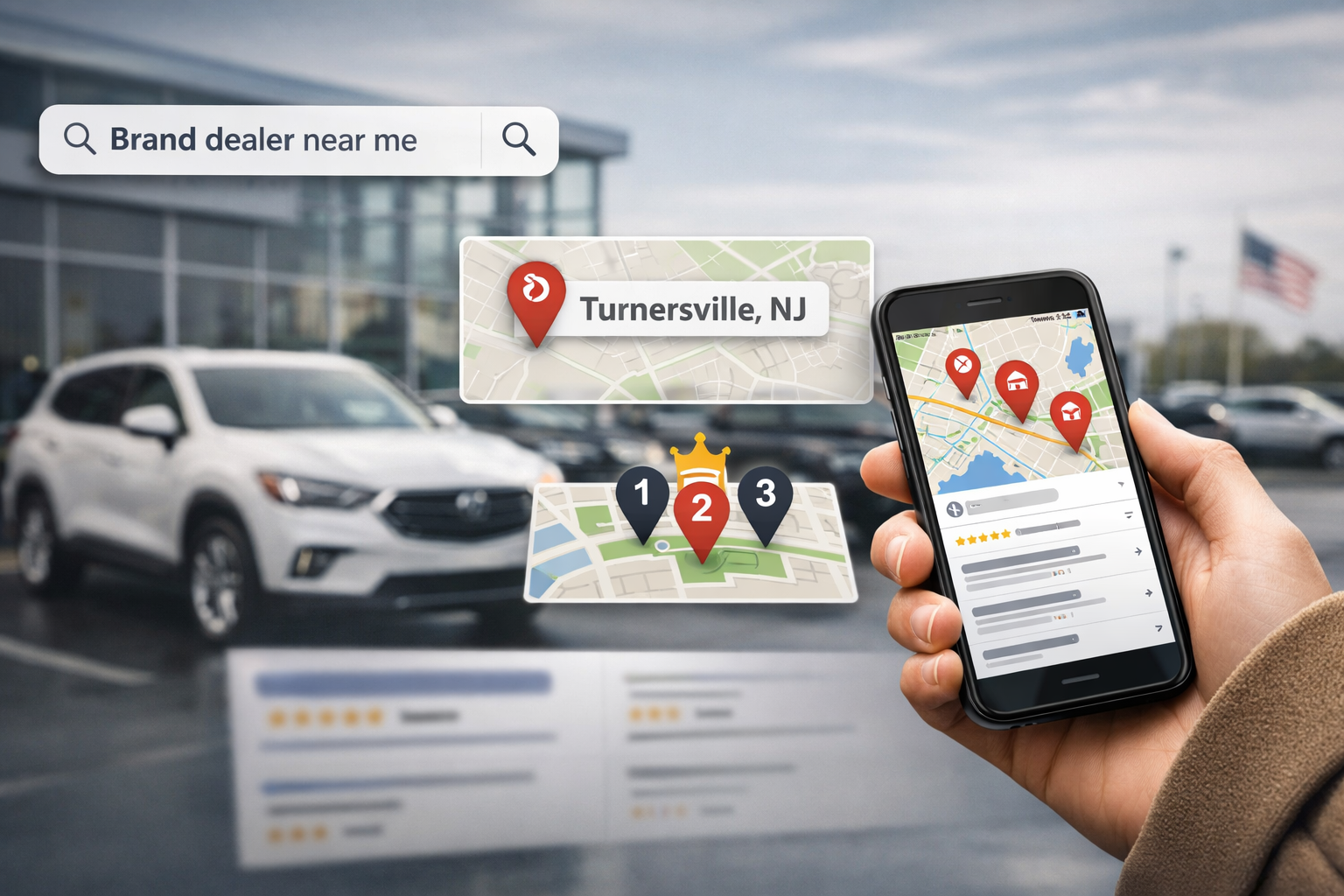
How to Rank Higher for “[Brand] Dealer Near Me”
When someone in Turnersville searches “[brand] dealer near me,” they’re not browsing — they’re buying. If your dealership isn’t in the top 3 map results, you’re losing high-intent traffic to competitors down the street. In this guide, Ritner Digital breaks down exactly how local dealerships can dominate Google’s map pack and turn search visibility into real showroom visits.
Why Are My Google Ads Leads Not Turning Into Showroom Visits?
If your Google Ads are generating leads but not showroom visits, the problem likely isn’t traffic — it’s friction. This guide explains the most common breakdowns in dealership follow-up, targeting, and CRM processes that prevent leads from turning into sales.

How Much Should a Dealership Spend on Digital Marketing Per Month?
Not sure how much your dealership should invest in digital marketing each month? This guide breaks down percentage benchmarks, real-world budget ranges, and how to calculate profitable ad spend based on gross per vehicle and acquisition costs.