How We Built the Ritner Digital Website Using Claude and Squarespace — and Why That Matters for Your Business
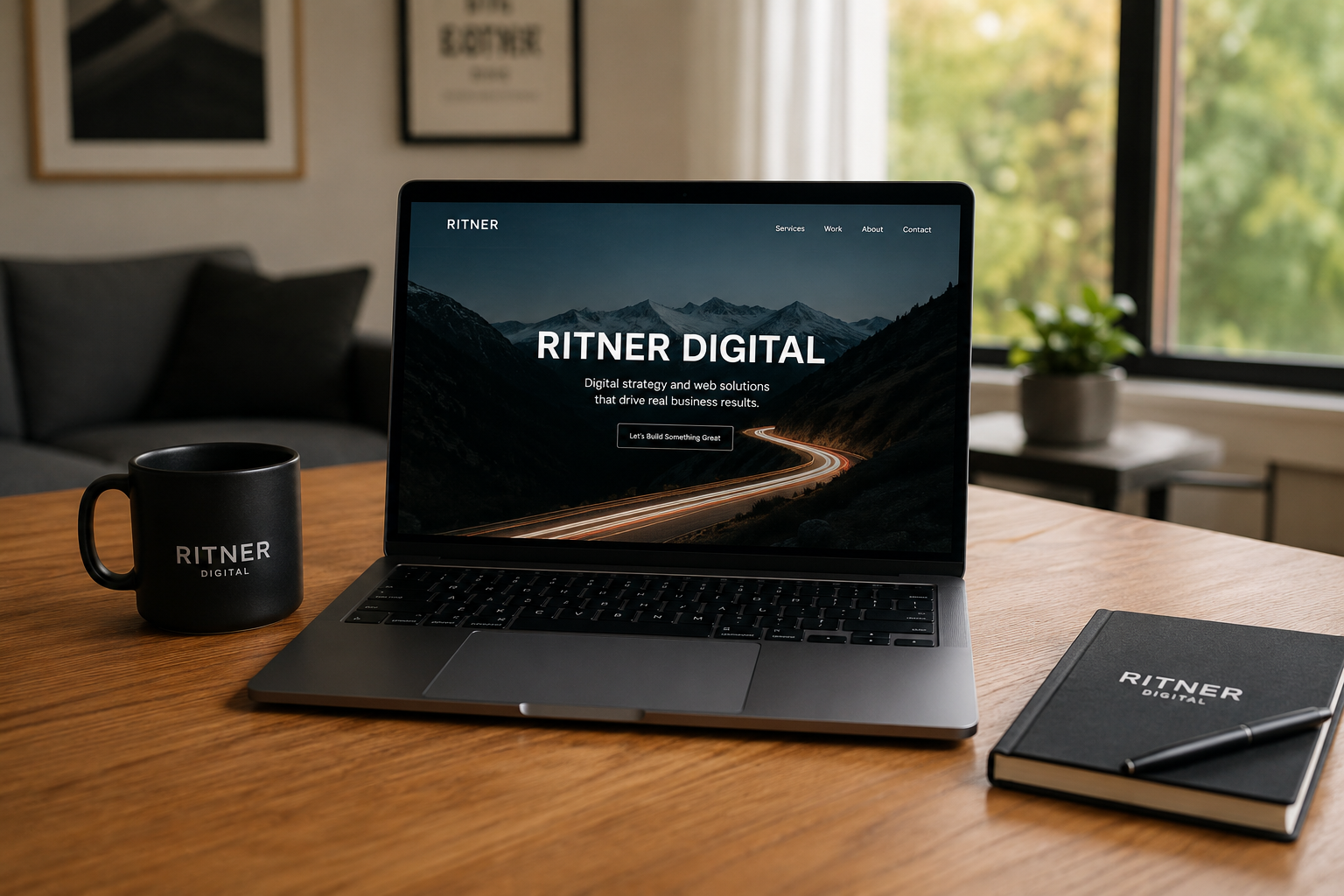
We built our own website. Not by hiring an outside agency, not by wrestling with a developer for three months, and not by choosing between a generic template and a five-figure custom build. We built it ourselves — using Claude as our creative and strategic partner and Squarespace as the platform it lives on.
We're writing about it because the process changed how we think about what's possible for businesses at every size. And because if you're a company that needs a website that actually does something — one that reflects who you are, converts the people who land on it, and doesn't require a full-time developer to maintain — we think this approach is worth understanding.
This is the honest story of how we did it, what worked, what didn't, what we'd do differently, and what the whole experience tells you about where web design is heading in 2026.
Why We Didn't Just Hire Someone
Let's start with the obvious question. We're a digital agency. We know people who build websites. Why didn't we just hand it off?
Part of the answer is control. When you build your own site, you understand every decision that went into it — the copy, the structure, the navigation logic, the SEO choices. When something needs to change six months later, you can change it without opening a ticket and waiting two weeks for a revision.
Part of the answer is speed. With modern AI-assisted tools, the initial design and wireframing phase can drop by up to 80% compared to traditional approaches. You can move from a vague concept to a live URL fast enough to test multiple layouts in a single afternoon. That kind of speed used to be reserved for teams with large development budgets. It isn't anymore. Elementor
And part of the answer is that we wanted to know firsthand what this workflow actually feels like — not in theory, not from a case study, but from actually doing it. If we're going to recommend an approach to clients, we should be able to speak about it from experience.
Why Squarespace
There's a lot of noise right now about AI website builders, vibe coding tools, and whether traditional platforms like Squarespace are even relevant anymore. We looked at the full landscape before we chose, and our reasoning was straightforward.
AI-first builders win on speed — you can have a site generated in 30 to 60 seconds — but Squarespace wins on design quality, customization, ecommerce, and long-term reliability. If you want a site you'll still be proud of in six months, Squarespace is the more grounded choice. JPK Design Co
The appeal of tools like Claude Code — Anthropic's command-line AI coding environment — is real. You don't need to be a developer to build a custom site in 2026. Claude Code bridges that gap better than anything, letting you describe what you want in plain language, question decisions you aren't sure about, and get clear explanations throughout. The result is a site that's 100% yours. Sanjay Tarani
But that approach has friction. Claude Code is not a visual editor. If you want to drag a button three pixels to the right with a cursor, you cannot. You tell Claude in plain English and it moves the button. You also need a terminal, and if the terminal genuinely intimidates you, that's friction. Quality depends on the prompts, and vague prompts give vague output. Sanjay Tarani
For Ritner Digital, we wanted the best of both. Squarespace gives us a visual editor we can work in intuitively, reliable hosting, built-in SEO tools, and a platform our whole team can update without anyone touching a codebase. Claude gives us everything else.
What Squarespace's AI Tools Actually Do
Squarespace has been building out its own AI suite aggressively. Squarespace's AI toolkit now includes Blueprint AI, which can draft a full website in under four minutes by answering questions about your brand — generating layouts, color schemes, fonts, images, and copy — alongside Layout Switcher, site themes, Brand Identity for design and tone alignment, AI-Powered Image Editing, and an AI Content Support tool with tone adjustment and audience targeting. Squarewebsites
Blueprint AI got us to a structural starting point faster than we expected. You answer a series of questions about your business, your aesthetic preferences, your target audience, and the kind of content you'll be publishing. The system builds a layout — not just a template, but a populated draft with sections, copy placeholders, and a visual direction. From there, you're editing and refining, not starting from scratch.
The honest assessment: Blueprint AI produces a starting point, not a finished site. You'll spend 20 to 30 minutes making choices, and then you'll want to customize from there. That's fine — it's exactly what a good starting point should do. It eliminates the blank-page paralysis that kills the first two days of any DIY website project and gets you into the editorial phase immediately. JPK Design Co
What it does not do is write copy that sounds like you, position your services with strategic clarity, or make the structural decisions about what should be on the page and why. That's where Claude came in.
What Claude Did That Squarespace Couldn't
This is the core of it. Claude wasn't a backup tool we used when we got stuck. It was the primary thinking partner throughout the build, and its contributions fell into several distinct categories.
Messaging and Positioning
Before a single page was built, we used Claude to work through the foundational questions that most businesses skip or rush. Who is this site actually for? What does someone need to believe before they contact us? What's the single clearest way to say what we do? What objections is a first-time visitor likely to have, and where on the site should we address them?
Claude is massively helpful at rethinking a website's user journey as a business evolves, and at brainstorming ways to make the process of discovery to action easier for visitors. That was exactly the kind of strategic conversation we needed before we started writing a single word of copy. Squarespace
The output wasn't final copy — it was clarity. A clear positioning statement, a prioritized list of what every key page needed to accomplish, and a message hierarchy for the homepage that told us what should appear above the fold, what should appear in the first scroll, and what could live further down for the visitors who were already close to converting.
Copy That Sounds Like a Real Company
External language models like Claude can generate and refine content in many ways — brainstorm ideas, translate tone, or write first drafts, then paste the results into Squarespace. But we'd add a significant nuance to that framing: Claude works best when you treat it as a collaborative writer, not a copy machine. Squarewebsites
Every section of copy we produced went through multiple rounds. We'd share the goal of the section, the audience, the tone we were going for, and examples of writing we felt was in the right direction. Claude would draft. We'd push back — too formal here, not specific enough there, this section buries the lead. Claude would revise. By the third or fourth iteration on each section, we had copy that didn't read like it came out of a template.
The thing most people miss about using AI for copywriting is that the quality of the output is directly proportional to the quality of the direction you provide. Generic prompt, generic copy. Specific prompt with real context about your business, your clients, and your voice — that produces something worth publishing.
Site Structure and Navigation Logic
One of the most underappreciated parts of building a website is deciding what should be on it in the first place. Most small business sites either have too many pages — because the thinking was "we should have a page for everything" — or too few, because someone defaulted to a home / about / contact structure without thinking about the buyer's journey.
We used Claude to map out every page before we built a single one. What's the purpose of this page? Who arrives here and from where? What do they need to leave knowing, feeling, or doing? How does this page connect to the others? Where is the next logical step?
AI tools now create logically sound user flows based on millions of successful website patterns, saving an average of four to six hours during the initial planning phase and outputting structures that are inherently optimized for search engine crawling. Claude did something similar for us at the strategic level — acting as a sounding board for structure decisions we might otherwise have just guessed at. Elementor
SEO Foundation
Squarespace's AI SEO Auditor delivers real-time analysis of SEO performance, providing actionable insights on keywords, meta descriptions, and content structure to enhance search visibility. We used that tool as a baseline check throughout the build. But Claude did the more strategic SEO work — the keyword thinking, the meta description drafts, the title tag options, the internal linking logic, and the content structure decisions that affect how Google reads each page. Squarewebsites
We wrote every page with a target query in mind. Not stuffed — structured. The H1 reflects the primary intent. The copy answers the question someone is actually typing. The meta description gives someone a reason to click from a search result. None of that is automatic from any AI tool; it requires deliberate thinking about what you're trying to rank for and why. Claude made those conversations fast and grounded.
The Workflow We Actually Used
Here's how the build actually ran, in broad strokes.
We started with a brand brief — a document we built in Claude that captured our positioning, tone, target audience, service offerings, competitive differentiation, and the specific objections a first-time visitor might have. This brief became the reference document for every copy decision throughout the build. Every page, every headline, every CTA was checked against it.
From there, we used Squarespace's Blueprint AI to generate the initial structure and visual direction. We answered its questions using language we'd already developed in the brand brief, which made the starting point considerably more on-target than it would have been if we'd improvised. The output gave us a visual shell and a rough content skeleton.
We then moved page by page. For each section, we'd brief Claude with the goal, the audience, the tone, and the brand brief, ask for a draft, iterate, and drop the finished copy into Squarespace. Design adjustments — layout choices, color refinements, image decisions — happened in parallel directly in the Squarespace editor.
Agencies now use AI to understand clients' target users better, accelerate persona generation during discovery, and create prototypes refined through ongoing A/B testing — helping solidify design choices earlier in the process before heavy development starts. We essentially ran the same process on our own site that a good agency runs for its clients. Clutch
The whole build — from brand brief to live site — took less time than we expected. More importantly, it produced a site that every member of our team understood completely, because we'd been inside every decision.
What We'd Tell Any Business Considering This Approach
The combination of Claude and Squarespace isn't magic. It's a workflow. And like any workflow, it produces results proportional to the quality of thinking you put into it.
A few things we'd tell any team considering this approach:
Start with strategy, not the platform. The biggest mistake businesses make when building their own sites is opening Squarespace, picking a template, and starting to fill in the blanks. That's designing in reverse. Spend time in Claude first — work through your positioning, your audience, your message hierarchy, and your page structure before you touch the visual editor. The build goes faster and the result is more coherent.
Don't publish the first draft. AI copy is a first draft. It's a strong first draft — stronger than most people could produce alone in the same amount of time — but it needs your voice, your specifics, your examples, and your edits. The key thing is that AI content should be a starting point that you then enhance with your own expertise, not something you just publish verbatim. The sites that read like AI-built sites are the ones where someone skipped that step. Squarewebsites
Use Blueprint AI as a scaffold, not a finished product. It will get you to a structural starting point fast. It will not get you to a finished site. Budget time for the refinement phase — that's where the real work happens and where the real differentiation comes from.
Understand what you're giving up. Squarespace is the right platform for a wide range of business websites. It is not the right platform for every website. Complex ecommerce with dozens of products, variants, and existing payment integrations takes more than an afternoon. And some teams genuinely need a full WYSIWYG workflow for multiple non-technical content authors — for which Squarespace remains a better fit than custom-coded solutions. Know your constraints before you choose your approach. Sanjay Tarani
Why This Is Now a Viable Service — Not Just a DIY Experiment
Here's the part that matters most for companies reading this who are thinking about their own site.
Custom agency sites average $2,000 to $10,000, while automated AI-assisted platforms reduce entry costs to $150 to $600 annually. For most small businesses in 2026, the average cost of a high-quality, professional website falls between $2,000 and $8,000, with more advanced builds reaching $15,000 or more. ElementorLevitate
The gap between those numbers has always existed. What's changed is that the quality you can produce at the lower end of that spectrum has improved dramatically. A Claude-informed, Squarespace-built site done thoughtfully — with real strategic copy, intentional structure, and careful SEO — produces a result that would have required a mid-range agency budget eighteen months ago.
According to Gartner, 70% of web design will be shaped by generative AI by 2026. That shift isn't coming. It's here. The question for most businesses isn't whether to engage with AI-assisted web design — it's whether to figure it out alone or work with a team that has already done it and knows where the traps are. Clutch
We built our own site using this workflow. We know what it takes, what it produces, and where it requires human judgment that no AI tool provides on its own. And we're now doing the same for clients who want a site that works — without the timeline, cost, and dependency that a traditional agency relationship usually requires.
If Your Company Needs a Website That Actually Works for You
If you're looking at your current site and seeing something that doesn't reflect who you are, doesn't convert, or hasn't been touched since someone built it three years ago — let's talk about what a modern build looks like and what it would take to get you there.
We'll bring the workflow. You bring the business.
Start the conversation with Ritner Digital →
Sources: JPK Design Co (2026), Platformer (2026), Squarewebsites (2026), Sanjay Tarani / DoxAI (2026), Launch the Damn Thing (2026), Elementor (2026), Clutch.co (2026), Gartner via Clutch, DesignRush (2026), Levitate (2026)
Frequently Asked Questions
Do we need to know how to code to use this approach?
No, and that's genuinely one of the most important things about it. Squarespace is a visual editor — you drag, drop, click, and type. Claude is a conversation — you describe what you want in plain English and iterate from there. There's no terminal, no codebase, no deployment pipeline. The technical barrier is low enough that anyone who can manage a Google Doc can manage this workflow. What it does require is strategic thinking — clarity about who your site is for, what it needs to accomplish, and what good copy and structure look like. That's a thinking problem, not a coding problem.
What does Claude actually do in this process — isn't it just an AI writing tool?
It's much more than that, and treating it only as a writing tool is where most people underuse it. In the Ritner Digital build, Claude did four distinct things: it helped us work through positioning and messaging strategy before a single page was touched; it acted as a sounding board for site structure and navigation logic; it drafted and refined copy across every page through iterative feedback; and it informed the SEO decisions — keyword thinking, title tags, meta descriptions, internal linking logic — throughout. The writing is the most visible output, but the strategic thinking that precedes it is where Claude adds the most value that a traditional DIY build would simply skip.
How is this different from just using Squarespace's built-in Blueprint AI?
Blueprint AI is a scaffolding tool. It gets you from nothing to a populated structural starting point — layouts, sections, color direction, rough placeholder copy — in under five minutes. That's genuinely useful. What it doesn't do is think strategically about your specific business, your specific audience, or the specific job each page needs to do. It generates a plausible generic site. Claude turns that into a site that sounds and feels like your company, with copy that serves a real conversion goal and structure informed by actual buyer psychology. The two tools are complementary. Blueprint AI builds the shell; Claude fills it with intent.
How long does a site build like this actually take?
It depends on the complexity of the site and the depth of the strategic work you put in upfront, but the short answer is considerably less time than a traditional agency engagement. A focused build — five to eight pages, done with clear direction and iterative copy work — can go from brand brief to live site in a matter of days rather than weeks. The biggest variable is how quickly you can get clear on your positioning and messaging. Teams that come in with a strong point of view on who they are and who they serve move fast. Teams that are still working those questions out during the build move slower — but Claude actually helps with that too.
What kinds of businesses is this approach best suited for?
Service businesses, professional services firms, agencies, consultants, B2B companies, and any organization that needs a clean, credible, conversion-oriented web presence without a large development budget or a long build timeline. It works especially well for companies whose primary website goal is to establish authority, communicate clearly what they do, and convert visitors into leads or conversations. It's less ideal for businesses with complex ecommerce needs — large product catalogs, multi-variant inventory, sophisticated fulfillment integrations — where a more purpose-built platform or a heavier custom build makes more sense.
What does Ritner Digital actually do in this process — why not just do it ourselves?
The tools are accessible. The workflow is learnable. What we bring is the experience of having done it, the strategic judgment about what makes a site actually convert rather than just look good, and the copy and positioning expertise to get Claude producing something worth publishing rather than something that reads like it came out of a content generator. Most businesses that attempt this on their own produce a site that looks like a Squarespace template with AI copy pasted in — because they skip the strategy layer entirely and go straight to generating content. We don't skip that layer. It's where most of the value lives. We also bring an outside perspective on your business that internal teams almost never have, which tends to produce sharper positioning than anything written from inside the organization.
Will the copy actually sound like our company, or will it be obvious it was AI-assisted?
That depends entirely on how the process is run. AI copy that goes straight from prompt to published page sounds like AI copy — generic, slightly flat, and interchangeable with every other site in your category. AI copy that goes through multiple rounds of iteration, incorporates specific details about your business and clients, gets pushed for voice and specificity, and is edited by someone who knows what good writing sounds like reads like a real company wrote it. The output reflects the quality of the process. We run a process that produces the latter.
Can we update the site ourselves after it's built?
Yes, and that's one of the deliberate advantages of building on Squarespace rather than a fully custom-coded solution. The Squarespace editor is designed for non-technical users. Swapping copy, adding a blog post, updating service descriptions, changing an image, adding a new section — all of that is point-and-click. You don't need to call anyone, open a ticket, or wait for a developer to be available. That independence matters for a growing business. Your site should be a living thing you can evolve as your company evolves, not a static artifact you're afraid to touch.
Is Squarespace good for SEO — we've heard mixed things?
Squarespace has historically had a mixed reputation in SEO circles, mostly stemming from older versions of the platform that gave users limited control over technical SEO elements. The current version is significantly better. You have full control over page titles, meta descriptions, URL slugs, header hierarchy, image alt text, canonical tags, and sitemap generation. It integrates cleanly with Google Search Console and Google Analytics. The built-in AI SEO tools provide actionable recommendations on content structure and keyword use. It's not the most flexible SEO platform in existence — WordPress with the right plugins still offers more granular control — but for most small and mid-sized business sites, Squarespace's SEO capabilities are more than sufficient, especially when the underlying content and copy are strategically built from the start, which is exactly what the Claude-informed process is designed to produce.
What's the first step if we want to explore this for our business?
A conversation. We'll want to understand your current site situation — what's working, what isn't, what your primary conversion goal is, and who your audience is. From there we can give you an honest assessment of whether this approach is the right fit, what a build would involve, and what timeline and investment looks like. There's no standard package, because no two businesses have the same site problem. But the conversation is free and it gives both sides enough information to know whether it makes sense to move forward.