Same Industry, Totally Different Game: Why Car Import Marketing and Dealership Marketing Are Nothing Alike
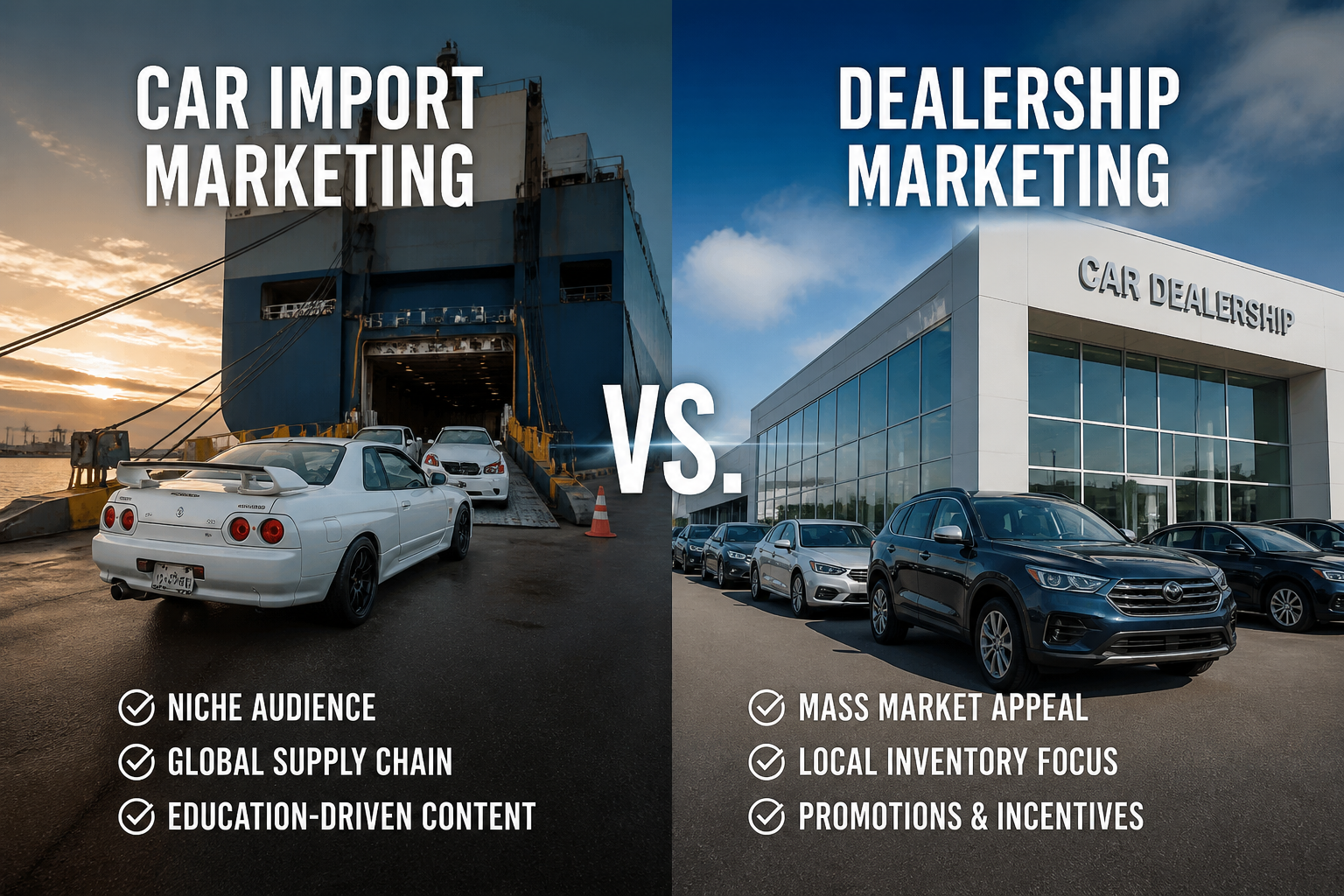
From the outside, it looks like the same business.
Cars go in. Cars come out. Money changes hands.
But spend five minutes inside the marketing strategy of a car importer versus a franchised dealership and the similarities evaporate almost immediately. The audiences are different. The buying cycle is different. The emotional triggers are different. The channels that work are different. Even the definition of a successful lead is different.
This matters because the automotive industry has a tendency to treat marketing as a monolith — as if the same playbook that moves certified pre-owned inventory off a dealer lot applies equally to someone importing a right-hand-drive Japanese domestic market vehicle or a low-volume European specialty car. It doesn't. And the businesses that try to run dealership marketing tactics on an import audience — or vice versa — consistently underperform the ones who understand the fundamental distinction between the two.
Let's break down exactly where those distinctions live and why they demand entirely different marketing approaches.
The Buyer: Who You're Actually Talking To
This is where everything starts, and it's where the divergence between import and dealership marketing is most dramatic.
The dealership buyer
The dealership buyer is, broadly speaking, everyone. Franchised dealerships serve the mass market — people who need reliable transportation, want to take advantage of manufacturer incentives, need financing options, and are making a relatively familiar purchase from a known brand they've already been conditioned to trust through decades of national advertising. The emotional drivers vary — some buyers are practical, some are aspirational, some are brand loyal — but the purchase itself is socially normal, widely understood, and supported by an enormous infrastructure of consumer protection, warranty coverage, and financing accessibility.
Dealership marketing is mass market marketing. The audience is broad, the message needs to be accessible, and the funnel needs to accommodate buyers at every stage of awareness and readiness. Someone who sees your ad on a Tuesday might be ready to buy on Saturday, or might be 14 months away from a purchase decision. Your marketing has to work for both.
The import buyer
The import buyer is a fundamentally different animal. This is a person who has already decided that what the mainstream market offers isn't enough — or isn't right for them. They are researching vehicles that require active effort to find, purchase, and in some cases legally register. They are tolerating complexity, longer timelines, higher uncertainty, and often premium pricing because the thing they want simply doesn't exist in a showroom down the street.
This is a self-selected audience of enthusiasts, specialists, and people with highly specific requirements. A fleet manager sourcing right-hand-drive utility vehicles for a specialized operation. A collector pursuing a specific JDM sports car that was never officially sold in the United States. A business importing commercial vehicles built to specifications that domestic manufacturers don't offer. A luxury buyer who wants a configuration or model unavailable through official channels.
What these buyers share is specificity. They know exactly what they want, they've done significant research before they find you, and they're not going to be moved by a generic "come see our selection" message. They're looking for expertise, transparency, and confidence that you can actually deliver what they need — which is a completely different marketing job than moving high-volume retail inventory.
The Buying Cycle: How Long and How Complex
Dealership buying cycles
Dealership purchases move relatively quickly by considered-purchase standards. The average car buyer researches for a few weeks to a few months, visits one or two dealerships, and makes a decision. The financing is handled in-house. The vehicle is on the lot or can be ordered within a known timeframe. The paperwork is familiar. The customer drives home the same day or within a week.
This means dealership marketing is optimized for capturing intent at the moment it peaks — which is why paid search, retargeting, and time-sensitive offers are such dominant tactics in dealer marketing. The window between "I'm ready to buy" and "I bought" is short, and the marketing that works best is the kind that shows up at exactly that moment and removes friction between the buyer and the purchase.
Import buying cycles
Import buying cycles are a different category of length and complexity entirely. Depending on what's being imported and from where, the process from initial inquiry to vehicle delivery can take anywhere from six weeks to six months or longer. There are compliance requirements, shipping timelines, customs clearance, titling and registration processes, and in some cases modification requirements to meet local regulations. The buyer knows this going in — or learns it quickly — and they're making peace with that complexity because the vehicle is worth it to them.
This extended cycle fundamentally changes what marketing needs to accomplish. You're not trying to capture a spike of purchase intent and convert it immediately. You're trying to build enough trust and authority over a longer relationship that when the buyer is ready to commit — after they've asked their questions, done their research, and resolved their concerns — they choose you over every other importer they've evaluated.
Content marketing, email nurture sequences, detailed educational resources, and consistent presence in the specific communities where import enthusiasts gather are far more important here than the urgency-driven campaigns that dominate dealership marketing. You're playing a longer game, and the marketing has to reflect that.
The Message: What Actually Moves These Buyers
What moves a dealership buyer
Dealership buyers respond to a predictable set of motivators that national automotive advertising has spent decades conditioning them to care about. Price and incentives — manufacturer rebates, low APR financing, lease specials. Selection — the reassurance that your inventory is large enough to accommodate their preferences. Brand trust — the manufacturer's reputation doing most of the heavy lifting before the local dealer's marketing even enters the picture. Convenience — your location, your hours, your service department, your trade-in process.
Local dealership marketing is largely the art of translating national brand equity into local preference. Why should someone buy their Toyota from your store rather than the one across town? Price, experience, service reputation, and convenience are the battleground. The product itself is largely standardized.
What moves an import buyer
Import buyers are almost entirely unmoved by the triggers that dominate dealership marketing. They're not responding to manufacturer incentives because there are none. They're not comparing your price to the store across town because there often isn't a store across town selling what you have. They've already accepted that this purchase is going to cost more, take longer, and require more effort than walking into a dealership — so the marketing that works isn't about lowering the barrier. It's about justifying the complexity.
What moves an import buyer is expertise demonstrated convincingly. Can you show them you know this vehicle category better than anyone else? Can you walk them through the compliance process with specificity and confidence? Can you show them vehicles you've successfully imported before — with documentation, with client stories, with transparent timelines? Can you speak their language — the specific terminology, the specific configurations, the specific concerns of someone who has already done significant homework on this purchase?
The marketing message for an import business is fundamentally a credibility message. It says: we know this world, we've navigated it successfully for other buyers like you, and we can get you what you want. That's a completely different creative and strategic brief than "come in this weekend for our Presidents' Day event."
The Channels: Where These Buyers Actually Live
Where dealership buyers are reached
Dealership marketing lives across a wide range of channels because the audience is broad. Google paid search captures high-intent buyers actively looking for specific vehicles or local dealerships. Display and social retargeting re-engages people who've visited the website. Facebook and Instagram advertising reaches buyers in the awareness and consideration stages. Third-party listing platforms — AutoTrader, Cars.com, CarGurus — are major traffic sources for inventory discovery. Email marketing nurtures leads who haven't converted yet. And local SEO ensures the dealership shows up when someone nearby searches for the brand or vehicle type they want.
The common thread is reach and volume. Dealership marketing is a funnel game — getting as many relevant people into the top of the funnel as possible and converting enough of them to hit monthly targets.
Where import buyers are reached
Import buyers are concentrated in communities that most mainstream automotive marketers have never thought to engage. Enthusiast forums — for specific vehicle makes, models, and categories — are where serious import buyers research, ask questions, and form opinions about which importers are credible. YouTube channels dedicated to specific JDM models, European specialty vehicles, or the import process itself reach buyers who are deep in their research phase. Instagram and Facebook groups organized around specific vehicle communities are where enthusiasts share finds, discuss importers, and ask for recommendations.
LinkedIn matters for commercial and fleet import buyers — fleet managers, operations directors, and procurement professionals sourcing specialty vehicles for business use. Niche automotive publications and blogs carry authority with serious enthusiasts in a way that general automotive advertising never could.
SEO for import businesses is hyper-specific. The searches that matter aren't "used cars near me" — they're "import 1990 Toyota Land Cruiser HZJ80," "right hand drive Hiace van compliance US," or "grey market vehicle import specialist." These are low-volume, high-intent searches from buyers who are ready to engage with someone who clearly knows what they're doing. Owning those search terms is disproportionately valuable because the competition for them is far thinner than the competition for generic automotive search terms.
The Brand Identity: What You're Selling Beyond the Vehicle
Dealership brand identity
Dealership brand identity is built on a combination of the manufacturer's national brand and locally specific differentiation — community involvement, customer service reputation, longevity, and the human relationships that keep customers coming back for their next vehicle and their service appointments. The manufacturer does the heavy brand lifting. The dealer's job is to be the best local expression of that brand while differentiating on experience, trust, and relationship.
Import brand identity
Import businesses have no manufacturer umbrella to stand under. The brand is entirely self-built — and what it needs to communicate, above everything else, is specialized authority. This is a business that knows something most people don't. It has navigated complexity that most buyers couldn't navigate on their own. It has access to vehicles and configurations that aren't available through conventional channels.
The import brand is an expertise brand. Every piece of marketing content, every social media post, every client testimonial, every vehicle delivery photo — all of it should be reinforcing the message that this business is the definitive authority in its specific category of importation. That identity attracts the buyers who need what you have, pre-qualifies them before they ever reach out, and justifies the premium that comes with genuine specialized knowledge.
The Content Strategy: Educate vs. Promote
This distinction deserves its own section because it's where the practical marketing differences become most actionable.
Dealership content strategy
Dealership content is largely promotional in nature — inventory highlights, lease specials, manufacturer offers, service department promotions, community events. Educational content exists but it plays a supporting role. The primary job of dealership marketing content is to drive traffic, generate leads, and move inventory. The buyer already understands the product category. What they need from your content is information about availability, pricing, and why your store is the right choice.
Import content strategy
For an import business, educational content isn't supporting the marketing strategy — it is the marketing strategy. The buyer needs to understand the import process before they can commit to it. They need to understand compliance requirements, shipping timelines, duty calculations, registration processes, and what can go wrong and how it gets handled. They need to understand the specific vehicles you specialize in — what makes them desirable, what condition standards look like, what the ownership experience is like in their market.
Every piece of genuinely educational content an import business produces does double duty: it helps a potential buyer understand the process well enough to feel confident moving forward, and it demonstrates the expertise that makes this importer the credible choice over every alternative. A detailed blog post about navigating EPA compliance for a specific vehicle category isn't just SEO content — it's a sales tool that pre-qualifies buyers, answers objections, and builds the trust that eventually converts into an inquiry.
Video content is particularly powerful in this space. A walkthrough of a vehicle that just cleared customs, a step-by-step explanation of the inspection process, a client delivery video with genuine reactions — these are the kind of content that moves import buyers because they make the abstract process feel real and the outcome feel worth pursuing.
Where Both Worlds Overlap
Despite the differences, there are principles that apply equally to both sides of this marketing divide.
Reputation management matters everywhere. Reviews, testimonials, and client stories are trust signals regardless of what you're selling. The specific platforms may differ — Google reviews matter more for dealerships, forum reputation matters more for importers — but the underlying dynamic is identical.
Visual quality is non-negotiable for any automotive marketing. Cars are visual products and buyers make emotional connections through imagery. Whether you're shooting a new model launch at a dealership or documenting the arrival of a rare JDM import, the quality of your photography and video directly reflects the quality of your brand.
Response speed matters in both contexts. The buyer who sends an inquiry and waits two days for a response has already moved on. The specific lead response tools differ — a dealership might use an AI platform like Impel, an importer might rely on a highly personalized email follow-up — but the urgency is the same.
And in both cases, the marketing ultimately has to reflect the reality of the business behind it. Overpromising on availability, timelines, or pricing erodes the trust that both dealership and import marketing work hard to build. The best automotive marketing — in any segment of the industry — is the kind that sets accurate expectations and then exceeds them.
The Takeaway for Automotive Businesses
If you're running a dealership and you're evaluating your marketing strategy, the question to ask is whether you're effectively capturing high-intent local buyers at the moment they're ready to move — and whether your brand is the obvious local choice in your manufacturer category.
If you're running an import business and you're evaluating your marketing strategy, the question to ask is whether your content and presence are convincingly establishing you as the definitive expert in your specific import category — and whether a buyer who finds you through research comes away confident enough in your expertise to reach out.
Same industry. Totally different game. And the businesses that understand which game they're playing — and market accordingly — are the ones that consistently outperform the ones trying to run the wrong playbook.
Ready to Build the Right Marketing Strategy for Your Automotive Business?
At Ritner Digital, we understand that automotive marketing isn't one-size-fits-all. Whether you're running a dealership, an import operation, or anything in between, we build strategies tailored to your specific buyer, your specific market, and your specific goals. Let's talk about what the right playbook looks like for you.
Get in Touch → ritnerdigital.com/#contact
Sources: Ritner Digital industry analysis. AutoTrader Consumer Insights (2025), Cox Automotive Car Buyer Journey Study (2025), Sprout Social Automotive Industry Report (2025)
Frequently Asked Questions
Can a dealership and a car import business use the same marketing agency or do they need specialists?
They can use the same agency, but only if that agency genuinely understands the distinction between the two business models and builds separate strategies accordingly. The mistake happens when an agency treats both as "automotive clients" and applies the same playbook — inventory-focused advertising, urgency-driven promotions, broad geographic targeting — to a business whose buyers respond to none of those triggers. Before hiring any marketing partner for an import business specifically, ask them to explain how their approach differs from dealership marketing. If they can't answer that question with specificity, they're going to run the wrong strategy and wonder why it isn't working.
Why doesn't traditional dealership advertising work for import businesses?
Dealership advertising is built around mass market reach, urgency, and price — manufacturer incentives, weekend sales events, low APR financing. Import buyers have already opted out of the mainstream market by definition. They're not looking for a deal on something widely available. They're looking for something specific that requires expertise to source and navigate. Urgency-driven advertising reads as irrelevant to them, broad geographic targeting misses the reality that serious import buyers will travel or ship regardless of location, and price-focused messaging misunderstands what they're actually evaluating. The trust and expertise signals that move import buyers require a fundamentally different creative approach.
What's the single most important marketing investment for a car import business just getting started?
Content that demonstrates expertise before a buyer ever reaches out. For an import business, the sales process begins long before the first conversation — it begins when a potential buyer finds your website, reads your blog, watches your videos, or discovers your presence in an enthusiast community and decides whether you know what you're talking about. An import business with a modest advertising budget but a deep library of genuinely useful educational content — explaining the import process, documenting past vehicles, walking through compliance requirements — will consistently outperform a competitor spending more on ads but showing nothing that establishes credibility. Build the expertise content first and let it do the pre-qualification work.
How important are enthusiast forums and online communities for import marketing, and how should a business approach them?
Extremely important, and carefully. Enthusiast forums and communities are where serious import buyers form their opinions about which importers are worth trusting — and those communities have strong immune responses to overt advertising. The businesses that build genuine credibility in these spaces do it by contributing real value: answering technical questions accurately, sharing honest information about vehicles and the import process, and participating as a knowledgeable member of the community rather than a vendor looking for leads. Over time, that authentic presence generates referrals, reputation, and inbound inquiries that no paid advertising can replicate. The approach that backfires is showing up only to post promotional content — forums will ignore it at best and actively distrust you at worst.
Should a dealership and an import business be on the same social media platforms?
Not necessarily. Dealerships should maintain a strong presence on Facebook and Instagram because that's where their broad consumer audience spends time, and on LinkedIn if they're doing commercial fleet sales. Import businesses need to go where their specific buyers are, which varies significantly by vehicle category. JDM enthusiasts are concentrated in specific Instagram communities, YouTube channels, and forums. Commercial vehicle importers need LinkedIn for fleet and procurement buyers. European specialty vehicle buyers might be reachable through different enthusiast platforms entirely. The platform strategy should follow the audience, and the import audience is fragmented across niche communities rather than concentrated on mainstream platforms the way a mass-market dealership audience is.
How does SEO differ between a dealership and an import business?
Dealership SEO is highly competitive and geographically focused — ranking for terms like "Toyota dealer near me" or "used trucks [city name]" requires significant investment because every competing dealership in the area is fighting for the same terms. Import business SEO operates in a completely different competitive landscape. The search terms that matter are highly specific — vehicle make, model, year, and import-related qualifiers — and the competition for those terms is often thin because most importers aren't investing in content-driven SEO. A well-executed import SEO strategy targeting specific vehicle searches can produce disproportionate results with less investment than comparable dealership SEO, because you're owning a niche rather than competing in a crowded mass-market space.
Can an import business benefit from the same lead response tools that dealerships use?
Some of them, yes — but the application is different. AI-powered lead response tools that work well for dealerships are optimized for high-volume, fast-moving inquiries where speed is the primary variable. Import inquiries tend to be lower volume but significantly higher intent — a buyer who reaches out to an importer has usually done substantial research and has specific questions that require knowledgeable, personalized responses. The speed principle still applies: responding quickly signals professionalism and seriousness. But the quality and specificity of that response matters far more for an import business than for a dealership, where a fast automated acknowledgment followed by a human follow-up is often sufficient to keep the lead warm.
How should an import business handle the fact that its inventory is constantly changing and often one-of-a-kind?
This is actually a marketing advantage that most import businesses underutilize. The scarcity and uniqueness of import inventory — the fact that this specific vehicle in this specific configuration won't be available again — is a genuine emotional driver for the enthusiast buyer. Marketing each vehicle as an individual story rather than a line item in an inventory list creates engagement that static inventory listings never achieve. Detailed sourcing stories, condition documentation, specification breakdowns, and the narrative of how a particular vehicle made it from Japan or Europe to the buyer's driveway are all content formats that convert serious import buyers and build the brand's authority simultaneously.
Is email marketing relevant for import businesses given the longer buying cycle?
It's arguably more relevant for import businesses than for dealerships precisely because of the longer buying cycle. A dealership lead who doesn't convert in 30 days is largely a lost lead — the buyer has probably purchased elsewhere. An import buyer who inquires and isn't ready to commit might be six months away from a decision, but they're still genuinely interested. An email nurture sequence that delivers useful content — vehicle arrivals, compliance updates, educational resources, client delivery stories — keeps an import business top of mind through a decision cycle that most businesses give up on too early. The import buyers who receive consistent, valuable email communication over several months and then become clients are often the most loyal and highest-value customers in the business.
What does success look like in import marketing versus dealership marketing, and how do you measure it differently?
Dealership marketing success is measured in volume metrics — leads generated, appointments set, vehicles sold, cost per sale, and monthly targets hit. The funnel is wide and the measurement is relatively straightforward because the sales cycle is short enough that marketing activity and sales outcomes are closely connected in time. Import marketing success is measured differently because the funnel is narrower and longer. Relevant metrics include inquiry quality rather than just inquiry volume, average time from first contact to sale, content engagement from buyers in the research phase, and brand visibility within specific enthusiast communities. A month with three highly qualified inquiries from serious buyers is a better marketing outcome for most import businesses than a month with thirty low-quality leads — and the strategy should be built around producing the former rather than chasing the latter.