When to Publish and Pray vs. When to Promote: A Content Distribution Framework for High-Output Companies
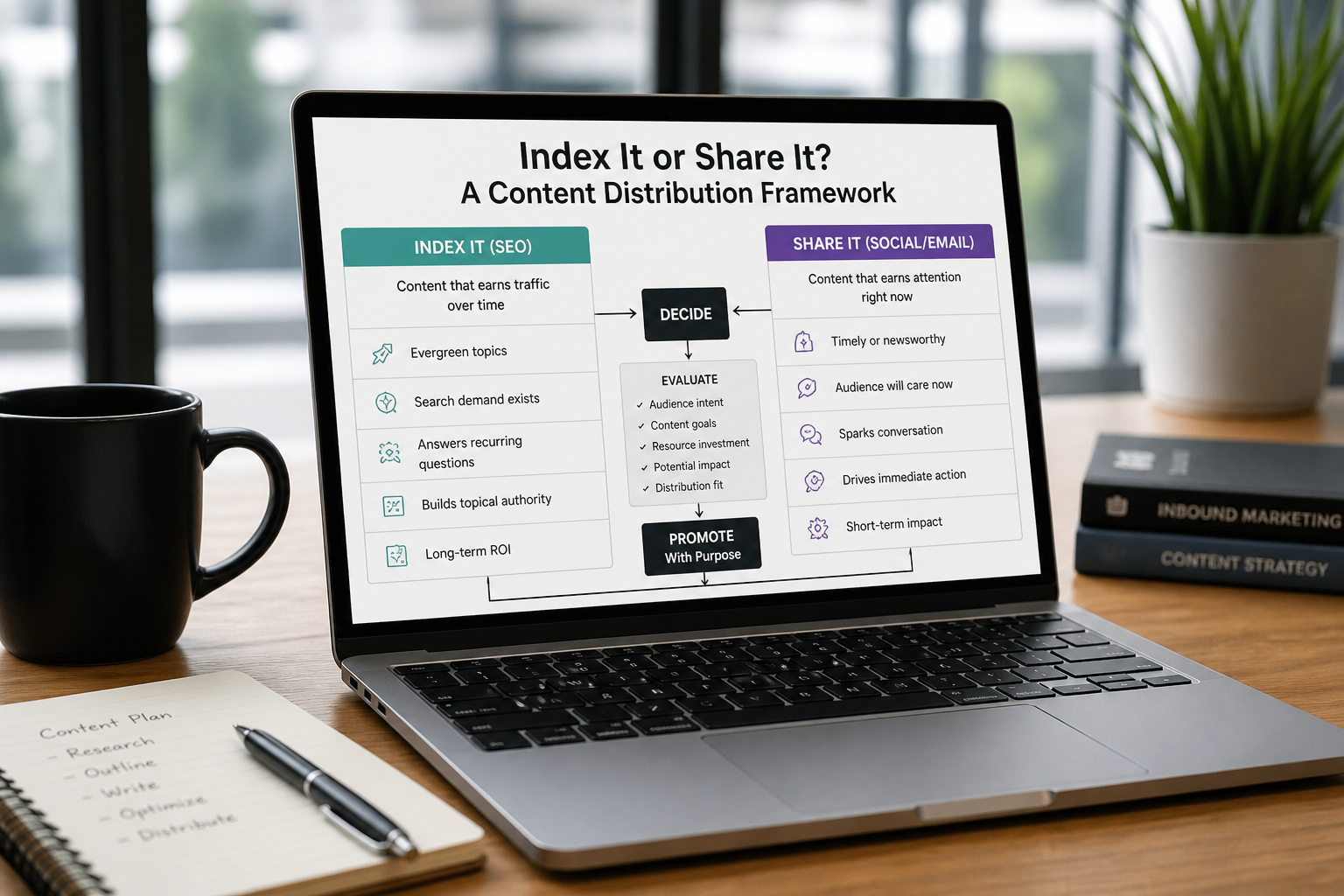
If you're producing content at volume — multiple blog posts a week, regular guides, frequent updates, consistent video or podcast output — you've almost certainly run into the decision fatigue that comes with it.
Do you share every piece on LinkedIn? Do you push everything to Facebook? Do you send it all to your email list? Or do you publish it, let Google find it, and move on to the next piece?
Most high-output content teams default to one of two broken extremes. Either they share everything everywhere all the time — turning their social channels into a content firehose that their audience tunes out — or they produce consistently but promote inconsistently, leaving genuinely valuable content sitting on the website collecting dust while the social channels go quiet for days at a time.
Neither approach is a strategy. Both are expensive in different ways.
This post is a practical framework for making the publish-vs-promote decision intentionally — so that your highest-value content gets the distribution it deserves, your social channels stay focused and relevant, and your indexable content library is working for you in search without requiring constant manual amplification.
First, Understand What You're Actually Trying to Accomplish
Before deciding where a piece of content goes, you need to be clear about what it's supposed to do. Content serves different functions in a lead generation engine, and the function determines the distribution strategy.
Content that generates demand
This is content designed to reach people who don't know you exist yet — people who aren't in your CRM, aren't following your social channels, and haven't searched for your business specifically. Its job is to introduce your brand, demonstrate your expertise, and pull people into your orbit for the first time. This content needs reach above everything else.
Content that captures demand
This is content designed to be found by people who are already looking for what you offer — people searching Google for specific questions, specific problems, or specific solutions. Its job is to show up at the moment of intent and convert that intent into a lead. This content needs search visibility above everything else.
Content that nurtures existing relationships
This is content designed for people who already know you — existing leads, past clients, email subscribers, social media followers. Its job is to keep you top of mind, deepen trust, demonstrate ongoing expertise, and move people closer to a buying decision over time. This content needs targeted distribution above everything else.
The single most important question to ask about any piece of content before deciding how to distribute it is: who is this actually for, and where are those people?
The Case for Just Indexing It
There is a genuinely strong argument for publishing content and letting search do the work — and it's an argument that most social-media-first content teams don't take seriously enough.
Search traffic compounds. Social traffic evaporates.
This is the fundamental economics of content distribution that makes indexing a legitimate primary strategy for the right type of content. A blog post that ranks on page one of Google for a relevant search term will generate traffic tomorrow, next month, next year, and five years from now — without any additional promotion effort. A LinkedIn post promoting the same content will generate a spike of traffic over 24 to 48 hours and then functionally disappear.
For content that's genuinely optimized for search — targeting specific queries with real volume, answering questions comprehensively, building topical authority in a defined area — the long-term return on indexing dramatically exceeds the short-term return on social promotion. The compounding nature of search traffic means that a library of well-optimized content is an asset that grows in value over time, whereas a social media promotion calendar is an ongoing operational cost that produces no residual return.
Not every piece of content has social legs
Some content is genuinely valuable to a person who searches for it and finds it — but it won't generate engagement if it shows up unprompted in someone's social feed. A detailed technical guide to a specific compliance process. A comprehensive FAQ about a niche product category. A step-by-step walkthrough of a process your buyers need to understand before they can purchase. This content serves a real function in your lead generation engine — capturing high-intent search traffic and pre-qualifying buyers before they ever reach out — but it isn't the kind of thing that generates likes and comments on LinkedIn.
Promoting this content on social isn't just ineffective — it actively hurts your social channel's performance by training the algorithm that your content doesn't generate engagement, which suppresses the reach of the content that actually does.
High-volume content output requires prioritization
If you're publishing five pieces of content a week, promoting all five on social isn't a strategy — it's noise. Your audience will stop paying attention, your social channels will feel like an RSS feed rather than a genuine professional presence, and the content that actually deserves amplification will get lost in the volume. Selective social promotion — reserving your social distribution for the content that's genuinely built for it — keeps your channels focused, maintains audience attention, and makes every piece you do promote feel like a deliberate recommendation rather than an automated dump.
The Case for Social Distribution
Social distribution isn't the right move for everything, but when it is the right move, it does things that search indexing simply cannot.
Social reaches people who aren't searching
Search captures intent that already exists. Social creates intent that didn't exist before. Someone scrolling LinkedIn wasn't looking for your take on industry trends — but if your post stops them mid-scroll and makes them think, you've introduced yourself to a potential buyer who never would have found you through search. This top-of-funnel brand building function is something that indexed content on a blog can't replicate, because nobody searches for a problem they don't yet know they have.
Social builds the brand signals that support SEO
As the relationship between social media and search visibility has tightened — particularly since Meta's July 2025 indexing update and Google's increasing use of E-E-A-T signals — consistent, high-engagement social content actively supports the domain authority and brand credibility that make your indexed content rank better. Social distribution and search indexing aren't competing strategies. Done correctly, they're compounding ones.
Some content needs a human context to land
Data points, opinions, industry takes, and behind-the-scenes perspectives all perform better when they come with a human voice attached. A blog post that presents data clearly is valuable. The same data point framed as a LinkedIn post with a personal perspective — "we've been watching this trend for six months and here's what it actually means for your business" — creates engagement that the blog post alone never would. The social format adds the human context that makes content feel worth engaging with rather than just worth reading.
The Decision Framework: Four Questions to Ask About Every Piece of Content
Rather than making this decision by feel or defaulting to habit, run every piece of content through these four questions before it goes live.
Question 1: Is this content targeting a specific search query with real volume?
If yes — if this piece was written specifically to rank for a term that people are actively searching — then indexing is the primary distribution strategy. Social can support it, but the success metric is search ranking and organic traffic, not social engagement. Optimizing the post for search, building internal links to it from related content, and letting it accumulate authority over time is the move. Social promotion is optional and secondary.
If no — if this content isn't targeting a specific search query, or if the search volume for the relevant terms is negligible — then search indexing alone won't do much work for you, and social distribution becomes the primary channel for getting it in front of people.
Question 2: Does this content have a clear point of view or a reaction-worthy insight?
Social media rewards content that makes people feel something — agreement, surprise, curiosity, mild disagreement. If a piece of content has a genuine take, a counterintuitive finding, a data point that challenges conventional wisdom, or a perspective that people in your industry will have opinions about — it has social legs. These are the posts that generate comments, shares, and the algorithmic reach that comes with genuine engagement.
If a piece of content is purely informational — here is how this process works, here are the steps, here is the answer to your question — it may be extremely valuable to the person who needs it, but it isn't going to generate the reaction that makes social distribution worthwhile. Index it and let search deliver it to the people who are actively looking for it.
Question 3: Who is this content for — people who know you or people who don't?
Content designed for people already in your ecosystem — existing leads, current clients, subscribers — belongs in targeted distribution channels: email, retargeting, direct outreach. It doesn't need the broad reach of social or the discovery function of search. Sending it to your email list or including it in a nurture sequence gets it in front of the right people without diluting your social channels with content that's only relevant to a subset of your audience.
Content designed for people who don't know you yet needs reach — which means either search (for intent-driven discovery) or social (for interruption-driven discovery), depending on whether the buyer knows they have the problem your content addresses.
Question 4: What does the content format actually lend itself to?
Long-form guides, technical documentation, comprehensive FAQs, and detailed how-to content are built for search. They're too long to promote effectively on social, they answer questions that people search for specifically, and their value compounds over time as they accumulate ranking authority.
Short-form opinions, data-driven insights, industry commentary, client stories, behind-the-scenes content, and perspective pieces are built for social. They're designed to be consumed quickly, they provoke reactions, and they perform best when they reach a broad audience at a specific moment rather than sitting in a searchable archive.
Video and audio content occupies a middle ground — it can be indexed effectively on YouTube and podcast platforms while simultaneously serving as highly shareable social content. For high-output teams, repurposing long-form video or audio into social clips is often the highest-efficiency distribution decision available.
A Practical Distribution Matrix for High-Output Teams
Here's how this framework plays out across the most common content types a high-output lead generation operation produces.
Long-form educational blog posts targeting specific search queries: Index as primary strategy. Optional social promotion if the post contains a genuinely shareable insight that can be extracted and framed as a standalone social post. Don't promote the post itself — promote the insight and link to the post for people who want to go deeper.
Industry opinion and commentary pieces: Social as primary strategy. Index for residual search value but don't optimize heavily — this content isn't answering a search query, it's contributing to a conversation. LinkedIn and relevant community platforms are the distribution channels that matter.
Data-driven reports and original research: Both, sequentially. Publish and index the full report. Extract the most compelling data points and promote them as a series of social posts over days or weeks. The report builds search authority and serves as a lead magnet. The social posts generate awareness and drive people to the report.
Client case studies and success stories: Both, with targeting. Index for search — case studies rank for brand-specific and solution-specific queries. Promote on social for social proof and brand building. Also include in email nurture sequences for leads in the consideration stage where social proof is most persuasive.
FAQ and technical documentation content: Index only. These answer specific questions from buyers who are already deep in the research process. They will be found by the people who need them through search. They will generate zero engagement on social and will hurt your channel's algorithmic standing if you promote them there.
Video content: YouTube indexing as primary for long-form. Short clips extracted from long-form video for social distribution. Transcripts turned into blog posts for additional search indexing. One piece of video content can generate three to five distinct distribution assets across different channels if it's produced and repurposed deliberately.
Email newsletters and subscriber-only content: Email distribution as primary. Selected pieces can be repurposed into social posts or expanded into indexed blog content if they prove to resonate with the subscriber audience. Don't promote subscriber content on social before your list sees it — your most engaged audience should feel like they're getting first access, not discovering your content through the same channels as everyone else.
The Operational Reality: Building the Decision Into Your Workflow
Frameworks are only useful if they're actually applied at the moment content is being planned, not retroactively after it's already been produced. The most effective way to implement this is to make the distribution decision part of the content brief — before a word is written, before a video is shot, the team should already know whether this piece is being built for search, built for social, or built for both.
This changes how content gets written. Search-first content is structured differently — headers optimized for featured snippets, comprehensive coverage of a specific topic, internal linking to related indexed content. Social-first content is structured differently — a strong opening hook, a clear point of view, a format that works in a feed environment, a length calibrated to the platform. Content that tries to serve both audiences without being deliberately designed for either serves neither particularly well.
Building the distribution decision upstream — into the brief, into the editorial calendar, into the production process — is what separates high-output content teams that generate compounding returns from high-output content teams that produce a lot and wonder why the results aren't proportionate to the volume.
The Bottom Line
Not all content is created equal, and not all content deserves the same distribution treatment.
The indexed content library you're building is a long-term asset that compounds in value as it accumulates search authority and continues generating traffic without ongoing promotion effort. Treat it accordingly — build it deliberately, optimize it for search, and let it work.
The social content you share is a short-term amplifier that builds brand presence, generates demand, and keeps your audience engaged between their search-driven discovery moments. Treat that accordingly too — be selective, be genuinely interesting, and don't dilute it with content that wasn't built for social consumption.
The businesses that get this distinction right — that build indexed content libraries that generate compounding organic traffic while running social channels that stay focused, engaging, and algorithmically healthy — are the ones whose content investments produce returns that justify the output. The ones that conflate the two end up with social channels nobody pays attention to and search rankings nobody bothered to build.
Want a Content Strategy That Actually Converts at Volume?
At Ritner Digital, we help high-output businesses build content distribution frameworks that make every piece of content work as hard as it should — in search, on social, and everywhere in between. If you're producing content consistently and not seeing the lead generation results that output should be producing, let's talk about why.
Get in Touch → ritnerdigital.com/#contact
Sources: Ritner Digital content strategy analysis. Sprout Social Content Strategy Report (2025), HubSpot State of Marketing Report (2025), Semrush Content Marketing Study (2025), Metricool LinkedIn Trends (2026)
Frequently Asked Questions
How do we decide how much content should be indexed versus shared on social if we're just starting to build a content program?
In the early stages of a content program, lean heavily toward indexed content over social promotion. The reason is compounding returns — indexed content that starts accumulating search authority now will be generating traffic six months from now regardless of what else you're doing, while social content from six months ago has already evaporated. Build the indexed library first and treat social promotion as a selective amplifier for your strongest pieces rather than the default distribution channel for everything you produce. Once the indexed library is established and generating baseline organic traffic, you have a much clearer picture of which topics resonate enough to warrant social amplification.
We're a small team producing a lot of content. How do we realistically make a distribution decision for every single piece without it becoming a bottleneck?
Build the decision into a simple content brief template that every piece goes through before production starts. The brief should include a single required field: primary distribution channel — search, social, email, or combination. If the writer or producer can answer that question before they start, the content gets built for the right channel from the beginning and the distribution decision is already made by the time the piece is finished. The bottleneck usually happens when teams try to make the distribution decision after the content is already written, which means retrofitting content that was built for one channel into another — and that never works as well as building for the channel from the start.
Is there a minimum search volume threshold a keyword needs to hit before we bother optimizing content for it?
Not a hard one, and obsessing over volume thresholds is one of the most common mistakes content teams make. A keyword with 50 monthly searches that perfectly describes the specific question a high-intent buyer asks before purchasing what you sell is worth more than a keyword with 5,000 monthly searches that attracts curiosity browsers who will never become customers. For lead generation specifically, intent matters more than volume. A piece of content that ranks for a low-volume, high-intent search term and converts a meaningful percentage of that traffic into leads can outperform a high-traffic piece that generates no qualified interest. Evaluate search terms based on buyer intent and commercial relevance first, volume second.
How often should we be promoting content on social versus letting it just sit indexed?
There's no universal frequency, but a useful rule of thumb for high-output teams is to promote roughly one in three or one in four pieces of content on social — reserving those slots for the pieces with the clearest point of view, the most shareable insight, or the strongest relevance to your current audience's immediate concerns. The rest goes into the indexed library to do its work in search. This ratio keeps your social channels selective enough to maintain audience attention and algorithmic health while still giving your best content the amplification it deserves. If your output is five pieces a week, that might mean one or two social promotions per week — which is actually a more sustainable and effective social cadence than promoting everything.
What's the best way to repurpose indexed content for social without it feeling like we're just sharing a link?
Never lead with the link. Extract the single most compelling insight, data point, or perspective from the indexed piece and build a standalone social post around it — something that delivers real value to someone who never clicks through to the full article. The post should be complete enough to be worth reading on its own and interesting enough to make people want more. The link to the full piece goes at the end as an optional next step for people who want to go deeper, not as the hook that's supposed to motivate them to engage in the first place. Content that asks for a click before it's delivered any value gets ignored. Content that delivers value upfront and then offers more gets shared.
How do we handle evergreen indexed content that's several years old — should we be resurfacing it on social periodically?
Yes, and this is one of the most underutilized distribution tactics available to high-output content teams. Evergreen indexed content that's still accurate and still relevant can be shared on social multiple times over its lifetime — especially as your social audience grows and the majority of your current followers never saw the original promotion. Update the framing to make it feel current, reference any new data or developments that add context, and present it as a fresh perspective rather than a recycled post. Content that took significant effort to produce deserves more than one promotional window, and most audiences have zero memory of what you posted more than a few months ago.
Should different people on our team be responsible for indexed content versus social content, or should the same writers handle both?
Ideally, the same writers understand both formats but specialize in one. Search-optimized long-form content and high-engagement social content require genuinely different skills — different structural instincts, different opening strategies, different relationships with brevity and depth. A writer who excels at comprehensive, well-structured blog content doesn't automatically write compelling social posts, and vice versa. For high-output teams, having one person or function responsible for the indexed content library and another responsible for social content adaptation tends to produce better results than asking everyone to do both equally well. What you don't want is writers making distribution decisions in isolation — the editorial strategy should drive those decisions, not individual preference.
We've been publishing indexed content for a year and our search traffic is still minimal. What are we doing wrong?
Usually one of three things. First, the content isn't targeting terms with genuine search demand — it's written around topics the team finds interesting rather than questions buyers are actively searching for. Second, the content isn't comprehensive or authoritative enough to compete with what's currently ranking — Google rewards depth and specificity, and thin content on competitive topics rarely breaks through regardless of how consistently it's published. Third, the domain doesn't yet have enough authority for Google to trust it as a credible source — which is a longer-term problem solved by earning backlinks, building topical authority across a cluster of related content, and giving the indexed library enough time to establish its track record. Usually all three are contributing factors simultaneously, which is why a content audit with an honest assessment of search intent alignment is the necessary first step before producing more volume.
How does email fit into this framework — is it a third distribution channel or a subset of social?
Email is its own distinct channel with its own distinct function and should be treated as such. Social distribution is for reaching people who don't know you well — it's a reach and discovery channel. Indexed content is for capturing people who are actively searching — it's an intent channel. Email is for deepening relationships with people who already know you — it's a trust and conversion channel. The content that belongs in email is often different from what belongs on social or in search: more specific, more personal, more directly relevant to where your subscribers are in their relationship with your business. The most effective high-output content programs treat email as the channel where the best indexed content gets curated and the most valuable social content gets contextualized — a synthesis layer that delivers the highlights of your content program to your most engaged audience in a format built for them specifically.
At what point does content volume become counterproductive for lead generation?
When quality starts declining to maintain quantity, or when distribution becomes so diluted that nothing gets proper amplification. There's no universal content volume threshold that's too much — some businesses publish daily and generate compounding returns, others publish weekly and achieve the same. The variable that matters isn't how much you publish but whether each piece serves a clear strategic function, whether it's distributed through the right channel for its purpose, and whether your team has the capacity to produce it at a standard that reflects well on the brand. Content produced faster than it can be done well is actively harmful — it dilutes your search authority, trains your audience to expect mediocrity, and wastes production resources on assets that will never generate meaningful returns. When in doubt, publish less and distribute better.