SEO, Explained Like You're Five: Organic Growth, Google Ads, Social Media — and Why People Call SEO "Free"
Here's a secret about marketing meetings: half the room is nodding along to words they'd struggle to explain to a kid. Organic. Impressions. Algorithm. The vendor talks, the owner nods, the invoice arrives — and the plain-English version never gets said out loud, partly because confusion is profitable for the people selling the confusing thing.
We think you should be able to explain every dollar of your marketing to a five-year-old. Genuinely. Not because the ideas are childish, but because if you can't say it simply, you probably can't evaluate it either — and evaluating it is the whole game.
So this is the five-year-old version of the whole thing: what organic growth is, what SEO actually does, how that's different from Google Ads and social media, and the real answer to the question everyone's too embarrassed to ask — why do SEO people keep saying it's "free" when they're charging me money?
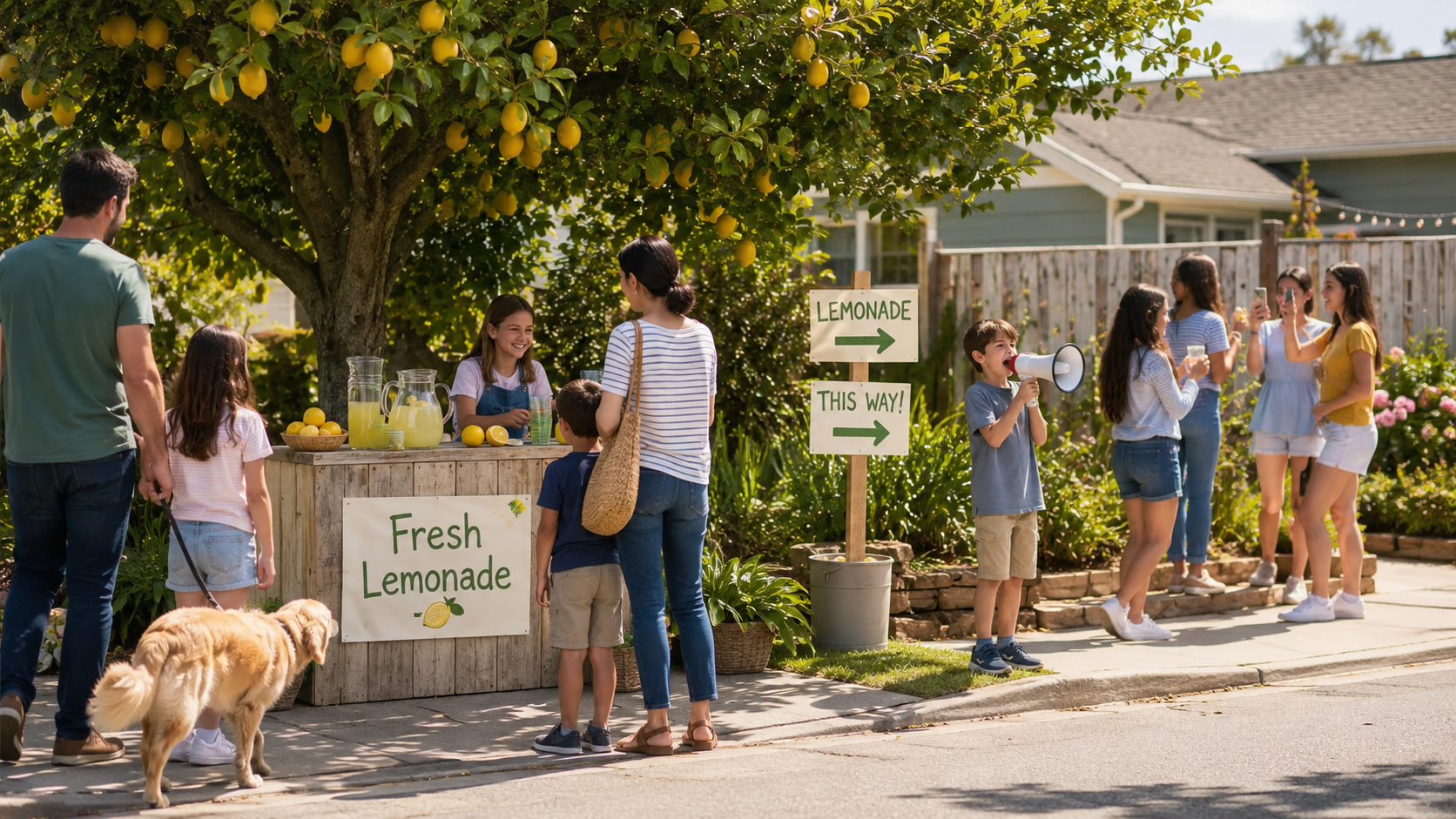
We're going to do it with a lemonade stand. Every kid-sized explanation gets a grown-up follow-up, and every grown-up number gets a source, because that's how we do everything. Ready? You run a lemonade stand.
What is organic growth?
The five-year-old version: You make really good lemonade. A kid walks by, tries it, and tells two friends. Those friends come, and they tell their friends. Soon, when anyone on the street is thirsty, somebody says "go to that stand." Nobody paid anyone to say it. People just... know you now. That's organic growth — you grew like a plant grows. On your own, from good roots.
What that means for your business: Organic growth is every customer who arrives without you paying for that specific arrival — they searched, they heard, they were told, they remembered. It's the opposite of a coupon blast or an ad click: nobody was rented. And it's built on the single most valuable thing a hometown business owns, which is that people trustthe recommendation chain — small business is literally the most trusted institution in America, the only one with majority confidence, which is why "somebody told me about you" beats "I saw your ad" every single time. The catch: in 2026, the street where the telling happens isn't just the sidewalk. It's a search box.
What is Google, really?
The five-year-old version: Imagine one kid stands on the corner of every street in the world, and everybody — everybody — asks that kid where to go. "Where's good lemonade?" "Who fixes bikes?" "Where's a doctor?" The kid doesn't guess. The kid has walked every street, peeked at every stand, listened to what everyone says about everyone, and keeps a giant list. When you ask, the kid points at a few names. Almost everyone goes where the kid points.
What that means for your business: That kid is Google, and the pointing is the search results page. This isn't a small deal you can opt out of: 77% of patients look for providers online before choosing, and the same behavior runs through trucks, contractors, venues, and every considered local purchase. The kid on the corner has also started answeringquestions directly instead of just pointing — about two-thirds of Google searches now end without a click to any website— which raises the stakes on being the name in the answer, not just a name on the list. And your customers now also ask a second kid, the robot one; we'll meet him near the end.
Okay — so what is SEO?
The five-year-old version: SEO is everything you do so that when someone asks the corner kid "where's good lemonade?", the kid says your name first. You can't pay the kid to say it — he doesn't take money for the pointing. But you can make it easy for him to love you. Four things work:
Make really good lemonade. Put up a big clear sign that says LEMONADE — not "Beverages & Solutions LLC" — so the kid knows exactly what you sell. Get the neighbors to vouch for you, out loud, where the kid can hear. And keep your stand where the kid can find it — right address, open when your sign says, table not falling over.
That's it. That's SEO. Good stuff, clear sign, neighbors vouching, easy to find.
What that means for your business: Those four kid-things map exactly onto the four grown-up things, and now you can decode every SEO proposal you'll ever receive. Good lemonade = content and a genuinely useful site — real answers to the questions your customers actually ask, written so specifically that only you could have written them. The clear sign = pages named in your customers' language — "a page can't win a search it doesn't have", and it can't win one it refuses to phrase plainly. Neighbors vouching = reviews and links — other real people and real websites telling Google you're legitimate, the trust signals that decide who ranks. Easy to find = the technical and listings layer — a claimed Google Business Profile with correct hours, a site that loads fast on a phone, forms that actually work. Every legitimate SEO task on earth is one of these four. If a vendor's pitch doesn't translate into one of them, ask again until it does — or walk.'
Then what are Google Ads?
The five-year-old version: Remember how the corner kid won't take money for the pointing? He will rent you a megaphone. Pay him, and before he points anywhere, he'll shout "LEMONADE AT TIMMY'S STAND!" — with a little tag that says this is a paid shout. It works! Thirsty people come today. But here's the deal: the shout costs money every single time, the price goes up when other stands want shouts too, and the very second you stop paying — silence. Nobody remembers the shout. It was never about you. It was about the megaphone.
What that means for your business: Google Ads are real and sometimes smart — they're the fastest visibility money can buy, and for a brand-new business with zero presence, a reasonable bridge. But go in with the grown-up numbers: clicks average about $5 across industries — $8+ in home services, with leads commonly running $30–$130 depending on your field — and that's per lead, not per customer; divide by your close rate for the real price. The costs have climbed for most of the past five years, the auction gets most expensive exactly when your season peaks, and the moment the budget pauses, so does everything. Ads are rent. We wrote the whole rent-vs-own budget math here — the short version is that rent can supplement a plan and can never be one.
And social media?
The five-year-old version: Social media is a big party in somebody else's backyard. Everyone's there! You can stand on a chair and tell people about your lemonade, and sometimes a bunch of them listen. But it's not your backyard. The owner decides who can hear you — and most days, he only lets a few of your friends hear, unless you pay him. He can change the rules whenever he wants. And if he ever closes the gate, you lose every friend you made there, because you never got their addresses. The party is fun. The party is not your house.
What that means for your business: The backyard owner is the algorithm, and every business that's watched its page reach the same 200 followers no matter what it posts has met him. Social is genuinely good at two things: staying warm with people who already know you, and catching a spark when something shareable happens — the Santa run, the open house, the great review. What it structurally cannot be is your foundation, because the reach is borrowed, the contact list belongs to the platform, and the rules change without a vote. The move that separates smart operators: use the party to point people home — to your site, your list, your booking page — so every borrowed moment deposits into something you actually own.
The big question: why do SEO people say it's "free"?
The five-year-old version: Okay, this one needs a tree.
You love lemonade, so you have two choices. You can buy lemons — every day, forever, and the store can raise the price whenever it wants. Or you can plant a lemon tree. Planting is hard. You dig, you water, you wait, and for a long time — no lemons. Everybody walks past your dirt patch and says "that was dumb, just buy lemons." But then one season, the tree fruits. And now lemons just... show up. Every day. You didn't pay for today's lemons. Or tomorrow's. The tree makes them while you sleep.
When people say SEO is "free," they mean the tree. The lemons are free. The tree was not.
What that means for your business — and the honest correction: "Free" is sloppy language and we'll fix it right now: SEO is not free, it's owned. Building it costs real money — the work, the content, the fixes, whether that's a flat $1,000 a month with us or a bigger retainer elsewhere — and it costs the hardest currency of all, patience. What's free is every visitor after the tree fruits. The page that ranks doesn't charge you per click. The review base doesn't bill monthly. The Google profile that sends you the 9 PM booking has no meter running. That's the entire economic difference from ads: with ads your thousandth customer costs the same as your first (or more); with SEO your thousandth customer costs approximately nothing, because the asset compounds instead of expiring. Anyone who tells you SEO is free is selling carelessly. Anyone who tells you it's rented is selling ads. The truth is it's a tree — and we've published our own tree's growth from bare dirt, month by month, dips included, so you can see exactly what the boring seasons look like before the fruit.
One more kid just moved to the corner: the robot
The five-year-old version: There's a new kid now, and he's a robot. People don't even ask him "where should I go?" — they ask him everything, like a friend. "Where's lemonade that's not too sour? My little brother is picky." And the robot doesn't point at a list. He just answers, with a name. He learned everything the same way the first kid did — walking the streets, reading the signs, hearing the neighbors — so the stands the robot recommends are the stands that did their homework. And here's the wild part: you can't pay this kid to say your name at all. Not even with a megaphone.
What that means for your business: The robot is AI search — ChatGPT, Gemini, Google's AI answers — and it's not a someday thing: a third of American adults already ask AI health questions alone, and the buying questions follow the same path. The beautiful simplicity for you: the robot reads the same four things the corner kid reads — good content, clear signs, vouching neighbors, findable stand — just more strictly. Which means the lemon tree you plant for Google fruits twice. There is no separate robot tree. There's one tree, and the answer layer is the part money can't reach, which makes it the most valuable branch.
Putting it all together: what a smart lemonade stand does
The kid version, one last time: plant the tree first and tend it always. Rent the megaphone sometimes, on purpose, for specific loud moments — not as a way of life. Go to the party to make friends, and always invite them back to your house. And be so good, so clearly labeled, and so vouched-for that both kids on the corner — the pointing one and the robot one — say your name without being asked.
The grown-up version is the same sentence with invoices attached, and the ratios matter more than the slogans: most local businesses we audit are 90%+ megaphone-and-party with no tree at all, which is the most expensive possible arrangement— maximum rent, zero equity, every January a reset to bare dirt.
The honest part
Three things, in plain kid-proof language. Trees are slow. Real timeline: early signs in 60–90 days, real fruit in seasons, not weeks — and anyone promising a full harvest by next month is selling magic beans. Nobody controls the corner kid. Not us, not anyone; the honest promise is the four kinds of work, done well and shown to you monthly, the way we show our own — never a guaranteed spot in the pointing. And simple isn't the same as easy. Everything in this post is genuinely this simple to understand — that was the point — but the doing is hundreds of small, unglamorous tasks sustained for months, which is exactly why it's a job. If a vendor makes it sound complicated, they're hiding something. If they make it sound effortless, same.
The bottom line
Four sentences, like always — the whole post small enough for a lunchbox. Organic growth is people finding and recommending you on their own, and SEO is the four chores that make it happen: good lemonade, a clear sign, neighbors vouching, a stand that's easy to find. Google Ads rent a megaphone that goes silent when the money stops; social media is a party in a backyard you don't own; both can help and neither can be the plan. SEO isn't free — it's a lemon tree: expensive and slow to plant, then fruiting every day at no charge, for years, for both kids on the corner. Plant the tree.
Frequently Asked Questions
What is organic growth in business, in simple terms?
Customers who arrive without you paying for that specific arrival — they searched and found you, read your reviews, heard about you, or were named by an AI answer. It's "organic" because it grows from roots you built (your content, reputation, and visibility) rather than from rented attention. Its defining economic feature: once built, each additional customer costs roughly nothing, unlike ads, where every customer is purchased at full price forever.
What is SEO, explained simply?
Everything you do so that when someone asks Google (or an AI) a question your business answers, your name comes back first. It reduces to four kinds of work: genuinely useful content, pages clearly named in your customers' language, trust signals like reviews and links from others, and a technically healthy, correctly listed site. Every legitimate SEO task is one of those four — and any proposal that can't be translated into them deserves harder questions.
Is SEO really free?
No — and be suspicious of anyone who says so carelessly. Building it costs real money and months of work; what's free is every visitor after it's built, because a ranked page, a review base, and a strong profile have no per-click meter. The accurate word isn't "free," it's owned: an asset that compounds and keeps producing, versus ads, which are rent that expires the moment payment stops. We've published our own build from zero, month by month, so the true cost and true payoff are both on the record.
SEO vs. Google Ads — which is better for a small business?
Wrong question; the right one is ratio. Ads deliver today at an average of roughly $5 per click and $30–$130 per lead depending on industry, forever, at rising prices; SEO delivers slowly, then compounds at near-zero marginal cost, and it's the only lane that reaches AI answers, where ads can't buy the recommendation at all. Most healthy local budgets are owned-first with ads as a deliberate supplement for launches and peak moments — not the reverse, which is the most expensive arrangement available.
Do I still need social media if I'm doing SEO?
They do different jobs, and the honest ranking matters: social keeps existing fans warm and catches shareable moments, but its reach is borrowed — an algorithm decides who hears you, and the contact list belongs to the platform. It cannot be the foundation, as every business posting to the same 200 followers has learned. Use it, enjoy it, and point every borrowed moment back to property you own: your site, your list, your booking page. Party at their house; sleep at yours.
How long does SEO take to work?
Early signals — indexing, impressions, map-pack movement — typically show in 60–90 days, with meaningful lead movement building over the following months and compounding from there. That's the honest tree timeline, and it's precisely why seasonal and January-dependent businesses have to plant in the off-season. Anyone promising page one in weeks is selling magic beans; the only thing that grows that fast is regret.
Want the five-year-old version of your own numbers?
Here's the offer, plainly: we'll run your business through the free visibility check and explain every finding the way this post explains things — what the corner kid currently says about you, what the robot kid says, how your sign, your lemonade, and your neighbors' vouching actually stand, and which chores we'd do first. No jargon survives the call; if we can't say it simply, we don't get to say it. Yours whether or not you ever hire us, with a real reply from the founder within one business day. No pressure, no pitch deck.
Get your free visibility check → — mention "plain English" in the form.
Sources
WordStream by LocaliQ — 2026 Google Ads benchmarks: average CPC and cost-per-lead by industry
Search Engine Land (SparkToro study) — Roughly two-thirds of Google searches end without a click
Tebra — Patient Perspectives survey: 77% of patients look for providers online
Rock Health — Consumer Adoption survey: one in three U.S. adults uses AI chatbots for health questions
Ritner Digital — 180-day SEO report card: our own domain, from bare dirt, dips included