The Company Whose Name You Stepped On This Morning: SEO and AI Search for Foundries and Legacy Manufacturers
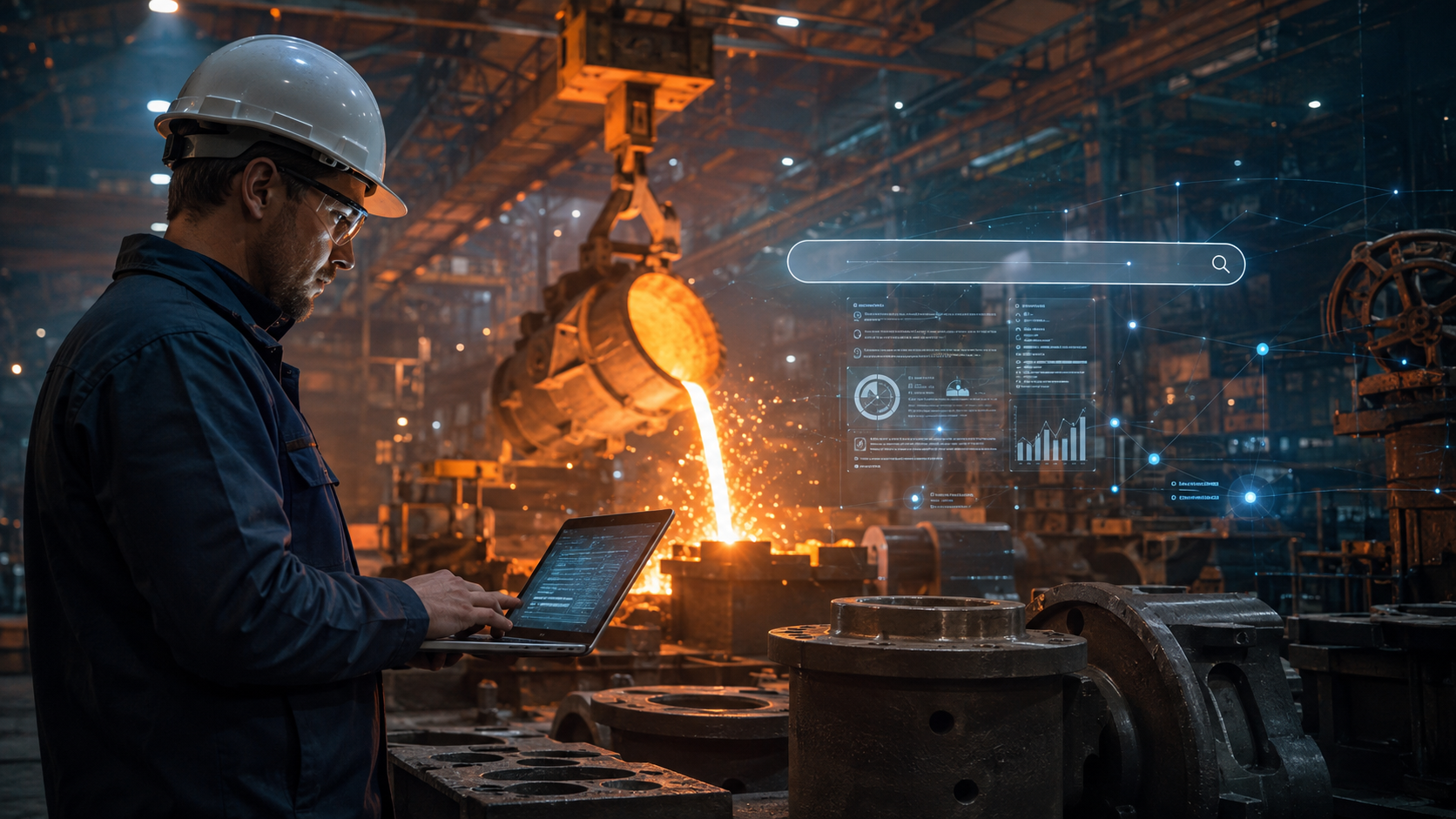
Somewhere this morning, you stepped on a company's name and never noticed.
It was cast in iron, stamped into a manhole cover or a trench grate or a curb inlet — a company name, maybe a founding year, maybe a city, poured into metal and set into the street, where it will outlast every billboard in town. The company behind it has probably been pouring metal for a hundred years or more. It employs skilled people who make heavy, precise, unglamorous things that civilization does not work without. Its products are under your feet, in your storm drains, holding up your bridges.
And it has almost certainly never needed marketing. Not really. Its business was built on specifications, relationships, distributors, and a reputation old enough to have survived two world wars — a machine that ran beautifully for a century.
This post is about why that machine just developed a problem, why the problem is measurable, and what the demand playbook looks like for exactly this kind of company. We'll say up front, plainly, that this is an inbound post: this is a space we'd genuinely love to work in, the industrial-scale version of the hometown businesses this firm was built for. So consider it a public audition — the thinking, shown free, with every number sourced, as always.
The space, by the numbers — and why it's more "hometown" than you'd think
Start with what American metalcasting actually is, because the popular picture is wrong. This isn't a handful of smokestack giants. It's roughly 1,750 foundries across the country, a $52 billion industry directly employing over 160,000 people — and the detail that matters most for this post: nearly 80% of domestic metalcasters employ fewer than 100 workers. The industry is overwhelmingly composed of small and mid-size, often family- or founder-rooted operations, clustered through Ohio, Pennsylvania, Indiana, Wisconsin, and the industrial Midwest — hometown guys, in steel-toed boots, at scale. And about 90% of all durable goods contain a casting, which means these quiet companies are load-bearing for basically everything.
It's also a space under real pressure. The U.S. foundry count fell from 2,380 in 2005 to under 2,000 a little over a decade later, squeezed by imports and offshoring — followed, more recently, by a sharp reversal in the wind: reshoring sentiment, supply-chain resilience mandates, and above all the infrastructure spending wave, where Buy America provisions require domestically produced iron and steel on federally funded projects — meaning every bridge bearing, valve body, and manhole cover in that pipeline creates demand that can only be filled domestically. The survivors of the hard decades are standing in front of the best domestic demand environment in a generation.
Which makes the timing of the marketing problem almost cruel. The demand is arriving. The question is who it finds.
The machine that ran for a century — and the buyer who broke it
Here's how a legacy manufacturer historically won business, and why "we've never needed marketing" was, for a hundred years, simply true. The products were sold by specification: a civil engineer writes your product into the project drawings — often by name, followed by the magic words "or approved equal" — and that spec generates purchase orders for years. The specs were maintained by relationships: your regional reps, the lunch-and-learns, the trade-show booth, the distributor network that stocked and pushed your line. The trust was maintained by the reputation — the name literally cast into the streetscape, a form of proof no ad agency ever matched. Sales knew the buyers personally. Buyers called sales when they needed things. The website was a brochure nobody read, and that was fine.
Then the buyer changed — not gradually, generationally, and the data on it is unambiguous:
Millennials and Gen Z now make up 71% of all B2B buyers. The engineer specifying your trench grates, the procurement lead at the DOT, the contractor's project manager — increasingly, they're under 45, digital-native, and they buy the way they live: nearly 70% of the way through their purchasing process before ever engaging a seller, initiating first contact themselves more than 80% of the time. Gartner's own numbers say buyers now spend just 17% of their total purchase journey meeting with suppliers — 5–6% with any single rep — and 67% actively prefer a rep-free experience.
Read that against the century-old machine. The machine assumes the buyer calls first and learns from your rep. The actual buyer now researches alone, forms the shortlist alone, and calls only to validate a decision that's mostly made — which means the relationship network that maintained your specs for decades now activates after the moment that matters. And the newest wrinkle compounds it: B2B buyers increasingly run that anonymous research phase through AI — asking ChatGPT, Gemini, and Perplexity to compare vendors and summarize options before any human contact. An engineer at 4 PM on a deadline doesn't call three reps to compare load ratings anymore. They ask the machine. The machine answers with whoever is findable, structured, and credible online — and that answer can't be bought, only earned.
None of this kills the reps, the shows, or the distributors. It moves the decisive moment upstream of all of them — into a search box the legacy manufacturer has never once competed in.
The reality check any manufacturer can run in ten minutes
Before the journey and the playbook, a test — because in this space, seeing it beats being told it. Pick your three most-specified product categories and run them the way a 34-year-old project engineer would, brand-blind: the problem search ("trench drain load rating requirements"), the compliance search ("Buy America compliant [category]"), and the AI question (ask ChatGPT to recommend manufacturers for the application and summarize the options).
Here's what a century-old manufacturer typically finds. The problem searches are won by distributors' thin category pages, a competitor who bothered, or — increasingly — an AI Overview stitched together from whoever published anything at all. The compliance searches return law-firm explainers and government PDFs, with no manufacturer in sight. And the AI answer names two or three companies with visible technical content, sometimes gets basic facts wrong about the rest, and frequently omits the market leader entirely — because the machine never claimed to know who matters; it only knows who's legible. A hundred years of physical proof in the streets, and the systems every young engineer consults can barely confirm the company exists.
That gap — between how established you are and how findable you are — is the entire opportunity, and it's widest right now, while your competitors' websites are the same brochures yours is. In most industrial categories, the reference position is still sitting there unclaimed. It will not stay that way through the infrastructure cycle.
The specifier journey: where a casting order actually begins
Every vertical we work has a journey — the recruit's, the patient's, the buyer's — and the industrial version has a special property: the sale happens months before the purchase order, inside a document you'll never see being written.
It starts with an engineer and a problem: a stormwater project, a streetscape, a plant floor. They search the problem, not the brand — "H-20 vs H-25 load rating," "ADA detectable warning requirements," "trench drain grate sizing," "ductile vs gray iron for municipal castings." Whoever's technical content answers those questions becomes the tab that stays open. Then it gets specific: spec language they can paste into the drawings, dimensional data, CAD and BIM files to drop into the model, submittal sheets, compliance documentation — and here's the industrial secret hiding in plain sight: the manufacturer whose CAD file gets dropped into the drawing is the spec. "Or approved equal" notwithstanding, the named product wins the overwhelming share of what follows, because no contractor litigates equality against a drawing when the named part is available. Then, and only then, comes the buying layer — the contractor pricing the job, the distributor quoting it, the municipality's procurement checking Buy America compliance — all of it downstream of a decision made by a search.
So the demand question for a foundry isn't "how do we get more RFQs." It's "whose name is in the spec?" — and in 2026, the path into the spec runs through Google, through downloadable technical assets, and increasingly through an AI summary an engineer skimmed at 4 PM. That's the ballgame.
The unfair advantage: a century of answers nobody has published
Now the part that makes this space genuinely exciting to a firm like ours, because the raw material is absurd.
A hundred-year-old foundry is sitting on the deepest content goldmine we've ever described: a century of metallurgical judgment, load-rating knowledge, coating and corrosion experience, installation wisdom, failure analysis, and spec-writing fluency — almost none of it published anywhere an engineer can find it. The questions get typed every day: what load class does this application actually need, how do you size a trench drain, what does Buy America compliance actually require on a casting, when does ductile iron earn its premium over gray. The company that answers them, in public, in plain engineering English, with real data, becomes the reference — and reference content is precisely what search engines and AI engines cite, because it passes the test nothing generic can: only this company could have written this.
Layer the trust math on top. Search and AI engines now systematically reward demonstrated first-hand expertise, verifiable history, and authentic authority — the entity signals that most companies have to manufacture. A legacy foundry is those signals: a founding date in the 1800s, a name physically cast into ten thousand streets, generations of engineers who specified it, an address that hasn't moved since the trolley era. That's the hometown-guys thesis at industrial scale — maximum banked credibility, minimum translation into the language machines read. The whole job is the translation.
The play: what we'd actually build, in order
Concretely — the demand system for a company like this, five layers:
1. Product pages rebuilt as spec-grade landing pages. Every product line gets what a vehicle page gets at a dealershipor a service gets at a practice: a real page, named in the specifier's language, carrying dimensions, load ratings, materials, compliance status, spec language ready to paste, and the CAD/BIM/submittal downloads right there — because the download is the conversion, and the drawing is the deal.
2. The engineering resource library. The century of answers, published: application guides, load-class explainers, sizing tools, coating comparisons, install details — provider-reviewed by your actual engineers, bylined, and structured to be cited. This is the layer that captures the problem-stage searches where specs are born, and the layer AI engines will quote for the next decade.
3. Entity and AI visibility, tested prompt by prompt. The structured data, consistent citations, and machine-readable company facts that get the firm named — correctly — when an engineer asks an AI to compare options, verified the way we verify everything: by asking the engines and publishing what they say. Most industrial firms have never once run this check; the honest results are usually "absent," which is also the opportunity.
4. The compliance-demand layer. Buy America is generating searches with federal money attached — compliance explainers, domestic-sourcing documentation, project-type landing pages. Brand-new demand, on searchable questions, in a wave that's at peak spend right now. First mover keeps it.
5. Channel-safe architecture. The part legacy manufacturers rightly worry about: none of this competes with your distributors — it feeds them. The visibility wins the spec; the "where to buy" layer routes the demand to the channel, with distributor locators and clean handoffs. Your reps stop cold-hunting and start harvesting inbound that arrives pre-sold, the way modern buyers insist on arriving anyway.
The honest part
Four things, plainly, because industrial marketing pitches are usually where honesty goes to die in a PowerPoint. We don't have a foundry on the roster — same disclosure we make in every vertical we enter, and we'd rather say it than imply otherwise; what we can show is our own published growth from zero and audits run at a published-in-full standard. Attribution requires adult patience here: most B2B decisions take three months to over a year, specs convert to POs across budget cycles, and anyone promising month-three revenue attribution in this space is lying to you — what's measurable monthly is the leading layer: rankings, downloads, citations, AI presence, RFQ quality, reported in numbers you can check. Marketing influences the spec, not the pour: capacity, quality, and lead times still win or lose the work itself — we make you findable and specifiable; the foundry has to stay excellent. And we're one person, on purpose — the right fit is the mid-size manufacturer without a marketing department, or the marketing lead who needs the search-and-AI specialist their generalist agency isn't; if you need a twelve-seat account team, we'll say so on the first call.
The bottom line
Four sentences, like always. The companies whose names are cast into the streets have the strongest trust signals in American industry and, right now, near-zero presence in the places where a 71%-millennial buying population actually decides — the searches, the downloads, and the AI answers where specs are born, 70% finished before any rep hears about it. The demand wave is real and domestic-only in large part, courtesy of Buy America and the infrastructure spend, and it will find somebody's spec sheet. A century of unpublished answers is the cheapest, most defensible content advantage we've ever described — it just needs translating into the language engineers search and machines cite. The name has been in the street for a hundred years; the job now is getting it into the answer.
Frequently Asked Questions
Does SEO really matter for a foundry or industrial manufacturer that sells through reps and distributors?
More than almost anywhere, because the decisive moment moved upstream of the channel: buyers are now nearly 70% through the process before engaging a seller and initiate contact 80%+ of the time, spending only 17% of the journey with suppliers at all. The reps and distributors still close and fulfill — search and content now determine whose product they're closing. Done right, visibility feeds the channel rather than fighting it: the spec gets won online, the PO flows through your distributors.
What does "winning the spec" mean, and how does marketing influence it?
Engineers write products into project drawings — often by name, plus "or approved equal" — and that spec drives purchase orders for the life of the project and often beyond. The path into the spec is now digital: the technical answer that ranked for the engineer's problem search, the spec language ready to paste, and above all the CAD/BIM file that gets dropped into the drawing. Marketing's job is making your product the easiest correct answer at that moment; the named product in the drawing wins the overwhelming share of what follows.
Do engineers actually use ChatGPT for sourcing and spec research?
Increasingly, yes — B2B research is becoming AI-mediated, with buyers asking ChatGPT, Gemini, and Perplexity to compare vendors and summarize options before any human contact, and the majority-millennial buyer base treats it as default behavior. The engines answer from what's findable and structured about each manufacturer — and the recommendation itself can't be bought, which makes the earned technical-content layer the only way in. Most industrial firms have never checked what AI currently says about them; that check is where we'd start.
How is Buy America changing demand for domestic castings?
Federally funded infrastructure projects require domestically produced iron and steel, so every casting in the pipeline — covers, grates, bearings, valve bodies — creates demand only U.S. foundries can fill, during the spending wave's peak phase. That demand is searchable: engineers and procurement teams are actively researching compliance requirements and compliant suppliers. Published compliance documentation and Buy America content converts a policy tailwind into inbound — and right now, in most casting categories, almost nobody has claimed those searches.
How long does industrial B2B SEO take to show results?
Two clocks, honestly stated. Leading indicators — rankings on spec-stage searches, resource downloads, AI citations, RFQ quality — move on the normal 60–90-days-then-compounding timeline. Revenue attribution runs on the industry's clock: most B2B decisions take three months to a year-plus, and specs convert to POs across project and budget cycles. Anyone promising traceable industrial revenue by month three is selling something; anyone refusing to show you the leading indicators monthly is hiding something.
We're a small foundry, not a giant — is this playbook even for us?
It's especially for you — nearly 80% of U.S. metalcasters employ fewer than 100 people, and the playbook scales down cleanly: a smaller shop needs pages for its core capabilities and alloys, its niche answered in public, its entity signals clean, and its AI presence checked — the same layers at focused scope. Small also moves faster: no committee between the metallurgist who knows the answer and the page that publishes it. The trust is already banked; it's the same hometown math, poured in iron.
Find out whose name the engineers are finding
Here's the offer, plainly: we'll run your company through the free visibility check — what ChatGPT, Gemini, and Claude actually say when asked about products and suppliers in your categories, how you stand in the searches where specs are born, and a plain-English read on your site, technical content, and entity signals — with what we'd build first, in order. Yours whether or not you ever hire us, with a real reply from the founder within one business day. No pressure, no pitch deck, and no pretending we've poured iron — just the search-and-AI layer, done honestly, with the numbers published.
Get your free visibility check → — mention "manufacturing" in the form.
Sources
American Foundry Society — Industry statistics: $52B industry, 160,000+ direct jobs, 90% of durable goods contain castings
American Foundry Society — U.S. metalcasting economic impact: ~1,750 foundries, ~80% under 100 employees
American Foundry Society — Trade: U.S. foundry count decline from 2,380 (2005)
6sense / Business Wire — 2024 Buyer Experience Report: buyers ~70% through the process before engaging; 80%+ initiate contact themselves
Gartner — 67% of B2B buyers prefer a rep-free experience (2026 survey)
Growth Method (Gartner data) — 17% of buying time with suppliers; 5–6% with any one rep
Sopro — B2B buyer statistics: Millennials and Gen Z now 71% of B2B buyers; decision timelines
Geisheker Group — How AI changed the B2B buying process: AI-mediated vendor research
PapaverAI — U.S. forgings and castings: IIJA peak spending and Buy America domestic-content demand