Stop Building Doorway Pages: Why Thin Location Pages Are Killing Your Local SEO
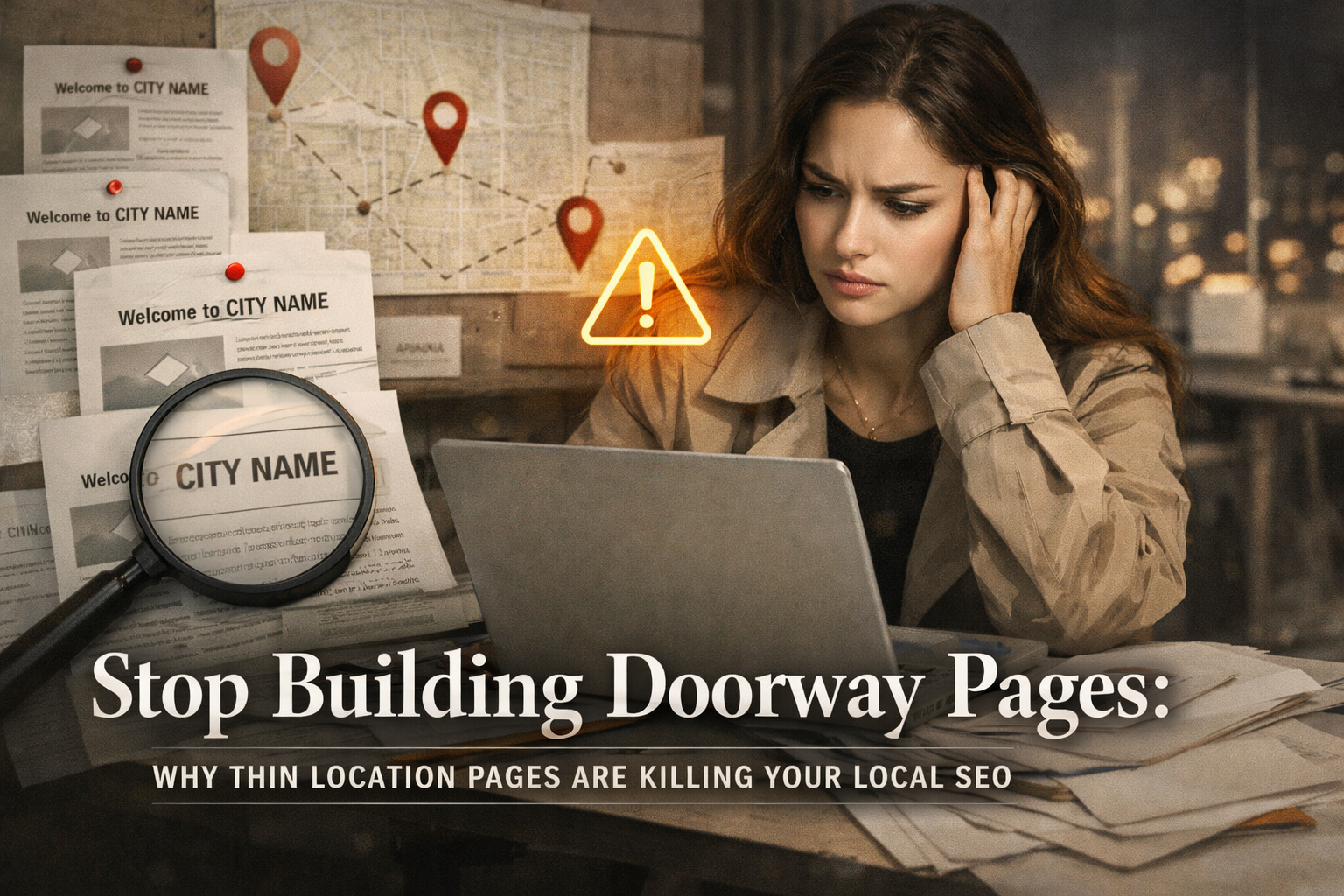
Your website has a page for Arlington. And a page for Falls Church. And a page for McLean. And one for Tysons. And one for Vienna. And one for Fairfax. And one for Annandale. And one for Burke. And one for Springfield. And one for Centreville. And one for Chantilly. And one for Herndon. And one for Reston. And one for Sterling. And one for Ashburn. And one for Leesburg.
And if you open any two of those pages side by side, they're identical — except the city name has been swapped and maybe the zip code is different. Same paragraph structure. Same service descriptions. Same stock photo. Same call to action. The Arlington page says "we provide top-quality plumbing services to homeowners in Arlington, VA 22201." The Falls Church page says "we provide top-quality plumbing services to homeowners in Falls Church, VA 22042." The McLean page says — you can already finish the sentence.
Some businesses take it even further. Two pages for the same town — one targeting the city name, one targeting the zip code. "Plumbing Services in Reston VA" and "Plumbing Services in 20190." Or three pages, because Reston has multiple zip codes and someone told you that each zip code needs its own page. Or pages for neighborhoods within cities, each one a carbon copy of the city page with the neighborhood name dropped in.
If your website looks like this, someone told you this was a good SEO strategy. Maybe it was an agency. Maybe it was a freelancer. Maybe it was something you read in a blog post from 2014. Whoever told you, they were wrong — or more precisely, they were right once, a long time ago, and the strategy has since become not just ineffective but actively harmful to your website's search performance, your brand credibility, and your relationship with Google.
This post is about what doorway pages are, why they were built, why they don't work anymore, how they're hurting your site right now if you have them, how to tell if your current agency is still building them for you, and what to do instead.
What Doorway Pages Are and Where They Came From
Doorway pages — also called gateway pages, bridge pages, or thin location pages — are pages created primarily to rank for specific search queries and funnel users to a single destination or experience. In local SEO, the most common form is the location page: a page targeting "[service] in [city]" that exists not because the business has something unique to say about serving that city, but because someone decided that having a page with that city name on it would help the site rank for searches in that city.
The strategy has its roots in an earlier era of search engine optimization when it genuinely worked. In the mid-2000s and into the early 2010s, Google's algorithm was significantly less sophisticated than it is today. Having a page with a specific city name, zip code, and service keyword in the title, the URL, the headings, and the body text was often enough to rank for that local query — even if the page was thin, duplicative, and offered no unique value. The algorithm looked at keyword presence. The page had the keywords. The page ranked.
Agencies and SEO practitioners built entire business models around this approach. "We'll create fifty location pages for your service area." "We'll target every zip code in your county." "We'll build a page for every city within thirty miles of your business." The deliverable was easy to produce — write one template page, swap in the city names and zip codes, publish fifty pages, send the client a report showing all fifty new pages, and collect the monthly retainer. Some agencies still sell exactly this service today, often as part of a local SEO package that promises "location targeting" or "geo-specific landing pages."
The problem is that Google figured this out. A long time ago.
Google's Position: This Is Spam
Google doesn't consider doorway pages a gray area or a risky-but-sometimes-effective tactic. Google considers them spam. Explicitly, by name, in their published spam policies.
Google's documentation defines doorway pages as pages created to rank for specific queries that funnel users to the same content or destination. Their guidance specifically calls out location pages as a common form — multiple pages targeting different cities or regions with substantially similar content. Google's stated position is that these pages are a negative user experience because they present the searcher with multiple similar results in the search listings, each of which takes the user to essentially the same place.
This isn't an informal guideline or a suggestion. It's a spam policy. Violations of Google's spam policies can result in manual actions — penalties applied by Google's human review team that can demote individual pages or your entire site in search rankings. They can also result in algorithmic filtering, where Google's automated systems identify the pattern and simply stop ranking the pages, or reduce the ranking authority of the site as a whole.
The distinction between a manual action and algorithmic filtering matters for a practical reason: a manual action shows up in Google Search Console and can be addressed through a reconsideration request. Algorithmic filtering doesn't notify you. Your pages just quietly stop performing, your site's overall authority gradually erodes, and you have no notification from Google telling you why. You just see traffic declining and rankings slipping, and if you don't know what to look for, you blame the algorithm update or the competition rather than recognizing that your own site structure is the problem.
Why Thin Location Pages Don't Work Anymore
Even if Google never penalized doorway pages — even if there were no spam policy, no manual actions, no algorithmic filtering — the strategy still wouldn't work in today's search environment. The algorithm has evolved past the point where thin location pages provide any ranking benefit, and in most cases, they actively prevent the site from ranking as well as it could.
Here's why.
Google Understands Geography Without Your Help
Google knows where your business is located. It knows from your Google Business Profile. It knows from your NAP (name, address, phone number) citations across the web. It knows from the structured data on your website. It knows from your actual physical address. And it uses that information, combined with the searcher's location, to determine whether your business is relevant to a local query.
When someone in Falls Church searches for "plumber near me," Google doesn't look for a page on your website that says "plumber in Falls Church." Google looks at your business location, your service area, your relevance to the query, your authority, your reviews, and dozens of other factors to determine whether to show your business. The Falls Church page on your website adds almost nothing to that calculus — Google already knows whether you serve Falls Church. The page isn't providing Google with information it doesn't have. It's just providing a thin piece of content that dilutes your site.
Content Quality Signals Have Evolved
Google's algorithm today evaluates content quality with a sophistication that would have been unimaginable when doorway pages first became popular. The helpful content system, introduced in 2022 and refined continuously since, is designed to identify and demote content that exists primarily for search engines rather than for users. Content that's templated, thin, repetitive across multiple pages, and lacking in unique value is exactly what this system targets.
A location page that swaps the city name and zip code but otherwise offers identical content to thirty other pages on the same site is the textbook definition of content created for search engines rather than users. Google's systems can identify this pattern, and when they do, the impact isn't limited to the individual doorway pages. The helpful content system evaluates the site as a whole. A site with a large proportion of unhelpful, thin content can see ranking reductions across all of its pages — including the pages that are actually good.
This is the most insidious effect of doorway pages: they don't just fail to help. They actively damage the performance of your legitimate content. Your homepage, your service pages, your blog posts, your about page — all of these can be dragged down by the algorithmic weight of thirty or fifty thin location pages telling Google that your site prioritizes quantity over quality.
Duplicate Content Creates Confusion, Not Coverage
When you have thirty pages with nearly identical content, Google has to decide which one to index and rank. This is the canonical page selection process, and when you have dozens of pages competing for that selection, the outcome is unpredictable and usually bad.
Google might pick the wrong page as the canonical — showing the Centreville page when someone searches for your services in Reston, because the algorithm couldn't meaningfully differentiate between them. Google might index some pages and ignore others entirely, creating gaps in your coverage that you don't even know about. Google might split the ranking signals — backlinks, engagement, authority — across all thirty pages instead of consolidating them on one strong page, meaning none of your pages rank as well as a single, comprehensive service page would.
This is the cannibalization problem, and it's one of the most common and least understood consequences of thin location pages. You think you're casting a wider net by having more pages. What you're actually doing is splitting your site's authority across dozens of weak pages instead of concentrating it on a few strong ones. The net result is that you rank worse, not better, for the queries you're trying to target.
What These Pages Do to Your Brand
Set aside the algorithm for a moment. Think about what a potential customer experiences when they find one of your doorway pages.
They search for "HVAC repair in McLean." They click on your result. They land on a page that says "We provide premier HVAC repair services to homeowners and businesses in McLean, Virginia. Our team of experienced technicians is committed to providing top-quality HVAC solutions to the McLean community." They notice the page is thin — a few paragraphs of generic text, no specific information about the company's experience in McLean, no case studies, no reviews from McLean customers, nothing that suggests the company has any particular connection to or knowledge of McLean. It reads like a form letter with the city name filled in.
Then, out of curiosity or due diligence, they click to your Arlington page. Same text. City name changed. They check your Fairfax page. Same text again. They now know exactly what they're looking at: a website that's been stuffed with fake location pages to game search results. Whatever trust the initial click generated is gone. The customer's impression isn't "this company serves a lot of areas" — it's "this company is trying to trick Google, and by extension, trying to trick me."
This is the brand damage that doorway pages create, and it's harder to quantify than the SEO damage but equally real. In an environment where customers research businesses online before making contact, your website is your first impression. A website full of thin, templated location pages makes a specific impression: this company cuts corners, prioritizes shortcuts over substance, and treats its web presence as a search engine manipulation exercise rather than a genuine representation of the business. That's not the impression you want to make with a potential customer who has plenty of other options.
For businesses that sell to other businesses — professional services, contractors, consultants — the brand damage is even more pronounced. A B2B buyer doing due diligence on a potential vendor will notice doorway pages immediately and will draw the obvious conclusion: if this company takes shortcuts in how it presents itself, it probably takes shortcuts in how it delivers its services. Fair or not, that inference is natural and common.
How to Tell If Your Agency Is Building Doorway Pages for You
If you're working with an SEO agency or a marketing firm and you're not sure whether they're building doorway pages on your site, here's how to check.
Look at Your Sitemap or Site Structure
Go to your website and look for a pattern of location pages. They might be organized under a URL structure like /service-areas/arlington/ or /locations/falls-church/ or /plumbing-services-mclean-va/. If you see dozens of pages following the same naming pattern, each targeting a different city or zip code, you're looking at doorway pages.
Compare the Content Across Location Pages
Open three or four of these location pages in different tabs. Read the text on each one. If the content is substantially identical — same structure, same paragraphs, same claims, with only the city name, zip code, or minor details swapped — these are thin location pages. It doesn't matter if someone rewrote each one slightly to avoid exact duplication. If the pages say essentially the same thing with minor variations, Google's systems are sophisticated enough to identify the pattern.
Check the Page Count vs. Your Actual Presence
How many physical locations does your business have? If you have one office in Fairfax and your website has forty-seven location pages, the math doesn't work. A business with one location doesn't need forty-seven location pages. A business with one location needs one strong service area page — or at most, a handful of pages about genuinely distinct markets it serves, each with unique, substantive content.
Ask Your Agency Directly
Ask them: "How are our location pages differentiated from each other? What unique content does each one have? What's the strategic purpose of having separate pages for each city?" If the answer is vague — "it helps with local SEO" or "Google likes to see location-specific pages" — that's a red flag. If the answer is "each page targets a different keyword for local search," that's a doorway page strategy, and it's the answer you'd expect from someone still operating on SEO principles from 2012.
A good agency should be able to explain exactly why each page exists, what unique value it provides to the user, and how it fits into a broader content strategy. If the only reason a page exists is to have the city name in the URL and the title tag, the page shouldn't exist.
Look at the Results
If your agency has been building location pages for months or years, look at the analytics. How much traffic does each location page get? What's the bounce rate? Are these pages generating leads, calls, form submissions? In most cases, you'll find that the majority of location pages get negligible traffic, high bounce rates, and zero conversions. They're dead weight — pages that exist on your site but contribute nothing except the accumulated negative signal of thin content.
The Cannibalization Problem in Detail
Cannibalization deserves its own section because it's the most technically damaging consequence of doorway pages and the one that's hardest to see without deliberate analysis.
Here's how it works. Suppose you're a cybersecurity consulting firm based in Reston. You have a strong, well-written service page about your cybersecurity assessment services. That page has been accumulating backlinks, generating engagement, and building authority over time. It ranks on the first page for several relevant queries.
Then someone — your agency, your internal marketing person, a well-meaning consultant — decides you need location pages. They create pages for "cybersecurity assessment services Reston," "cybersecurity assessment services Tysons," "cybersecurity assessment services Arlington," "cybersecurity assessment services Fairfax," and fifteen more.
Now Google has to figure out which page on your site is the most relevant result for a query like "cybersecurity assessment Northern Virginia." Before, the answer was clear — your strong service page was the only candidate. Now there are eighteen candidates, all targeting variations of the same topic. Google splits the signals. The backlinks that were powering your original service page now compete with eighteen other pages for relevance. The engagement metrics are diluted across multiple pages. Google's confidence in which page to rank decreases, and the result is often that none of your pages rank as well as the single service page did before the location pages were created.
You've taken your strongest asset — a well-performing service page — and weakened it by surrounding it with thin pages that compete for the same queries. It's the SEO equivalent of opening eighteen identical stores on the same block: instead of one strong store with all your customers, you have eighteen empty stores confusing everyone about where to go.
The fix for cannibalization is consolidation — removing or redirecting the thin pages and concentrating your content and authority on a smaller number of strong pages. But many businesses don't realize they have a cannibalization problem because they see thirty location pages and think "more pages means more chances to rank." The opposite is true. More weak pages means fewer chances to rank well.
What to Do Instead
If doorway pages are the wrong approach to local SEO, what's the right one? The answer depends on your business structure, but the principles are consistent regardless of industry.
If You Have One Location
If your business operates from a single location and serves a surrounding area, you don't need individual pages for every city in your service area. You need a strong, comprehensive presence that communicates your location, your service area, and your expertise.
Your Google Business Profile is the single most important factor in local search visibility. Make sure it's complete, accurate, and actively managed — correct business category, accurate service area, up-to-date hours, regular posts, and a consistent stream of reviews. Google Business Profile optimization will do more for your local visibility than fifty doorway pages ever could.
On your website, have a clear service area page — one page that describes where you work, presented in a way that's useful to a potential customer. "We're based in Fairfax and serve clients throughout Northern Virginia, including Arlington, Falls Church, McLean, Tysons, Reston, and the surrounding communities." That single sentence, on a well-structured page with strong content about your services, communicates your geographic coverage to both Google and potential customers more effectively than thirty thin location pages.
If there are specific markets within your service area where you have genuinely differentiated experience or a distinct story to tell, those can merit their own pages — but only if the content is substantially unique. A page about your work in Arlington is justified if you've done significant work in Arlington, if you can feature Arlington-specific case studies, if there's something about the Arlington market that's different from your other markets and worth addressing. It's not justified if the only thing differentiating it from your Fairfax page is the city name.
If You Have Multiple Locations
If your business has multiple physical locations, each location legitimately merits its own page — because each location is a real, distinct presence with a unique address, unique staff, unique hours, and potentially unique services. This is not a doorway page situation. This is a multi-location business with genuine geographic diversity.
Each location page should have unique content: the specific address, the team at that location, the services offered at that location (if they differ), reviews from customers at that location, photos of that specific office or storefront. The page should be a genuine representation of the actual location, not a template with the address swapped in.
The difference between a legitimate multi-location page and a doorway page is substance. A real location page tells you something specific and useful about that location. A doorway page tells you the same thing every other doorway page tells you, with a different city name in the headline.
Invest in Content That Actually Ranks
The traffic that fifty thin location pages fail to capture can be captured by a handful of strong, substantive content pieces that address the actual questions and needs of your potential customers in your service area.
A blog post about "what to expect during a home inspection in Northern Virginia" — written with genuine local knowledge, specific to the building styles, common issues, and regulatory environment of the region — will outperform thirty location pages targeting individual Northern Virginia cities. It will outperform them in search rankings, in user engagement, in time on page, in conversion rate, and in the impression it makes on the reader about your expertise.
Content that demonstrates local expertise is different from content that claims local presence. A doorway page claims presence — "we serve McLean." Content that demonstrates expertise says "here's what we know about the McLean market, here's what's different about working here, here's what our clients in this area typically need." One is a keyword play. The other is a genuine resource. Google can tell the difference, and so can your customers.
Build Local Authority Through Real Signals
Local SEO authority comes from signals that are much harder to fake than a location page. Reviews from customers in your service area. Backlinks from local organizations, chambers of commerce, industry associations, and local media. Citations in local business directories. Engagement with your Google Business Profile. Content that genuinely serves the local community.
These signals take longer to build than a batch of doorway pages, but they create durable ranking authority that doesn't depend on tricking Google's algorithm — it aligns with it. Google's algorithm is designed to surface businesses that are genuinely relevant, authoritative, and trusted in their local market. Every signal that communicates genuine local relevance makes your site stronger. Every doorway page that tries to simulate local relevance makes it weaker.
The Conversation You Need to Have With Your Agency
If you've read this far and you're looking at your website with fresh eyes — noticing the location pages, recognizing the template, seeing the pattern — you need to have a conversation with whoever built those pages.
That conversation should cover three things.
First, acknowledge the history. Doorway pages were a legitimate strategy at one point. If your agency built them in 2015, they may have been following the best practices of the time. The issue isn't that they were built — it's that they haven't been removed or consolidated as search has evolved. An agency that built doorway pages years ago and hasn't revisited the strategy isn't necessarily bad. They may just be behind.
Second, assess the damage. Pull up your analytics and look at how those location pages are performing. In most cases, you'll find that they're generating minimal traffic, high bounce rates, and negligible conversions. Some may not be indexed by Google at all. If you have access to Google Search Console, check for manual actions and look at the page indexing report to see how Google is treating these pages. The data will likely confirm what this post describes — the pages aren't working and may be actively hurting your site.
Third, plan the cleanup. Removing doorway pages isn't as simple as deleting them. If any of those pages have accumulated backlinks or are indexed by Google, deleting them creates 404 errors that waste whatever authority those links carried. The correct approach is usually to redirect the location pages to the most relevant surviving page — your main service page or your service area page — using 301 redirects that transfer the link authority and prevent broken links. Then, focus your content investment on the pages that remain: making them stronger, more substantive, and more useful than any of the thin pages they replaced.
If your agency pushes back on this — if they insist that the location pages are working, that they're necessary, that Google still rewards this approach — ask them to prove it with data. Ask them to show you the traffic, the rankings, the conversions that those pages are generating. If they can't, the pages aren't earning their place on your site. If the agency continues to advocate for a doorway page strategy after being presented with Google's own spam policies, that tells you something important about whether their SEO knowledge is current.
The Bigger Picture: Quality Over Quantity
The doorway page approach represents a philosophy about SEO that's fundamentally outdated: the idea that more pages equals more rankings, that targeting every keyword variation with a dedicated page is the path to search visibility, and that the goal of a website is to capture as many search queries as possible regardless of whether the pages behind those queries provide any value.
Modern SEO works the opposite way. Fewer, stronger pages outperform many weak ones. A site with twenty pages of excellent, substantive content will outrank a site with two hundred pages of thin, duplicative content — for the same queries, in the same market. Google's algorithm has been moving in this direction for over a decade, and every major update reinforces the principle: quality over quantity, depth over breadth, substance over keywords.
This doesn't mean you should have the fewest possible pages on your website. It means every page should earn its place. Every page should offer something to the visitor that no other page on your site offers. Every page should exist because a real person with a real need would benefit from finding it — not because a keyword tool said there were searches for that term and someone decided to create a page to capture them.
The businesses that win in local search today aren't the ones with the most location pages. They're the ones with the strongest Google Business Profile, the best reviews, the most substantive content, and the clearest demonstration of genuine local expertise. A single well-optimized website with authoritative content and strong local signals will outperform a website with a hundred doorway pages — every time, in every market, for every query that matters.
The Bottom Line
If your website has dozens of location pages that are substantially identical except for the city name and zip code, those pages are not helping you. They are likely hurting you — damaging your search rankings through cannibalization, triggering Google's spam detection systems, eroding your brand credibility with potential customers, and occupying space on your site that could be filled with content that actually works.
The fix is not to rewrite the doorway pages with slightly more unique content, hoping to get them just above the threshold of acceptability. The fix is to remove them, redirect them, and replace the strategy entirely with an approach built around quality content, genuine local authority, and the signals that modern search algorithms actually reward.
If someone is still building doorway pages for you — still telling you that you need a page for every city, every zip code, every neighborhood — they're selling you a strategy that Google explicitly classifies as spam. That's not a gray area. That's not a matter of opinion among SEO professionals. That's Google's own published policy, and building your site's local SEO strategy on a foundation that Google calls spam is not a risk worth taking when better approaches exist.
Your website doesn't need more pages. It needs better pages. And the difference between a business that ranks well locally and one that doesn't is almost never the number of location pages on the site. It's the quality of the content, the strength of the local signals, and the credibility of the overall web presence.
One strong page beats fifty weak ones. Build the strong page.
Frequently Asked Questions
My Agency Built These Pages and My Rankings Are Fine. Should I Still Be Concerned?
Maybe. "Fine" is relative — you may be ranking despite the doorway pages, not because of them. The question to ask is whether you'd rank better with those pages consolidated into stronger content. In many cases, businesses that remove doorway pages and redirect them to a single strong service page see rankings improve because the cannibalization is eliminated and the authority consolidates. Also consider the risk dimension: Google's spam policies are enforced through both manual actions and algorithmic updates. Rankings that depend on a strategy Google explicitly calls spam are rankings that can disappear overnight with the next update. Building on a compliant foundation is more durable.
How Many Location Pages Is Too Many?
There's no specific number that triggers a penalty — it's about the quality and differentiation of the content, not the count. A business with ten physical locations and ten unique, substantive location pages is fine. A business with one location and fifty nearly identical city pages has a problem. The test is simple: does each page offer unique, valuable content that a visitor would find useful, or does it exist only to target a geographic keyword? If you can't articulate what makes the page different from every other location page on your site, the page probably shouldn't exist.
Will Removing Doorway Pages Hurt My Rankings in the Short Term?
It's possible to see a brief fluctuation as Google recrawls and reindexes your site after removing or redirecting pages. But in the vast majority of cases, the consolidation improves rankings within weeks because the authority that was split across many weak pages is now concentrated on fewer strong pages. The key is to use 301 redirects rather than simply deleting the pages — this ensures that any link equity those pages accumulated is transferred to the redirect target rather than lost.
My Agency Says They Write Unique Content for Each Location Page. Is That Different From Doorway Pages?
It depends on what "unique" means. If each location page has genuinely different, substantive content — local case studies, area-specific information, different services or pricing, reviews from customers in that area — then it may be a legitimate content page rather than a doorway page. If "unique" means "we reworded the same three paragraphs slightly differently for each city," that's still a doorway page with a thin disguise. Google's systems evaluate substantive uniqueness, not superficial rewording. Read the pages yourself. If they're saying the same thing in slightly different words, they're doorway pages regardless of what the agency calls them.
What About Service-Plus-Location Pages Like "Plumbing Repair in Reston" vs. "Water Heater Installation in Reston"?
Pages that combine a specific service with a location can be legitimate if the service differentiation is real and each page has substantive, unique content about that specific service. "Plumbing Repair in Reston" and "Water Heater Installation in Reston" are different services with different information needs — a page about water heater installation can cover different content than a general plumbing page. The problem arises when you create the same service page for dozens of locations: "Water Heater Installation in Reston," "Water Heater Installation in Herndon," "Water Heater Installation in Sterling" — all with identical content except the city name. That's still a doorway page pattern, just with a service layer added.
Related Reads
〰️
Related Reads 〰️

How Many Pages Should Our Website Have?
"How many pages should our website have?" It's one of the most common questions we get from clients, and the honest answer is: it depends. But not in a vague, noncommittal way. There's a real framework for figuring out the right number of pages — and it has everything to do with what your business does, where you do it, and what your customers are actually searching for.

Do I Need More Than 10 Pages for My Website?
More pages doesn’t automatically mean more traffic. If you’re wondering whether your website needs more than 10 pages, the answer isn’t about volume — it’s about strategy. Here’s what actually drives SEO, credibility, and conversions (and when adding pages makes sense).
Why Your Sitemap Belongs in Your Footer (And Why Nobody Is Judging Your Internal Linking)
Put your sitemap link in your footer. It helps Google crawl your site more efficiently, index new content faster, clean up old pages sooner, and distribute authority across your entire content library. It costs nothing and takes thirty seconds. And if you're worried about people judging your messy internal linking — we promise you, nobody with a social life is visiting your sitemap. Nobody.