How Many Pages Should Our Website Have?
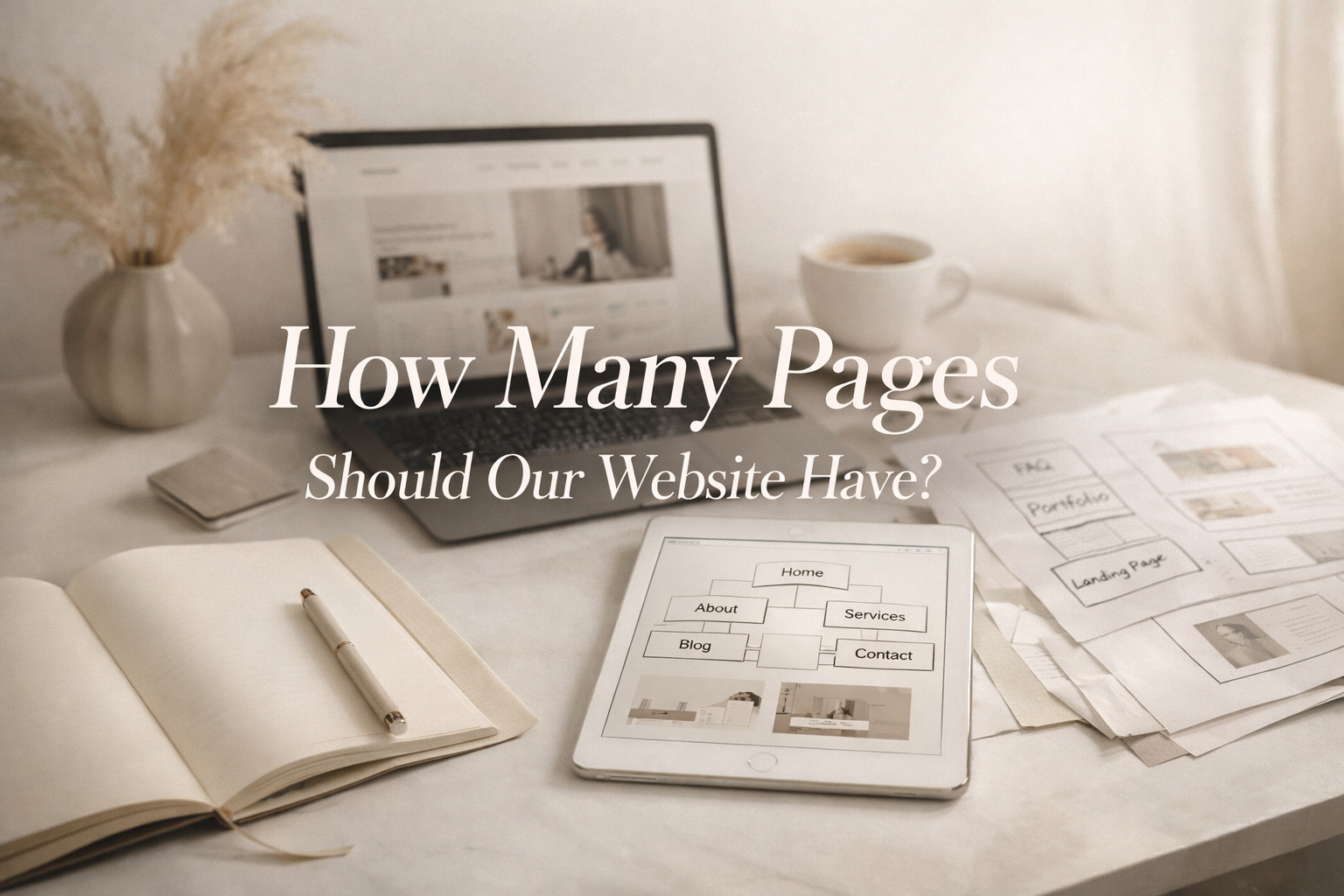
The answer isn't a number. It's a strategy. Here's how to think about it the right way.
We get this question constantly. A business owner is getting ready for a new website — or looking at their current one and wondering if it's enough — and the first thing they want to know is: how many pages do we actually need?
It's a completely reasonable question. And the answer most agencies give — "it depends" — is technically correct but practically useless.
So let's actually break it down. Not with a magic number, but with a framework that helps you understand why certain pages exist, what they do, and how to figure out the right structure for your specific business.
Why There's No Universal Page Count
A one-location plumbing company and a multi-state healthcare network are not going to have the same website. That's obvious. But even within the same industry, two businesses with different service offerings, service areas, and growth goals can end up with wildly different site structures — and both can be correct.
The number of pages your site needs is driven by three things: what you offer, where you offer it, and what your audience is searching for. That's it. Everything else is either cosmetic or strategic filler.
A site with 12 strong, well-optimized pages will outperform a site with 60 thin, redundant pages every single time. Google doesn't reward you for having more pages. It rewards you for having the right pages — pages that are relevant, useful, and structured in a way that signals clearly what your business does and where it does it.
The Pages Every Business Website Needs
Regardless of your industry, size, or location count, there's a core set of pages that every business website should have. Think of these as your foundation.
Homepage
This is your front door. It should clearly communicate who you are, what you do, where you do it, and what makes you different — within seconds. It's not a place to tell your entire story. It's a place to make a strong first impression and guide visitors to the next step, whether that's a service page, a contact form, or a phone call.
About Page
People want to know who they're doing business with. This is especially true for local and family-owned businesses where trust and reputation matter. Your About page should tell your story — how long you've been in business, who runs it, what you stand for — in a way that connects with real people, not in a way that reads like a corporate bio nobody asked for.
Contact Page
This seems obvious but it's remarkable how many businesses make it hard to actually get in touch. Your contact page should have your phone number, a contact form, your physical address, your service area, and your hours. If you serve multiple locations, make it easy for someone to figure out which one applies to them. Don't make someone hunt for how to reach you.
Service Pages
This is where most businesses either get it right or get it very wrong — and where the page count question starts to matter.
The Service Page Question: One Page or Many?
Here's the fork in the road that determines a huge chunk of your site's page count.
A lot of businesses put all their services on a single page. Plumbing, drain cleaning, water heater repair, sewer line replacement, gas line work — all crammed into one long scroll with a paragraph for each. It's neat. It's tidy. And it's a missed opportunity.
Here's why. When someone searches "water heater repair in Arlington VA," Google is looking for a page that is specifically about water heater repair. Not a general plumbing page that mentions water heater repair in one paragraph between fourteen other services. A dedicated page with a clear title, relevant content, and specific information about that service gives you a dramatically better chance of ranking for that search.
This is the single biggest lever most small and mid-size businesses have for increasing their website's page count in a way that actually matters. Every distinct service you offer deserves its own page — not because more pages are better, but because each page gives you an opportunity to rank for the specific terms people use when they're looking for that exact thing.
If you offer eight services, that's eight service pages. If some of those services have meaningful sub-specialties — emergency repair versus scheduled maintenance, residential versus commercial — those might warrant their own pages too, as long as there's enough substance to justify them. The test is simple: would someone search for this specific service on its own? If yes, it should have its own page.
The Location Page Question
This is the second major driver of page count, and it matters enormously for local businesses.
If you serve one area from one location, your service area is probably covered well enough by your homepage, contact page, and service pages that reference your geography naturally. But if you serve multiple cities, counties, or regions, dedicated location pages can make a significant difference.
A location page is a page built specifically around a geographic area you serve. Not a duplicate of your homepage with the city name swapped in — that's thin content and Google sees right through it. A real location page has unique content that's relevant to that specific area: the services you offer there, the types of customers you serve, any local context that's meaningful, and clear calls to action.
For example, if you're an HVAC company based in Fairfax that also serves Loudoun County, Prince William County, and Arlington, each of those areas could have its own landing page that talks about the specific services you provide there and why customers in that area choose you. When someone in Loudoun County searches for HVAC service, that dedicated page gives you a much better shot at showing up than a generic homepage that lists five counties in the footer.
The math here is straightforward. If you offer eight services across four locations, the fully built-out version of your site might have 32 service-location pages — one for each combination — plus your core pages. That's a site with 40 or more pages, and every single one has a purpose.
You don't have to go that deep on day one. But understanding the math helps you see why some sites legitimately need dozens of pages while others function perfectly with fifteen.
Content and Resource Pages
Beyond your core service and location pages, there's a third category that can add real value to your site: content that educates, answers questions, and builds authority.
This is where blog posts, FAQ pages, resource guides, and how-to content live. These pages aren't about directly selling your services. They're about showing up for the informational searches your audience is making and positioning your business as the trusted authority in your space.
If you're a roofing company, a blog post titled "How to Know When Your Roof Needs to Be Replaced" isn't going to generate a phone call every time. But it puts you in front of homeowners at the beginning of their decision-making process — before they've chosen a contractor, before they've even decided they need one. That's top of funnel visibility, and it compounds over time.
The key is quality over quantity. One well-written, genuinely useful blog post per month is worth more than four thin posts stuffed with keywords that nobody actually wants to read. Content pages should only exist if they provide real value to a real person. If you're creating pages just to create pages, you're wasting your time and potentially diluting your site's quality in Google's eyes.
Pages You Probably Don't Need
Not every page earns its place. Here are a few that businesses often include out of habit or because someone told them to, but that rarely add meaningful value.
A "Services" landing page that just links to individual service pages. If your navigation already directs people to each service, an intermediary page that just lists links is an extra click that adds no content. Either make it a substantive overview page or skip it.
Separate pages for every staff member. Unless your business model is built on individual practitioners — like a law firm or medical practice — a single team page is usually enough. Individual bio pages that are two sentences long just create thin content.
Location pages with no unique content. If your "Serving Arlington" page is identical to your "Serving Fairfax" page with the city name swapped out, you're not helping anyone. Either write genuinely unique content for each location or consolidate until you're ready to do it properly.
Pages for services you no longer offer or areas you no longer serve. Outdated pages confuse visitors and send mixed signals to Google. If it's not current, take it down or redirect it.
A Simple Framework for Figuring Out Your Page Count
Here's a practical way to estimate what your site actually needs.
Start with your core pages — homepage, about, contact, privacy policy. That's four.
Add one page for every distinct service you offer. Count the services you'd want to show up for if someone searched for them individually. If that's six services, that's six pages.
If you serve multiple distinct geographic areas and want to rank locally in each one, add a location page for each area. If that's four areas, that's four more pages.
If you want to go deeper, consider service-location combination pages for your highest-value pairings. You don't need every combination — start with the services and areas that drive the most revenue or have the most search demand.
Add a blog or resources section and plan for a realistic publishing cadence — even one post a month gives you twelve new pages a year, each one a new opportunity to rank for a relevant search.
For a typical local service business, this framework usually lands somewhere between 15 and 50 pages to start, with room to grow intentionally over time. For multi-location or multi-service businesses, the number can go well beyond that — and that's fine, as long as every page earns its place.
The Bottom Line
The right number of pages for your website isn't a number you pick out of thin air or copy from a competitor. It's the natural outcome of clearly defining what you do, where you do it, and what your customers are searching for — and then making sure every one of those things has a dedicated, well-crafted page on your site.
More pages isn't automatically better. Fewer pages isn't automatically cleaner. The goal is the right pages, built with purpose, and structured so that both Google and your customers can find exactly what they're looking for without guessing.
If you're not sure whether your current site has enough pages — or too many of the wrong ones — that's a conversation worth having.
Let's Look at Your Site Together →
Frequently Asked Questions
Is there a minimum number of pages a business website should have?
There's no hard rule, but most legitimate business websites need at least a homepage, about page, contact page, and individual pages for each core service. For most businesses, that puts the practical minimum somewhere around 8 to 12 pages. Anything less than that and you're likely not giving Google or your customers enough information to work with.
Can having too many pages hurt my website?
It can, if those pages are thin, duplicate, or outdated. Google values quality over quantity. A site with 200 pages where half of them are low-value or redundant can actually perform worse than a focused site with 30 strong pages. Every page on your site should exist for a reason and provide genuine value to the visitor.
Should every service have its own page even if it's a small offering?
If someone might search for that service on its own, yes. Even a service that makes up a small percentage of your revenue can drive valuable traffic if it has a dedicated page optimized for the right terms. The question isn't how big the service is internally — it's whether there's search demand for it externally.
How important are location pages for local SEO?
Very important, especially if you serve multiple distinct areas beyond your immediate address. Dedicated location pages give Google a clear signal that you serve that area and provide a landing spot for people searching from that geography. But they need to be well-written with unique content — thin location pages with swapped city names can do more harm than good.
How often should I add new pages to my website?
There's no required cadence, but consistency matters more than volume. For most businesses, one or two quality blog posts or resource pages per month is a sustainable pace that builds meaningful organic visibility over time. The important thing is that every new page serves a purpose and targets a real search opportunity.
Does a bigger website rank better than a smaller one?
Not automatically. A bigger site with well-structured, relevant, high-quality pages can build more topical authority and rank for a wider range of searches. But size alone isn't a ranking factor. A focused 25-page site that's expertly built will outperform a bloated 100-page site full of filler every time.
Our agency built our site with only five pages. Is that enough?
For most businesses, probably not. A five-page site — typically home, about, services, blog, contact — is a starting point, not a strategy. If all your services live on one page and you have no location-specific content, you're leaving significant search visibility on the table. It's worth evaluating whether expanding your site structure could open up opportunities you're currently missing.
Where should we start if we want to expand our website?
Start with your services. If you have one services page covering everything, break it out into individual pages for each distinct offering. That's usually the single highest-impact change a business can make. From there, look at your service areas and whether dedicated location pages make sense, then layer in content over time based on the questions your customers are actually asking.
Related Reads
〰️
Related Reads 〰️
Do I Need More Than 10 Pages for My Website?
More pages doesn’t automatically mean more traffic. If you’re wondering whether your website needs more than 10 pages, the answer isn’t about volume — it’s about strategy. Here’s what actually drives SEO, credibility, and conversions (and when adding pages makes sense).

Content Marketing Is a Lot Like Fishing
Content marketing and fishing have more in common than you might think. You're picking your spot, choosing your bait, and figuring out what gets a bite. Whether it's service pages, industry pages, or location pages — the strategy is all about testing, adjusting, and landing the catch.

High-Volume vs. Low-Volume Keywords: How to Plan Content That Actually Grows Traffic
Should you chase high-volume keywords or focus on low-volume wins? This guide breaks down how to balance keyword volume, intent, and competition to build a content strategy that compounds organic traffic over time.