The Firehouse Calendar: Why Fire Prevention Week, Santa Runs, and Holiday Hall Rentals Are Your Whole Digital Year
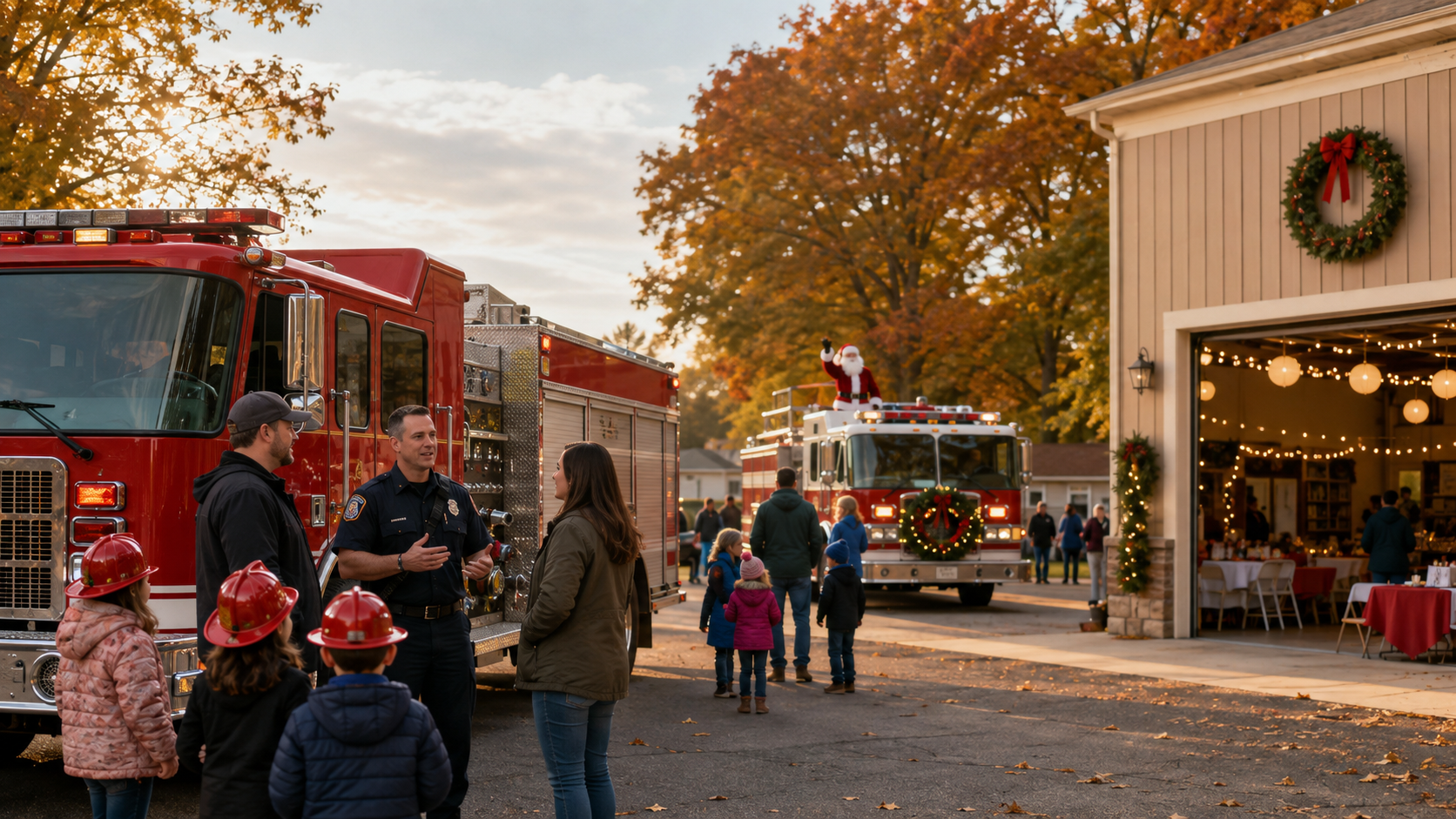
Picture the best Saturday of a fire company's year. It's October. The bay doors are up, the engine's out front, and sixty kids in plastic helmets are taking turns in the jump seat while a firefighter shows their parents how fast a kitchen fire moves. Somebody's working the grill. An older member is telling the story of the '94 fire to anyone who'll stand still. Three different adults ask, half-joking, "so what's it take to join?"
Now the question that decides whether that Saturday was a recruiting event or just a nice afternoon: how did those sixty families find out about it?
For most companies, the honest answer is: the same 200 Facebook followers who see everything, a banner on the firehouse lawn, and whatever the algorithm felt like doing that week. The families who came were mostly the families who already knew. The thousands of households in the first-due area who didn't already know — including this year's would-be recruits, hall renters, and donors — never heard a word.
That's the whole thesis of this post, and it applies to every date on the firehouse calendar: a fire company's recruiting and revenue year concentrates into a handful of moments each fall and winter, and every one of those moments is now decided by web pages most stations have never built. Fire Prevention Week and open house season in October. The Santa run in December. The holiday hall bookings that get shopped in September and October. Get the pages right and each moment compounds. Skip them and the year quietly leaks away — again.
Let's walk the calendar, with the data linked, because that's how we do everything.
First, the stakes — in the fire service's own numbers
Before the calendar, the reason it matters, because the recruiting math has never been this unforgiving.
The NFPA counted 676,900 volunteer firefighters in the U.S. in 2020, down from 897,750 in 1984 — a loss of more than 220,000 volunteers while the country's population grew by nearly 100 million. Relative to population, that's a 30% decline in volunteers per 1,000 residents, and per the National Volunteer Fire Council's current fact sheet, the number reached a new low in 2023 — while call volume has more than tripled in forty years. The base is aging, too: in small communities, more than half of firefighters are over 40. And this isn't an abstract national story — New Jersey's small towns are feeling it directly, with departments that once ran deep rosters now stretched thin on daytime coverage.
Here's the detail that makes this a marketing post and not just a lament. The NVFC — the volunteer fire service's own national council — published a piece whose title asks the exact right question: "Is Volunteerism Dying or Has Your Marketing Flatlined?" Their answer, drawn from departments that are actually growing rosters: the volunteer spirit isn't dead — but the companies winning recruits are the ones treating recruitment like the year-round visibility campaign it now is, instead of a line in the newsletter. The spark still exists in your town. The question is whether the moments that fire it are findable. Which brings us to the calendar.
Moment 1 — Fire Prevention Week and open house season (October)
Fire Prevention Week 2026 runs October 4–10 — the week of October 9, commemorating the Great Chicago Fire, and the longest-running public health observance in America, dating to 1922. This year's NFPA theme is lithium-ion battery safety ("Charge into Fire Safety") — which, note, is exactly the kind of topical hook a station's website can own locally: "are e-bike batteries safe to charge indoors" is a real search your neighbors are running right now, and almost no local page answers it.
For most companies, FPW anchors open house season — and open houses work. Abington Township's five companies outside Philadelphia draw over 1,000 residents a year to theirs, explicitly using them to teach safety and invite residents to join. The open house is recruiting's front door: it's where the spark from the recruit's journey we mapped on our firehouse page gets lit in person, sixty families at a time.
But here's what actually happens after the best open house of your company's life, and it's where the moment is won or lost. The kid goes home wearing the plastic helmet. That night — or three weeks later — the parent who asked "what's it take to join?" finally sits down and searches. "[Your company] volunteer requirements." "How to become a volunteer firefighter in [town]." Or they just ask ChatGPT. The open house creates the search; the pages answer it — or don't. A station with a permanent event page ("Open House & Fire Prevention Week at [Company]" — same URL, refreshed every year) plus an honest join guide converts that Saturday into applications for months. A station with neither converts it into sixty plastic helmets and a nice afternoon. Same event, same effort, completely different year.
Moment 2 — The Santa run (December)
Now the one we'd argue is the most beloved, least published event in American community life.
Nearly every volunteer company in South Jersey — and thousands more across the country — runs Santa through the neighborhoods on an engine each December. Kids wait at the curb in pajamas. Parents film it. For one night per neighborhood, the fire company is the most popular institution in town, which, given that small local institutions are already the most trusted in America, is saying something.
And then look for it online. In most towns: a Facebook post the day before, maybe a blurry route map in the comments, and a hundred variations of the same question — "what time does Santa come down our street??" — answered one reply at a time, if at all. The single most searched, most shared, most goodwill-rich thing the company does all year, and it has no page.
Build the page — "[Company] Santa Run: Schedule, Route Map, and Nights" — and watch what it does, because it works on three levels at once. Traffic: for two weeks in December it becomes the most-visited page the company has ever had, pulling in the whole town, not the same 200 followers. Links and shares: the town Facebook groups, the local news roundups, the township newsletter — everyone links the page with the map, and those genuinely local links are exactly the authority signal no station can buy and every station needs. And downstream: every visitor lands one click from the join guide, the hall rental page, and the donation page, in the exact week they love you most. The Santa run page isn't a courtesy to parents. It's the company's biggest annual deposit into the trust account that recruiting, rentals, and fund drives spend from all year.
One more thing, because it compounds: keep the same URL every year and refresh it each November. By year three, "santa run [your town]" — a search your neighbors are absolutely running — belongs to you permanently, and the page ages into authority while every neighboring company starts from zero each December with a new Facebook post.
Moment 3 — Holiday hall rentals (booked September–November, held in December)
And now the revenue engine, because the first two moments cost money and this one funds them.
Most fire company banquet halls beat the venue across town on price, parking, and kitchen — and lose the December bookings anyway, because the booking decision happens on a phone in September and October, when the office party planner and the family organizing the holiday gathering search "holiday party venue near me" and "party hall rental [town]." The company whose entire online rental presence is a phone number on a page from 2014 — "call Ed for availability" — isn't in that search. The 9 PM booking goes to the venue with pricing, photos, capacity, and an inquiry form, even at a higher price, because bookable beats better every time the searcher can't reach a human.
The fix is one honest page: the hall, photographed for real; rates and what's included, published (the "call for a quote" traploses halls exactly the way it loses light installers); capacity, kitchen, and bar rules in plain English; December availability stated; and an inquiry form that's been test-submitted so it actually delivers. Then harvest the reviews — every reunion, shower, and retirement party the hall hosted this year is a Google review waiting for a polite ask, and the hall's rating isthe fire company's rating in the eyes of every searcher who's never met a member.
The budget math writes itself, and it's the same math on our firehouse page: for most companies with a hall, one incremental booking a month covers the entire cost of doing this work professionally — and December's bookings alone, won instead of lost, can fund the year. The dependency tax runs the other way too: every boosted post and fundraising-platform fee is rent paid because the owned presence isn't doing its job.
The quiet fourth moment — everything the first three pay for
There's a fourth entry on the calendar that doesn't look like a moment because it's spread across the whole year: the fund drive letter, the boot drive, the pancake breakfast, the budget vote or fire district levy where it applies. Every one of them is a withdrawal from the same account the first three moments deposit into — the town's sense that it knows this company, trusts it, and sees where the money goes.
And every one of them now gets a quiet online check before the check gets written. The resident holding the annual fund letter looks the company up before donating — and finds either a real site with real faces and a donation page that works, or a dead link and an unclaimed listing with the old chief's name. The commuter at the boot drive intersection Googles the company at the red light. The levy voter, like any voter, votes for the institution they feel they know — and "feel they know" is built in Octobers and Decembers, one open house page and Santa run map at a time, not in the two weeks before the vote. The companies that treat the fall calendar seriously don't just win the fall; they walk into every ask the rest of the year with the trust account full.
The calendar, run in reverse
Same physics as every seasonal business: demand is a spike, visibility is a slope, and pages take weeks to index and 60–90 days to earn signals. So, working backward:
Hall rentals get shopped September–November for December dates → the hall page needs to be live and indexed now — this is the deadline currently expiring. Fire Prevention Week is October 4–10 → the open house page and the join guide it feeds need to be live by early September, so they're ranked when the post-open-house searches start. The Santa runpage should be live by early November — refreshed, not rebuilt — so it's indexed before the December search spike, with the route and dates added the moment they're set. And behind all three, the evergreen layer — the join guide, the hall page, the company's entity signals — builds year-round, which is what a flat monthly engagement exists to hold steady while the members do the actual firefighting.
Miss the windows and it's not a disaster; it's just another year of the quiet leak. The open house that recruited nobody findable. The Santa run that delighted the town and banked nothing. The hall, dark on the second-best revenue weekend of the year. Same company, same effort, same great people — minus the pages.
The honest part
Three things, said plainly, the same way we say them on the firehouse page itself:
We can't manufacture the spark, and neither can anyone. The desire to serve, the kid's awe at the engine, the neighbor's gratitude — that's yours, earned by the real work. What the pages do is stop the spark from dying in a dead search. If ChatGPT says nothing when a resident asks how to volunteer in your town — and for most companies it says nothing, or something wrong — the spark had nowhere to land.
We don't have a firehouse on the roster yet. We'd rather say that plainly than imply otherwise, same as always: what we can show is our own published growth from zero, our local-business work, and sample audits at the published-in-full standard yours would get. The first company in gets the founder's full attention and the early rate.
And $1,000 a month is real money for a volunteer company — we won't pretend otherwise. The honest case is the hall math above, and if your situation genuinely can't carry it, the free visibility check will tell you that plainly instead of an invoice. Either way you'll know exactly where your station stands before the calendar's biggest weeks arrive.
The bottom line
Four sentences, like always. A fire company's digital year is three moments — Fire Prevention Week and open house season, the Santa run, and the holiday hall bookings — and each one is a recruiting or revenue spike decided by pages most stations have never built. The recruiting stakes are the worst in the fire service's recorded history, and the fire service's own council says the difference between dying volunteerism and a full roster looks a lot like marketing. The pages compound — same URLs, refreshed yearly, aging into authority no neighboring company can catch with a Facebook post. Hall bookings for December are being decided right now; the rest of the calendar is 60–90 days behind them.
Frequently Asked Questions
When should a fire company start building its online presence for the fall?
Now — late summer — and the deadlines stagger from there: the hall rental page immediately (December bookings are shopped September–November), the open house page and join guide by early September (Fire Prevention Week is October 4–10), and the Santa run page by early November. Pages take weeks to index and 60–90 days to show early ranking signals, so a company that starts when the season arrives is building for next year's season.
Does a Santa run page really help with SEO and recruiting?
Disproportionately, yes — it's the rare page that wins on every axis at once. It captures real search demand ("santa run [town]" and "what time does santa come" are genuinely searched every December), earns the authentic local links and shares that build entity authority, and puts the whole town one click from the join guide and hall page during the week they love the company most. Keep the same URL and refresh it annually; by year three it's a permanent asset no competitor's day-before Facebook post can touch.
How do we actually get hall rentals booked online?
With one honest page: real photos, published rates or ranges, capacity and kitchen details, stated availability, and a test-submitted inquiry form — because the December booking decision happens on a phone at 9 PM in September, and "call Ed for availability" loses to any venue that's bookable in that moment. Then ask every event host for a Google review while the party's fresh; the hall's rating is the company's rating to every stranger who searches. For most companies, one incremental booking a month covers the entire flat rate.
We're all volunteers — who maintains all these pages?
Not you, and that's the point of doing it professionally: the members' job is the firefighting, and the failure mode of volunteer-maintained websites is well known — built in a burst of energy, stale within a year, forms silently broken. A webmaster arrangement handles the annual refreshes, the form testing, the domain and DNS in the company's name (not a member's personal account — you'd be surprised), and the updates in days instead of committee meetings. The calendar runs on schedule whether or not anyone at the station remembers it.
Does this apply to career and municipal departments too?
The recruiting and community-trust halves apply fully — hiring pipelines, open houses, public education, and AI answers about the department are decided by the same pages, and most of the calendar works identically. The difference is structural: municipal sites often sit under city IT and procurement rules, so the work runs on whatever the city's CMS allows, with the Google Business Profile, entity signals, and review work — which live outside the CMS entirely — carrying more of the load. Where the bureaucracy is the bottleneck, you'll hear it plainly in the free check.
What does the free station visibility check include?
Two things, same standard as our published samples: an AI visibility test — we ask ChatGPT, Gemini, and Claude about volunteering, hall rentals, and donating in your area and record whether your company is named, and whether what they say is even correct — and a plain-English read on your Google listing, map-pack standing, and site health, ranked by what can still matter this season versus what builds next year's. Yours whether or not you hire us, with a real reply from the founder within one business day.
Find out where your station stands before the season decides for you
Tell us about your company — town, coverage area, what's going on with recruiting and the hall — and we'll run the free station visibility check while there's still calendar left to use it: the AI test for your area, your map-pack and listing standing, and what we'd fix first, in plain English, ordered by the deadlines above. No pressure, no pitch deck, and the honest parts included — same as this post.
Get your free station visibility check → — mention "firehouse" in the form.
Sources
NFPA / FireRescue1 — Fire Prevention Week 2026: October 4–10, "Charge into Fire Safety" theme
FireRescue1 — Fire Prevention Week history: longest-running public health observance since 1922
National Volunteer Fire Council — "Is Volunteerism Dying or Has Your Marketing Flatlined?" (NFPA counts: 676,900 volunteers in 2020 vs. 897,750 in 1984)
National Volunteer Fire Council — Volunteer Fire Service Fact Sheet (volunteer numbers reached a low in 2023; call volume tripled in 40 years)
FirefighterNow — U.S. volunteer firefighter statistics: 30% per-capita decline, aging volunteer base
CBS News — Small towns in N.J. feeling the crunch of the volunteer firefighter shortage
Abington Township, PA — Fire Prevention Week open houses drawing 1,000+ residents annually