ChatGPT Has Ads Now. Here's What They Can Buy — and the One Thing They Can't.
For a couple of years now, we've been telling every business that would listen the same thing: your customers are asking ChatGPT who to trust, and you can't buy your way into the answer — it has to be earned.
So when OpenAI started putting ads inside ChatGPT this year, you'd be forgiven for thinking that sentence just expired.
It didn't. In fact, the fine print of the rollout makes the case stronger — because OpenAI drew a line, publicly and structurally, between the ad and the answer. But the launch changes plenty else: who sees what, where the commercial pressure lands, which industries can't advertise at all, and how fast every business's AI-visibility clock is now running.
This post is the full picture — what launched, who sees it, where the rollout stands as of this writing, and what it actually means for a local business deciding where next year's marketing dollar goes. Every claim is linked to its source, because that's how we do everything — and because this story is moving fast enough that you should be able to check the dates yourself.
What actually happened, in order
The announcement. In OpenAI's own words, the plan was to test ads for logged-in adult users in the U.S. on the free and Go tiers, with ads appearing at the bottom of answers when a relevant sponsored product or service matches the current conversation. The stated reasoning: subsidize free access to AI while protecting three things — conversation privacy (chats stay private from advertisers, data never sold to them), user control (personalization can be turned off, ad data cleared), and, critically, answer independence.
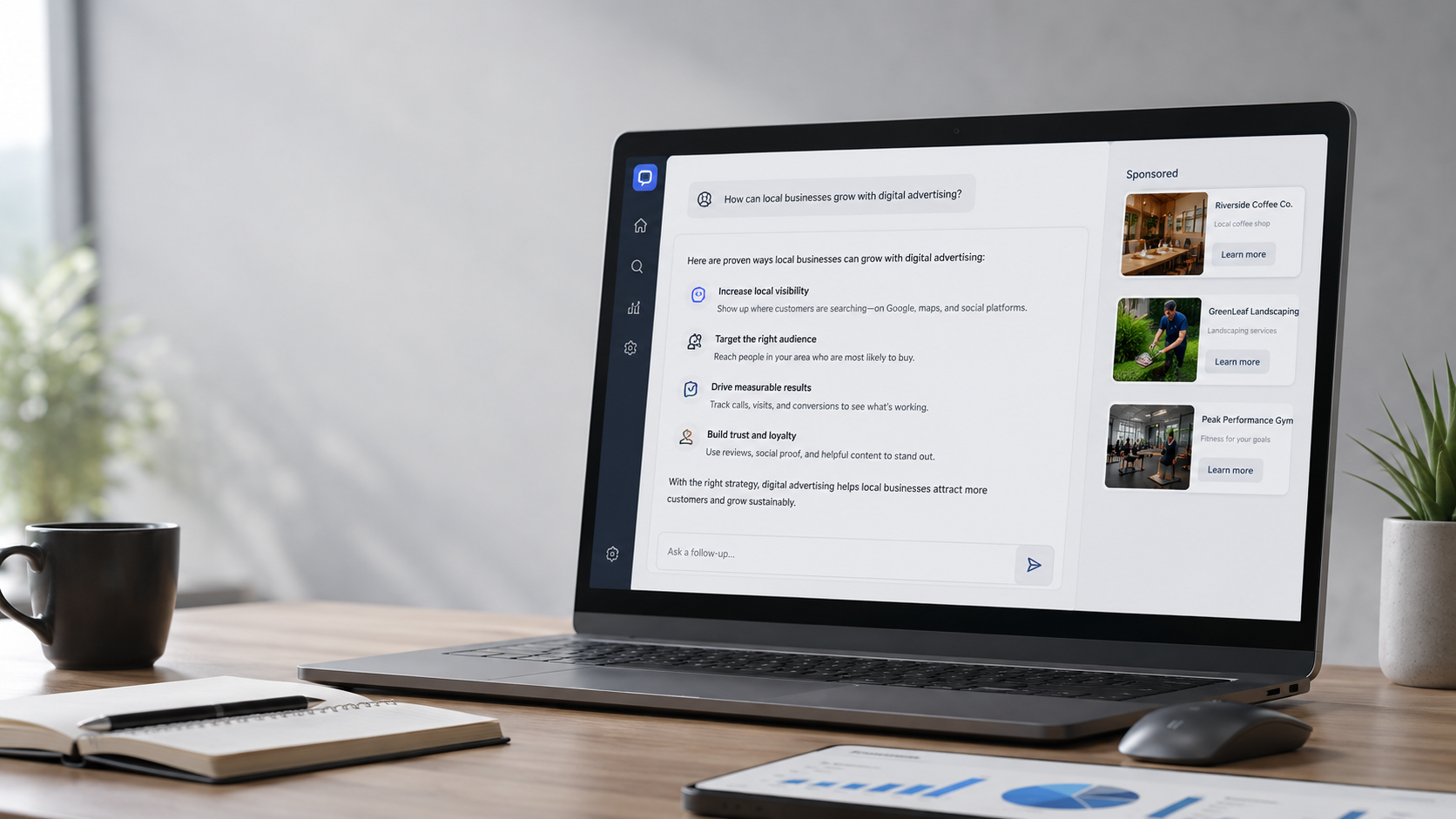
The launch. Ads went live on February 9, 2026, for U.S. users on the Free and Go tiers — Go being the $8/month plan. Everyone on Plus, Pro, Business, Enterprise, and Education sees no ads at all, and OpenAI has positioned ad-free access as a permanent feature of paid tiers. The ads themselves appear as clearly labeled sponsored cards below the response, matched contextually to the conversation rather than by traditional keyword bidding — and blocked entirely from sensitive contexts like health, mental health, and politics, and from minors.
The expansion. It hasn't stayed a small U.S. test. Per OpenAI's own running update page, the company reported encouraging early results in March and announced in May that the pilot would expand to the United Kingdom, Mexico, Brazil, Japan, and South Korea. By summer, reporting had the ads program operating across the U.S., U.K., Canada, Australia, New Zealand, Japan, and Korea, with a self-serve Ads Manager open to advertisers — no minimum spend, CPC and CPM bidding — plus a product-feed feature letting retailers upload whole catalogs. One analysis counted 86 days from six-figure enterprise pilot to open self-serve, a rollout pace that compressed what took other platforms years. The EU is the notable holdout, delayed over unresolved GDPR consent requirements.
The money. The big holding companies didn't wait: WPP, Omnicom, and Dentsu joined the pilot, with Omnicom placing more than 30 clients and early brand commitments reported at $200,000–$250,000 — roughly double a typical experimental ad budget. When the world's largest ad buyers pay double the usual tuition to learn a channel, they're telling you what they think it becomes.
The audience. The scale explains the urgency. OpenAI has reported 900 million-plus weekly active users, with chatgpt.com consistently ranked among the five most-visited sites on Earth. And the ad-supported free tier skews young: a majority of U.S. adults under 30 use consumer ChatGPT, and nearly half of all messages come from users under 26 — which is to say, the ads are reaching the next twenty years of your customers first.
The sentence that matters more than the launch
Buried in all of that is the structural detail every local business should tattoo somewhere visible, and it comes from OpenAI's own design of the product: the ads sit next to the answer — they do not change it.
OpenAI states plainly that ads don't influence ChatGPT's responses. The sponsored card renders below the answer, labeled, visually separated. What ChatGPT actually says — which dealership it names when a buyer asks who to trust, which practice it recommends when a new resident asks who's taking patients, whether your business exists at all in its picture of your town — is determined by relevance and the underlying signals about your business, not by anyone's ad budget. As one early analysis put it after the launch: you can buy visibility alongside the organic answer, but you cannot buy a better position inside it.
If that structure sounds familiar, it should. It's Google, 2000. When AdWords launched, plenty of people declared organic search dead — why earn a ranking when you can buy the slot above it? A quarter century later we know exactly how that played out: the ads built a trillion-dollar company, and the organic results underneath them stayed the thing users actually trust and click for anything that matters — which is why the rent-vs-own math has governed every marketing budget since. The arrival of a paid lane didn't kill the earned lane. It made the earned lane more valuable, by confirming the channel was where the customers were and by giving every user twenty years of practice distinguishing the ad from the answer.
That's what just happened to AI search. There is now officially a rent lane and an own lane. The rent lane is a labeled card below the answer, available to whoever bids. The own lane is the answer itself — the recommendation, the citation, the being-named — and it is still built the only way it's ever been built: entity signals, structured data, and content worth citing, assembled from what's findable and credible about your business. The day ChatGPT started selling the card is the day the answer's unbuyability stopped being our claim and became OpenAI's product architecture.
What the ads actually look like — and why the format matters
Worth pausing on the format itself, because it tells you where this is headed.
A ChatGPT ad today is a labeled, subtly tinted sponsored card that renders below the response — a product or service matched to what the conversation is already about, drawn from the current topic, chat history, and past ad interactions rather than keyword bids. Ask about redoing a deck, and a home-improvement retailer's card might appear under the answer. Ask about anything health-related, political, or sensitive, and nothing appears at all. There's no auction for position inside the answer because no such position exists; the card is the whole paid surface.
Two implications hide in that design. First, contextual matching means intent-rich placement without keywords — the ad system reads the conversation the way the answer engine does, which is exactly why the retail giants and agency holding companies moved first: a user mid-conversation about a purchase is worth more than a user scrolling a feed. Second, and more useful for you: the same signals that would someday make your ad match well are the signals that make the organic answer name you today. A business whose services, service area, and specifics are clearly structured online is legible to both systems. The GEO work isn't a hedge against the ads; it's the prerequisite for either lane working.
Which reframes the budget question properly. This isn't "should we buy ChatGPT ads" — it's the same two-column worksheet as every other channel: the rent lane (the card: instant, labeled, expires with the spend, priced by an auction that only gets hotter as the agencies scale in) and the own lane (the answer: slow to earn, free to keep, compounding, and — uniquely on this platform — the thing users came for). Google spent twenty-five years teaching everyone that the businesses who win long-term run owned-first and rent the gaps. There is no reason to expect the AI version to run differently, and every reason to expect the owned lane's head-start window to be shorter this time.
What this means for a local business, practically
Five things, in descending order of how much they should change your behavior:
1. The answer just became more valuable, not less. Ads arriving means commercial intent is arriving — OpenAI itself notes people use ChatGPT while actively exploring options, and the ad platform exists to monetize exactly those moments. Every dollar the big agencies pour in trains more users to bring their buying questions to the chat window. All of those users see one organic answer before they see any card. If your business isn't in that answer — or is in it wrong — the traffic surge the ads are chasing flows straight past you.
2. If you're in healthcare, the organic lane is the only lane. Health and mental health advertising is blocked at the platform level, and ads are excluded from health-related conversations entirely. Read that as a practice owner: when one in three American adults asks AI health questions and a patient asks who to see near Sewell, there will never be a sponsored card to fall back on. The recommendation is organic or it's nobody. For medical, dental, PT, and therapy practices, ChatGPT's ad launch didn't open a channel — it certified that the earned channel is the whole game.
3. The free tier is where your customers are. The users who see ads — Free and Go — are the mass market: the households, the young buyers, the under-26 cohort sending half the platform's messages. The professionals on ad-free Plus and Business tiers are, statistically, more likely to be you than your customer. Which means the version of ChatGPT your next customer uses now has a commercial layer in it — and the businesses treating the platform as a serious discovery channel are pricing that in while everyone else is still asking whether AI search is real.
4. Should you buy the ads? Honestly: probably not yet — but watch closely. Early advertisers describe attribution as messy and the first months as a learning budget rather than a performance budget, and the brands writing $250K checks are buying data, not customers. For a local business, self-serve access with no minimum spend means the door is open when the targeting and measurement mature — and when your category's auction is still cheap, which it won't stay. Our honest position is the same one we hold on every rented channel: some rent can be smart, all-rent never is, and rent on a brand-new platform is smart last, after the owned presence is built — because the ad card works a lot harder when the organic answer beneath it already knows your name.
5. The deadline mechanic applies, again. If you've read our seasonal posts, you know the physics: visibility is a slope, demand is a spike. ChatGPT's ad rollout is a demand spike in slow motion — every quarter of expansion brings more commercial users asking more buying questions. The businesses getting cited and named now, while their categories are quiet, are compounding into position before the crowd arrives. The ones who wait for ChatGPT ads to "prove out" will start building organic visibility at the exact moment it's hardest and most contested. Same story as Google, 2003. You know who won that one: the businesses already ranked when everyone else showed up.
The honest part
Three things, plainly, because AI-platform news ages fast:
This story is still moving. Formats, markets, policies, and pricing have all changed multiple times in a matter of months, the EU rollout is unresolved, and anything in this post could be superseded — which is why every claim above carries a dated source you can check. When the picture changes materially, we'll update or follow up; that's the standard we publish everything under.
Nobody — including us — fully knows how AI ads will perform. The honest state of the channel is: enormous audience, real intent, immature measurement. Anyone selling you confident ChatGPT-ads ROI projections in year one is selling something. What is known, because OpenAI built it into the product, is that the answer layer stays earned — and earning it is measurable, monthly, in the same Search Console-and-citation terms we publish for ourselves.
And the trust question is live. OpenAI says it won't optimize for time spent and will keep answers independent; users and regulators will hold them to it, and so should you. If that line ever blurs — if the ad ever leaks into the answer — the earned-visibility playbook doesn't get weaker, it gets mandatory, because trust will flow to whatever remains verifiably organic. Either way the assignment for a local business is the same one it's been all along.
The bottom line
Four sentences, like always. ChatGPT is now showing labeled ads to its free-tier users — the mass market, the young, your customers — with a self-serve ad platform, no minimum spend, and international expansion already underway. By OpenAI's own design, the ads sit beside the answer and cannot change it — so AI search now has a rent lane and an own lane, and the own lane, the answer itself, is still earned through the signals and content your business puts in the world. Healthcare can't even use the rent lane, and every other category's rent will only get more expensive as the agencies pile in. The moment to find out what the answer currently says about you was before the ads showed up; the second-best moment is now.
Frequently Asked Questions
Who sees ads in ChatGPT?
Logged-in adult users on the Free tier and the $8/month Go tier, per OpenAI — launched in the U.S. in February 2026 and expanding internationally to markets including the U.K., Japan, South Korea, Mexico, and Brazil, with the EU delayed over GDPR. Users on Plus, Pro, Business, Enterprise, and Education plans see no ads, and OpenAI has committed to always offering an ad-free paid tier. Ads are also excluded from minors' accounts and from sensitive conversations.
Can a business buy its way into ChatGPT's answers?
No — and this is the most important fact of the entire launch. Ads appear as clearly labeled sponsored cards below the response, and OpenAI states the ads do not influence what ChatGPT actually says. Which business the answer names is still assembled from organic signals — entity data, structured content, citations, reviews — exactly the earned visibility that GEO builds. You can rent the card; the answer has to be owned.
Can medical practices advertise on ChatGPT?
No — health and mental health advertising is blocked at the platform level, and ads are excluded from health-related conversations entirely. For practices, that makes the stakes unusually clean: when a patient asks ChatGPT who to see, the organic recommendation is the only recommendation there will ever be. A practice that's absent from the answer has no paid fallback — the earned lane is the whole road.
Should a local business buy ChatGPT ads right now?
Probably not yet, honestly. Early advertisers report immature attribution and treat spend as a learning budget, and the six-figure pilots are big brands buying data. The self-serve platform's no-minimum access means the option stays open as measurement matures — but the sequence matters: build the owned presence first, because the sponsored card performs better when the organic answer already names you, and rent should always be the supplement, never the plan.
Does ChatGPT launching ads mean AI search is replacing Google?
It means AI search graduated into a commercial channel — the same milestone Google hit when AdWords launched in 2000. With 900 million-plus weekly users and the world's largest agencies committing six-figure pilots, ChatGPT is now a place businesses pay to be seen, which historically is the moment a channel stops being optional. Google isn't going anywhere — but the discovery pie is now split, and both slices reward the same underlying work: being the findable, structured, citable answer.
How does a business show up in ChatGPT's organic answers?
The same way it earns AI visibility everywhere: clean entity signals (consistent name, location, and history across the web), structured data on a healthy site, content specific enough to be worth citing, real reviews, and genuine local authority — then testing it, prompt by prompt, the way we've published for real businesses. It's earned, it's measurable, and it compounds — which is exactly why it can't be bought and exactly why it's worth building before your category gets crowded.
Find out what the answer says about you — before the ads pile in around it
Here's the offer, plainly: we'll run your business through the free visibility check — we ask ChatGPT, Gemini, and Claude who they'd recommend for what you do, in and around your market, and record exactly what they say about you and whether it's even correct — then give you a plain-English read on your Google standing and site health, with what we'd fix first to earn the answer while your category's still quiet. Yours whether or not you ever hire us, with a real reply from the founder within one business day. No pressure, no pitch deck.
Get your free visibility check → — mention "AI search" in the form.
Sources
OpenAI — Our approach to advertising and expanding access to ChatGPT
OpenAI — Testing ads in ChatGPT (running updates: March and May 2026 expansion announcements)
Launchcodex — ChatGPT ads are live: a complete breakdown (Feb 9 launch date, tier details, blocked categories, EU delay, answer independence)
Northeast Times — ChatGPT now shows ads, and marketers are scrambling (agency pilots via CNBC/AdWeek: WPP, Omnicom, Dentsu; $200K–$250K commitments)
2Point Agency — ChatGPT advertising: the complete 2026 guide (ad format, contextual matching, self-serve Ads Manager, no minimum spend)
explainx.ai — OpenAI's "Advertise in ChatGPT" launch (900M+ weekly users, launch markets)
Monks — Navigating the ChatGPT ad rollout (free-tier demographics: under-30 adoption, under-26 message share)
MarketScreener — OpenAI introduces advertising in ChatGPT for U.S. users (sensitive-topic and minor exclusions)