The Math Behind When a New Site Finally Gets Clicks
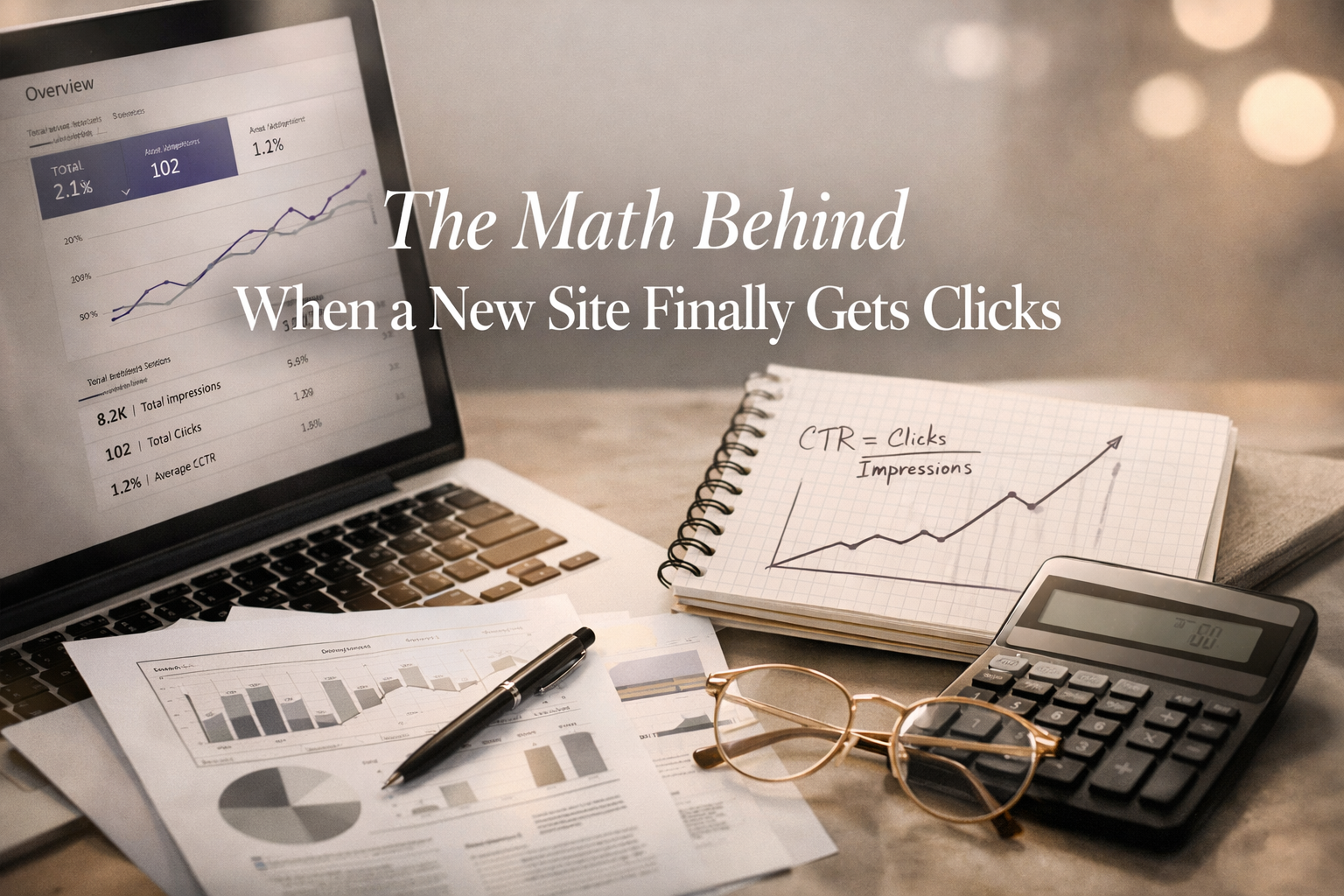
If you’ve launched a new site and opened Google Search Console expecting… something… you probably saw this instead:
Impressions slowly ticking up
Clicks hovering near zero
A growing sense that SEO might just be vibes
It’s not vibes.
It’s math.
And once you understand the math, early-stage SEO gets a lot less stressful.
Impressions always come before clicks
For new domains, Google almost always follows the same sequence:
Show your pages a little
Show them a bit more
Watch what users do
Then decide whether to trust you
Clicks don’t unlock impressions.
Impressions unlock clicks.
That’s why new sites feel “invisible” — they’re still in the data collection phase.
The simplest formula in SEO
At its most basic, organic traffic works like this:
Clicks = Impressions × CTR
CTR (click-through rate) is where expectations usually break down.
Most people subconsciously assume:
“If I get impressions, I’ll get clicks”
In reality, CTR is often tiny at the beginning.
What CTR actually looks like in organic search
Here’s a realistic range of organic CTRs, especially for new sites.
🔴 Low CTR (very common early on)
0.1% – 0.3%
Positions 20–40
New domains
Page 2–4 results
Example:
1,000 impressions × 0.2% CTR = 2 clicks
That’s not bad performance.
That’s normal.
🟡 Average CTR (early traction phase)
0.5% – 1%
Long-tail queries
Positions 10–20
Strong intent match
Example:
1,000 impressions × 0.8% CTR = 8 clicks
This is usually when teams first notice “hey, this is working.”
🟢 High CTR (strong fit + visibility)
2% – 5%+
Page 1 results
Very specific queries
Clear “how do I” or “why isn’t this working” intent
Example:
500 impressions × 3% CTR = 15 clicks
This is where SEO starts to compound.
So how many impressions before you see clicks?
There’s no magic number — but there are probabilities.
A rough rule of thumb for new sites:
200–500 impressions → maybe 1 click
500–1,000 impressions → a few clicks
1,000–3,000 impressions → a consistent trickle
5,000+ impressions → real patterns emerge
If your CTR is 0.2%, you need:
500 impressions to get ~1 click
5,000 impressions to get ~10 clicks
That’s not failure.
That’s math playing out.
Why long-tail queries matter so much early
New sites rarely win big, competitive keywords right away.
They win on:
Long, specific searches
Awkward phrasing
Edge-case questions
Long-tail queries:
Have less competition
Care more about relevance than authority
Often convert better than broader terms
That’s why early clicks usually feel random — they’re not.
They’re just coming from places people don’t think to look.
The compounding effect most people miss
Here’s the part that doesn’t show up clearly in dashboards:
Once Google sees:
A click
A normal time on page
No immediate bounce back to search
It often:
Expands impressions for similar queries
Tests your page higher
Increases your future CTR opportunities
Clicks don’t just come from impressions.
They help create more impressions.
That’s the flywheel.
Why this stage feels slow (but isn’t broken)
If you’re seeing:
Low impressions
Low CTR
Very few clicks
It usually means:
Your domain is new
Your rankings are still page 2–4
Google is still deciding how much to trust you
Time alone doesn’t fix that.
But consistent impressions + reasonable engagement usually do.
The real takeaway
Early SEO isn’t about instant traffic — it’s about building a sample size.
Once you understand:
How impressions accumulate
What realistic CTRs look like
And how clicks compound trust
The waiting becomes a lot easier to stomach.
And if you don’t want to decode this math, manage expectations internally, or figure out why performance looks “low” but isn’t actually broken — reach out to Ritner Digital.
We help teams understand both sides of modern marketing:
The strategy and
The numbers underneath it
Because today, marketing isn’t just creative anymore.
It’s analytical.
And sometimes, it’s a little technical too.
FAQs
How many impressions does a new site need before getting clicks?
There’s no fixed number, but most new sites start seeing their first clicks somewhere between 200 and 1,000 impressions.
At early-stage CTRs (often 0.1%–0.3%), clicks are a probability game. Low clicks don’t mean something is wrong — they usually mean the sample size is still small.
What is a “good” CTR for a new website?
For a brand-new domain, a CTR between 0.1% and 0.5% is completely normal, especially when rankings are on page 2 or lower.
Higher CTRs (1%+) usually appear once:
Rankings move closer to page 1
Search intent is very specific
Google has tested the page long enough to trust it
Why do impressions increase before clicks?
Because Google tests visibility before it tests trust.
Impressions allow Google to observe:
Query relevance
User behavior
Whether searchers reformulate the query afterward
Clicks come after Google feels confident the page won’t disappoint users.
Is low traffic early on a sign of bad content?
Not necessarily.
Most often, low early traffic means:
The domain is new
Authority hasn’t been established yet
Rankings haven’t reached high-CTR positions
Content quality matters, but time + data matter too.
Why do long-tail keywords drive the first clicks?
Long-tail queries:
Have less competition
Rely more on relevance than authority
Often appear in unstable SERPs
That makes them ideal entry points for new sites, even when overall traffic is still low.
Can improving CTR alone increase traffic?
Yes — to a point.
Better titles, clearer intent matching, and stronger meta descriptions can improve CTR, which can:
Lead to more engagement
Encourage Google to test higher rankings
Create a compounding visibility effect
CTR doesn’t replace rankings, but it can help unlock them.
How long should you wait before changing SEO strategy?
Generally, 6–10 weeks is a reasonable window for a new page or domain.
If impressions are growing but clicks are low, the issue is usually position or CTR — not strategy. If impressions aren’t growing at all, that’s when a rethink is warranted.
When should you get outside help with SEO performance?
If you’re:
Unsure whether low traffic is normal or a real issue
Struggling to explain performance internally
Juggling strategy, content, and technical constraints
It may be time to get a second set of eyes.
If you need help understanding the numbers and the systems behind them, reach out to Ritner Digital.
We help teams make sense of organic growth without guesswork — or panic.
Related Reads
〰️
Related Reads 〰️
Why Organic Traffic Is the Most Sustainable Growth Strategy in 2026
Paid ads deliver short-term results. Organic traffic compounds. Learn why SEO and content marketing are the most sustainable growth strategies for businesses in 2026 — and how to build traffic that converts long after campaigns end.
High-Volume vs. Low-Volume Keywords: How to Plan Content That Actually Grows Traffic
Should you chase high-volume keywords or focus on low-volume wins? This guide breaks down how to balance keyword volume, intent, and competition to build a content strategy that compounds organic traffic over time.

Have a Business Idea? Test It Before You Bet the House
Got a business idea but not sure if it’ll actually work? Before you go all in, learn how to test demand with a lean website and SEO strategy that shows you what people are really searching for.