What AI Overviews Did to Local Business Traffic in 2026 — And What Still Gets Clicked
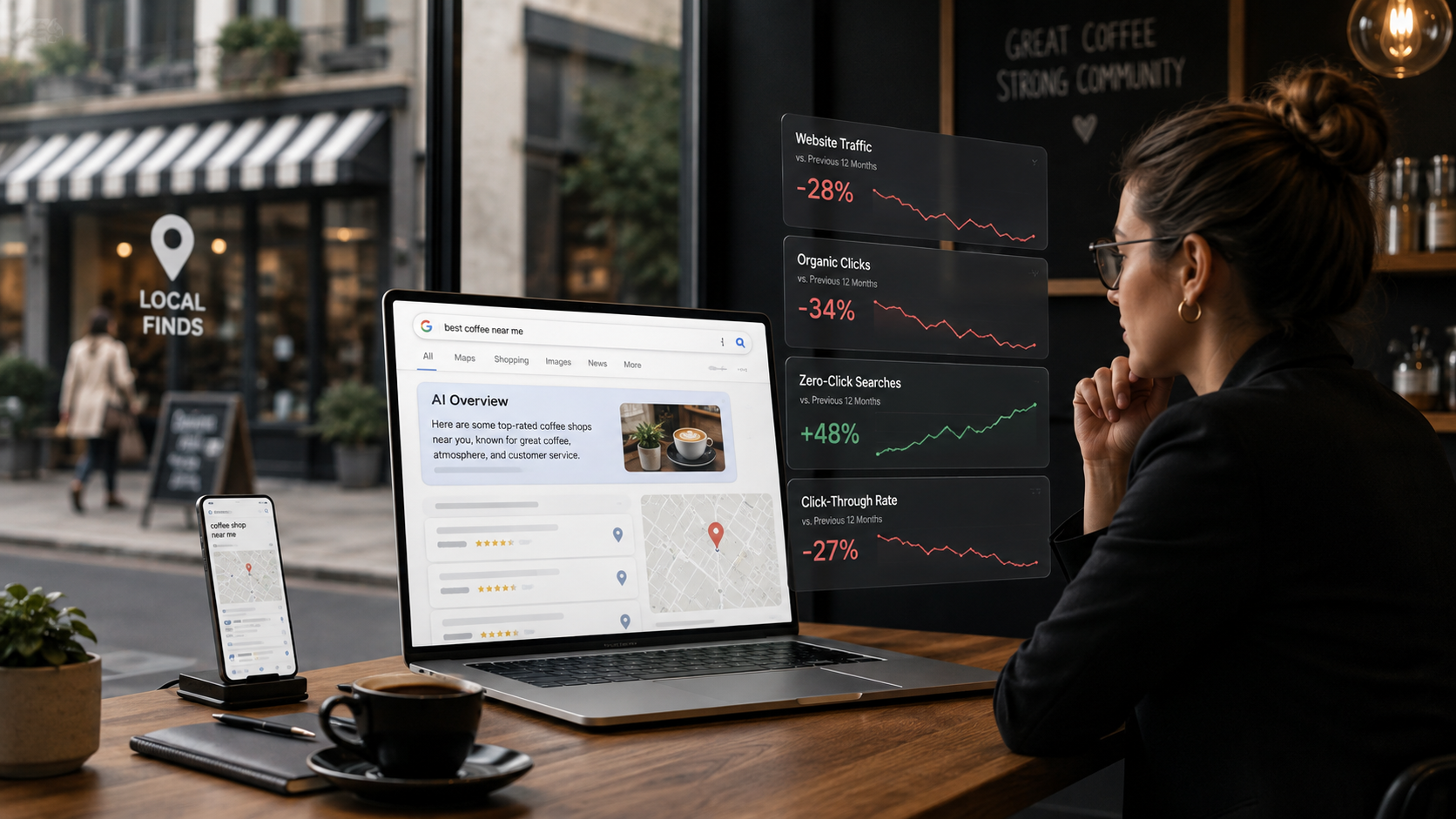
2026 is the year the click became optional.
Google now answers a huge share of searches itself — an AI-written summary, sitting above the links, built from the web's content and increasingly consumed instead of it. If you run a local business, you've felt some version of this even if you couldn't name it: impressions that look fine while clicks sag, a traffic chart that flattened for no visible reason, a vague sense that "we rank fine" and "the phone rings less" have stopped agreeing with each other.
This post is the full accounting. We compiled every major study we could verify — Pew Research, Ahrefs, Seer Interactive, SparkToro, Semrush, BrightEdge — on what AI Overviews actually did to traffic, and we put our own Search Console numbers next to the industry data, because publishing our own numbers is the house standard and a research post that hides its author's data isn't research. Every statistic below is dated and linked. Cite freely; that's what it's for.
The short version, if you read nothing else: the damage is real and unevenly distributed, paid ads got hit harder than organic, and five specific kinds of clicks survived — including the most valuable one, which most businesses have never heard of.
Part 1: The damage, measured
How widespread are AI Overviews now? More than most owners realize, with an honest caveat: measurement varies by methodology. At the aggressive end, Advanced Web Ranking tracking put AI Overviews on roughly 48% of Google queries by March 2026, up from about 34.5% in December 2025; Conductor's 21.9-million-search sample found 25% of queries with 34.5% average market coverage; other trackers land between. The spread across studies runs roughly 13% to 60% because each samples different keywords — but every tracker agrees on the direction: up, fast, into more query categories every quarter.
What happens to clicks when one appears? This is the best-documented answer in modern search. Pew Research Center tracked 68,879 real searches from 900 U.S. adults and found users clicked a traditional result just 8% of the time when an AI summary appeared, versus 15% without one — a 47% relative drop — and were far more likely to end the entire session after an AI answer (26% vs. 16%). Ahrefs' December 2025 analysis of 863,000 keywords and 4 million AI Overview URLs found a 58% CTR reduction for top-ranking pages — nearly double its own April 2025 measurement, meaning the bite deepened within a single year. Seer Interactive measured organic CTR falling from 1.76% to 0.61% — a 61% drop — on queries with AI Overviews. And mobile takes it worse than desktop (−29% vs. −21%), because the summary fills the screen your local customer is actually holding.
The signature every owner should learn: BrightEdge found total search impressions up roughly 49% since AI Overviews launched, while click-throughs fell nearly 30%. Impressions up, clicks down — being seen more and visitedless — is the fingerprint AI Overviews leave on a Search Console account, and we'll use it as a diagnostic in Part 5.
Zoom all the way out and it stacks onto the trend we've written about before: a majority of U.S. Google searches now end without a click to any website, per SparkToro/Datos — and the AI layer is accelerating it.
Part 2: The plot twist — paid ads got hit harder
Here's the number almost nobody quotes, and it should reorganize a few budgets. In the same Seer Interactive research measuring organic's 61% decline, paid CTR fell from 19.7% to 6.34% when an AI Overview appeared — a 68% drop, worse than organic.
Sit with that. The standard panic response to "AI is eating organic clicks" is run more ads — and the data says the ads are being eaten faster. The AI summary doesn't discriminate between the earned listing and the purchased one below it; it intercepts the click before either gets a look, which means every dollar of the rent lane now buys a click that's 68% harder to get on affected queries, at auction prices that didn't fall to match. If you needed one statistic to bring to the meeting where someone proposes advertising your way out of the AI era, it's this one.
Part 3: What still gets clicked — the five survivors
Now the half of the headline that matters more, because the click didn't die — it concentrated. Five kinds survived, and together they're the whole 2026 playbook:
1. Transactional and commercial intent. The asymmetry is dramatic: informational queries lose roughly 34.5% of their CTR to AI Overviews, while transactional queries lose under 10% — and AI Overviews trigger far more often on informational searches than commercial ones in the first place. When someone is doing rather than learning — booking, buying, visiting, calling — the click survives, because a summary can't schedule an appointment or hold inventory. For a local business, this is the reprieve: "pediatric dentist Sewell accepting new patients" and "trench grate ADA compliant buy" behave nothing like "why does my knee hurt."
2. Local and branded intent. The map pack, the Business Profile, the branded search — the surfaces where a local customer finishes the job — remain click-and-call machinery, and branded queries show far smaller CTR losses because the searcher already knows where they're going. Everything we've ever written about the tended profile and the hometown name got more valuable in 2026, not less: branded demand is AI-resistant demand, and building it is the long game.
3. The citation — the new position one. The most important survivor, and the least known: Seer Interactive found brands cited inside AI Overviews earn 35% more organic clicks and 91% more paid clicks than non-cited brands. Read that again — the AI answer isn't only a click-thief; it's a recommendation engine, and being its source confers a visibility premium bigger than most ranking gains. This is the exact content-format game we've been documenting across clients: specific, first-hand, structured, only-you-could-write-it material gets quoted; commodity content gets summarized into oblivion. In 2026, the strategic question quietly changed from "do we rank?" to "are we the answer's source?"
4. The click that survives converts absurdly well. The quality flip: Ahrefs reports AI-search visitors converting at 23x the rate of regular search visitors, and Semrush data shows AI-driven traffic converting 4.4x traditional organic. The AI layer pre-answers the casual questions and forwards the serious people. Fewer visitors, dramatically better ones — which means judging 2026 traffic by 2023 volume expectations mismeasures the business. Leads, not sessions, were always the scoreboard; now the data insists on it.
5. The click AI structurally can't replace. Real-time and proprietary specifics: your actual prices, this week's inventory, tonight's availability, the booking calendar, the preorder form. A summary can describe the category; it cannot transact your particulars. Every page built around live specifics — the bake schedule, the hall's December availability, the published rate card — is a click no AI Overview can intercept, which is one more argument for publishing the numbers "call for a quote" hides.
Part 4: Our own Search Console, during all of this
Industry data is other people's weather. Here's ours, because a research post that won't show its own chart is asking for a trust it hasn't earned.
[INSERT GSC CLICKS CHART]
This domain launched from zero in 2026 — into the exact environment described above, with no ad spend, ever. Weekly Google clicks went from 41 in early May to a record 202 by late July — roughly 5x in a quarter — with the dips published alongside the peaks in every monthly benchmark report. The domain earned 375 backlinks in under a year, including citations from other marketing firms, verifiable in both directions.
Two honest framings of that. First, the encouraging one: that growth happened during the zero-click era, on a brand-new domain, by building for the 2026 rules from day one — citation-worthy formats, entity structure, specific first-hand content — which is evidence the survivors above aren't theoretical. Second, the humble one: we're a single small domain, not a 300,000-keyword study; our numbers illustrate the playbook, they don't prove it at scale. That's why every claim in Parts 1–3 leans on the big datasets, and our chart is offered as a worked example — the same standard we'd hold anyone else's case study to.
Part 5: How to read your chart against this data
The practical section — ten minutes, your own Search Console, same method as our chart-reading guide:
[INSERT GSC IMPRESSIONS VS CLICKS]
Pull 16 months of impressions and clicks, monthly, and compare their shapes. Impressions steady-or-up while clicks fell— the BrightEdge signature — means the AI layer is likely absorbing your visibility: you're being seen, summarized, and skipped, and the response is the citation game (Part 3, #3), not more of the same content. Impressions and clicks falling together means you didn't lose a click-through battle — you lost rankings, and AI Overviews are not your alibi; run the standard diagnosis. Clicks holding while the industry's fell means your traffic already lives in the surviving intents — local, branded, transactional — and the job is deepening the moat. Then check the query report: which queries lost CTR at stable position? Those are your AI-Overview casualties, named individually, and each is a candidate for the citation treatment. If leads held while sessions dipped, you may simply be living the 23x effect — measure accordingly.
What this means vertical by vertical
Because this data lands differently depending on what you sell, here's the sixty-second read for each of the businesses we write for:
Medical, dental, PT, and therapy practices. Health is the most AI-answered category in search — informational medical questions trigger summaries at among the highest rates measured — which sounds like bad news until you remember the asymmetry: the booking searches ("accepting new patients," "near me," the branded check) sit in the surviving intents, and the AI recommendation layer has no ad slot in healthcare at all. For practices, the citation game is the whole game: provider-reviewed content that AI quotes, plus a fortress of local and branded signals underneath it.
Dealerships. The research phase ("best truck for towing," comparison content) is getting summarized — but the money clicks were always transactional and inventory-anchored, and a summary cannot hold your actual trucks. Live inventory pages, real prices, and the buyer guides AI cites by name are the 2026 moat — and note that the marketplaces renting you leads are fighting the same paid-CTR collapse with worse cards.
Seasonal and home services. "How much does X cost" queries increasingly get an AI answer — assembled from whoever published pricing. Which converts our long-standing publish-your-rates argument from best practice into survival: the installer whose rate card is the summary's source gets both the citation and the surviving transactional click; "call for a quote" gets summarized out of existence.
Firehouses, police departments, and nonprofits. Mission organizations live in informational search — "how to volunteer," "how do I get a police report," "where to donate" — exactly the AI-answered zone. The move is to be the answer: structured, specific institutional pages that the summary quotes and links, because for a nonprofit whose findability is the mission, a citation in the AI answer is service delivery, not marketing.
Manufacturers and B2B. The spec-stage research your buyers run is AI-mediated now; the surviving clicks are the CAD file, the submittal sheet, and the compliance documentation — proprietary specifics no summary replaces — plus the citation premium when the engineer's AI briefing quotes your resource library.
One playbook, five accents: own the surviving clicks, become the answer's source, and measure by leads.
The honest part
Four disclosures, because research posts age and honest ones say so. The measurements disagree on magnitude — trigger rates span 13% to 60% by methodology, CTR losses span 15% to 89% by query type — and we've cited the spread rather than cherry-picking the scariest number; the direction is unanimous across every independent study, which is the finding that matters. This data has a shelf life — Google recalibrates constantly, as it visibly did in late 2025, and we'll update or follow up as the picture moves, as we did with ChatGPT's ads. Our own numbers are illustration, not proof— one small domain, stated plainly above. And no, this doesn't mean SEO is dead — it means SEO's scoreboard changed: from ranks and raw clicks to citations, surviving-intent clicks, and leads. The businesses reading the old scoreboard are losing games they don't know they're playing.
The bottom line
Four sentences, like always. AI Overviews now sit on as much as half of Google searches and cut clicks by up to 58% where they appear — and the popular escape hatch, paid ads, got hit harder at −68%. But the click concentrated rather than died: transactional, local, and branded intent survived nearly intact, cited brands earn 35% more clicks than uncited ones, and the visitors who still arrive convert at multiples of the old traffic. The 2026 game is being the answer's sourceand owning the clicks AI can't replace — and our own from-zero chart grew 5x inside this exact environment by playing it. Check your impressions against your clicks tonight; the fingerprint is either on your account or it isn't, and either answer tells you your next move.
Frequently Asked Questions
What are Google AI Overviews?
AI-generated summaries Google places above traditional results, assembled from web sources with citation links, answering the query directly on the results page. Launched in the U.S. in May 2024 and expanded aggressively since, they now appear on somewhere between a quarter and half of queries depending on the tracker, most heavily on informational searches. They're distinct from ChatGPT-style assistants — which have their own dynamics we've covered— but both reward the same underlying thing: being a citable source.
How much do AI Overviews reduce clicks?
The verified range, by study: Pew found users clicking traditional results 8% vs. 15% of the time — a 47% relative drop; Ahrefs measured a 58% CTR reduction for top-ranking pages across 863,000 keywords; Seer measured organic CTR falling 61%. The losses skew heavily toward informational queries (−34.5%) while transactional queries lose under 10%— the asymmetry that makes local, commercial-intent SEO the sturdiest position in 2026.
Do AI Overviews affect Google Ads too?
Worse than organic, per the best available measurement: Seer Interactive found paid CTR collapsing from 19.7% to 6.34% — a 68% drop — when an AI Overview appears, versus organic's 61%. The summary intercepts the click before the ad gets seen, at auction prices that haven't adjusted downward. "Just run ads" is not an escape from the AI era; it's paying rising rent for a shrinking room — and the one paid outcome that does thrive is being a cited brand, which lifts paid clicks 91% and is earned, not bought.
What kinds of searches still send traffic in 2026?
Five, per the data: transactional and commercial intent (<10% CTR loss); local and branded searches, where the map pack and Business Profile still finish the job; queries where you're cited inside the AI Overview (+35% organic clicks); anything anchored in live specifics AI can't hold — prices, inventory, availability, booking; and the smaller-but-better stream of AI-referred visitors converting at multiples of traditional traffic. Every one is buildable, and together they're the modern local playbook.
How do I know if AI Overviews hit my website?
Run the fingerprint check in Search Console: 16 months of impressions versus clicks, monthly. Impressions steady-or-rising while clicks fell is the AI-absorption signature; both falling together means lost rankings, a different disease with a different diagnosis. Then open the query report and find terms that lost CTR at stable position — those are your named casualties, and each is a candidate for citation-focused content. Ten minutes, your own data, no vendor required — though it's also the first thing our free check runs.
Is SEO dead now?
No — its scoreboard changed. Rankings and raw traffic were always proxies; the 2026 currencies are citations inside AI answers, clicks in the surviving intents (local, branded, transactional), and leads — where the arriving traffic now converts at several times the old rate. Our own domain grew 5x during this exact era by building for the new scoreboard from day one. What's actually dead is commodity content and volume-only measurement — and honestly, good riddance to both.
Find out where your business stands in the zero-click era
Here's the offer, plainly: we'll run your business through the free visibility check — the impressions-versus-clicks fingerprint on your own Search Console, which of your queries the AI layer is absorbing, whether you're cited or skipped in the answers ChatGPT, Gemini, and Claude give about your market, and which of the five surviving click types your business is positioned to own — with what we'd build first, in plain English. Yours whether or not you ever hire us, with a real reply from the founder within one business day. No pressure, no pitch deck.
Get your free visibility check → — mention "AI Overviews" in the form.
Sources
Pew Research Center (via Omnibound compilation) — 8% vs. 15% click rates with/without AI summaries; 26% vs. 16% session-end rates; 68,879 tracked searches
Ahrefs (December 2025, via Memeburn) — 58% CTR reduction for top-ranking pages; 863,000 keywords, 4M AI Overview URLs; BrightEdge impressions +49% / clicks −30%
Seer Interactive (via The Stacc) — Organic CTR −61% (1.76%→0.61%); paid CTR −68% (19.7%→6.34%); AI Overview prevalence tracking to 48% of queries
Seer Interactive (via Omnibound) — Cited brands earn 35% more organic and 91% more paid clicks
SQ Magazine compilation — Informational queries −34.5% CTR vs. transactional under −10%
AEO Vision — Trigger-rate methodology spread (13–60%); Conductor 25% / 34.5% coverage data
Searchlab — Mobile −29% vs. desktop −21%; featured-snippet displacement data
PikaSEO (Ahrefs/Semrush conversion data) — AI-search visitors converting 23x; AI-driven traffic 4.4x traditional organic
Ritner Digital — July 2026 benchmark report and 180-day report card (our own Search Console data, published monthly)