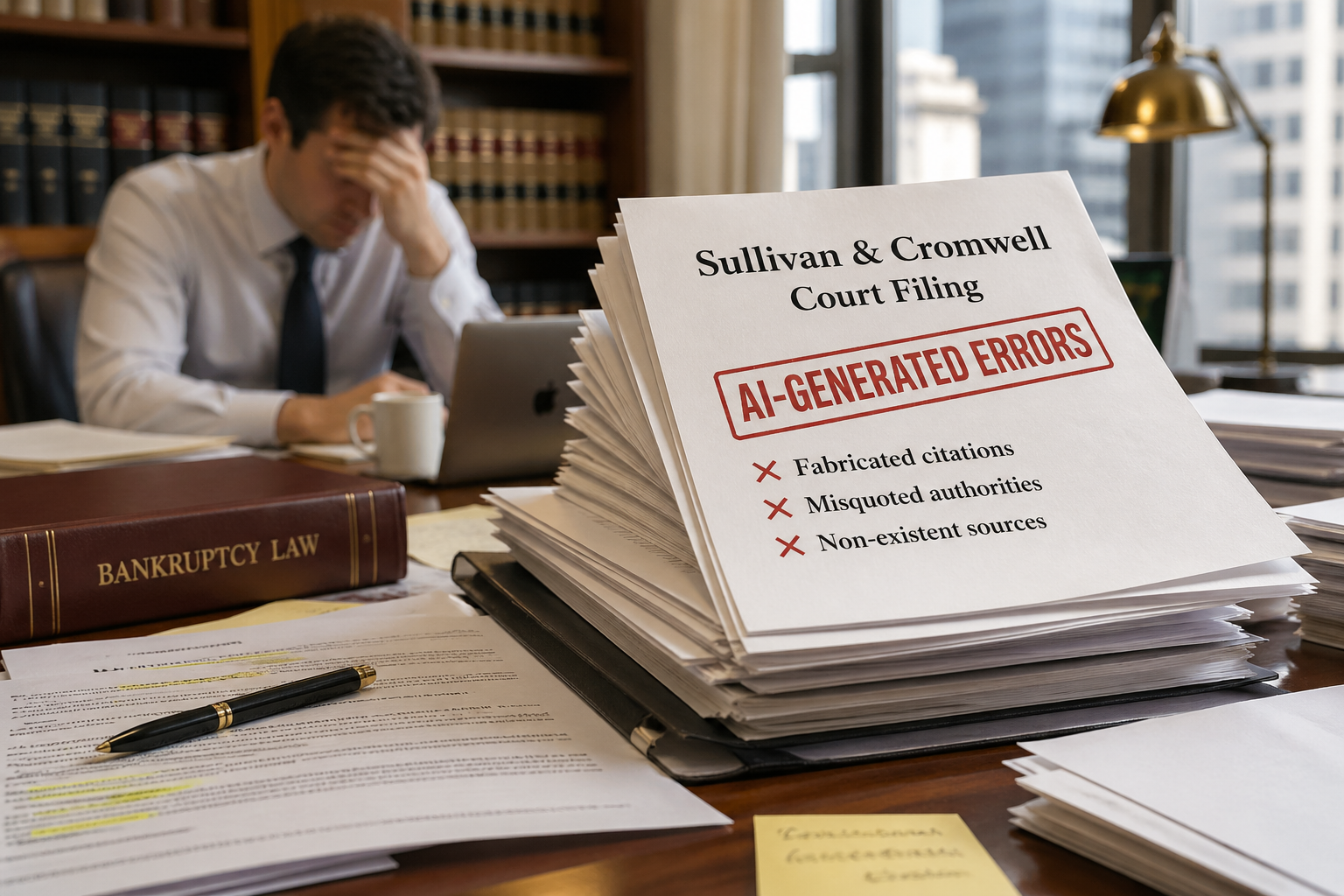
This Was Not Supposed to Happen Here
When AI hallucinations appear in court filings, they usually involve a solo practitioner working alone, a small firm cutting corners, or a junior associate who trusted an output they didn't understand. The narrative writes itself: someone who didn't know better used a tool they weren't equipped to evaluate.
That narrative just broke.
On April 18, 2026, Andrew Dietderich — founder and co-head of Sullivan & Cromwell's global restructuring group — wrote a letter to Chief Bankruptcy Judge Martin Glenn of the Southern District of New York. He apologized profusely after submitting a court filing peppered with errors, including fabricated citations generated by AI. The letter included a three-page list identifying and correcting more than 40 errors. CNN
Sullivan & Cromwell is not a firm that cuts corners. It is the law firm that advises OpenAI on the safe and ethical deployment of artificial intelligence. Above the Law Its partners reportedly charge around $2,000 an hour. It is, by any measure, one of the most resource-rich, process-driven, and professionally demanding legal institutions on the planet.
The firm stated that its safeguards were "designed to prevent exactly this situation" — and that regrettably, the review process did not identify the inaccurate citations generated by AI, nor did it identify other errors that appeared to result in whole or in part from manual error. Bloomberg Law
The errors were not caught internally. Dietderich learned of the problems only after they were caught by opposing counsel from Boies Schiller Flexner. CNN
If this can happen at Sullivan & Cromwell, it can happen anywhere. And that single fact is reshaping how B2B organizations think about AI adoption in 2026.
The Incident in Context: This Is Not an Anomaly
Before examining what this means for B2B adoption broadly, it is worth understanding how common this problem actually is — because the Sullivan & Cromwell incident is dramatic precisely because of who it happened to, not because of what happened.
Legal technologist Damien Charlotin has catalogued over 1,000 cases where generative AI produced hallucinated content in legal filings. Above the Law The database spans three years, crosses every tier of the profession, and continues to grow.
In the letter, Dietderich described AI hallucinations as situations where AI tools "fabricate case citations, misquote authorities, or generate non-existent legal sources." CNN This is the mechanism — the same statistical generation process we described in our previous post on Whisper Down the Lane — producing outputs that are plausible in structure but false in substance, delivered with complete confidence.
As noted by legal commentators, not all AI hallucinations are consequential. Some made-up citations and holdings reflect or embody real citations and holdings that the AI has blended into an approximate composite. But the Sullivan & Cromwell case involved errors significant enough to require a three-page single-spaced correction list — and cost the firm's clients weeks of runway in a case involving alleged human trafficking and forced labor in Cambodia. Substack
The stakes of a hallucination are not always abstract. Sometimes they are very concrete.
The B2B Adoption Paradox: Everyone Is Buying, Few Are Deploying
The Sullivan & Cromwell incident lands at a specific moment in the B2B AI adoption curve — one defined by a paradox that is becoming increasingly difficult to ignore.
Companies are buying the components of AI infrastructure but remain hesitant to weave it into daily operations. Goldman Sachs's latest adoption tracker shows corporate use of generative AI crept up to 9.7% of U.S. firms in the third quarter of 2025, only a modest rise from 9.2% three months earlier. AEI
In 2024, after a couple of years of experimentation, 74% of companies had yet to see tangible value from their AI initiatives. And as of mid-2025, nearly two-thirds of organizations remained stuck in the pilot stage, having not begun scaling AI across the enterprise. TechRepublic
In a survey of more than 120,000 enterprise respondents conducted between March 2025 and January 2026, only 8.6% of companies report having AI agents deployed in production, while 63.7% report no formalized AI initiative at all. TechRepublic
This is not what the infrastructure investment numbers would suggest. UBS estimates companies will spend $375 billion on AI infrastructure in 2026, rising to $500 billion the following year. AEI The capital is flowing. The deployment is not.
The gap between AI investment and AI integration is the defining tension in B2B technology right now — and the Sullivan & Cromwell incident illuminates exactly why that gap exists.
Trust Is the Bottleneck — and It Is Getting Harder to Build
The most common explanation for slow enterprise AI adoption is technical: integration complexity, data quality issues, talent scarcity. These are real barriers. But the data increasingly points to something more fundamental beneath them: trust.
Stack Overflow's 2025 developer survey revealed a striking puzzle. More than 84% of respondents were using or planning to use AI tools in 2025 — but only 29% said they trust those tools, down 11 percentage points from 2024. Use is rising while trust is falling. Stack Overflow
Informatica's survey of 600 data leaders found that while nearly 7 in 10 organizations have adopted generative AI, 75% of data leaders say employees need serious upskilling in data literacy, and 74% need AI literacy — meaning most organizations are deploying tools that most of their people are not equipped to critically evaluate. Informatica
McKinsey's 2026 AI Trust Maturity Survey, conducted across approximately 500 organizations, found that inaccuracy and cybersecurity remain the most frequently cited AI risks as adoption expands — and that active mitigation lags behind risk awareness across nearly every AI risk category. McKinsey & Company
The survey also found that confidence in organizational response to AI incidents has declined even as AI incident frequency remains stable — meaning organizations are not getting better at handling the problems AI creates, even as they deploy it more widely. McKinsey & Company
This is the trust paradox in B2B AI: adoption is accelerating faster than the governance, verification, and literacy infrastructure needed to make that adoption safe. The Sullivan & Cromwell incident is a precise, high-profile illustration of what that gap looks like when it costs you.
The Specific Mechanism: Why Safeguards Fail
One of the most important details in the Sullivan & Cromwell incident is that the firm had safeguards. Dietderich explicitly stated that the firm's safeguards were designed to prevent exactly this situation — and that regrettably those safeguards failed in this instance. Bloomberg Law
This is not a story about an organization that deployed AI recklessly. It is a story about an organization that deployed AI with documented policies and still produced a filing with more than 40 errors. Understanding why requires understanding how AI hallucinations interact with human review processes.
The problem is what researchers call automation bias — the well-documented tendency for human reviewers to give disproportionate credence to outputs generated by automated systems, particularly when those outputs are presented with high confidence and in authoritative formats. An AI-generated legal brief that looks correct — proper citation format, coherent legal reasoning, plausible case names and dates — is extremely difficult to catch through a review process that is itself relying on the reviewer's memory of whether those cases exist.
As legal commentators noted, there are technical tools specifically designed to catch AI hallucinations in legal briefs — tools like BriefCatch's RealityCheck that validate citations against real legal databases. The Sullivan & Cromwell incident underscores that process safeguards alone, without technical verification tools, are insufficient. Substack
The lesson generalizes well beyond law. In any B2B context where AI-generated content is reviewed by humans who are not equipped to independently verify every claim — which is most B2B contexts — the review process is not a reliable backstop for hallucinations. It catches what the reviewer notices. It misses what looks plausible.
What This Means for Different B2B Functions
The implications of the Sullivan & Cromwell incident — and the broader trust gap it represents — are not uniform across B2B functions. Some use cases are much higher risk than others, and the appropriate level of AI integration varies accordingly.
High-Stakes Functions: Verification Is Non-Negotiable
Legal, compliance, finance, and regulatory functions share a common characteristic: errors have direct, material consequences — to clients, to courts, to regulators, or to the organization's own risk profile. In these functions, AI-generated content must be treated as a draft requiring verification against primary sources, not as a finished output requiring only light review.
In financial services, banks deploying AI for credit scoring are pairing AI outputs with explainable models and audit trails so that each decision can be explained to a regulator or customer. In generative AI contexts, companies are pairing large language models with knowledge bases and fact-checking mechanisms to prevent hallucinations from reaching end users. Medium This is the model that high-stakes B2B functions should be following — AI as a drafting and synthesis tool, with systematic verification as a non-optional second step.
Research and Content Functions: Specificity Reduces Risk
For B2B marketing, content, and research functions — the area most directly relevant to Ritner Digital's clients — hallucination risk manifests differently than in legal contexts, but it is no less real. AI-generated content that misattributes research, fabricates statistics, or inaccurately represents industry data can damage brand credibility, erode buyer trust, and — as we have written about extensively — produce outputs that AI models then re-cite inaccurately in a compounding error cycle.
The mitigation here is the same principle we have advocated throughout this series: specificity and original data. Vague AI-generated content is the most hallucination-prone because there is nothing distinctive for the model to anchor on. Content built around specific, verifiable, original data points — your own survey findings, your own benchmark analysis, your own cited primary research — gives both human reviewers and AI systems something concrete to check against.
Process Automation Functions: Pilots Before Production
Only 8.6% of companies report having AI agents deployed in production — and the companies that have successfully scaled AI are those that moved from pilots to production with proper training and guardrails in place. TechRepublic For B2B organizations automating operational workflows with AI, the Sullivan & Cromwell incident reinforces the case for incremental deployment with documented verification checkpoints, rather than broad rollouts predicated on the assumption that AI outputs will be accurate enough not to require checking.
The Adoption Implication: Trust Must Be Earned, Not Assumed
Here is the strategic implication that the Sullivan & Cromwell incident makes unavoidable for B2B leaders.
AI adoption in B2B is not primarily blocked by technology. The technology exists, is improving rapidly, and is being invested in at extraordinary scale. What is blocking the translation of investment into deployment is the trust infrastructure — the governance, literacy, verification processes, and organizational accountability needed to deploy AI in ways that don't expose the organization to the kind of public embarrassment, legal liability, or reputational damage that Sullivan & Cromwell just experienced.
If models were credited for saying "I don't know" when unsure, rather than presenting uncertain outputs with the same confidence as certain ones, organizations would have significantly more confidence deploying tools they are already buying. AEI The calibration problem — AI's tendency to be confidently wrong — is not just a technical problem. It is the primary trust barrier to B2B adoption at scale.
Organizations with explicit accountability for responsible AI achieve higher AI maturity scores than those without clear accountability. McKinsey & Company The Sullivan & Cromwell incident demonstrates what the absence of effective accountability looks like in practice: policies that exist on paper, a review process that failed in execution, and a public apology to a federal judge.
Building the trust infrastructure that makes AI deployment genuinely safe in high-stakes B2B contexts requires four things that no AI vendor can provide for you:
Human verification workflows calibrated to the stakes. The higher the consequence of an error, the more rigorous the verification requirement. Legal citation checking requires database validation. Financial data requires source verification. Marketing claims require fact-checking against primary sources. The verification workflow should be proportional to the risk, not uniform across all use cases.
AI literacy at every level of the review chain. The trust paradox — employees trusting AI outputs they are not equipped to critically evaluate — is the deepest structural vulnerability in current B2B AI deployment. Informatica Organizations that invest in AI literacy alongside AI tools are building the human infrastructure that makes the technology usable at scale. Organizations that deploy tools without building literacy are building toward their own version of the Sullivan & Cromwell moment.
Explicit ownership and accountability for AI outputs. The Sullivan & Cromwell letter makes clear that the firm's review process failed — but it does not make clear exactly who was responsible for ensuring that review process worked. Diffuse accountability is the enemy of consistent process. Every AI-assisted output that carries organizational or legal risk needs a named owner whose job it is to verify it.
Technical verification tools, not just human review. Human review alone is not a sufficient backstop for AI hallucinations when those hallucinations appear in authoritative formats. Purpose-built verification tools that check AI outputs against primary sources — legal databases, financial data providers, fact-checking APIs — are increasingly necessary infrastructure for any B2B function using AI for high-stakes content production. Substack
The Paradox of the High-Profile Incident
There is one more thing worth saying about the Sullivan & Cromwell incident — something that cuts against the easy narrative of AI hype and AI danger.
The incident happened. It was caught. It was corrected. The errors were identified before the hearing, the corrected filing was submitted, and the legal process continued — damaged in credibility and timeline, but not destroyed.
More than three years into the breathless hype cycle kicked off by ChatGPT's launch, it is clear that generative AI can do a lot for a very specific kind of worker — and can lead to embarrassing outcomes for others. The distinction often comes down to whether the work is fundamentally deterministic, with clear right and wrong outcomes, or whether it involves complex judgment in domains where the model's confident output can't be easily verified. CNN
This is not an argument for slowing AI adoption. It is an argument for accurate AI adoption — deploying tools in the contexts where they genuinely reduce error and improve output, while maintaining rigorous human oversight in the contexts where AI confidence and AI accuracy diverge most dangerously.
The firms and organizations that will get AI adoption right in 2026 are not the ones moving fastest. They are the ones moving most deliberately — building the governance, literacy, verification, and accountability infrastructure that lets AI do what it does well, while catching what it does badly before it reaches a judge, a client, or a buyer.
Sullivan & Cromwell learned this the hard way, in public, in a bankruptcy court in Manhattan. The lesson is available to everyone else for free.
Wondering whether your content is being represented accurately by AI — or whether you have your own Sullivan & Cromwell moment waiting to happen in your marketing pipeline?
Talk to us → ritnerdigital.com/#contact
Frequently Asked Questions
What exactly happened in the Sullivan & Cromwell AI incident?
Sullivan & Cromwell, one of Wall Street's most prestigious law firms, filed a court motion in a bankruptcy case that contained more than 40 errors — including fabricated case citations generated by AI. The errors were caught by opposing counsel, not by the firm's own review process. The firm's co-head of restructuring wrote a letter to the presiding bankruptcy judge apologizing and submitting a corrected filing with a three-page error list.
Is this a Sullivan & Cromwell problem specifically or an industry-wide problem?
Industry-wide. Legal technologist Damien Charlotin has catalogued more than 1,000 cases of AI hallucinations appearing in court filings across three years. The Sullivan & Cromwell incident is notable because of the firm's prestige and resources — not because the underlying problem is unusual. The same hallucination dynamic that affects solo practitioners affects elite law firms. The mechanism does not respect institutional reputation.
Why didn't Sullivan & Cromwell's safeguards catch the errors?
The firm has stated that it has policies designed to prevent this — and that those policies were not followed in the preparation of this specific filing. The deeper issue is that human review processes are poorly suited to catching AI hallucinations when those hallucinations appear in authoritative, plausible formats. A fabricated case citation that looks real — correct format, plausible name, coherent date — is extremely difficult to catch without verification against a legal database. Human review catches what the reviewer notices. Technical verification tools catch what the human review misses.
What does this mean for B2B organizations that are adopting AI?
It reinforces that the bottleneck to successful AI adoption in B2B is not the technology — it is the trust infrastructure. Organizations that deploy AI without building corresponding governance, AI literacy, verification workflows, and explicit accountability are building toward their own version of this incident. The stakes and the public profile will differ. The mechanism is identical.
Is AI adoption slowing because of incidents like this?
Adoption is not slowing — it is accelerating at the investment level. But deployment is lagging significantly behind investment. Most organizations are stuck in pilot stage. The gap between buying AI and safely deploying AI is the defining challenge in enterprise technology right now, and incidents like Sullivan & Cromwell's make the cost of closing that gap carelessly very visible.
What is the right approach to AI in high-stakes B2B content?
Use AI as a drafting and synthesis tool. Treat every AI-generated output in a high-stakes context as a draft requiring verification against primary sources. Invest in technical verification tools where they exist — citation checkers, fact-checking APIs, database validation. Build AI literacy across the review chain. Assign explicit ownership and accountability for AI-assisted outputs. Scale AI use to the reliability that your verification infrastructure can actually support — not to what the technology theoretically makes possible.
References
Bloomberg Law. (2026, April 21). Sullivan & Cromwell Apologizes to Judge for AI Hallucinations. Bloomberg Law. https://news.bloomberglaw.com/business-and-practice/sullivan-cromwell-apologizes-to-judge-for-ai-hallucinations
Above the Law. (2026, April 21). Sullivan & Cromwell Files Emergency 'Please Don't Sanction Us For All These AI Hallucinations' Letter. Above the Law. https://abovethelaw.com/2026/04/sullivan-cromwell-files-emergency-please-dont-sanction-us-for-all-these-ai-hallucinations-letter/
CNN Business. (2026, April 23). Another 'Hallucinated' Court Filing Highlights the Difference Between Silicon Valley and the Rest of the World. CNN. https://www.cnn.com/2026/04/23/business/ai-hallucination-sullivan-cromwell-nightcap
Lat, D. (2026, April 21). An AI Screw-Up By… Sullivan & Cromwell? Original Jurisdiction. https://davidlat.substack.com/p/sullivan-cromwell-ai-fail-screw-up-error-hallucination
Stack Overflow. (2026, February). Closing the Developer AI Trust Gap. Stack Overflow Blog. https://stackoverflow.blog/2026/02/18/closing-the-developer-ai-trust-gap/
McKinsey & Company. (2026, March). State of AI Trust in 2026: Shifting to the Agentic Era. McKinsey. https://www.mckinsey.com/capabilities/tech-and-ai/our-insights/tech-forward/state-of-ai-trust-in-2026-shifting-to-the-agentic-era
Informatica. (2026, January). CDO Insights 2026: AI Adoption Accelerates but Trust and Governance Lag Behind.Informatica. https://www.informatica.com/blogs/cdo-insights-2026-ai-adoption-accelerates-but-trust-and-governance-lag-behind.html
American Enterprise Institute. (2025, September). Fewer Hallucinations Could Mean Faster AI Adoption by Business. AEI. https://www.aei.org/economics/fewer-hallucinations-could-mean-faster-ai-adoption-by-business/
TechRepublic. (2026, January). AI Adoption Trends in the Enterprise 2026. TechRepublic. https://www.techrepublic.com/article/ai-adoption-trends-enterprise/
Forrester Research. (2026). The State of Business Buying, 2026. Forrester. https://www.forrester.com/press-newsroom/forrester-2026-the-state-of-business-buying/
Ritner Digital is a B2B digital marketing agency specializing in AI-era content strategy, entity SEO, and search visibility. We help B2B brands build content that earns AI citations — accurately and consistently.