Why Great Content Without a Distribution Strategy Is Just a Very Good Diary
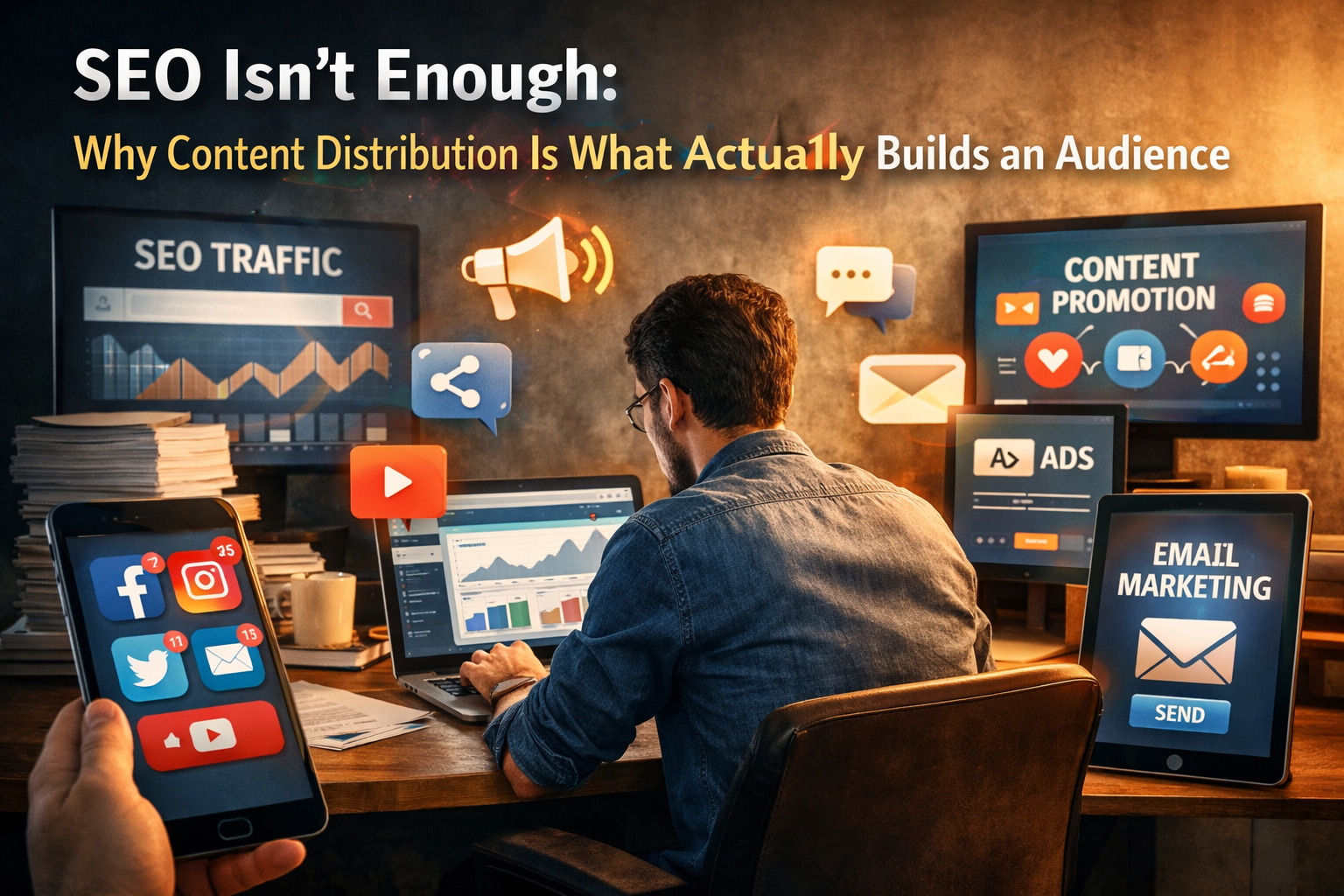
There is a version of content marketing that a lot of businesses are running right now without realizing it. The blog is updated consistently. The writing is solid. The topics are well-researched and genuinely useful. The SEO fundamentals are in place — proper headings, clean URLs, reasonable keyword targeting, decent page speed.
And almost nobody reads it.
Not because the content is bad. Because nobody knows it exists.
This is the distribution problem, and it is far more common than the content quality problem. Most businesses that are serious about content marketing have figured out how to produce decent content. Very few have figured out how to build the kind of consistent, compounding distribution infrastructure that turns good content into steady, predictable traffic.
The gap between those two things — between being good at content and being good at distribution — is where most content strategies quietly fail.
SEO Is a Distribution Strategy, But It's Not the Whole Strategy
The most common response to the distribution problem is to point at SEO. If the content is optimized correctly, search will distribute it. Google will send the traffic. You don't need to actively build an audience because the audience will find you through search.
This is partially true and dangerously incomplete.
What SEO Actually Delivers
SEO is one of the most valuable distribution channels available to a content publisher. It is durable, compounding, and — once established — relatively low-cost per visit compared to paid alternatives. A page that ranks well for a high-intent search term will continue delivering traffic for months or years without ongoing promotion. That's real leverage and it's worth building toward.
But SEO has a timeline problem. New content from new or mid-authority domains does not rank immediately. The compounding benefits of SEO — the domain authority that makes new content rank faster, the backlink profile that signals credibility to search engines, the topical authority that makes a publication the go-to source in its category — take time to develop. Twelve to eighteen months of consistent publishing before meaningful organic search traffic materializes is not unusual. For some domains in competitive categories, it takes longer.
A content strategy that relies exclusively on SEO for distribution is a strategy that produces nothing for a year, then gradually produces something, then eventually produces a lot — assuming it survives long enough to get there. Most don't. Not because the SEO strategy was wrong, but because the gap between publishing and ranking is long enough that without any other distribution mechanism feeding the business in the meantime, momentum dies.
The Ranking Is Not the Endpoint
There's also a subtler problem with treating SEO as the complete distribution answer: a page that ranks for a search term gets found by people who were already looking for something. That's valuable — high-intent traffic that converts well. But it does nothing to build the kind of relationship with an audience that creates loyalty, repeat visits, direct traffic, and the word-of-mouth referrals that accelerate everything else.
Search traffic is transactional. Someone had a question, your content answered it, they left. Some percentage will return. Most won't. Building a publication on search traffic alone means you are perpetually dependent on the algorithm and perpetually starting fresh with new visitors who have no prior relationship with you.
A distribution strategy that builds a following — an audience that comes back because they want to, not because they searched for something — creates a fundamentally different and more durable asset.
What Distribution Actually Means
Distribution is not promotion. It is not posting a link to your latest article on every platform you have a profile on and hoping someone clicks it. That's broadcasting. It generates almost no compounding value and produces the kind of engagement metrics that feel discouraging enough to make people give up.
Real distribution is the systematic process of putting your content in front of the right people, through the right channels, in a format that earns their attention and makes them want more. It is as much a skill as writing, and it compounds in the same way that SEO does — slowly at first, then significantly.
The Channels That Actually Build a Following
Not all distribution channels are equal for building a loyal audience base rather than one-time visitors. The ones that compound most reliably tend to share a common characteristic: they create a direct relationship between publisher and reader that doesn't depend on an algorithm deciding whether to show your content on any given day.
Email is the most valuable. A subscriber who has given you their email address and opted into your content is the highest-quality audience member you can have. They're not dependent on an algorithm. They're not competing with every other post in a social feed. They told you directly that they want to hear from you, and your content lands in their inbox when you send it. Email open rates for well-run newsletters in professional categories routinely exceed 40 to 50 percent — a level of reach that no social platform comes close to delivering organically.
Building an email list from a content operation is slower than building social followers but dramatically more durable. An email list you own is an asset. A social following you've accumulated is an audience you're renting from a platform that can change the rules at any time.
LinkedIn drives qualified professional discovery. For B2B-oriented publishers and professional content creators, LinkedIn's current organic distribution mechanics — which remain significantly more favorable than most other platforms — make it the most efficient channel for reaching new professional audiences with substantive content. A well-performing LinkedIn post regularly reaches non-followers, building brand awareness with exactly the kind of audience that's likely to subscribe, share, and eventually become a client.
Community participation compounds quietly. Showing up consistently in the places where your target audience already gathers — industry Slack groups, niche subreddits, LinkedIn comment sections, Facebook Groups, Discord servers — builds the kind of ambient brand recognition that eventually drives people to seek out your content directly. This is not about dropping links. It is about being a genuinely useful presence in conversations your audience is already having, and being associated with insight rather than self-promotion.
Repurposing extends reach without proportional effort. A single well-researched long-form piece of content is the raw material for a LinkedIn post, a newsletter section, a short-form video script, a Twitter thread, a podcast topic, and a quote graphic. Each format reaches a different slice of the potential audience for that content. Building a repurposing workflow — even a simple one — multiplies the distribution of every piece you produce without multiplying the production effort.
The Following Is the Moat
Here is the strategic case for investing seriously in distribution and audience-building rather than treating it as secondary to content production: a publication with a genuine following is worth dramatically more — as a business, as an authority platform, as a revenue generator — than one producing equivalent content quality with no following.
The following is the moat. It is what makes it difficult for a competitor to replicate what you've built even if they can match your content quality. Great content is increasingly replicable — AI has made decent content cheap and fast. A loyal, engaged audience built over years of consistent value delivery is not replicable. It is the differentiated asset.
Why Direct Traffic Is the Most Valuable Metric
Most content operations track organic search traffic as their primary north star metric. It's a reasonable proxy, but it misses the most important signal: direct traffic — people who typed your URL directly or clicked a bookmark because they wanted to read your content specifically.
Direct traffic is the truest measure of whether you've built a following or just a traffic source. A publication with strong direct traffic has readers who think of it by name, who come back without being prompted by a search or a social post, and who are building a habit around consuming your content. That audience is the one that converts to email subscribers, that shares your content unprompted, that generates the word-of-mouth referrals that accelerate every other distribution channel.
SEO drives discovery. Distribution strategy drives repeat visits. A following drives direct traffic. These are sequential stages, and skipping straight from SEO to revenue means skipping the stage where the audience relationship actually develops.
The Compounding Math of Audience Building
The compounding dynamic of audience building is worth making explicit because it is the reason the short-term investment in distribution pays long-term dividends that pure content production never will.
Every newsletter subscriber you earn has some probability of sharing your content with someone else, some probability of eventually becoming a client or customer, and some probability of being in a position to link to your content from their own publication or website. Every LinkedIn follower you build increases the organic reach of your next post, which increases the number of new people who see it, some of whom will follow, compounding the reach of the post after that.
These are small probabilities at the individual level. At scale, across thousands of subscribers and followers built over years, they become the mechanism by which the largest independent media brands and most authoritative content operations have built what they've built. Not through any single viral moment, but through consistent, compounding audience growth built on consistent, compounding distribution.
What a Real Distribution Strategy Looks Like
Understanding the importance of distribution is one thing. Building the actual infrastructure is another. Here's what a functional distribution strategy looks like for a content operation that is serious about building a following rather than just producing content.
The Publishing-to-Distribution Ratio
Most content operations spend 90 percent of their effort on production and 10 percent on distribution. The operations that build the largest and most engaged audiences tend to invert that ratio significantly — or at minimum reach something closer to 50/50.
This is a genuine shift in how you think about where your time goes. For every hour spent writing, an equivalent hour should be spent putting what you wrote in front of people. That means actively building the email list, not just passively hoping readers subscribe. It means engaging in comment sections and communities, not just posting links. It means repurposing content across formats, not just publishing once and moving on.
Build the Email List From Day One
The email list should be the primary audience-building focus from the first piece of content you publish. Not after you have significant traffic. Not once the blog is "established." From day one.
Every piece of content should have a clear, specific call to action to subscribe. Not a generic "sign up for updates" but a value proposition that makes the subscription worth it in its own right — a weekly roundup, an exclusive analysis, a tool or template, a perspective that isn't available anywhere else. The offer has to be compelling enough that someone who just read one good piece of your content immediately understands why they should opt into more.
Treat list growth as a primary KPI alongside traffic and ranking. A publication with 500 loyal email subscribers is building something more durable than one with 50,000 monthly visitors and no email list.
Show Up in the Conversation Before You Try to Own It
The fastest way to build distribution in a new category is not to publish and promote but to participate first. Find where your target audience is already gathering and become a genuinely useful presence there before you ever mention your own content.
Answer questions thoroughly. Share other people's work when it's good. Take positions in discussions. Be the person in the community who consistently adds value rather than the one who shows up to drop links and disappear. When you eventually share your own content in those spaces, you're doing it as a trusted community member rather than a stranger asking for attention. The reception is completely different.
Track What's Actually Building the Relationship
Vanity metrics — total pageviews, social impressions, follower counts — measure reach. They don't measure the relationship. The metrics worth tracking if you're trying to build a following are the ones that indicate whether people are choosing to come back: email open rates, direct traffic percentage, subscriber growth rate, content shares per piece, and return visitor rate.
These metrics tell you whether you're building an audience or just renting eyeballs. The goal is an audience. The distribution strategy should be evaluated on whether it's building one.
The Honest Summary
Being good at SEO and content is the entry requirement for a content operation that works. It is not sufficient. The businesses and publications that build real, durable, compounding audiences are the ones that treat distribution with the same seriousness they treat production — that understand a follower base is a business asset, that an email list is more valuable than equivalent search traffic, and that the relationship with the reader is the thing worth building toward.
Great content without distribution is a very good diary. Great content with a real distribution strategy is a business.
The gap between those two things is not a talent gap. It's a priority gap. The content is already good enough. The question is whether you're spending the time to make sure anyone knows it exists.
Frequently Asked Questions
How Do I Start Building an Email List if I Have No Traffic Yet?
Start with the audience you already have access to — your personal network, your LinkedIn connections, your existing clients if you're running a services business. Send a direct, personal message to people you know who would genuinely benefit from the content you're publishing and invite them to subscribe. Fifty engaged subscribers you recruited manually are worth more than five hundred passive subscribers acquired through a pop-up on a page they bounced from in thirty seconds. Build the first hundred subscribers through direct relationship, then build the systems to scale from there.
How Often Should I Be Publishing to Build a Following?
Consistency matters more than frequency. A weekly newsletter published every Tuesday builds a stronger audience habit than a daily newsletter that misses three weeks and comes back sporadically. Decide on a cadence you can sustain at the quality level you want to maintain, publish on that schedule without exception, and resist the temptation to increase frequency before you've mastered consistency. The audience relationship is built on reliability as much as on content quality.
Is It Worth Paying to Promote Content to Build a Following Faster?
Paid promotion can accelerate audience building but only if the organic signals are already strong. Paying to put content in front of new people only works if those people, once they see it, find it compelling enough to subscribe, follow, or return. If the content isn't already earning strong organic engagement — good email open rates, real LinkedIn comments, genuine shares — paid promotion will amplify a weak signal and produce poor returns. Fix the organic engagement first, then use paid to accelerate what's already working.
What's the Right Balance Between SEO Content and Audience-Building Content?
They're not mutually exclusive, but they serve different purposes and are optimized differently. SEO content is structured around what people are searching for — it answers existing demand. Audience-building content is structured around developing a distinctive voice and point of view — it creates demand for your specific perspective. The best content operations do both. A reasonable starting framework is to ensure that every SEO-focused piece also has a strong call to action to subscribe, and that every audience-building piece is structured well enough to earn search rankings over time. The two strategies reinforce each other when they're both being executed.
How Long Before a Distribution Strategy Starts Producing Measurable Results?
Longer than most people expect, and the returns are back-loaded in the same way SEO is. The first three to six months of serious distribution work — building the email list, showing up consistently on LinkedIn, participating in communities — will produce modest visible results. But the compounding begins in that period even when it isn't yet visible in the numbers. By month twelve, the audience that felt small at month three has grown, the engagement signals have strengthened, and the distribution reach per piece is meaningfully larger than it was at the start. Evaluate distribution strategy on a twelve-month horizon, not a thirty-day one.