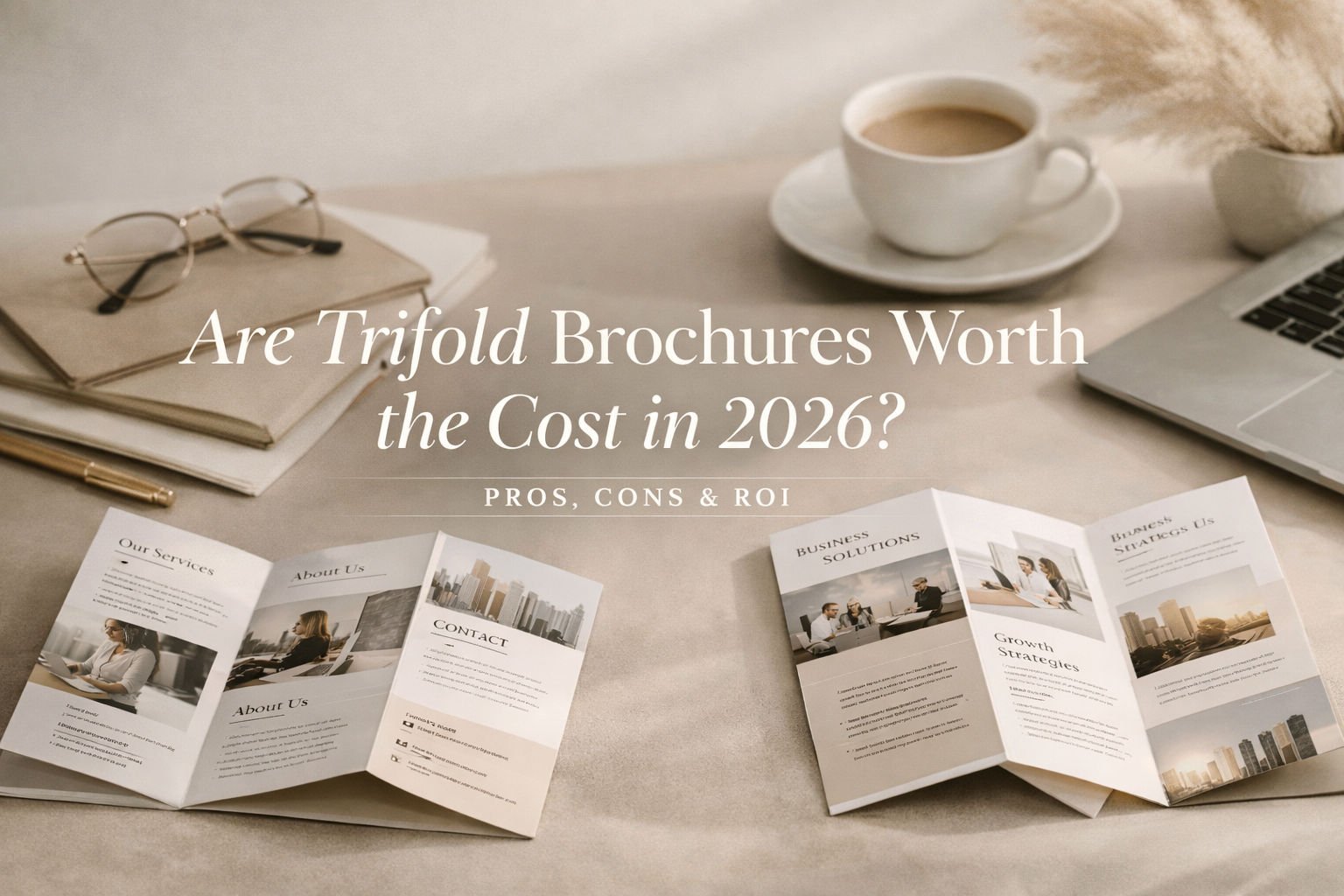
Are Trifold Brochures Worth the Cost in 2026?
Ah yes.
The trifold brochure.
Once the undisputed heavyweight champion of waiting rooms, trade shows, and acrylic display holders everywhere.
But this is 2026.
We scan QR codes.
We Google before we call.
We judge brands by their website speed.
So… is printing a stack of glossy trifolds strategic — or just nostalgic?
Let’s talk about it.
A Quick Throwback
In the early 2000s (and honestly, well into the 2010s), a trifold brochure was marketing.
You had:
Your services
Your mission
Maybe a stock photo handshake
A phone number in 14pt bold
It was portable. Tangible. Legit-looking.
But fast-forward to today:
Printing costs are higher.
Attention spans are lower.
And your website can say more, faster, and better.
So the question isn’t “Do brochures still work?”
It’s: When do they make sense?
The Case for Skipping the Brochure
Let’s start with the uncomfortable truth.
1. Most People Google You Anyway
Hand someone a brochure and what do they do?
They look you up.
Your website, reviews, social presence — that’s where decisions happen. A business card with a clean URL (or QR code) often accomplishes the same next step without the printing overhead.
2. Information Changes Fast
Services evolve. Pricing shifts. Messaging sharpens.
A website updates in minutes.
A brochure updates when you reorder 1,000 more.
Outdated print = expensive mistake.
3. They’re Easy to Ignore
Trade show tables are graveyards of abandoned trifolds.
Unless your design and messaging are exceptional, brochures tend to blend into beige marketing noise.
The Case for Bringing It Back (Strategically)
Now let’s flip it.
Because “old school” isn’t always wrong — it’s just underused.
1. Tangibility Builds Trust
Physical materials signal investment.
A well-designed, high-quality brochure says:
We’re established.
We’re serious.
We didn’t print this at home last night.
In certain industries — legal, medical, financial, home services — that tactile credibility still matters.
2. You Control the Narrative
A website invites wandering.
A brochure forces focus.
You decide:
What they see first
How the story unfolds
What action to take
No pop-ups. No distractions. No competitors one tab away.
3. It Stands Out (Ironically)
Because fewer companies print now, a beautifully designed trifold can feel premium — not outdated.
Marketing trends are cyclical. When everyone zigs digital, a polished physical asset can zag.
Pros & Cons: The 2026 Reality Check
✅ Pros
Tangible and memorable
Great for in-person networking
Reinforces brand credibility
Useful leave-behind after meetings
Can support QR-driven traffic to your website
❌ Cons
Printing costs (design + production)
Harder to update
Can feel generic if poorly designed
Often discarded quickly
ROI harder to track without QR or custom URLs
The Business Card Alternative
Here’s a practical middle ground:
Instead of investing $1,000+ into a large brochure run, consider:
A premium business card
A sharp website
A QR code that leads to a specific landing page
A downloadable digital brochure (PDF)
You reduce cost.
You maintain flexibility.
You keep the physical touchpoint.
And you let your website do the heavy lifting.
When a Trifold Makes Sense in 2026
It might be worth testing if:
You attend frequent in-person events
Your audience skews older or less digital-native
You sell higher-ticket services that require trust-building
Your current marketing feels stale and too online
You want a tactile brand experience
It probably doesn’t make sense if:
Your business is primarily online
Your services change often
Your website isn’t conversion-optimized yet
You’re printing it “just to have something”
The Real Question Isn’t Print vs. Digital
It’s integration.
If your trifold:
Drives to a strategic landing page
Includes a QR code
Reinforces consistent messaging
Feels premium and intentional
It can absolutely earn its place.
If it’s just a condensed version of your homepage on glossy paper?
Save the money.
Bottom Line
Trifold brochures aren’t dead.
They’re just no longer automatic.
In 2026, print should support digital — not replace it.
Test it if your marketing feels flat.
Track it with QR codes or custom URLs.
Design it intentionally.
And remember:
The tool isn’t outdated.
Unstrategic marketing is.
FAQs
Because before you send that file to print, let’s answer the real questions.
1. Do trifold brochures still work in 2026?
Yes — but not automatically.
They work best in in-person environments where tactile materials reinforce credibility. Think networking events, trade shows, medical offices, real estate meetings, or consultations.
They don’t work as a substitute for a strong website. They work as a supplement.
2. Are brochures outdated?
Outdated? No.
Overused poorly in the past? Absolutely.
Brochures feel outdated when:
The design looks generic
The messaging is cluttered
They repeat what’s already on your homepage
A clean, modern, strategically written brochure can actually stand out more today because fewer businesses are printing.
3. Is a business card enough instead?
In many cases — yes.
A premium business card paired with:
A strong website
A clear URL
A QR code to a landing page
…can accomplish the same goal at a lower cost and with more flexibility.
If your main objective is getting someone to look you up later, a business card often does the job.
4. How much do trifold brochures typically cost?
Costs vary based on:
Design quality
Paper stock
Finish (matte, gloss, soft-touch, etc.)
Quantity
Between design and printing, you could easily spend hundreds to a few thousand dollars per run.
And remember — once they’re printed, updates aren’t free.
5. How can I track ROI on a brochure?
This is where 2026 strategy comes in.
Add:
A QR code to a custom landing page
A unique URL
A specific offer or call-to-action
If you’re not tracking it, you’re guessing.
6. Who should consider using a trifold brochure?
Brochures tend to make sense for:
Service-based businesses with in-person consultations
Industries that rely heavily on trust (legal, financial, medical)
Companies attending frequent networking or trade events
Brands wanting a tactile, premium experience
If your business is fully digital and rarely meets clients face-to-face, it may not be necessary.
7. What are the biggest downsides of printing brochures?
Upfront cost
Harder to update
Risk of overloading information
Often discarded quickly
Can feel generic if not well-designed
Printing something “just to have something” is rarely strategic.
8. Should I test brochures if my marketing feels stale?
Possibly — but do it intentionally.
If everything you’re doing is digital and blending in, introducing a physical touchpoint can create contrast. Just make sure it:
Aligns with your brand
Directs traffic to your website
Has a clear purpose
Old-school works when it’s paired with modern strategy.
9. What’s better: a brochure or a downloadable PDF?
A downloadable PDF gives you:
Easy updates
Lower cost
Shareability
Trackable links
A printed brochure gives you:
Tangibility
Physical presence
In-person leave-behind value
The right answer depends on how and where you’re marketing.
10. What’s the real deciding factor?
Intent.
If a trifold brochure supports your overall marketing strategy, reinforces your brand, and directs people to the right next step — it can absolutely be worth it.
If it’s just marketing muscle memory from 2012?
Probably not.
Related Reads
〰️
Related Reads 〰️
One Thing We Can All Learn From the Automotive Industry: Don’t Underestimate the Business Card in 2026
The automotive industry sells some of the most expensive products in the world — and still relies on business cards. In 2026, that’s not nostalgia. It’s strategy. Here’s why old-school tools still win in high-trust marketing.

They Don’t Like Those AI Images
AI images are everywhere—but not everyone’s buying in. While some brands embrace sleek, generated visuals, others stick with old-school stock photos because they signal trust and authenticity. This post breaks down why visual preferences aren’t about trends—they’re about what your audience believes when they see your brand.

How Much Should You Really Spend on Marketing at $1–5M in Revenue?
Marketing budgets shouldn’t be a vibes-based decision. If your company is doing $1–5M in revenue, this guide breaks down exactly how much you should spend on marketing — with real dollar ranges by growth stage and advice on where that money actually goes.