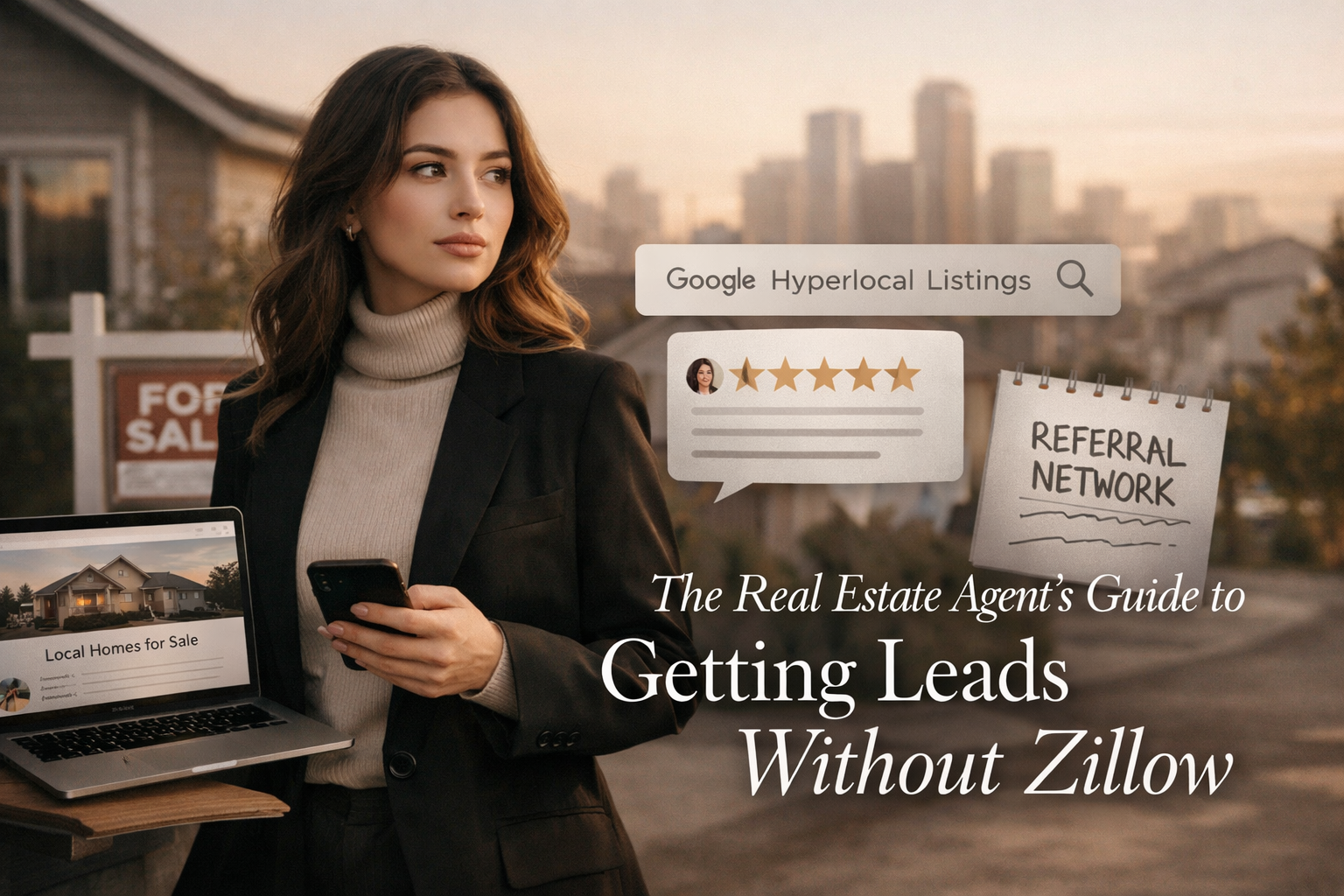
The Real Estate Agent's Guide to Getting Leads Without Zillow
There's a moment that most real estate agents hit — usually sometime in their second or third year — when they look at their monthly expenses and realize they're sending a significant check to Zillow for leads that six other agents are also getting. The leads are expensive. The conversion rate is low. The people on the other end of the phone often don't know they submitted an inquiry, or they submitted twelve and can't remember which agent is which. And the agent is competing not on the basis of their local knowledge, their reputation, or their track record — but on who calls back fastest.
It works, in the sense that deals close. But it works the way a slot machine works — you keep feeding it money, and occasionally it pays out. The economics are tolerable when the market is hot and every lead is a potential transaction. They're brutal when the market tightens and that same monthly spend produces fewer closings at lower commissions.
The deeper problem isn't the cost. It's the dependency. An agent whose business depends on Zillow for lead flow doesn't have a business — they have a subscription. If Zillow raises its prices — which it has and will again — the agent pays more. If Zillow changes its algorithm or its lead distribution model — which it has and will again — the agent adjusts or suffers. If Zillow decides to compete more directly with agents, the agent is funding their own competition.
This guide is about building lead generation that you own. Not rented. Not subscribed to. Owned — by you, built on your reputation and your knowledge of your market, generating inquiries from people who want to work with you specifically rather than whichever agent's name came up next in the rotation.
The Problem With Rented Leads
Before we talk about what to build, it's worth understanding why the portal model is structurally problematic for agents — not just expensive, but fundamentally misaligned with how a sustainable real estate business works.
Portal leads are shared leads. When a buyer submits an inquiry on Zillow, that inquiry may go to multiple agents, depending on the zip code, the pricing tier, and the competitive dynamics of the market. You're not buying exclusive access to a potential client. You're buying the chance to race other agents to the phone. Speed matters more than expertise. Availability matters more than fit. The agent who answers fastest often wins the lead, regardless of whether they're the best agent for that client.
Portal leads are low-intent. Many Zillow inquiries come from people who are casually browsing, months away from a transaction, or just curious about a property's price. The inquiry form is frictionless by design — Zillow wants as many leads as possible flowing through the system because that's what they sell to agents. Low friction means low commitment, and low commitment means low conversion. Industry data consistently shows that portal lead conversion rates run between 1 and 3 percent. That means for every hundred leads you pay for, you might close one to three deals. The rest are dead ends, tire kickers, and people who never answer the phone.
Portal leads have no loyalty built in. A client who finds you through Zillow has no particular reason to work with you over any other agent. They didn't choose you. An algorithm assigned you. The relationship starts from zero — no trust, no context, no sense of who you are or what you offer. You have to earn everything from scratch in a conversation where the client may be simultaneously talking to two other agents they also found through the same portal.
Portal leads build Zillow's business, not yours. Every dollar you spend on Zillow makes Zillow's platform more valuable. It doesn't make your business more valuable. When you stop paying, the leads stop. There's no residual benefit, no compounding return, no asset that you've built. Compare that with a client who finds you through your own website, your own content, your own community presence — that client's relationship with you builds equity in your brand, generates referrals, and creates the kind of compounding growth that a sustainable business requires.
None of this means you need to quit Zillow tomorrow. For some agents, particularly those who are newer and building their pipeline, portal leads serve a purpose. But every agent should be building channels that they own alongside — and eventually instead of — channels they rent.
Your Website: The Foundation of Everything
Your website is the only digital real estate you actually own. Your Zillow profile is rented. Your social media accounts are borrowed. Your brokerage page could change if you switch firms. Your website is yours — your domain, your content, your brand, your lead capture, your asset.
Most agents treat their website as an afterthought. It's a template from their brokerage or a vendor, populated with an IDX search and a headshot, and it generates almost nothing because it offers nothing that a buyer or seller can't get more easily from Zillow or Realtor.com. The search functionality is identical. The listings are identical. There's no reason for a consumer to choose the agent's website over the portal — the portal has more listings, better search tools, and a more polished experience.
A website that generates leads needs to do something that portals can't. Portals can aggregate listings. They cannot provide hyperlocal expertise, genuine market insight, or the kind of content that makes a buyer or seller say "this agent knows this market better than anyone."
Community Content That Ranks and Converts
The single highest-value content you can create on your real estate website is deep, original community content — comprehensive guides to the neighborhoods, towns, and communities you serve.
Not thin, auto-generated pages with census data and median home prices pulled from an API. Those exist on every portal and every agent template site. They're undifferentiated, they add no value, and Google knows the difference.
What works is content that reflects your actual knowledge of the community. What it's like to live there. The character of the neighborhoods. The school situation — not just the ratings, but what the schools are actually like, what parents say about them, what the district's strengths and weaknesses are. The commute options. The restaurant scene. The parks. The quirks. The things that don't show up in a Zillow listing description but matter enormously to someone deciding where to live.
This content ranks in Google because it answers the questions buyers actually search for. "What's it like to live in [your town]." "Best neighborhoods in [your area]." "[Town A] vs. [Town B] for families." "Is [neighborhood] a good place to buy." These are high-intent searches from people who are actively considering a move — and they're searches that national portals don't compete for, because portals don't create community-level editorial content. They aggregate data. You provide insight. The gap between data and insight is where your competitive advantage lives.
This content converts because it builds trust before the first conversation. A buyer who reads your comprehensive guide to a community and finds it genuinely useful — accurate, detailed, clearly written by someone who lives and works there — is a buyer who trusts you before they've picked up the phone. When they do reach out, they're not a cold lead being distributed to the fastest dialer. They're a warm lead who specifically chose you because your content demonstrated the expertise they're looking for.
Write these pages yourself. Don't outsource them to a content mill. Don't use AI-generated filler. The value is in the specificity and authenticity — the details that only someone who actually knows the market can provide. If you've sold forty homes in a community, you know things about that community that no algorithm can replicate. Put that knowledge on your website, and let Google deliver it to the people who need it.
Blog Content That Answers Real Questions
Every question a buyer or seller asks you in conversation is a blog post waiting to be written. Every concern a first-time buyer raises during a showing is a search query someone else is typing into Google right now.
"How much are closing costs in [your state]?" "What should I know about buying a home with a septic system?" "How does the home inspection process work?" "Is it worth buying a fixer-upper in [your market]?" "What are property taxes like in [your county]?" "Should I sell my house before buying a new one?"
These questions represent real demand — people who need answers and will trust the person who provides them clearly and honestly. A blog post that answers one of these questions well will rank in Google, attract visitors from your target market, and position you as the knowledgeable, trustworthy agent those visitors are looking for.
The key is specificity. A generic post about "5 tips for first-time homebuyers" won't rank because there are a million of them. A post about "what first-time homebuyers need to know about buying in [your specific market]" competes in a much smaller pool, attracts a much more targeted audience, and demonstrates the local expertise that differentiates you.
Publish consistently. One substantive post per month is enough to build meaningful search visibility over time. Two per month is better. The content compounds — a post you write today continues generating traffic and leads for months or years if it's well-written and well-optimized. That's the opposite of a Zillow payment, which generates leads only as long as you keep paying.
SEO That Captures High-Intent Searches
Search engine optimization for real estate agents isn't about ranking for "homes for sale" — you'll never outrank Zillow or Realtor.com for that query, and you don't need to. It's about ranking for the long-tail, hyperlocal searches where portals don't compete and where buyer intent is high.
"Homes for sale in [specific neighborhood]." "Best school districts in [your county]." "[Town name] real estate market 2026." "Moving to [your area] from [common origin city]." "Cost of living in [your town]." These searches have lower volume than broad national queries, but the people making them are far more likely to become your clients — they're searching for your specific market, which means they're interested in your specific expertise.
Technical SEO basics matter: your site needs to load quickly, work well on mobile, have proper heading structure, and use descriptive page titles and meta descriptions. But the primary SEO strategy for a real estate agent is content — the community pages and blog posts described above. Google ranks pages that provide the best answer to the searcher's question. If your page is the best answer for "what's it like to live in [your town]," Google will rank it. The competition for these hyperlocal queries is often surprisingly weak — a handful of thin automated pages from portals and a few agents with mediocre content. A genuinely excellent page stands out.
Lead Capture That Respects the Visitor
Your website needs a way to capture contact information from visitors who aren't ready to pick up the phone but are interested enough to stay in your orbit. This is where most agent websites get it wrong — either by having no lead capture at all or by being so aggressive about it that visitors leave in annoyance.
The forced registration wall — "enter your email to see listing details" — is the real estate website equivalent of a car dealership locking the doors until you talk to a salesperson. It worked in 2012 when IDX search on agent websites was novel and visitors had no alternative. It doesn't work now. Buyers know they can see the same listings on Zillow without giving up their email, and a forced registration wall just sends them there.
What works is value-based lead capture. Offer something genuinely useful in exchange for contact information. A downloadable guide to buying in your market. A monthly market report with real analysis, not just numbers. A relocation guide for people moving to the area. A home valuation tool that provides an estimate and follows up with a personalized analysis. An email newsletter that's actually worth reading.
The principle is exchange: the visitor gives you their contact information because they're getting something valuable in return, not because you've blocked their access to something they can get elsewhere. The leads you capture this way are higher-quality — they've self-selected by engaging with your content, which means they're more likely to be genuinely interested in working with someone who has the expertise your content demonstrates.
Google Business Profile: Your Other Owned Asset
Your Google Business Profile is the second most important digital asset you own, after your website. For many agents, it's actually more visible — it appears in the local pack when someone searches for real estate agents in your area, it shows your reviews prominently, and it provides a snapshot of your business that many consumers see before they ever visit your website.
The optimization principles are straightforward but underutilized by most agents.
Complete every field. Business description, service area, categories, attributes, hours, website link, phone number. A complete profile ranks better than an incomplete one, and every empty field is a missed opportunity to give Google information about your business.
Define your service area with specificity. Don't list your entire state or even your entire metro area. List the specific communities, towns, and neighborhoods where you actually work. This tells Google to show your profile for searches in those areas and signals to potential clients that you're a local expert, not a generalist covering a hundred-mile radius.
Publish Google Posts regularly. New listing announcements, market updates, community content, open house notices, recent closings. Google Posts keep your profile fresh, give you more visual real estate in search results, and provide content that Google can index and associate with your business.
Reviews are your most powerful ranking factor. The agents who dominate local search results in real estate almost always have the most reviews — not just the highest rating, but the highest volume of recent, genuine reviews. We'll cover reviews in detail below, but from a GBP perspective, review quantity, quality, and recency directly influence where your profile appears in local results.
Photos matter more than you think. Your headshot. Your team. Your office. Your recent listings — not just the listing photos, but photos of you at the property, at the closing table, with your clients (with permission). These photos humanize your profile and differentiate it from the agents whose GBP has a single headshot from 2018.
Social Media: Building an Audience You Don't Have to Pay to Reach
Social media for real estate agents is simultaneously overhyped and underutilized. It's overhyped in the sense that most of the social media advice aimed at agents — "post every day," "go viral on TikTok," "build your personal brand" — produces a lot of activity and very few leads. It's underutilized in the sense that the agents who use social media well generate a consistent, low-cost stream of business from it.
The difference is approach. The agents who waste time on social media are the ones creating content for other agents — market statistics posts, motivational quotes, "just listed" graphics that all look the same. The agents who generate business from social media are the ones creating content for their potential clients — content that's useful, local, and grounded in the reality of buying or selling a home in their specific market.
What Works on Instagram and Facebook
Neighborhood and community content. A reel walking through a neighborhood you serve, pointing out the coffee shop, the park, the school, the library, narrated by you. This is the video equivalent of your website's community pages, and it performs well because it's genuinely useful to people considering a move. A buyer who's relocating from out of the area gets a feel for the community that listing photos can't provide. A local follower shares it because they're proud of where they live. The content works for your audience and works for the algorithm at the same time.
Market commentary that's specific and honest. Not "the market is hot!" or "now is a great time to buy!" — those are slogans, not content. "Here's what happened in [your market] this month — listings were up 12 percent, median price dipped slightly, and homes are sitting about two weeks longer than they were in the spring. Here's what that means if you're thinking about selling" is useful. It demonstrates expertise. It treats the viewer like an intelligent adult who wants real information, not a sales pitch.
Behind-the-scenes process content. What happens during a home inspection. What to expect at closing. How to prepare a home for listing photos. What a title search is and why it matters. This content demystifies the process for buyers and sellers who find it intimidating, and it positions you as the agent who educates rather than pressures. The trust that builds over repeated exposure to this kind of content is what eventually converts a follower into a client.
Client stories with permission. Not posed closing-table photos with keys and a "Congratulations to the Smiths!" caption. Real stories. "This family was relocating from Texas and needed to find a home near good schools within three weeks. Here's how we made it happen." The story demonstrates what working with you is actually like, which is far more compelling than a static testimonial.
What Doesn't Work
Just-listed and just-sold posts as your primary content. These are fine occasionally — they provide social proof that you're active and successful. But an Instagram feed that's nothing but listing announcements is a catalog, not a content strategy. Nobody follows a catalog.
Motivational quotes and generic real estate graphics. These are engagement bait for other agents, not content for potential clients. They generate likes from your industry peers and zero leads from actual buyers and sellers.
Posting the same content everywhere without adaptation. A long-form Facebook post doesn't work as an Instagram caption. A TikTok video doesn't belong on LinkedIn without modification. Each platform has its own norms, audience expectations, and content formats. Adapt or don't bother.
The Video Opportunity
Video content — particularly short-form video on Instagram Reels, TikTok, YouTube Shorts, and Facebook Reels — has the widest organic reach of any content format right now. For real estate agents, video is particularly powerful because real estate is inherently visual and spatial. A written description of a neighborhood is useful. A video walk through that neighborhood is immersive.
You don't need professional production. A phone, decent lighting, and the ability to speak naturally about your market are enough. The agents who succeed with video aren't the most polished — they're the most consistent and the most genuinely knowledgeable. A one-minute video where you walk through a neighborhood park and talk about why families love this area, shot on your phone in natural light, outperforms a professionally produced listing video in terms of reach and engagement because it feels real.
The barrier for most agents is discomfort with being on camera. That's understandable. It also passes. The first ten videos feel awkward. By the thirtieth, it's natural. And by the fiftieth, you have a library of content that's working for you continuously — generating views, building your audience, and positioning you as the local expert in a format that a growing percentage of consumers prefer over text.
Email Marketing: The Quiet Powerhouse
Email is the least glamorous lead generation channel and one of the most effective. It doesn't have the dopamine hit of a viral social media post. It doesn't generate instant gratification. But it reaches people who have explicitly opted in to hear from you, it converts at a higher rate than any social platform, and it compounds over time as your list grows.
Building the List
Your email list is built from every touchpoint in your business. Website lead captures — the market report, the buyer's guide, the home valuation tool. Open house sign-ins. Past client contacts. Networking events. Community involvement. Every person who interacts with your business and expresses interest is a potential subscriber.
The list doesn't need to be enormous. A real estate agent with 500 engaged, local email subscribers has a more valuable marketing asset than one with 10,000 Instagram followers. Those 500 people opted in because they're interested in your market. They're homeowners, potential sellers, potential buyers, and people who refer their friends. When you send an email, it lands in their inbox — not in an algorithm-filtered feed where 5 percent of your audience might see it.
What to Send
A monthly market update with real analysis. Not a data dump from MLS — a narrative that explains what the numbers mean. "Inventory is up 15 percent in our area, which is the first time we've seen that in two years. Here's what that means for sellers, and here's what it means for buyers." This positions you as the analyst who makes sense of the data, not just the agent who recites it.
New listing highlights — your own listings and notable new listings in the market. A curated selection with your commentary is more valuable than a raw feed. "This Cape Cod on Elm Street is the first sub-$400K listing in that neighborhood in months — it won't last" is more useful and more engaging than a link to the MLS listing.
Community content. The same kind of hyperlocal content you're publishing on your website and social media. A new restaurant opening. A school district announcement. A local event worth attending. This content reinforces your identity as someone embedded in the community, not just someone who sells houses in it.
Seasonal and situational content. Spring maintenance checklists for homeowners. Year-end tax considerations for property owners. What the latest interest rate change means for buyers in your market. Content that's timely and relevant to where your audience is right now.
The Conversion Path
Email doesn't generate leads the way a portal does — someone filling out a form and expecting a call. Email generates leads through sustained relationship building. A subscriber reads your market update every month for eight months. They start thinking about selling. When it's time to call an agent, they don't Google "real estate agents near me" — they reply to your email. The lead is warm, the trust is established, and the conversion rate is dramatically higher than any portal lead.
This is the patient game. It doesn't produce results in month one. It produces results in month eight, month twelve, month twenty-four — and those results compound because the subscriber who becomes a client also becomes a referral source, and their referrals join the list, and the cycle continues.
Reviews and Reputation: The Compound Interest of Real Estate Marketing
Reviews are the most underleveraged asset in most agents' marketing. They're free. They're permanent. They influence both search rankings and consumer decisions. And most agents treat them as something that happens to them rather than something they actively build.
Why Reviews Matter More Than Almost Anything Else
When a potential client searches for a real estate agent — whether on Google, Zillow, or any other platform — reviews are the first thing they evaluate after location and responsiveness. A high review count with a strong rating is the most powerful trust signal available to an agent. It says: this many people trusted this person with one of the largest financial transactions of their life, and this is how it went.
Reviews also influence Google's local search algorithm directly. Agents with more recent, positive reviews rank higher in local results. This means reviews don't just convert the people who read them — they also increase the number of people who see your profile in the first place. The effect compounds: more reviews lead to better ranking, better ranking leads to more visibility, more visibility leads to more clients, and more clients lead to more reviews.
Building a Review Engine
The agents with 200 or 300 Google reviews didn't get there by accident. They built a system.
Ask every client, every transaction. Not just the ones that went smoothly — though obviously prioritize those. Make the ask part of your closing process. After the transaction closes and the client is happy, send a personal message with a direct link to your Google review page. Make it one click. "It would mean a lot to me if you could share your experience. Here's the link — it takes about two minutes."
Time the ask correctly. The best moment is within a week of closing, when the positive emotions are fresh and the client is still in the orbit of the transaction. Too early feels premature. Too late and the moment has passed — life moves on and the review never happens.
Follow up once if they don't respond. A gentle reminder a week after the initial ask is appropriate. More than that is pushy. Some clients won't leave a review regardless, and that's fine. The ones who do are enough to build a strong profile over time.
Respond to every review — positive and negative. Your responses are read by future clients, and they reveal as much about you as the reviews themselves. A thoughtful response to a positive review shows gratitude and professionalism. A composed, non-defensive response to a negative review shows character. Both build trust with the people reading.
Diversify your review platforms. Google is the priority because it affects search visibility. But Zillow reviews matter for clients who find you there (even if you're reducing your Zillow spend, your profile and reviews remain). Facebook recommendations matter for clients who discover you through social. Realtor.com reviews matter for some markets. Build your primary presence on Google and let the others grow organically.
Referral Networks: The Oldest Lead Source and Still the Best
Referrals consistently produce the highest-converting, lowest-cost leads in real estate. A referred client comes with built-in trust, a warm introduction, and a predisposition to work with you. The conversion rate on referrals is multiples higher than any other lead source.
Most agents understand this intuitively but don't build referral generation into their business systematically. They wait for referrals to happen rather than creating the conditions for them to happen consistently.
Past Client Nurturing
Your past clients are your most valuable referral source, and most agents neglect them after the transaction closes. The relationship that was intense for three months goes cold, and two years later, when that past client's coworker mentions they're thinking about buying, the client doesn't think of you — because you haven't been present in their life since the closing.
Stay in touch. Not with spam. With genuine, value-add communication. The email newsletter covers part of this. Beyond email, a personal check-in once or twice a year — a phone call, a handwritten note, a home anniversary acknowledgment — maintains the relationship in a way that mass communication doesn't.
The math is simple. If you close thirty transactions a year and maintain relationships with all of them, after five years you have 150 past clients in your network. If each of those past clients refers one person every five to seven years, you're generating twenty to thirty referral leads annually from your existing network alone — leads that cost nothing except the time invested in maintaining the relationships.
Professional Referral Partners
Other professionals who serve the same clients you do — mortgage brokers, financial advisors, home inspectors, contractors, attorneys, insurance agents — are natural referral partners. They encounter people in transition — buying, selling, renovating, relocating — and they're asked for agent recommendations regularly.
Building these relationships requires genuine reciprocity. Refer business to them. Invite them to your client events. Include them in your content — feature a mortgage broker explaining rate locks in your newsletter, or a contractor discussing renovation costs on your social media. When you send business their way consistently, they send business your way consistently. It's not a formal arrangement. It's a relationship built on mutual professional respect and mutual benefit.
Community Involvement as Lead Generation
We covered this in detail in our Philadelphia neighborhoods piece, and the principle applies universally: being genuinely involved in your community generates leads. Not as a calculated marketing tactic — as a natural consequence of being known and trusted.
Coach a youth sports team. Join the PTA. Volunteer at the community fundraiser. Serve on a local board. Sponsor an event. These activities put you in contact with potential clients in a context that's entirely different from a sales interaction. People get to know you as a person, not as an agent. And when they or someone they know needs an agent, you're the person who comes to mind — not because you pitched them, but because they know you and trust you.
The agents who generate the most referral business in any market are almost always the ones who are most visibly involved in their community. The causation runs in both directions: involvement creates visibility, and visibility creates referrals, and referrals create more business, which creates more capacity for involvement. It's a virtuous cycle that feeds itself.
Open Houses: Lead Generation in Disguise
Most agents think of open houses as a service they provide to their sellers. They are that. But they're also one of the most effective lead generation tools available — the rare opportunity to have a face-to-face conversation with a potential buyer who has already demonstrated interest by showing up.
The buyers who attend open houses are, by definition, active. They're out looking at properties on a Saturday afternoon. Many of them aren't working with an agent yet — or they're working with one they're not committed to. An open house gives you thirty to sixty minutes in a room with these people, in a low-pressure environment, doing the thing you do best: talking about real estate.
The agents who convert open house visitors into clients do a few things consistently.
They engage in conversation, not sales pitches. Ask the buyer about their search. Where else have they been looking? What's important to them? How long have they been in the market? Listen more than you talk. The goal isn't to close them at the open house. It's to demonstrate competence and genuine interest in helping them.
They capture contact information with a reason to follow up. Not a sign-in sheet that feels like a surveillance log. A conversation that naturally leads to "I have some off-market listings coming up that might interest you — can I send you the details?" or "I'm putting together a list of properties in this price range in the area — would you like me to include you?"
They follow up promptly and personally. Not an auto-drip campaign. A personal text or email that references the conversation. "Great meeting you today — you mentioned you were interested in homes with larger yards in the area. I know of two that are coming on the market soon. Want me to get you the details?" Specific, personal, relevant.
Putting It All Together: The Lead Generation Ecosystem
None of these channels works in isolation. They work as a system — each one feeding the others.
Your website content fuels your SEO, which drives organic traffic, which captures leads through value-based offers. Your blog posts become social media content, which drives traffic back to your website. Your email newsletter nurtures leads from every source — website, social, open houses, networking — until they're ready to transact. Your reviews build trust that improves conversion at every stage. Your community involvement generates referrals and content. Your Google Business Profile captures local search traffic and feeds it to your website and phone.
The agents who break free from portal dependency don't do it by finding one replacement channel. They do it by building an ecosystem where every component supports every other component, and the whole system generates more leads than any single channel could alone.
This takes time. The compounding doesn't start immediately. The first six months feel like effort without payoff. The community pages take time to rank. The email list takes time to grow. The social media audience takes time to build. The referral network takes time to mature. The review count takes time to accumulate.
But every month, each channel is a little stronger than the month before. And at some point — usually around month eight to twelve — the system reaches a tipping point where leads start flowing consistently from multiple sources, none of which require a monthly payment to a portal. That's the moment the business changes. That's the moment you stop renting leads and start owning your pipeline.
The agents who reach that point don't go back. The quality of the leads is better. The cost is lower. The conversion rate is higher. The business is more resilient. And the asset they've built — the content, the audience, the reputation, the relationships — continues appreciating in value for as long as they maintain it.
Zillow will still be there if you want it. But you won't need it. And that changes everything.
Frequently Asked Questions
How Long Before I Can Stop Paying for Zillow Leads?
It depends on your market, your starting point, and how consistently you invest in building your own channels. Most agents who commit to the strategy outlined here — website content, SEO, social media, email, reviews, community involvement — begin seeing meaningful organic lead flow within six to twelve months. That doesn't mean you flip a switch and cancel Zillow on month seven. It means you begin reducing your portal spend as your owned channels pick up volume, and you redirect the savings into the activities that are generating better leads. Some agents make the transition in a year. Others take eighteen months to two years. The timeline matters less than the direction — every month you're building owned assets, you're less dependent on rented ones.
I'm a New Agent With No Past Clients and No Sphere. Where Do I Start?
Start with content and community. You may not have past clients to ask for referrals, but you have knowledge of your market and the ability to create content around it. Build your website's community pages. Start publishing blog posts that answer buyer and seller questions in your market. Begin posting on social media — neighborhood tours, market commentary, process explainers. Attend community events and introduce yourself to people, not as an agent looking for business, but as a neighbor who happens to be in real estate. Hold open houses for other agents in your office and convert visitors into your own contacts. The first year is the hardest because you're building from zero. But every piece of content, every relationship, every review from your early transactions is a brick in the foundation. Agents who start building that foundation from day one reach self-sufficiency faster than agents who rely exclusively on purchased leads and have nothing to show for it when the spending stops.
Can I Really Compete With Zillow in Search Results?
You can't outrank Zillow for "homes for sale in [city]" — and you don't need to. You compete for the searches Zillow doesn't target: hyperlocal queries, community-specific questions, and long-tail searches that reflect genuine buyer intent. "Best neighborhoods for families in [your town]." "What to know about buying a historic home in [your area]." "[Town A] vs. [Town B] schools." These searches have lower volume but dramatically higher intent, and the competition is beatable — often it's just a handful of thin automated pages. A single, well-written community page on your website can rank on the first page of Google for these queries and generate a steady stream of targeted traffic. You're not competing with Zillow. You're competing in the spaces Zillow doesn't occupy.
My Brokerage Provides a Website. Do I Still Need My Own?
Yes. A brokerage-provided website is controlled by the brokerage — they choose the platform, the template, the domain structure, and the features. If you leave the brokerage, you lose the site and everything you've built on it. Your own website, on your own domain, with your own content, belongs to you regardless of where you hang your license. It's portable, it builds equity in your personal brand, and it gives you full control over your content, your lead capture, and your SEO strategy. Use the brokerage site as a complement if you want. But build your own as the foundation.
How Much Should I Spend on This Compared to What I'm Spending on Zillow?
The beauty of the approach outlined here is that most of the work is time-intensive rather than capital-intensive. A professionally built website costs a fraction of a year's Zillow spend. Social media and content creation cost your time. Email marketing platforms cost $20 to $100 a month. Google Business Profile optimization is free. The ongoing costs are modest — website hosting, email platform, occasional paid social promotion. For most agents, the total annual cost of building and maintaining their own lead generation ecosystem is 30 to 50 percent of what they'd spend on portal leads — and the asset appreciates instead of evaporating at the end of each month.
Related Reads
〰️
Related Reads 〰️

How Do I Get More Clients for My Law Firm Without Paying for Leads?
Tired of paying for expensive legal leads? This guide explains how law firms can generate more clients through local SEO, content marketing, review generation, and referral systems — without relying on third-party lead vendors.

How Auto Dealerships Can Stop Losing Leads to CarGurus and Carvana
Your potential buyers are finding their next car on CarGurus and Carvana — not your website. That's not a traffic problem. It's a dependency problem. Here's the playbook for building a direct acquisition strategy that makes third-party platforms less necessary and puts your dealership back in control of the customer relationship.
Google Business Profile Optimization for Philadelphia Businesses: A Complete Guide
For most Philadelphia small businesses, the Google Business Profile is doing more work than the website — and getting less attention. A complete, well-optimized GBP is the difference between showing up in the local pack and being invisible when someone searches for what you do in your neighborhood. Here's a complete guide to getting it right, with strategies tuned to Philadelphia's unique neighborhood market.