What Lemme Gets Right: A Full Brand Analysis of Kourtney Kardashian's Supplement Empire
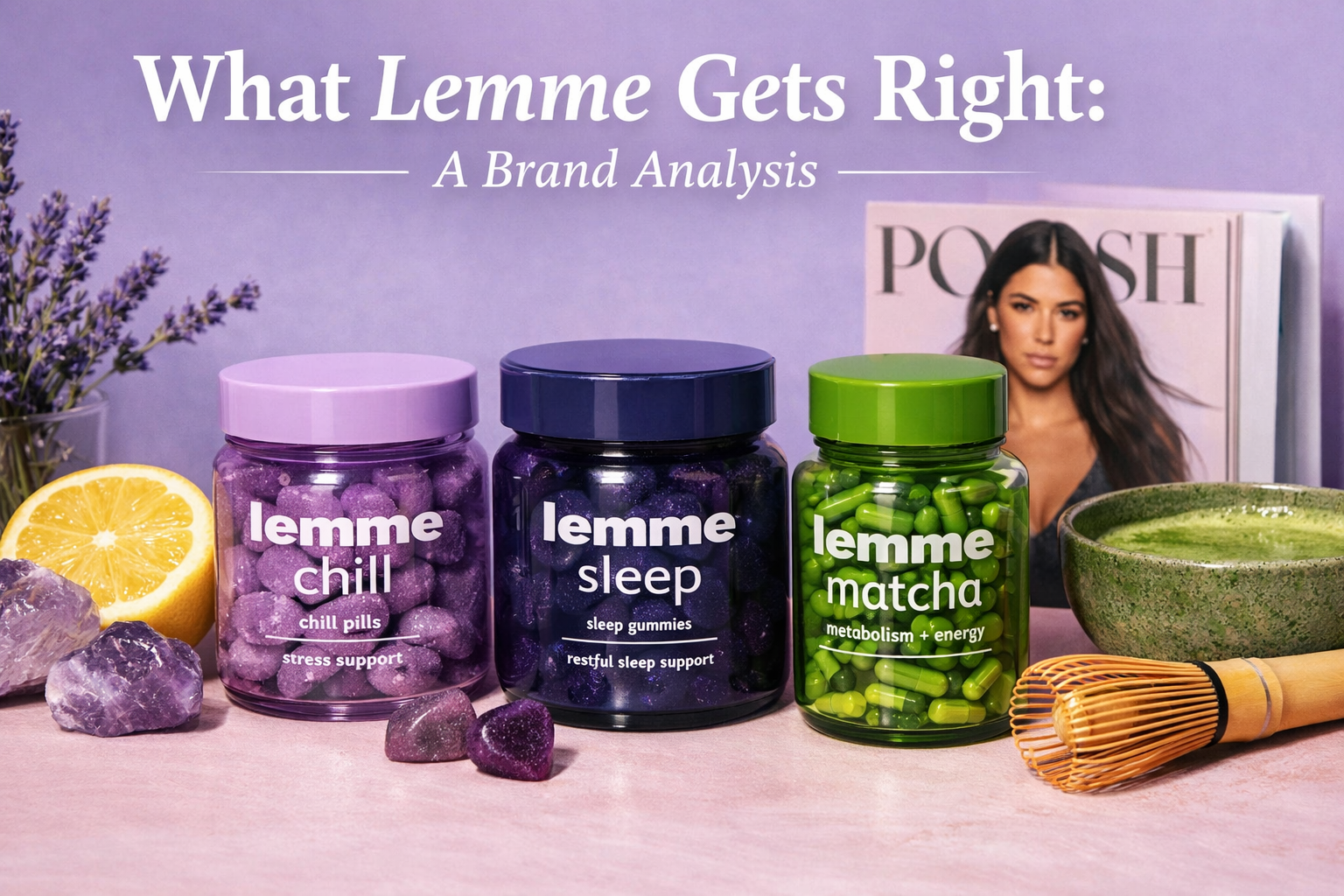
Kourtney Kardashian launched a gummy supplement brand in 2022. That sentence alone should make most marketing people cringe — the celebrity wellness brand is one of the most crowded, eye-roll-inducing categories in consumer products. Detox teas. Collagen powders. Appetite suppressant lollipops with dubious ingredient labels and convenient before-and-after photos. The graveyard is full.
And yet Lemme works.
Lemme's Debloat and Sleep have gone viral multiple times over, and Purr is the number-one gummy vaginal probiotic in the U.S. WWD The brand experienced 25% month-over-month growth since its launch, with six product sell-outs across its early SKUs. Glossy By early 2026, Lemme had moved from a digitally native DTC launch to broad retail access — including a Target expansion in 2024 and a Walmart rollout into just over 2,000 stores beginning January 1, 2026. Brand Vision Institutional backing followed, with major investment coming in from the likes of Unilever Ventures, Coefficient Capital, and Wittington Ventures. BeautyNewsDaily
This isn't a fluke. This is a branding case study — and it's one every marketer, DTC founder, and brand strategist should understand inside out.
The Mistake Everyone Makes About Lemme
Most people look at Lemme and say "it sells because Kourtney Kardashian has 200 million Instagram followers." That's lazy analysis. Plenty of celebrities with massive followings have launched products that tanked. Kim Kardashian's SKKN skincare line got roasted. Paris Hilton's fragrance empire peaked in 2005. Celebrity reach is a megaphone — it doesn't fix a broken message, and it doesn't manufacture trust in a category where trust is the entire product.
What Lemme figured out is something most brands still haven't: the founder has to be the product.
"It started with Poosh, with being able to spread this message that wellness is not about perfectionism," Kardashian Barker said in an interview. "I've been taking supplements since I had Mason, and he's turning 16 this year. That's when my wellness journey started." WWD
That timeline matters. Simon Huck, Lemme's co-founder, put it plainly: "She has been in wellness for 15–17 years — someone who has been taking vitamins and supplements for years. This was just the next evolution for her." Glossy By the time Lemme launched, Kourtney had already spent years being the Kardashian who got mocked for making her kids eat organic, who pushed back on processed food on national television, who was openly "extreme" about wellness before wellness was a personality type. The brand didn't create that story. It was the logical next chapter of it.
That's authenticity that money can't manufacture — and it's what separates Lemme from 90% of the celebrity brand landscape.
The Ecosystem Play: Poosh as a 3-Year Product Brief
One of the most underappreciated parts of Lemme's origin story is the role Poosh played before Lemme existed.
Kourtney's concerns and passions — topics like bloating and female health — were based on direct feedback from her Poosh community. Future product launches have been largely guided by customer opinions and needs gathered through that platform. Medium
This is a fundamentally different approach to product development than most consumer brands take. The typical model: identify a trend, find a white-label manufacturer, slap a celebrity face on it, launch. The Lemme model: spend three years building a media brand around your own wellness identity, accumulate community knowledge about what your audience actually struggles with, then build products that solve those specific problems for those specific people.
Huck confirmed this directly: "Kourtney and I felt that fun and levity needed to be there. You can have a science-backed brand and also have the levity and fun of Lemme, and those two things don't need to be on separate islands. These are all things that Kourtney was passionate about based on her feedback from her Poosh community." Yahoo!
Poosh wasn't just a content platform. It was a three-year product discovery engine. That's the kind of insight that changes how you think about brand building — the content comes first, the product is the monetization.
The Naming Structure Is a Masterclass
Look at the product lineup: Lemme Sleep. Lemme Debloat. Lemme Focus. Lemme Chill. Lemme Purr. Lemme Glow.
Each product is named after what it's used for — a pain point, if you will. Xandro Lab There's no clinical jargon. No ingredient-forward naming. No "Advanced Formula Pro Complex." Just: here's what you want, and here's the thing that gives it to you.
Kardashian Barker explained the name origin directly: "I couldn't think of the right word for each scenario in which to take a supplement, but we'd say all the time, 'Lemme focus on this.' Once we realized we use it so much in our vocabulary, none of us could get it out of our heads." Fashionista
The naming does the selling before the label even gets read. A first-time buyer doesn't need to understand ashwagandha to know that Lemme Chill is for stress. They don't need to research probiotics to know that Lemme Debloat is for when they feel like a balloon after dinner. The product names collapse the entire awareness-to-consideration journey into a single word.
This is the kind of thing that gets dismissed as "obvious" in hindsight and ignored in practice. Most brands name products to sound credible to experts. Lemme names products to sound desirable to buyers. Those are two completely different audiences, and only one of them is standing at the shelf with a credit card.
The Aesthetic Is Doing Real Work
Lemme deliberately rejects the clinical "pharmacy" look. This design philosophy positions Lemme on vanity tables or nightstands — not hidden in medicine cabinets — transforming functional supplements into desirable lifestyle objects. Quasa
Huck captured this perfectly: "This is not your grandmother's vitamins. You are loud and proud. If you go into a Lemme household, they have their Lemme Purr on their counter. They have their Lemme Sleep next to their nightstand. It really is this wellness badge of honor." WWD
That is not accidental. The visual identity of a product shapes how the buyer relates to it. If your supplement looks like a CVS house brand, you're competing on price and ingredients. If it looks like something from a curated boutique — something you'd leave out on a kitchen counter instead of burying in a cabinet — you're competing on identity and aspiration. Lemme chose the second lane on purpose, and it shows in both where the product lives in retail and how customers share it organically on social media.
The bottle itself is reportedly inspired by a 1930s cookie jar. That's not a detail that ends up in a product brief by accident. It's evidence of a team that understood the object had to feel collectible, nostalgic, and photo-ready before a single gummy was formulated.
The Social and UGC Engine
Lemme's organic growth on social media didn't happen because Kourtney posted about it. It happened because the brand built a content engine that ran largely on other people's voices.
Instead of traditional paid sponsorships, Lemme sent out its products as gifts with no posting requirements — no scripts, no contracts, no pressure. One standout example: TikTok creator Christina Kirkman received Lemme Sleep gummies and posted an unsponsored review. The result was 48 million views, thousands of comments, and a flood of organic interest. OptiMonk
Their social media content isn't overly produced — it's raw, funny, and usually includes real customers or Kourtney herself. They jump on trending audio and formats to stay culturally relevant, and they spotlight real people talking about their wellness journey, not just pretty product shots. OptiMonk
This is the UGC flywheel in action. By making the product visually shareable, naming it in a way that's conversational and relatable, and seeding it with real people rather than paid ambassadors, Lemme created conditions where ordinary customers became the brand's most effective sales channel. The brand didn't need to spend to reach those 48 million people. It earned them.
Lemme also uses social listening aggressively. TikTok comments function as live customer feedback: "What ingredient are you using for this? Can we get a hair, skin and nail gummy? Can you launch capsules?" Product development loops directly back to what the community asks for. Dtcpatterns
That's not a marketing strategy. That's a community architecture — and it's one of the hardest things to replicate because it requires genuinely giving a damn about the people buying from you.
The Distribution Sequence: DTC to Ulta to Target to Walmart
Here's where Lemme's brand architecture gets genuinely interesting — and where most brands make their biggest mistakes.
Lemme launched DTC via lemmelive.com in September 2022, debuting with just three products: Matcha for energy, Chill for calm, and Focus for clarity. In 2023, it landed in Ulta Beauty — and it felt less like a routine retail expansion and more like a natural next step. By entering a beauty-first space, the brand made a clear statement: supplements belong on the same shelf as skincare and makeup. BeautyNewsDaily
That sequencing was smart. Ulta established the beauty-wellness adjacency. It told the market that Lemme wasn't a pharmacy product — it was a personal care product, something you bought alongside your moisturizer and your mascara. That positioning primed the brand for what came next.
The Target debut followed in January 2024. Huck described the logic directly: "Target has become this ultimate wellness destination. Target is the perfect place for us to provide education on our science-backed formulations — a place our customer is already shopping at." Glossy
The Walmart rollout into just over 2,000 stores followed in January 2026 — each channel expansion functioning as a credibility signal as much as a distribution decision. Brand Vision
Most premium DTC wellness brands are terrified of mass retail. They worry that showing up at Target or Walmart dilutes the premium positioning — that the customer who paid $40 on the website will feel like a sucker when they see it next to the generic store brand. And that fear isn't irrational. A lot of brands have broken themselves trying to go wide too fast.
Lemme threaded this needle by using the founder's identity as a permission structure. Kourtney Kardashian's positioning isn't pure luxury — it's aspirational but accessible. It says "this is what a put-together, wellness-obsessed woman with taste actually uses." That aspiration travels. The woman picking up Lemme Debloat at Target doesn't feel like she's buying a knockoff. She feels like she's in on something that started somewhere better.
The sequencing — DTC, then Ulta, then Target, then Walmart — is the key. Each step reinforced the next. You can't skip straight to Walmart without first establishing that you belong somewhere more curated.
The Family as a Recurring Content Engine
For the Colostrum launch, Kim Kardashian appeared in a campaign where she "prosecuted" Kourtney for gatekeeping her beauty and gut health secret — playing the role of the lawyer, because she is one. Yahoo! Khloé appeared in a Lemme Sleep campaign. Julia Fox starred in the Lemme Play launch. Each family or celebrity cameo arrived with its own built-in cultural moment, its own earned media cycle, its own social spread.
This is a content infrastructure most brands can't buy. The Kardashian family isn't just a founder's last name on a label — it's a recurring cast of characters that gives the brand ongoing narrative fuel. Every sibling appearance is a content moment. Every family dynamic is a potential campaign angle. The "Kim prosecutes Kourtney for gatekeeping" concept worked because the audience already had a decade of context for that relationship. The ad didn't need to explain itself. It just had to execute.
For brands without a famous family, the lesson is still transferable: your recurring content characters don't have to be famous, they have to be known. Real customers, vocal advocates, brand-adjacent figures whose presence has been established — these can do some of the same work at a smaller scale.
What "Science-Backed" Actually Means Here (And Where It Gets Complicated)
Lemme doesn't just lean on Kourtney's name — it also leans on clinical credibility. Huck emphasized the point: "We use clinically studied dosages, third-party substantiation, and a medical advisory board of formulators, scientists and doctors." WWD
He also made a candid argument for product efficacy as the real foundation: "If you take Kourtney out of Lemme, if you take me out of Lemme, if you take community, our gorgeous, stunning brand out — the number-one reason Lemme has been successful is because the products deliver the results. Product efficacy is king in this category because if someone is spending $30, $60, $80 to try to solve for cognition, metabolic health, vaginal health, and it doesn't deliver, they're never coming back regardless of how stunning our bottle is." WWD
That's a remarkably self-aware statement from a co-founder, and it points to something true about the supplement category: the marketing can fill the funnel, but the product has to earn the repurchase. Retention is where celebrity brands live or die.
That said, it would be dishonest to write a full brand analysis without acknowledging the legitimate criticism. A class-action investigation launched in 2024 alleged that while Lemme uses effective ingredients, they are dosed at far lower levels than the amounts studied in the clinical research the brand cites. Cardozo AELJ The GLP-1 Daily supplement — positioned to mirror appetite suppression effects of Ozempic — drew scrutiny from doctors over the availability of clinical evidence and the ethics of marketing a natural alternative in the context of the obesity drug conversation. Hypebae
These aren't trivial concerns. The supplement industry is unregulated in ways that create real risk for consumers and real legal exposure for brands. Lemme moves fast into trending categories — colostrum, GLP-1 adjacency, sexual wellness — and the science doesn't always keep up with the launch velocity. That's a brand risk worth watching, and it's the tension at the center of a model built on cultural agility.
The Deeper Lesson: Ritual Over Transaction
The most important thing Lemme understood — the thing most consumer brands miss entirely — is that supplements aren't a purchase. They're a ritual.
Nobody takes one sleep gummy and feels the difference. The value accumulates over weeks. Which means the brand's job isn't to get someone to buy once — it's to get them to make the product part of a daily routine they'd miss if it was gone. That's a completely different marketing problem than selling a piece of clothing or a cup of coffee.
Lemme has mastered the art of making supplements feel like a treat rather than a task — wellness that has shifted from a self-care chore to an integrated daily lifestyle. Quasa
The gummy format is part of this. So is the flavor investment. So is the visual identity. So is the social content strategy showing real people incorporating the products into morning routines and bedtime rituals. Every single brand decision points toward the same outcome: making it easy, enjoyable, and identity-affirming to take these things every single day.
That's how you build a supplement brand with staying power. Not by going viral once. By building a product that becomes part of how people take care of themselves — and that they'll tell their friends about because it says something about who they are.
What the Rest of Us Can Take From This
You probably don't have Kourtney Kardashian's reach or her family. That's fine. The lessons here don't require it.
Content before commerce. Poosh gave Lemme a three-year head start on knowing exactly who the customer was, what they struggled with, and what they trusted. Build the point of view before you build the product.
Pain-point naming wins. What does your customer want? Name it that. Let your competitor worry about sounding technical.
Design for the counter, not the cabinet. Where does your product look like it belongs? Design for that shelf, not for what the category traditionally looks like.
Sequence your distribution. Where you sell is a brand statement. Each channel should make the next one easier, not cheaper.
Seed before you spend. Lemme got 48 million views on a product it gifted with no strings attached. Organic reach built on genuine product experience compounds in ways that paid media alone doesn't.
Build community, then interrogate it. Social listening isn't a metric — it's a product brief. Lemme's TikTok comment section has informed real SKU launches.
The product has to work. Celebrity, packaging, and naming can fill the top of your funnel. Efficacy is what keeps it full.
Lemme built something real in a category full of noise. The framework behind it is transferable — not because you can replicate the founder's platform, but because the underlying principles of authentic positioning, community-first content, and ritual-building apply to almost any consumer brand that's trying to be more than just another option on a shelf.
FAQs
What is Lemme?
Lemme is a wellness supplement brand founded by Kourtney Kardashian Barker in 2022. The product line includes gummy vitamins, capsules, lollipops, and liposomal liquids targeting specific pain points — sleep, bloating, focus, gut health, vaginal health, metabolic support, and more. It's currently available at Target, Walmart, Sephora, Ulta, and direct-to-consumer at lemmelive.com.
Why is Lemme successful when so many celebrity brands fail?
Most celebrity brands fail because the founder is just a face on a product. Lemme works because Kourtney had spent years building a credible wellness identity — through Poosh, through her public persona, and through being openly "extreme" about clean living long before it was a marketable trend. The brand was the next logical chapter of an existing story, not a cash grab attached to a famous name.
What role did Poosh play in Lemme's launch?
Poosh was more than a content platform — it was a three-year product research engine. By the time Lemme launched, Kourtney and her team had years of community feedback on what her audience actually struggled with. Products like Lemme Debloat and Lemme Purr were informed directly by conversations happening inside that community, which is why they resonated so immediately.
What does Lemme's naming strategy tell us about branding?
Everything. "Lemme Sleep," "Lemme Debloat," "Lemme Focus" — each name is the customer's desire stated plainly, not a clinical description of what's inside. It's benefit-forward naming that collapses the entire awareness-to-consideration journey into a single word. Most brands name products to impress industry peers. Lemme names products to speak directly to buyers.
How did Lemme manage to be both a premium brand and a Target product?
Through careful distribution sequencing and founder identity as a permission structure. The brand launched DTC, then moved to Ulta (establishing the beauty-wellness adjacency), then to Target, then to Walmart. Each step reinforced the next. Kourtney Kardashian's positioning — aspirational but accessible — travels across retail tiers in a way that purely luxury brand identity doesn't.
How does Lemme use social media and UGC?
By seeding product with real people and no posting requirements, then letting genuine reactions do the work. One unsponsored review of Lemme Sleep generated 48 million views on TikTok. The brand also uses social listening actively — TikTok comment sections have directly informed product development and new SKU launches.
What are the legitimate criticisms of Lemme?
Real ones exist. A class-action investigation in 2024 alleged that Lemme's ingredients, while clinically studied in isolation, are dosed at lower levels than the research supporting them. The GLP-1 Daily supplement drew scrutiny from doctors over the strength of evidence and the ethics of marketing a natural Ozempic alternative. The brand moves fast into trending categories, and the science doesn't always keep pace with the launch calendar.
What can small brands actually take from the Lemme playbook?
Build the point of view before the product. Name things after what the customer wants, not what the formula contains. Design for the shelf you want to be on. Sequence your distribution so each channel makes the next one more credible. Seed product with real people before you spend on media. And make your product easy and enjoyable enough to become a daily ritual — because retention, not acquisition, is where consumer brands actually win.
Is Lemme's success sustainable without Kourtney Kardashian?
That's the brand's real long-term question. Right now, the founder IS the brand. That's both the greatest strength and the single biggest point of failure. The brands that outlive their founders are the ones that build community, product quality, and brand values strong enough to stand on their own. Lemme has the community and the distribution infrastructure. Whether the products earn long-term loyalty independent of the cultural moment — that's still being decided.
Ritner Digital is a Philadelphia-based digital marketing agency that helps brands build online presence that actually converts. If you want to talk about what your brand is communicating — and whether it's working — get in touch.