Why Inbound Leads Convert Better — and What the Numbers Actually Say
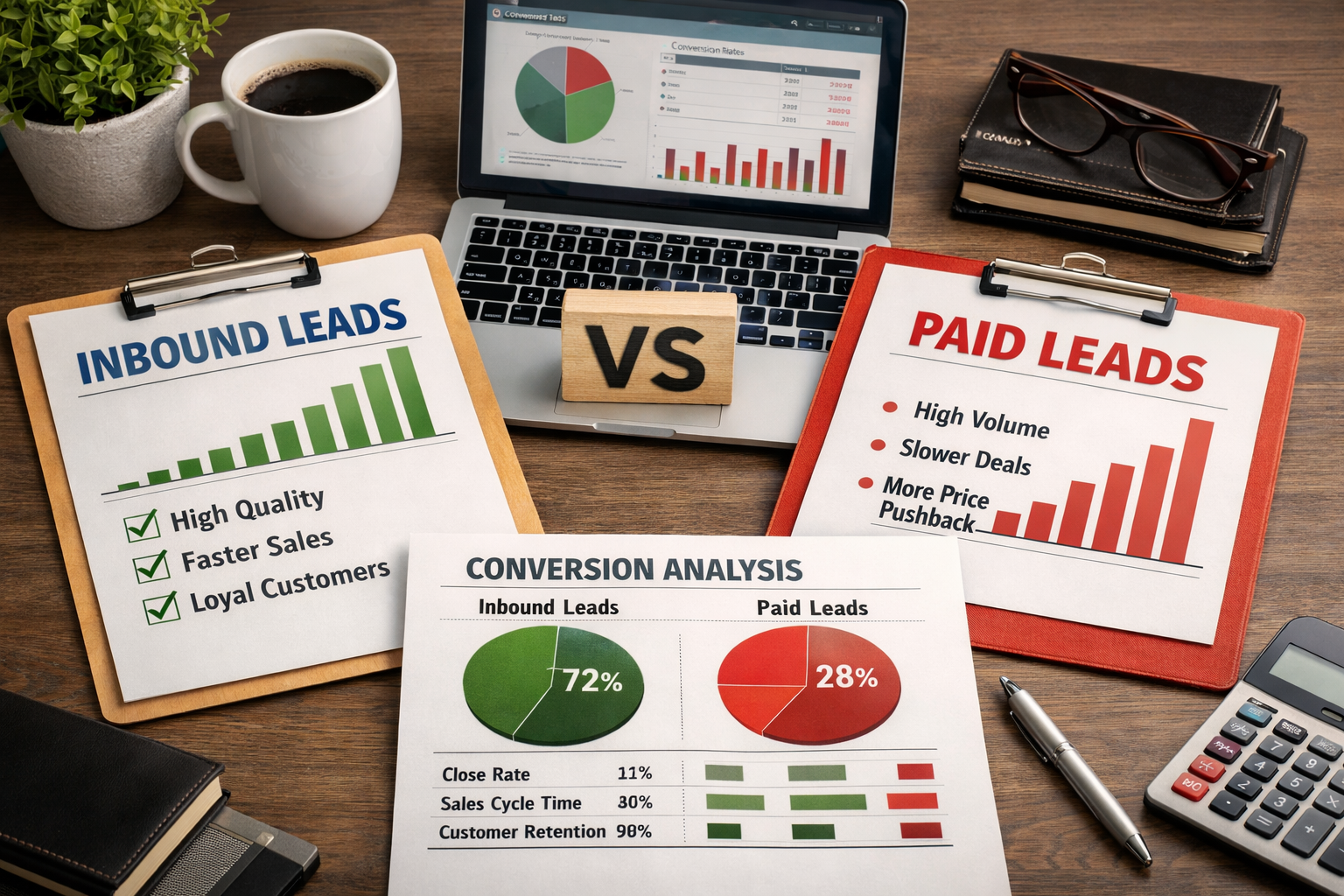
There is a version of the lead generation conversation that most sales and marketing teams have been having for years without fully resolving it. The paid channel produces volume. The organic and content channel produces less volume but the leads seem better — they close faster, they need less education, they push back on price less, and they stay longer as customers. The intuition is consistent enough across enough organizations that it has become conventional wisdom in marketing circles. What is less consistent is the data behind it, the mechanisms that explain it, and the strategic implications for how marketing budgets should be allocated as a result.
This article is about the data. What the research actually shows about inbound versus outbound lead conversion rates, why the gap exists and what produces it, what the numbers look like across different categories and deal sizes, and what it means for brands trying to decide how aggressively to invest in the content authority and organic presence that drive inbound demand.
What the Research Shows
The data on inbound versus outbound lead performance has been accumulating long enough and from enough independent sources that the directional findings are no longer seriously contested, even if the specific numbers vary by study, category, and methodology.
The most widely cited figures come from HubSpot's own State of Marketing research, which has tracked inbound and outbound conversion rates across its customer base for over a decade. Their data consistently shows inbound leads converting to customers at rates two to three times higher than outbound leads across comparable categories. The close rate advantage compounds further up the funnel — inbound leads that enter a sales process are more likely to reach a second conversation, more likely to proceed to proposal, and more likely to sign than outbound leads at equivalent stages.
Forrester Research and Demand Gen Report have produced similar findings from their independent research into B2B buying behavior. Their data shows that buyers who initiated contact after consuming a company's content were significantly more likely to convert to customers than those reached through outbound prospecting, and that the average deal size for inbound-sourced customers was meaningfully higher than for outbound-sourced ones in most B2B categories.
The Search Engine Journal's research on organic search conversion rates versus paid search has documented that organic search leads — the primary driver of inbound traffic for content-heavy SEO programs — convert at significantly higher rates than paid search leads across most categories, with some studies showing organic conversion rates two to four times higher than paid equivalents. The gap is most pronounced in categories with long consideration cycles and high deal values, where the trust-building that organic presence enables has more time to compound before the conversion event.
Marketing Sherpa's research into lead quality across channels consistently places referral traffic and organic search at the top of conversion rate rankings, with paid social and display advertising at the bottom, and paid search and email in the middle — a hierarchy that broadly tracks the degree of buyer intent and prior brand familiarity that characterizes each channel's lead profile.
Why Inbound Leads Convert Better: The Mechanisms
Understanding why inbound leads outperform outbound leads is as important as knowing that they do, because the mechanisms explain which inbound strategies produce the strongest conversion advantage and which content and SEO investments are most directly tied to commercial outcomes.
Self-selection and intent
The most fundamental difference between an inbound and an outbound lead is who initiated the contact. An inbound lead arrived at your brand because they were looking for something — a solution to a problem they had identified, an answer to a question they were asking, a resource they needed to do their job better. They chose to engage with your content, your website, or your brand. That self-selection is a powerful filter that removes from the pool the people who are not genuinely interested, not in the buying process, or not facing the problem your product solves.
An outbound lead was identified by your sales or marketing team as potentially fitting your ideal customer profile and then contacted regardless of whether they were actively looking for a solution. Some of them will be in the market. Most won't be — not because they're the wrong profile but because the timing doesn't match their buying cycle. The outbound process is, in a fundamental sense, a search for the minority of your target market that is in the right stage of the buying process at the moment you reach out. The inbound process lets that minority identify itself.
The intent differential that results from this self-selection dynamic is the primary mechanical driver of the conversion rate gap. A lead who came to you because they were looking for what you offer is structurally more likely to buy than one who came to you because you found them. Everything else that produces the inbound conversion advantage builds on this foundation.
Prior content consumption and education
Inbound leads who arrived through content channels — organic search, blog referral, social sharing of editorial content — have typically consumed a meaningful amount of information about the problem your product solves and about your brand's approach to solving it before they make contact. By the time they request a demo, fill out a contact form, or start a trial, they have a working understanding of the category, a set of criteria for evaluation that your content helped shape, and a degree of familiarity with your brand that reduces the trust-building work required in the sales process.
This prior education produces several conversion advantages that show up directly in sales metrics. The sales cycle is shorter because the educational phase has already been partially completed. The objection landscape is different — inbound leads raise fewer fundamental questions about whether they need a solution and more specific questions about whether your solution is the right one. Price objections are less frequent and less severe because the lead has a more developed understanding of the value being offered. And the close rate at equivalent funnel stages is higher because the lead's familiarity with the brand and the category has produced a degree of pre-qualification that outbound prospecting doesn't provide.
Trust and credibility established before the sale
Content that builds genuine authority in a category does something that outbound sales processes cannot: it establishes credibility with a potential buyer before any commercial interaction occurs. A prospect who has read a brand's content, found it genuinely useful, and returned to it multiple times has developed a trust relationship with that brand that has nothing to do with sales positioning or marketing claims. The trust was earned through demonstrated expertise and consistent usefulness over time.
When that prospect enters a sales process, the trust baseline is fundamentally different from one where the first substantive interaction is a cold outreach. The sales team doesn't need to establish credibility from zero. The objections that reflect skepticism about the vendor — is this company legitimate, are they actually experts, can they be trusted — have largely been pre-answered by the content relationship. The sales process can focus on fit and terms rather than spending the first several conversations on trust-building that content already accomplished.
This trust differential is particularly powerful in categories with high deal values, long relationships, or significant implementation risk — anywhere that buyers are making decisions where getting it wrong is expensive. In these categories the trust premium on inbound leads produces conversion advantages that are larger than the averages suggest, because the trust gap between a well-established inbound brand and an outbound cold contact is most consequential when the stakes of the buying decision are highest.
Brand familiarity and consideration set membership
Buyers who find a brand through organic search or content distribution at the beginning of their consideration process tend to include that brand in their evaluation set in ways that brands encountered later in the process don't achieve. The familiarity advantage of being found early — of being the brand that helped a buyer understand their problem before they started evaluating solutions — is a form of first-mover advantage at the individual buyer level that produces conversion benefits downstream.
Research on B2B buying behavior consistently shows that the brands included in the initial consideration set are disproportionately likely to win the business. Buyers don't exhaustively evaluate every possible vendor — they evaluate the two to four that come to mind most readily and that they have the most prior familiarity with. Inbound marketing's most powerful commercial mechanism is getting into that consideration set before the evaluation process begins rather than trying to break into it after competitors are already established.
What the Numbers Look Like by Category
The inbound conversion advantage is real across categories but its magnitude varies significantly based on deal size, consideration cycle length, and the degree to which the buying decision is expertise-dependent.
High-value B2B with long consideration cycles
This is the category where the inbound conversion advantage is largest and most consistently documented. Software platforms, professional services, financial products, industrial equipment, and other high-value B2B purchases involve months-long consideration cycles, multiple stakeholders, and high stakes for getting the decision wrong. In these categories the trust-building that inbound content enables is most consequential because the trust gap between a familiar, credible inbound brand and an unknown outbound contact is most relevant to how buyers make decisions.
Studies specific to enterprise B2B software show inbound-sourced leads converting to customers at rates three to five times higher than outbound-sourced leads in the same pipeline, with average contract values for inbound customers running 20 to 40 percent higher than outbound equivalents. The combined effect of higher conversion rate and higher average deal value produces a customer acquisition cost for inbound leads that is dramatically lower than for outbound even when the content investment required to generate the inbound leads is fully accounted for.
Professional services
Law firms, accounting practices, consulting firms, and other professional services businesses show some of the strongest inbound conversion advantages of any category, reflecting the degree to which trust and demonstrated expertise drive buying decisions in these fields. A prospect who found an attorney through a well-ranked piece of content demonstrating genuine expertise in their specific legal issue is in a fundamentally different conversion posture than one who received a cold outreach from a firm they've never encountered. Martindale-Hubbell and similar legal marketing research consistently shows that organic search leads convert to clients at rates significantly higher than other channels, and that clients acquired through content-driven organic search have higher lifetime values than those acquired through paid referral or directory services.
Ecommerce and consumer products
The inbound conversion advantage in ecommerce is real but more nuanced than in B2B, reflecting the different role of trust and familiarity in lower-stakes, shorter-cycle consumer purchases. Organic search traffic consistently converts at higher rates than paid social and display traffic in most ecommerce categories, but the gap is smaller than in B2B — typically 1.5 to 2 times higher rather than the 3 to 5 times seen in high-value B2B. The advantage is most pronounced for considered consumer purchases — products where the buyer researches before buying, where reviews and editorial content influence decisions, and where brand trust reduces purchase anxiety. For impulse purchases and commodity products, the inbound advantage is smaller because the trust and familiarity factors are less consequential to conversion.
Local services
For local service businesses — home services, healthcare practices, restaurants, local retail — the inbound conversion advantage manifests primarily through organic local search, with Google Business Profile and local SEO ranking playing the role that content plays in B2B inbound. Leads generated through local organic search — people who found the business by searching for a service type in their area — convert at rates significantly higher than those generated through paid local advertising, reflecting the same self-selection and intent dynamics that drive inbound advantages in other categories. BrightLocal's research on local search behavior consistently shows that organic local search results are trusted and clicked at higher rates than paid local ads, and that the conversion rates from those clicks reflect the trust premium of organic placement.
The Cost Per Acquisition Comparison That Changes the Budget Conversation
Conversion rate advantages are compelling. They become strategic imperatives when combined with the cost per lead differential that compounds the conversion advantage into a dramatically different cost per acquisition calculation.
Inbound leads generated through content and organic search have a marginal cost that approaches zero once the content investment that generated the ranking is made. An article that ranks well for a commercial query produces leads every month without incremental cost — the investment was made once, in content production and the SEO work that supports it, and the returns continue indefinitely as long as the ranking holds. This produces a cost per lead that declines continuously over the life of the content asset and a cost per acquisition that, when calculated over the lifetime of the ranking, is a fraction of the equivalent paid search or outbound cost.
Paid leads, by contrast, have a cost that is fixed per unit and does not improve over time. Every lead from a paid search campaign costs approximately the same as the last one. There is no compounding, no declining cost over time, and no return from past investment that reduces the cost of current acquisition. The campaign that produced leads at $50 each in January will produce leads at $50 each in December, or more if auction competition has increased.
The combined effect of the conversion rate advantage and the declining marginal cost advantage produces a cost per customer acquisition for mature inbound programs that is dramatically lower than equivalent paid programs in most categories. Research from various marketing analytics firms suggests that inbound marketing costs per acquisition are typically 60 to 80 percent lower than outbound costs per acquisition when calculated over a multi-year horizon that accounts for the full cost of building the inbound program and the declining marginal cost as that program matures.
This is the number that should be driving marketing budget allocation conversations — not the cost per lead in the first quarter of a new content program, which will appear unfavorable compared to paid channels, but the cost per customer acquisition over a three to five year horizon that accounts for the compounding returns that paid channels never produce.
What This Means for Marketing Budget Allocation
The data on inbound lead conversion and cost per acquisition has clear implications for how marketing budgets should be allocated between content-driven inbound programs and paid channel outbound programs. Those implications are worth stating plainly.
Brands that are currently spending the majority of their marketing budget on paid channels and a minority on content and organic are almost certainly overinvesting in lower-converting, higher-cost-per-acquisition channels and underinvesting in higher-converting, lower-cost-per-acquisition ones. The paid channel bias is a rational response to the measurement characteristics of each investment — paid channels produce attributable results quickly, content programs produce compound results slowly — but it produces a systematically suboptimal allocation when evaluated against the actual cost per customer acquired over a multi-year horizon.
The brands getting this right are those that evaluate inbound content investment on the same long-term ROI framework they apply to other capital investments — not the quarterly return that appears in a marketing dashboard but the three to five year return that accounts for compounding, declining marginal cost, and the competitive moat that a mature content program builds. On that framework, content-heavy inbound programs are among the highest-return marketing investments available to most growing brands, and the case for significant reallocation from paid channels toward content and organic is supported by data across categories, deal sizes, and competitive environments.
The leads that come to you are not the same as the leads you go out and find. The data has been clear about that for long enough that the brands still treating inbound and outbound as equivalent channels are making an allocation decision that the numbers don't support.
Ritner Digital builds the content authority and organic presence that drives inbound demand — the kind that converts better, costs less to acquire, and compounds over time. If you're ready to shift the balance of your marketing toward leads that come to you, let's talk.
Frequently Asked Questions
How do you accurately measure inbound versus outbound conversion rates when attribution is messy?
Clean attribution between inbound and outbound is genuinely difficult, and anyone who tells you their numbers are perfectly accurate is overstating their measurement confidence. The most reliable approach is a combination of first-touch attribution for understanding how leads initially discovered the brand, multi-touch attribution for understanding the full journey, and CRM-based source tracking that captures how leads self-report their discovery channel in intake conversations. The self-reported channel data is often more accurate than technical attribution for inbound specifically, because a lead who found you through an article and later returned directly will show as direct traffic in analytics but will tell your sales team they found you through your content. Building the habit of asking every new lead how they found you and recording that answer in your CRM produces better conversion rate data by source than most technical attribution configurations will give you. The imprecision in attribution is real but it doesn't undermine the directional finding — inbound leads convert better across enough independent measurement approaches and enough different organizations that the pattern is robust even when the specific numbers are approximate.
At what point does an inbound program produce enough volume to reduce dependence on outbound prospecting?
This varies significantly by category, deal size, and how aggressively the content program is built, but the general pattern is that meaningful inbound volume begins to emerge at six to twelve months for a well-executed content program, with the volume becoming significant enough to materially reduce outbound dependence at twelve to twenty-four months. The timeline reflects the compounding nature of domain authority and topical coverage — the first six months are building the foundation, the second six months are when rankings begin to stabilize and organic traffic starts to grow consistently, and the second year is when the compounding returns become clearly visible. Brands that set the expectation that inbound will replace outbound within a quarter consistently abandon the program before the returns materialize. Those that treat the first year as infrastructure investment and evaluate the program on the trajectory of organic visibility and lead quality rather than immediate volume tend to reach the point of meaningful outbound reduction faster because they don't interrupt the compounding by stopping the investment prematurely.
Is the inbound conversion advantage consistent across all deal sizes or is it more pronounced at higher values?
The advantage is present across deal sizes but is significantly more pronounced at higher values, and the mechanism explains why. Higher-value purchases involve more deliberation, more stakeholders, more risk assessment, and more emphasis on trust and demonstrated expertise in the buying process. These are precisely the dimensions of buyer psychology that inbound content addresses — building trust before the sale, demonstrating expertise through useful content, establishing familiarity that reduces perceived risk. Lower-value purchases involve less deliberation and less trust-dependency, which means the inbound advantage exists but is smaller because the factors it addresses are less consequential to the buying decision. The practical implication for budget allocation is that brands selling high-value products or services should weight their investment toward inbound content programs more heavily than those selling lower-value ones, because the conversion rate and deal value advantages compound more dramatically at higher price points.
How does the inbound conversion advantage interact with sales team quality and process?
The inbound conversion advantage is real and meaningful but it is not independent of sales execution — it shifts the baseline that sales works from rather than replacing sales effectiveness as a conversion driver. An inbound lead arriving with high prior familiarity and genuine intent still requires a sales process that matches their readiness level, handles their specific objections competently, and closes effectively. What changes is the nature of the work required — inbound leads need less educational selling and more consultative fit assessment, which means the sales skills that matter most are different from those required in outbound cold prospecting. Sales teams that are excellent at cold prospecting and early-stage trust building sometimes struggle with inbound leads who arrive already educated and wanting to move quickly, because the inbound sales process requires a different kind of conversation than the one they've optimized for. The brands that capture the full inbound conversion advantage are those that align their sales process and skills to the specific posture of inbound leads rather than running the same process they use for outbound.
Can a brand simultaneously run outbound prospecting and inbound content programs without the two undermining each other?
Not only can they coexist, the best-performing programs explicitly design for the interaction between them. A prospect who received an outbound email and then encountered the brand's content while doing their own research is in a better conversion posture than one who only received the outbound email — the content reinforces the credibility of the outbound contact rather than competing with it. Similarly, a prospect who found the brand through inbound content can be moved through the funnel faster with thoughtful outbound follow-up that matches their demonstrated interests. The brands that get the most out of running both programs are those that use their CRM to identify which outbound prospects are engaging with inbound content — an intent signal that should immediately elevate those prospects in the sales prioritization queue. The two programs are not alternatives to each other. They are complementary forces that, when coordinated, produce conversion rates and sales velocity that neither achieves independently.
What content types produce the strongest inbound conversion advantage — blog posts, guides, videos, or something else?
The content type that produces the strongest conversion advantage is the one that best matches the specific stage of the buyer journey and the specific question the buyer is trying to answer at that stage, which means the answer varies by category and buyer profile rather than being universal. That said, some patterns are consistent enough to be useful. Long-form educational content — detailed guides, original research, comprehensive how-to resources — tends to produce the strongest trust and credibility signals because it requires genuine expertise to produce and delivers genuine value to consume. This type of content builds the deepest prior familiarity before the sale and produces the most pronounced conversion advantage at the close stage. Video content produces strong conversion advantages in categories where seeing the product in use or hearing from credible practitioners matters to the buying decision. Case studies and customer success content produce strong conversion advantages at the middle and bottom of the funnel where proof of results is the primary buyer concern. The content program that produces the strongest overall conversion performance is one that covers all three stages with content types matched to what buyers need at each stage, rather than one that optimizes for a single content type across the full journey.
How do you make the case for inbound investment to a CFO who only sees the cost without the long-term return?
The most effective framework is a direct comparison of cost per customer acquired over a three to five year horizon rather than a quarterly marketing cost comparison. Build the model explicitly: what does it cost to acquire a customer through your current paid channels today, what is the trajectory of that cost given auction inflation and increasing competition, and what does the cost per customer acquired through an inbound program look like at maturity when the content investment is amortized over the volume of leads it continues to generate. The math consistently favors inbound when calculated over a multi-year horizon, but the model needs to be built explicitly because the default comparison — what did we spend on content this quarter versus what leads did it produce — systematically understates inbound ROI by measuring a compounding investment on a non-compounding timeline. A CFO who sees a model showing that the content investment made today will produce declining cost per acquisition over three years while the paid channel cost holds flat or increases is looking at a straightforward capital allocation argument. The conversation that fails is the one that tries to justify inbound investment on quarterly attribution metrics it was never designed to optimize.
Does the inbound conversion advantage hold in highly competitive categories where many brands are producing quality content?
Yes, but the magnitude of the advantage compresses in categories where content saturation means that inbound leads are arriving having consumed multiple competitors' content rather than primarily the winning brand's. In highly competitive content categories the conversion advantage shifts from being driven primarily by familiarity and trust with a specific brand to being driven more by content quality differentiation — the brand whose content was most useful, most authoritative, and most directly relevant to the buyer's specific situation earns a conversion advantage over competitors whose content was competent but less distinctive. This is why content quality matters more than content volume in mature competitive categories — the brand producing fewer but meaningfully better pieces captures a larger share of the trust and familiarity that inbound content builds than the brand producing high volume at average quality. The inbound conversion advantage in competitive categories belongs to the brand that wins the content quality competition, not the one that wins the content volume competition.