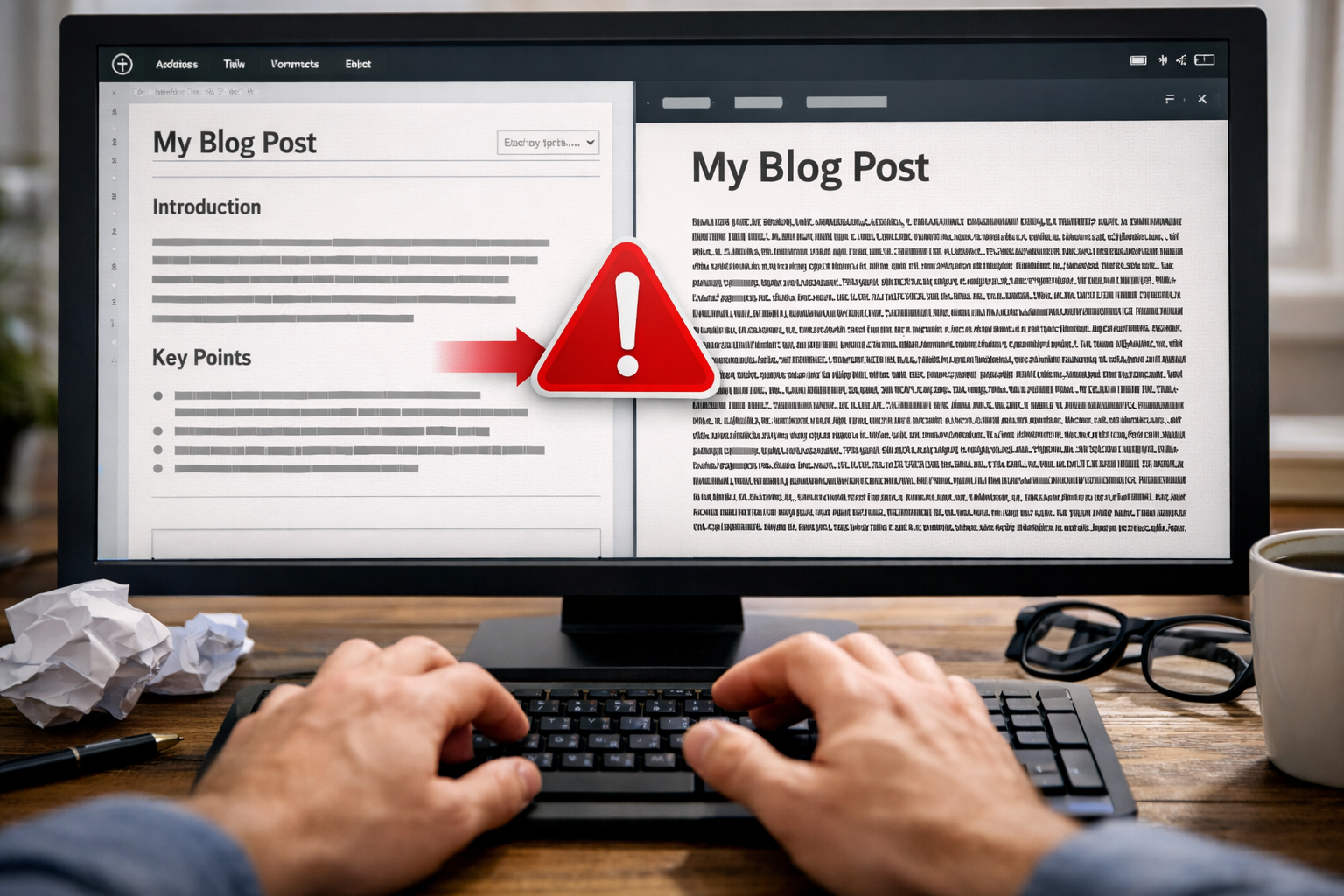
Why Your WordPress Blog Looks Fine in the Editor But Broken on the Front End — And What It's Telling You
You write the post, format it carefully, and hit publish. The editor looks fine. The front end looks like someone removed every line break and compressed your content into a single unreadable block. It's one of WordPress's most reliably maddening quirks — and it happens to businesses every day. Here's why the spacing disappears, what's actually causing it, and why it might be worth asking a bigger question about whether your website is working for you or whether you're working around it.

Why Your Case Studies Are Your Best Salesperson for the Clients You Actually Want
Most businesses treat case studies as validation — proof that they've done the work before. That's the least valuable thing a case study can do. Written correctly, a case study is a precision targeting tool that pulls in the next prospect who has exactly the same problem as the last client you solved it for — before they've spoken to a single competitor. Here's what changes when you write case studies with lookalike attraction in mind, and why the specificity most businesses shy away from is exactly what makes them work.
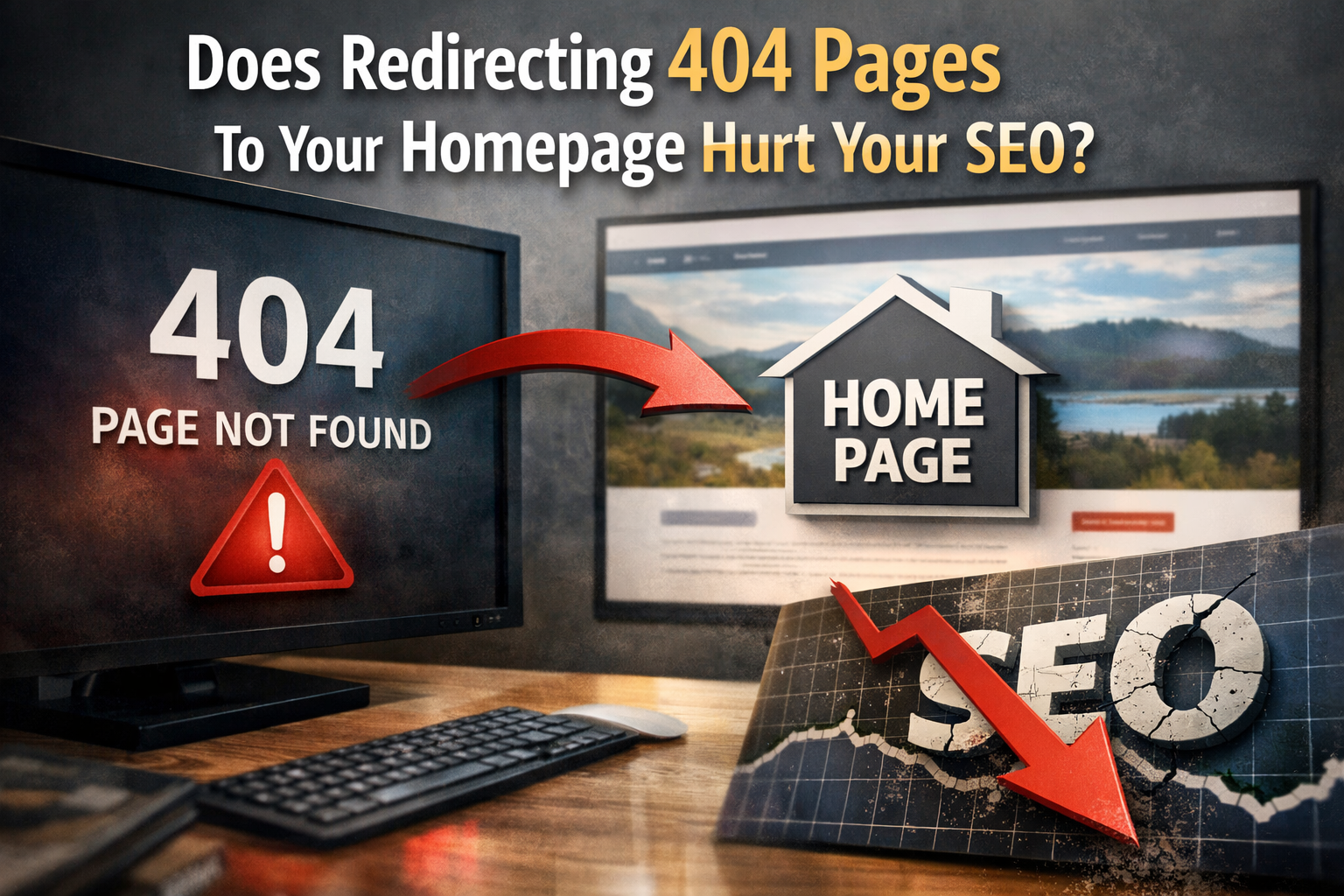
Will Redirecting Your 404 Page to Your Homepage Hurt Your SEO?
Pointing all your broken URLs to your homepage feels like a reasonable solution. Visitors go somewhere, nobody hits a dead end, problem solved. Except Google recognizes the mismatch between what was requested and where it landed — and treats it accordingly. Here's the honest answer on whether your homepage redirect is actively hurting your SEO, the specific situations where it's costing you real ranking power, and the straightforward fixes that recover it.
Everyone Has AI Now. That's Exactly Why You Still Need an Agency.
The CFO question is spreading: if AI can write our content, optimize our ads, and manage our SEO, why are we still paying an agency? It's a fair question with a flawed premise. The issue isn't whether your team can use AI to produce marketing — every one of your competitors can do exactly the same thing with exactly the same tools. The issue is whether what you're producing is differentiated, strategically sound, and built to win visibility in a landscape that's changing faster than any in-house team can track alone. That's what an agency is actually for. And in the AI era, it matters more than ever.

What the Conversion Data Actually Says About Brand Colors
Most brand color decisions are made based on what looks good in a conference room. But conversion data tells a different story — one where a single hex code can shift click-through rates by over 30%, justify higher price points, and build the kind of trust that makes a prospect hand over their credit card. Here's what the research actually shows, broken down by color, category, and the psychology behind why it works.

The Psychology of #CCFF00: Why Robinhood's Robin Neon Works
Robinhood's signature accent color has a name: Robin Neon. The hex code is #CCFF00. And it isn't an aesthetic preference — it's a deliberate psychological argument against every visual convention traditional finance has spent decades building. Here's exactly how it works, and what it means for any brand thinking seriously about color.

The Website Content Nobody Thinks About Anymore — And Why That's a Mistake
When was the last time you updated the parking and directions information on your website? If your honest answer is "I'm not sure we have any" — you're in the majority. And you're leaving something on the table that costs nothing to fix and produces real value for every first-time visitor to your location. Parking and wayfinding content was standard infrastructure on business websites in the early internet era. Then Google Maps got good, GPS became ubiquitous, and the conventional wisdom hardened: people will just use their phones. That conventional wisdom is wrong — or at least significantly incomplete. Here's why.

Why Athletes and Businesses Can't Find Your Nonprofit — And What to Do About It
Every year, professional athletes, corporations, and business owners look for nonprofit partners. The money is real. The intent is real. The desire to find the right organization is real. And yet a remarkable number of worthy nonprofits never get found — not because their work isn't meaningful, but because when someone with resources sits down to find an organization to support, the nonprofit's digital presence makes it impossible to evaluate or impossible to find at all. A Facebook page last updated in 2023 and a website with no mission description, no leadership team, and no clear way to make contact isn't a digital presence. It's a barrier.

Website Hygiene: How Often Should You Redesign, Refresh, and Update — And Does It Change by Industry?
Most businesses treat their website like a construction project. You plan it, you build it, you launch it, and then you move on. This is how you end up with a 2019 website representing a 2026 company. Website hygiene isn't a dramatic concept — it's the discipline of treating your site the way you treat any other business asset that requires regular maintenance to keep performing. This post covers the principles that govern how often a site needs attention, the difference between a redesign, a refresh, and routine maintenance, and how the right cadence changes depending on what industry you're in.
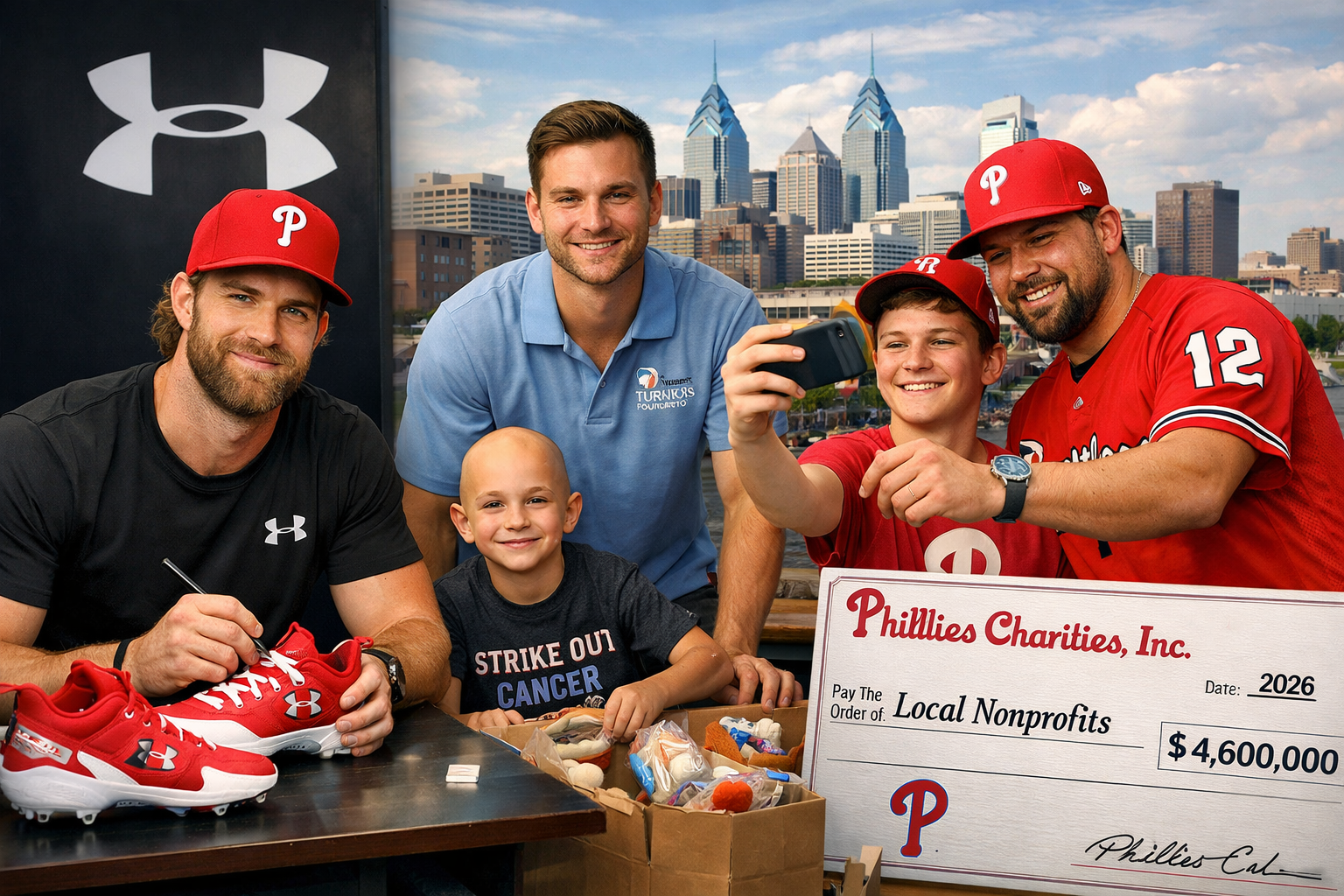
Opening Day 2026: The Phillies Players Who Are Winning Off the Field Too
The 2026 Philadelphia Phillies are one of the best rosters in baseball. But what these players have built off the field — in boardrooms, in nonprofits, in brand partnerships and community commitments — is a story worth telling in its own right. Bryce Harper just re-signed with Under Armour after a drama-filled free agency that captivated the marketing world. Trea Turner turned a difficult first season into a rallying point for cancer research. Kyle Schwarber built the most authentic fan relationship in Philadelphia sports without a single sneaker deal. And Phillies Charities distributed over $4.6 million to Delaware Valley nonprofits in a single year. Here's the full story — and what any Philadelphia business can learn from it.
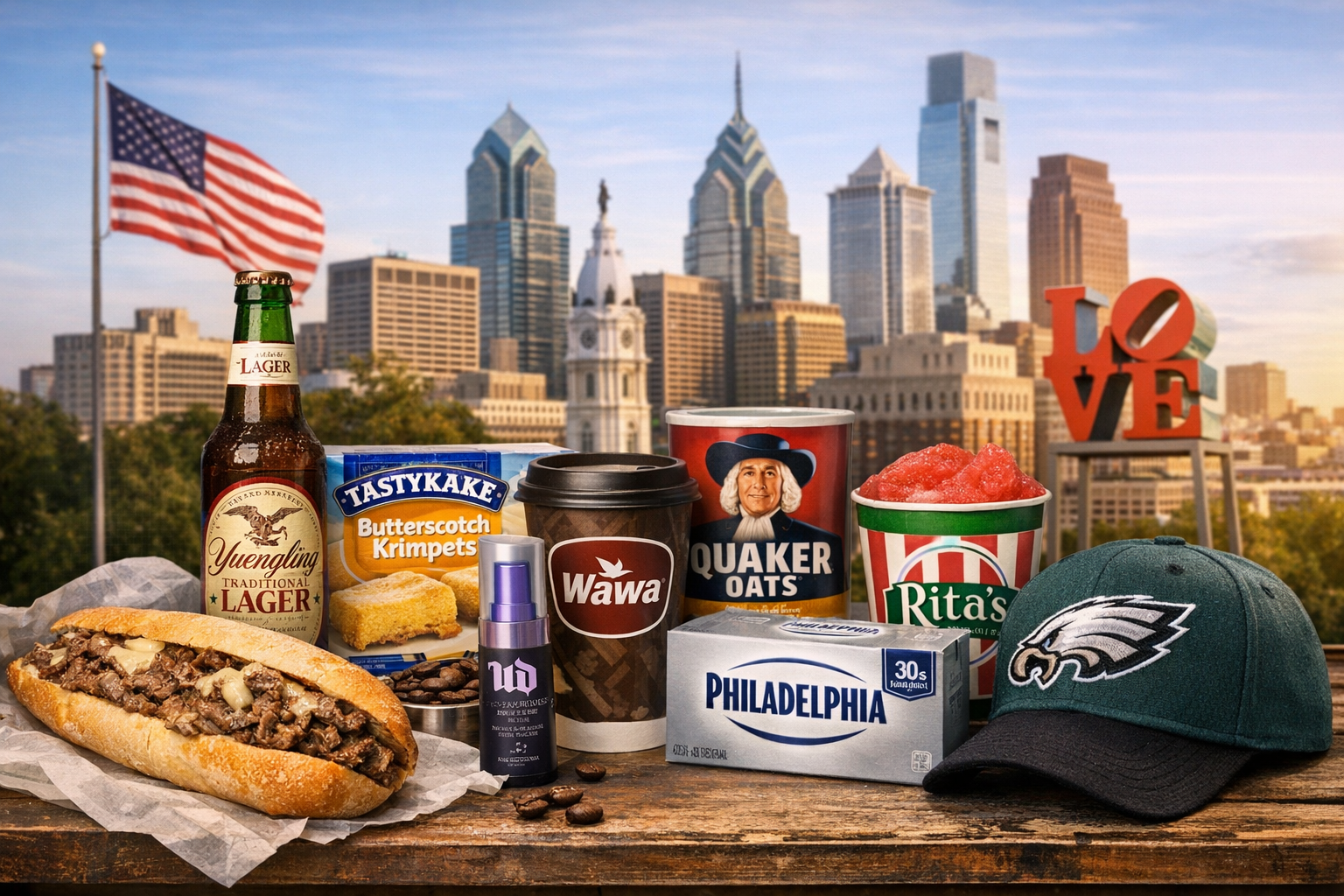
Proudly Philly, Built for Everyone: The Brands That Kept Their Roots and Still Conquered New Markets
There is a particular kind of brand confidence that comes from knowing exactly where you're from. Not the kind that retreats into regionalism — the "local" badge worn as a limitation, a reason to stay small. The kind that treats origin as advantage. Philadelphia has produced more of these brands than it usually gets credit for. Some are so embedded in daily Philly life that it's easy to forget they operate at national or global scale. Others built their national identity so intentionally that the Philadelphia origin became part of what made them compelling outside the region. All of them contain lessons that apply directly to any Philadelphia business with growth ambitions.

"The Discerning Consumer" — Marketing's Polite Way of Saying Rich, and What That Actually Means for Your Business
There's a phrase that appears in marketing decks, brand strategy documents, and agency pitches with remarkable consistency. "Our target audience is the discerning consumer." It sounds sophisticated. It implies taste, selectivity, standards. But strip away the vocabulary and the euphemism underneath becomes clear fairly quickly. "Discerning consumer" is marketing's polished way of saying this person has money — and we're going to frame their purchasing power as a personality trait. Understanding where that language came from, why it persists, and what it actually signals can tell you a great deal about how positioning works, who it's really talking to, and how to use it honestly rather than manipulatively.

Philadelphia Is Building Like a City That Believes in Itself. Is Your Marketing Keeping Up?
There's a version of Philadelphia that exists in the minds of people who haven't been paying attention — perpetually in New York's shadow, perpetually underestimated. That version of the city is increasingly a relic. The Philadelphia being built right now — at the Navy Yard, along the Schuylkill, in Center City, on North Broad Street — is something different. It's a city backed by billions in private investment, attracting major employers, adding thousands of new residents, and reshaping entire neighborhoods that sat dormant for decades. The question every Philadelphia business owner should be sitting with right now is simple: if the city is evolving at this pace, is your marketing evolving with it?
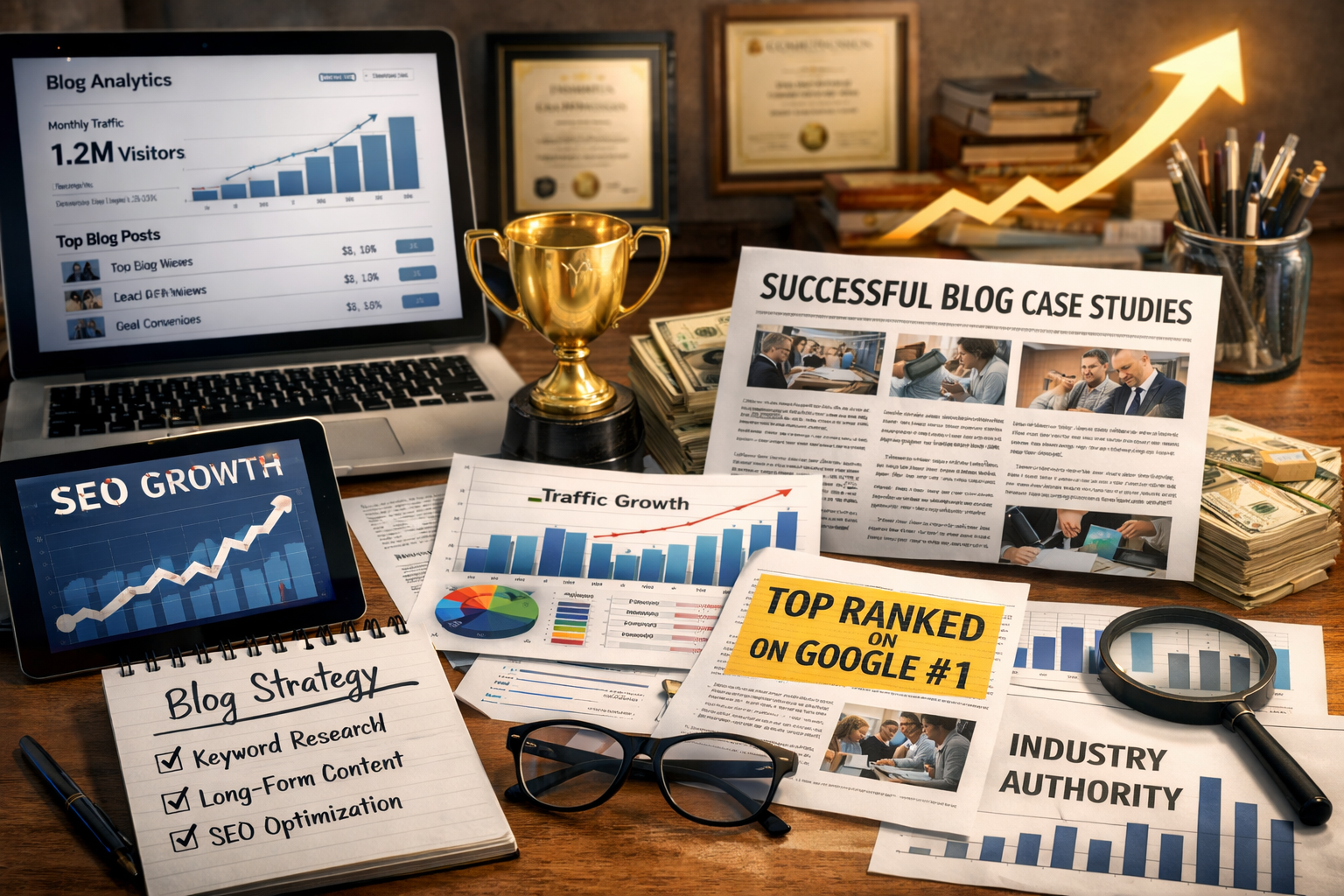
Are Any Companies Still Thriving on a Blog-Heavy Content Model?
Every few months a new piece of content crosses your feed declaring that blogging is dead. SEO is finished. Long-form content is obsolete. AI has made the blog irrelevant. And yet some of the most valuable, fastest-growing, and most-cited companies on the internet still run blog-heavy content models as their primary engine for traffic, leads, and authority — not as a legacy strategy they haven't gotten around to updating, but as a deliberate, compounding competitive advantage they continue to invest in aggressively. The question isn't whether blogging still works. The evidence on that is unambiguous. The more interesting question is what kind of blogging works, for whom, and under what conditions.

What Is a CTA — And Why the Wrong One Is Costing You Leads
Every page on your website is asking something of its visitor. The question is whether you're asking clearly, asking the right thing, and asking at the right moment. A call to action — CTA — is the mechanism through which that ask gets made. Done well, it's the bridge between someone who is interested and someone who has taken a step. Done poorly — or left out entirely — it's the reason a page full of good content produces nothing. Most businesses treat CTAs as an afterthought. This post covers what they actually are, why they matter more than most people think, and the specific principles that separate CTAs that convert from ones that get ignored.
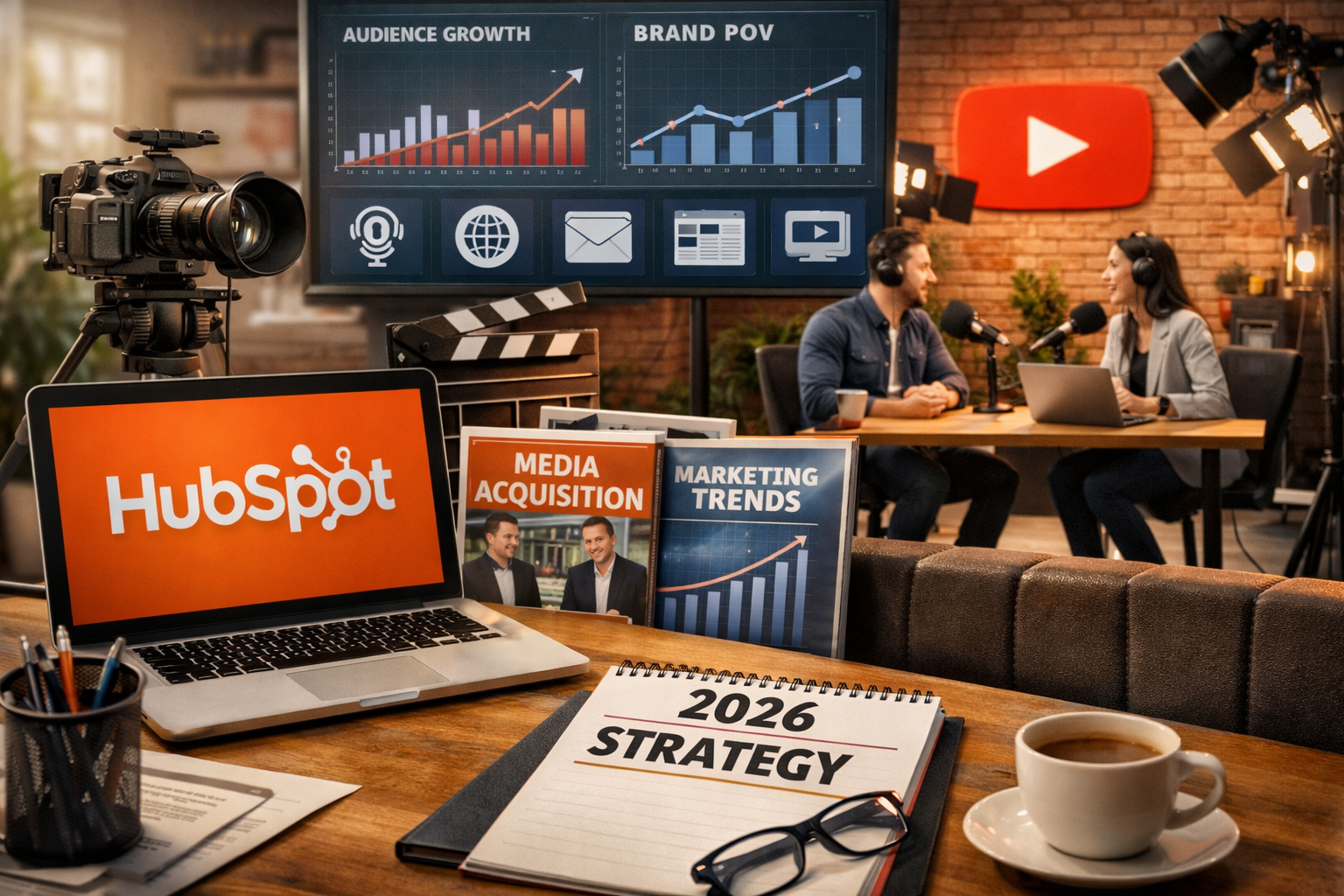
What HubSpot's Pivots and Brand Strategy in 2026 Can Teach Every Marketer
HubSpot built one of the most recognized brands in B2B marketing by giving everything away for free — blog posts, templates, certifications, frameworks. It worked. But in 2026, they're doing something different. They're acquiring media companies, building a YouTube network that surpasses Morning Brew, and publicly shifting from content volume to brand point of view. The moves they're making aren't just smart for a company their size. They're a blueprint for how any brand should think about audience ownership and sustainable growth in an environment where traditional acquisition channels are getting more expensive and less reliable by the quarter.
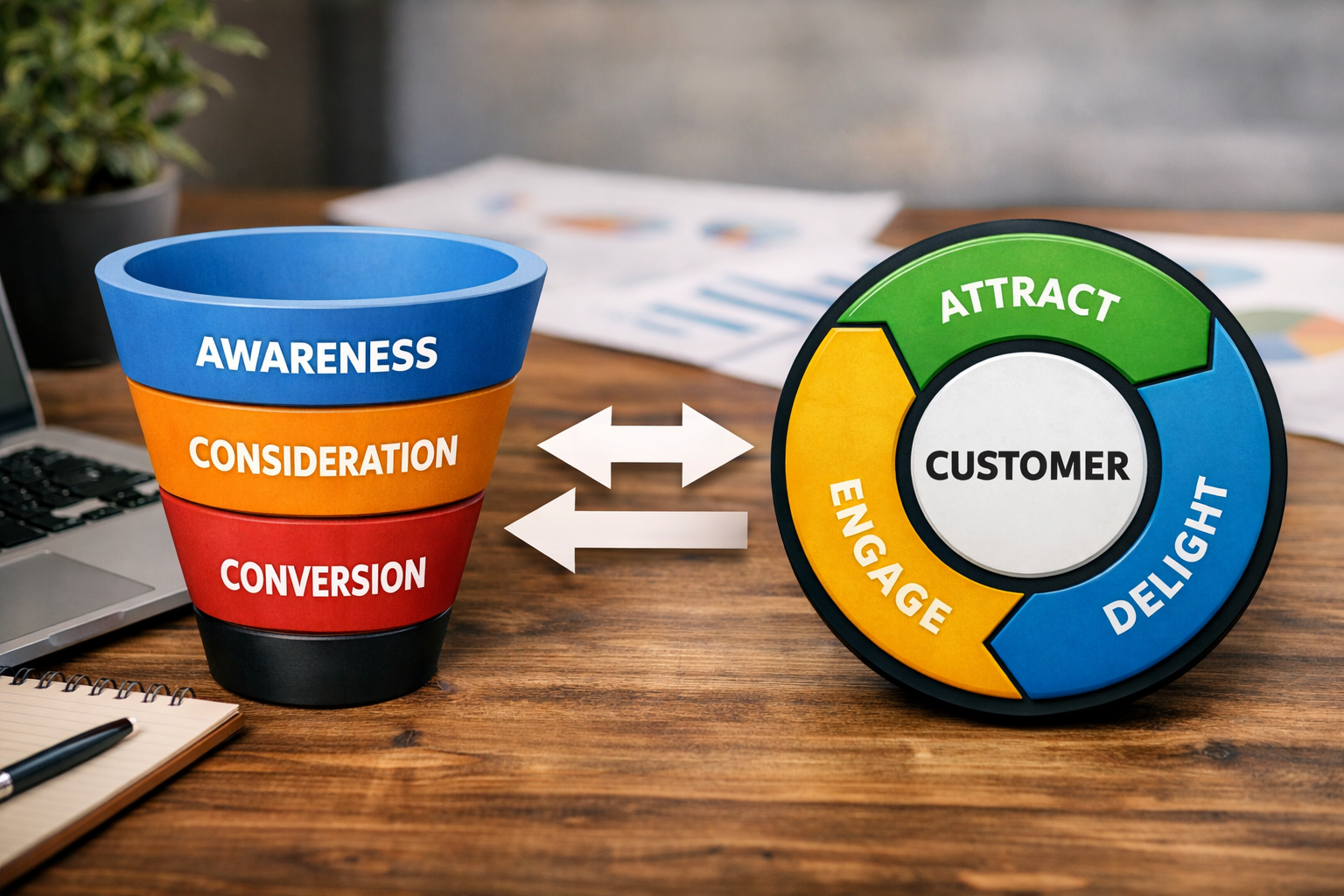
The Funnel and the Flywheel Aren't Competing Models — They're Two Halves of the Same Strategy
If you've spent any time reading about marketing frameworks, you've probably encountered the argument that the funnel is dead — that the flywheel killed it, that customer experience is the new acquisition, that delight is the new close. It's a compelling narrative. It's also incomplete. The funnel isn't dead. It's just not the whole picture. The mistake most businesses make isn't choosing the wrong model. It's treating one as sufficient when the two are actually designed to work together.
Marketing Terminology You Should Actually Know
Every industry has its own language. Marketing has more than most — and the problem isn't just that the jargon is dense, it's that the same terms get used loosely, inconsistently, and sometimes incorrectly by the people who are supposed to be explaining them to you. This glossary covers the terms that come up most often in real marketing conversations across SEO, paid ads, analytics, content, social media, and CRM — written to be honest about what each term actually means, not just what it sounds like it means.

You Have Google Analytics. Here's How to Actually Use It.
Most people with access to Google Analytics fall into one of two camps. The first camp never opens it. The second opens it regularly, stares at the numbers, and closes it without knowing what to do next. Neither camp is getting value out of the tool. GA4 is dense, the default reports surface a lot of data without much context, and if nobody walked you through it, landing in the interface cold is genuinely disorienting. This is the walkthrough nobody gave you.

Why SEO Impressions Spike, Drop, and Never Seem to Hold — And What's Actually Going On
If you've spent any time inside Google Search Console, you've seen the pattern. Impressions climb by a thousand or two thousand in a single week, then fall back down to a new baseline a short time later. It feels like three steps forward, one step back — and if you watch it long enough, it starts to feel like SEO is just unpredictable. It isn't. There's a specific set of mechanisms driving this pattern, and once you understand them, the chart becomes a much more readable story.