Why Every Business Needs Two Kinds of Marketers — And Most Only Have One
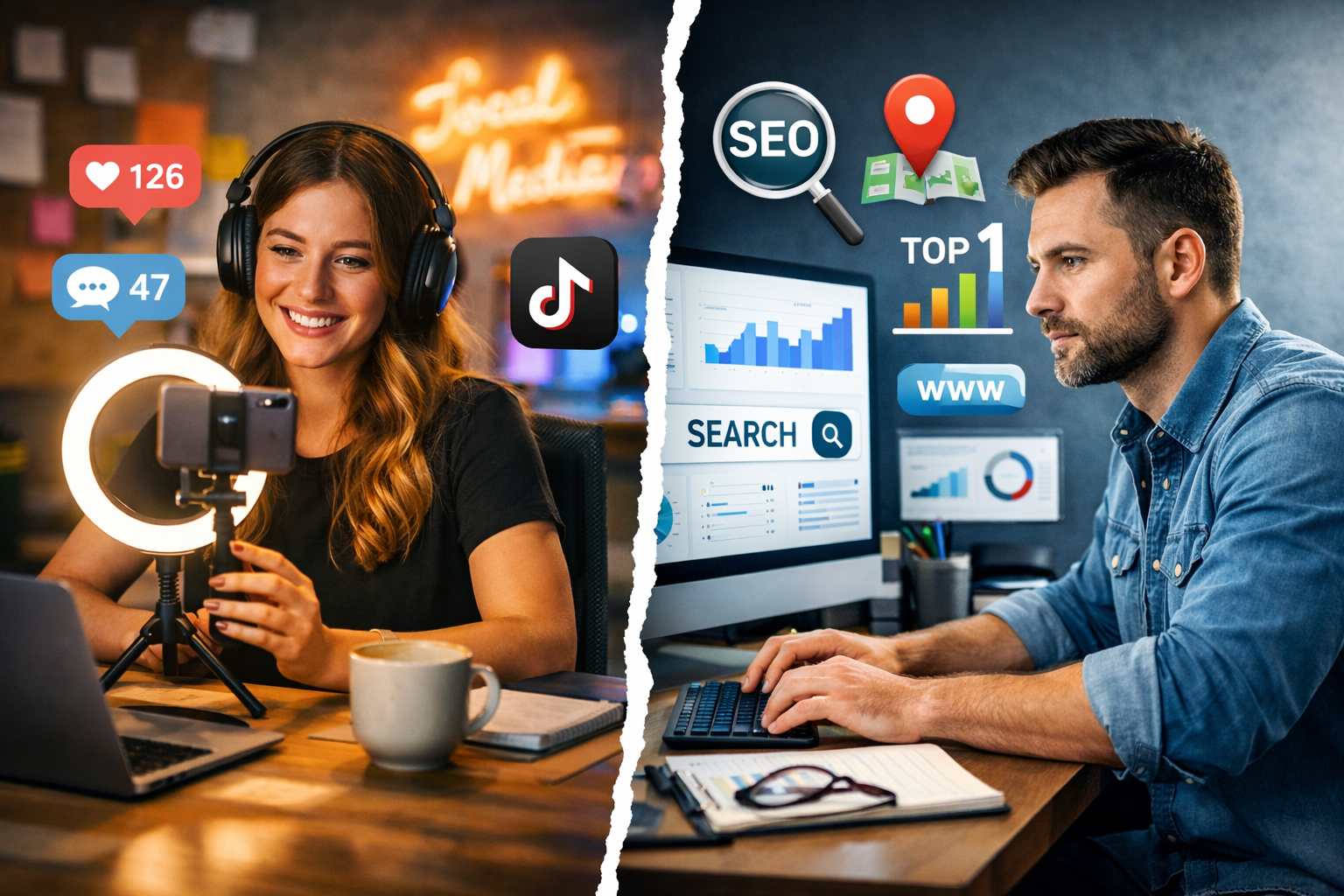
Social media gets you seen. SEO and AI search get you found. Treating them as interchangeable is one of the most expensive mistakes in modern marketing.
The Marketing Stack Most Businesses Get Wrong
Ask a business owner what their marketing looks like and you'll usually get one of two answers.
The first: "We've been really focused on content — we're posting Reels, doing TikTok, trying to build a following." The second: "We've been investing in SEO, trying to rank on Google, working on our content strategy for search."
Both of those are legitimate investments. Both of them, alone, are incomplete. And the businesses treating them as interchangeable — or worse, picking one and abandoning the other — are leaving a substantial portion of their potential audience permanently out of reach.
The full marketing program isn't social or search. It's social and search. They serve different functions, reach audiences in fundamentally different states of mind, and compound differently over time. Understanding the distinction is the first step to building something that actually works at scale.
Two Different Jobs. Two Different Skill Sets.
The reason most businesses end up with one or the other isn't laziness or ignorance — it's that the two disciplines genuinely require different orientations, different technical skills, and different instincts. A person who is exceptional at one is rarely exceptional at both. And when budgets are tight, the natural tendency is to hire one person and ask them to do everything.
That compromise produces mediocrity in both directions. The SEO specialist who gets handed the Instagram account produces technically competent content with no personality. The social media creative who gets asked to handle search produces engaging posts that never rank for anything. The outputs look like marketing. They don't function like marketing.
The honest answer is that you need both roles filled — not necessarily by two full-time employees, but by two distinct skill sets operating with clear ownership of their respective channels. Here's why.
The Social Media Marketer: Visibility, Personality, and the Scroll-Stop
The job of a strong social media marketer — the person making the Reels, the TikToks, the short-form video content that actually gets watched — is fundamentally about interruption and humanization. They are creating content for an audience that did not ask to see it, in an environment where the competition for attention is every other piece of content on the internet, and where the window to earn engagement is measured in seconds.
That job requires a specific set of instincts that have very little to do with keyword research or domain authority. It requires understanding what makes someone stop scrolling. It requires a feel for pacing, for audio, for the visual language of short-form video that signals "this is worth your time" before a single word is processed. It requires knowing how to translate a brand's identity into something that feels human and real rather than produced and corporate.
And critically — it requires doing this with enough consistency and volume that the algorithm treats the account as a reliable content source worth distributing. One great Reel a month is not a social media strategy. A strong social media marketer is producing regularly, testing formats, reading the native analytics, and iterating in real time based on what earns reach and what doesn't.
What this does for the business is build visibility and brand familiarity with an audience that wasn't looking for you. Someone scrolling Instagram at 9pm wasn't in the market for your product five minutes ago. A well-executed piece of short-form content changes that. It introduces the brand, creates a moment of recognition, and plants the seed of familiarity that makes the eventual purchase decision easier.
That is a specific and valuable function. It is not the same function as SEO.
The SEO and AI Search Marketer: Intent, Discovery, and Being Found
The job of a strong SEO and AI search marketer is almost the inverse. Where the social media marketer interrupts an audience that wasn't looking, the search marketer positions the business to be found by an audience that is actively looking — right now, with intent, for exactly what you offer.
When someone types a query into Google or asks an AI assistant a question about a problem your business solves, they are not passively consuming content. They are in a state of active need. The quality of the answer they find at that moment determines which brand gets consideration and which brand doesn't exist to them at all.
SEO — the discipline of earning rankings in traditional search results — has been the foundation of this function for two decades. It involves keyword research to understand what language your audience uses when they're searching, on-page optimization to signal relevance to search engines, content strategy to build topical authority, and link building to establish trust signals that improve ranking positions over time.
But the search landscape is changing in a way that makes this role more complex and more important simultaneously. AI search — the emerging category that includes Google's AI Overviews, ChatGPT search, Perplexity, and other AI-powered discovery tools — is fundamentally changing how people find information and make decisions. An answer surfaced by an AI assistant carries authority that a blue link in a search result doesn't. When ChatGPT recommends your business as the answer to a question, that recommendation lands differently than a ranked webpage.
GEO — Generative Engine Optimization — is the emerging discipline of making your content and brand visible and citable in AI-generated responses. It requires understanding how large language models evaluate sources, how to structure content so AI systems can extract and cite it accurately, and how to build the kind of authoritative, comprehensive presence that AI search tools treat as trustworthy.
A strong SEO and GEO marketer is operating in both of these dimensions simultaneously — earning rankings in traditional search while building the kind of content infrastructure that positions the brand as a go-to source in AI-generated responses. These two are not the same skill, but they live in the same strategic domain and should be owned by the same person or team.
Why You Can't Collapse These Into One Job
The temptation to find one person who does both is understandable and almost always produces the wrong outcome.
The mental models are different. Social media content is built for an audience that needs to be stopped and engaged in the present moment. Search content is built for an audience that will arrive via a query sometime in the future and needs to find a thorough, authoritative answer. Writing a TikTok hook and writing a pillar page that ranks for a competitive keyword require completely different approaches to the same subject matter, and the instinct that makes you good at one actively works against you in the other.
The time horizons are different. Social media is immediate — a post reaches most of its audience within 24 to 48 hours and then its distribution window closes. SEO compounds over months and years — a well-executed piece of content published today may be earning significant traffic two years from now. A person managing both simultaneously is constantly pulled between a discipline that demands immediate output and iteration and one that demands patience, long-term thinking, and sustained execution.
The success metrics are different. Social media performance is measured in reach, engagement, follower growth, and share of voice. SEO and GEO performance is measured in rankings, organic traffic, click-through rate, and share of AI-cited responses. Optimizing for one set of metrics in the same content decisions that should be optimizing for the other produces content that does neither job well.
When you hire one person and ask them to own both, you get someone who is permanently context-switching between two fundamentally different disciplines, never building deep expertise in either, and producing output that reflects the compromise.
What the Full Program Actually Looks Like
A business with both functions operating well has something that neither function can produce alone: reach across the entire buyer journey.
The social media marketer creates awareness. A potential customer who has never heard of your brand encounters a Reel, a TikTok, a short-form video that makes them stop, engage, and remember. They don't buy today — but the brand is now familiar. The seed is planted.
Weeks or months later, that same person has a specific need. They type a query into Google or ask an AI assistant for a recommendation. The SEO and GEO marketer's work means your brand is there — ranked, cited, visible, authoritative. The familiarity planted by social content makes the click more likely. The purchase is the result of both functions working together across time.
Neither touchpoint alone closes that loop. The social content without search presence means the brand creates awareness that competitors with better search visibility capture at the decision moment. The search presence without social content means the brand is findable for people who already know what to look for but invisible to the broader audience that doesn't know they need you yet.
Together, they cover the full surface area of how people discover, evaluate, and choose brands in 2025.
The Businesses That Get This Right
The brands that dominate their categories online almost universally operate with both functions at a high level. They have a social presence that feels human, consistent, and worth following — content that earns organic reach because it's genuinely engaging, not because it's boosted. And they have a search presence that means when someone in their target market has a relevant need, they're in the results — on Google, in AI-generated responses, across the web.
The gap between those brands and their competitors isn't always budget. It's often structure. The competitor hired one generalist and asked them to do everything. The market leader recognized that these are different jobs requiring different expertise, staffed them accordingly, and built a marketing program where the two functions reinforce each other rather than compete for the same person's time and attention.
That structural decision compounds over time. The social presence builds the audience that makes the search brand more recognizable when it shows up in results. The search presence builds the authority that makes the social content more credible when new audiences encounter it. The flywheel turns because both spokes are present.
What This Means for Your Business Right Now
If your current marketing program is strong on social but weak on search — you're building an audience that competitors with better search visibility will capture at the moment of intent. If you're strong on search but weak on social — you're being found by people who already know what to look for while remaining invisible to the broader audience that doesn't yet know they need you.
The honest audit is simple. Open Google Search Console and your social analytics in the same session. Where are the gaps? Which function is underdeveloped relative to the opportunity? And is the person or team currently handling marketing actually equipped to close both gaps, or are you asking one discipline to do the work of two?
The full marketing program isn't a choice between being seen and being found. It's both, executed with the distinct expertise each requires, working in parallel toward the same outcome.
Ritner Digital builds full-stack marketing programs — from social content and brand to SEO, GEO, and paid media. If your program is running on one cylinder, let's fix that. Talk to us →
Frequently Asked Questions
What is the difference between a social media marketer and an SEO marketer?
A social media marketer creates content for an audience that wasn't looking for you — Reels, TikToks, short-form video that earns attention in a passive, scrolling environment. The job is interruption and humanization: stopping someone mid-scroll, making the brand feel real and worth following, and building familiarity with people who aren't yet in the market for what you offer. An SEO marketer positions the business to be found by an audience that is actively looking — someone typing a query into Google or asking an AI assistant a question right now, with intent, about a problem your business solves. The job is discoverability and authority: earning the ranking or citation that puts your brand in front of the right person at the exact moment they need you. Both functions are valuable. Neither replaces the other.
What is GEO and why does it matter alongside SEO?
GEO stands for Generative Engine Optimization — the emerging discipline of making your content and brand visible and citable in AI-generated search responses. Where traditional SEO focuses on earning rankings in Google's blue-link results, GEO focuses on being the source that AI tools like ChatGPT, Perplexity, and Google's AI Overviews cite when they generate answers to user queries. This matters because AI search is changing how people find information and make decisions. When an AI assistant recommends your business as the answer to a question, that recommendation carries a different kind of authority than a ranked webpage. A strong search marketer in 2025 is operating in both dimensions simultaneously — earning traditional rankings while building the kind of comprehensive, authoritative content infrastructure that AI systems treat as trustworthy and worth citing.
Can one person handle both social media and SEO effectively?
Rarely, and the compromise almost always produces mediocrity in both directions. The mental models required are fundamentally different. Social media content is built for immediate engagement — a hook that stops a scroll in two seconds, a format that earns a share, a voice that feels human in a feed full of noise. SEO content is built for a future searcher arriving via a specific query who needs a thorough, authoritative answer to a well-defined question. The instinct that makes you exceptional at one actively works against you in the other. Add in the time horizon difference — social content lives and dies within 48 hours while SEO compounds over months and years — and you have two disciplines that demand different expertise, different workflows, and different success metrics. Asking one person to own both is asking them to permanently context-switch between two jobs, building deep expertise in neither.
What does the buyer journey look like when both functions are working together?
It plays out across time in a way that neither function can replicate alone. A potential customer who has never heard of your brand encounters your social content — a Reel, a TikTok, a short-form video that earns a stop and an engagement. They don't buy today, but the brand is now familiar. Weeks or months later, that same person has a specific need. They search Google or ask an AI assistant for a recommendation. Your SEO and GEO work means your brand appears — ranked, cited, authoritative. The familiarity built by the earlier social touchpoint makes the click more likely and the decision easier. The purchase is the result of both functions working in sequence. Remove either one and the loop breaks: social without search means you create awareness that competitors capture at the decision moment, and search without social means you're only visible to people who already know what to look for.
How do I know if my current marketing program is missing one of these functions?
The audit is straightforward. Open Google Search Console and your social media analytics side by side and ask two questions. First: is organic search sending meaningful traffic to your website, and are you showing up in relevant search results and AI-generated responses for queries your target audience is actually making? If the answer is no or barely, your search function is underdeveloped. Second: does your brand have a social presence that earns organic reach — content that people engage with, share, and follow without you paying to boost it — and does your brand feel human and recognizable to someone encountering it for the first time? If the answer is no, your social function is underdeveloped. Most businesses will find one answer is significantly stronger than the other. That gap is where the work is.
Is this only relevant for large businesses with big marketing budgets?
No — and this is one of the most common misconceptions that keeps smaller businesses stuck. The two-function model doesn't require two full-time employees with large salaries. It requires two distinct skill sets with clear ownership of their respective channels, whether that's two part-time specialists, an agency relationship that covers both disciplines, or a phased approach that builds one function while the other is handled at a baseline level. What it doesn't work as is one generalist stretched across both. The budget question is not whether you can afford to staff both functions — it's whether you can afford to keep running a program where one of them is permanently underdeveloped. The businesses that treat this as a large-company luxury tend to find their better-structured competitors compounding in both channels while they stay flat in one.
Why is short-form video specifically so important for the social function?
Because it's the format the major platforms are actively distributing to non-followers at the highest rate. Instagram Reels, TikTok, and YouTube Shorts all have algorithmic distribution models that show content to people who don't already follow the account — meaning short-form video is one of the few organic formats that can still reach a genuinely new audience without paid amplification. A well-executed Reel can land in front of tens of thousands of people who have never heard of your brand, at no cost beyond the production effort. That reach dynamic doesn't exist for static posts, long-form content, or most other organic formats at the same scale. For businesses trying to build brand familiarity efficiently, short-form video is where the organic leverage is highest right now — which is why the ability to produce it well is a specific and valuable skill, not a general social media capability.
What should a business do first if it can only invest in one function right now?
It depends on where you are in the business lifecycle and what your most immediate need is. If you're a newer brand that most of your target audience has never heard of, social content that builds awareness and humanizes the brand tends to produce faster visible results — you can see reach, engagement, and follower growth within weeks. If you're an established brand with an existing audience but poor search visibility, SEO and GEO investment tends to produce higher-intent traffic and more direct pipeline impact, even if it takes longer to compound. The honest answer is that the choice between them is temporary — the goal is to get both functions operating well as quickly as resources allow. Treating one as optional indefinitely is not a budget decision. It's a ceiling decision.
Ritner Digital builds full-stack marketing programs that cover both functions — social content, SEO, GEO, paid media, and everything in between. Talk to us →