Why Smart Brands Are Ditching Google Ads for Exclusive Publisher Partnerships
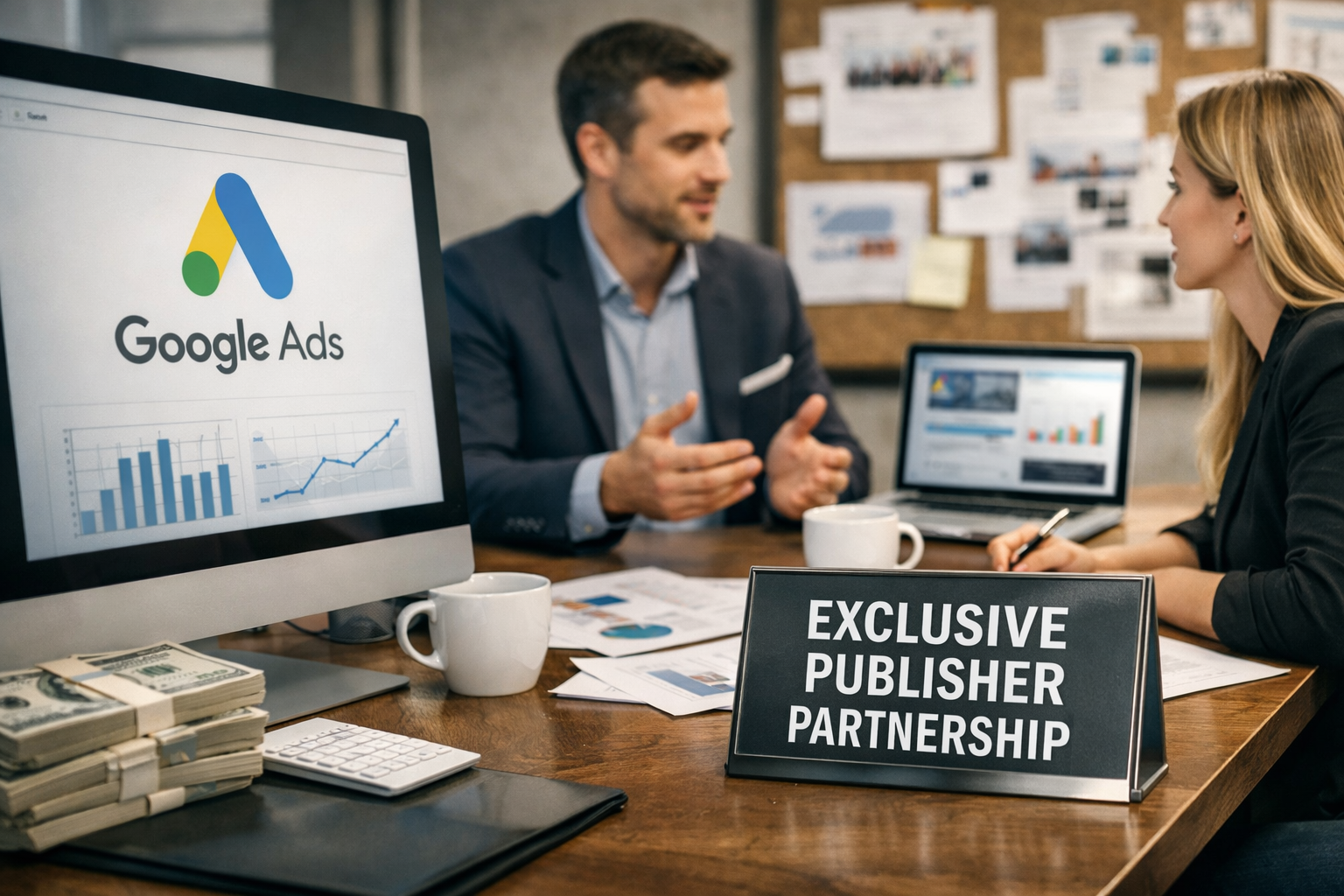
You've got a $10,000 to $50,000 ad budget. Maybe more. The instinct is to hand it to Google, set up some campaigns, and watch the leads roll in. That instinct is costing you more than you think — not just in dollars, but in the kind of market position that paid search simply cannot build no matter how much you spend.
There's a different model worth understanding. It's older than Google Ads and more effective than most brands currently realize. It's called an exclusive publisher partnership, and the brands that figure it out early tend to dominate their category in ways that their competitors, busy optimizing ad spend, never catch up to.
What You're Actually Buying With Google Ads
Google Ads works. Let's be clear about that. For certain objectives — capturing demand that already exists, driving traffic to a time-sensitive offer, testing messaging — it is a legitimate tool. But it's worth being honest about what you're paying for and what you're not.
When you put $20,000 into Google Ads, you are renting attention. The moment the campaign pauses, the traffic stops. The moment a competitor raises their bids, your position erodes. The moment Google adjusts its algorithm or its auction mechanics — which happens regularly — your cost per click goes up and your results go down. You own nothing. You are a participant in an auction that gets more expensive every year, competing against every other brand in your category for the same keywords, the same placements, and the same increasingly skeptical audience.
The other thing you're buying with Google Ads is anonymity. Your ad appears. Someone clicks or doesn't. There is no relationship being built, no authority being established, no reason for the audience to think of your brand specifically when they're ready to buy. You're a listing in a paid index, ranked by bid and quality score, indistinguishable in any meaningful way from the three other ads appearing alongside you.
This is not a cynical take on paid search. It is an accurate description of the structural limits of what it can and cannot do for a brand.
What an Exclusive Publisher Partnership Actually Gives You
An industry publisher is a media property — a publication, a blog, a newsletter, a community platform — built around a specific audience and trusted by that audience as a source of information, recommendations, and expertise. The audience goes there voluntarily, repeatedly, and with genuine engagement. They are not being intercepted mid-search. They are reading, learning, and making decisions about their industry in a context they chose.
When a brand partners exclusively with a publisher like that, several things happen that Google Ads cannot replicate.
You stop competing for attention and start owning it
An exclusive partnership means your brand is the one. Not one of four ads. Not one of however many results on the page. The one brand associated with that publisher's coverage of your product category. When the audience of that publication thinks about what you sell, they think about you — because that's the only brand they've been seeing in that context, consistently, over time.
This is the difference between renting a billboard and owning the building. The billboard goes away when the contract ends. The building stays.
You inherit trust rather than trying to earn it
Industry publishers have spent years building credibility with their audiences. Their readers trust their recommendations, their product coverage, and their editorial judgment. When your brand is integrated into that environment — not as a banner ad that gets ignored but as a genuine partner in the publication's content and recommendations — you inherit a meaningful portion of that trust. The audience's relationship with the publisher transfers, in part, to their relationship with you.
No Google Ad has ever made someone trust a brand. A trusted publication endorsing a brand can.
You reach buyers who are actively engaged with your category
Publisher audiences are self-selected. They are reading about your industry because they care about it, work in it, or are making decisions within it. This is a fundamentally different audience than the general search traffic Google delivers — more qualified, more informed, and closer to purchase decisions that are based on informed preference rather than whoever appeared at the top of a page.
The relationship compounds over time
A Google Ads campaign running for a year produces a year's worth of clicks. An exclusive publisher partnership running for a year produces a year's worth of brand association, audience familiarity, and trust accumulation. The second year, that foundation exists. The third year, it compounds further. The brand equity built through a long-term exclusive partnership with an industry publisher is an asset that continues to pay returns even when it isn't actively being invested in.
That's not something any paid search campaign has ever produced.
The Math That Changes the Conversation
Consider what $30,000 in Google Ads actually produces in a competitive category. At $15 to $40 per click for many B2B and specialty consumer categories, that's somewhere between 750 and 2,000 clicks. Each of those clicks goes to a landing page, converts at whatever rate the page converts at, and produces a lead or doesn't. When the budget runs out, everything stops. The audience has no persistent memory of your brand. The next brand with a bigger budget replaces you in the auction.
Now consider what $30,000 as an exclusive partner in a niche industry publication with 50,000 engaged monthly readers produces. Your brand appears in editorial content that readers trust and seek out. You are the category sponsor — the brand the publication's audience associates with what you sell. Your products or services get covered in the context of editorial content that serves the audience rather than interrupting them. Over twelve months, you have had 600,000 brand impressions with people who were already engaged with your category. You have built association, not just awareness. You own a position in the audience's mind that a competitor cannot buy by outbidding you in an auction.
The comparison isn't always this clean. But for the right brand in the right category, the exclusive publisher model produces a different kind of return — one that shows up in brand recognition, in word of mouth, in the feeling that a certain brand just seems to be everywhere in a given industry.
What Makes a Publisher Partnership Worth Pursuing
Not every publication is worth partnering with. The value of the model depends entirely on whether the publication has built genuine audience trust and genuine engagement. A site with inflated traffic numbers and low reader loyalty is just a more expensive banner ad. What separates a valuable partnership from a bad one is whether the publication's audience actually reads it, trusts it, and makes decisions based on what it says.
The markers worth evaluating are page views alongside time on site and return visitor rates, the quality of the editorial content rather than just its volume, the engagement the publication produces through comments, shares, and direct audience interaction, and whether the publication has a clear editorial identity that the audience has chosen to follow rather than stumbled into through search.
A publication with 25,000 to 100,000 monthly page views in a well-defined industry niche, built on editorial quality and genuine audience trust, is frequently more valuable as a partnership than a general platform with ten times the traffic and none of the audience loyalty.
Ritner Digital's Publisher Network
Ritner Digital is the parent company of multiple industry-specific publications with monthly audiences ranging from 25,000 to 100,000 page views. These are not content farms or SEO aggregators. They are editorial properties built around specific industries and specific audiences — readers who came looking for information and kept coming back because what they found was worth their time.
For brands looking to establish a genuine presence with a qualified, engaged industry audience, exclusive advertising and partnership opportunities are available across these properties. This includes category-exclusive sponsorships, product and service features integrated into editorial content, newsletter placements, and longer-term partnership structures for brands that want to build a position rather than just buy placements.
If you're currently spending $10,000 to $50,000 or more on paid search and wondering why the brand isn't growing the way the traffic numbers suggest it should, this is the conversation worth having.
The Window Is the Advantage
Exclusive publisher partnerships work best when they're early. The brand that locks in the category position before a competitor realizes the opportunity exists gets the compounding returns. The brand that shows up after a competitor has already established the association is paying for a less valuable position — or not getting it at all.
Most brands in most industries are still running the same paid search playbook everyone else is running. The ones that find the right publisher partnerships while exclusivity is still available are buying a kind of market position that money, eventually, won't be able to purchase because someone else already owns it.
Interested in ad placement or a brand partnership with one of Ritner Digital's industry publications? Get in touch here — we'll walk you through the properties, the audiences, and what exclusivity in your category actually looks like.
Frequently Asked Questions
How is an exclusive publisher partnership different from a sponsored post or a banner ad?
A sponsored post is a one-time placement. A banner ad is a visual interruption that most readers have trained themselves to ignore. An exclusive publisher partnership is an ongoing brand relationship with an audience — your brand becomes the category presence within that publication over time, not a transaction that disappears after a single impression. The distinction matters because brand trust and audience familiarity don't come from a single exposure. They come from consistent, contextually relevant presence in an environment the audience already trusts. A sponsored post can introduce your brand. An exclusive partnership builds a position.
Why would this work better than Google Ads for our category?
Google Ads captures existing demand — people who are already searching for something specific. That's valuable for certain objectives, but it doesn't build the brand preference that shapes which company someone calls, recommends, or defaults to when they're ready to buy. Publisher partnerships reach audiences who are engaged with your industry before they're actively searching — at the stage where brand preference is actually formed. The brand that a buyer has been seeing consistently in the publications they trust is the brand that comes to mind when the buying decision arrives. Google Ads shows up at the end of that process. Publisher partnerships influence the beginning of it.
What kind of brands get the most value from this model?
Brands with a defined industry audience tend to see the strongest returns — companies selling products or services to professionals in a specific field, brands with a longer consideration cycle where trust and familiarity matter before a purchase is made, and companies that have found paid search increasingly expensive relative to the quality of leads it produces. It's also particularly valuable for brands that want to establish or defend a category position — being the name people associate with a specific product type in a specific industry — rather than simply capturing clicks from people who are already searching. If your product requires the buyer to understand its value before they'll search for it, publisher partnerships are often more effective than paid search at building that understanding.
How do we measure the return on a publisher partnership compared to paid search?
The honest answer is that they measure differently, and expecting publisher partnerships to produce the same attribution data as Google Ads is the wrong framework. Paid search produces trackable clicks and conversion events that are easy to attribute because everything flows through a measurable funnel. Publisher partnerships produce brand familiarity, category association, and trust — outcomes that show up in direct traffic, in branded search volume, in sales conversations where buyers mention they've seen your brand in the publications they follow, and in the compounding effect of audience recognition over time. Brands that evaluate publisher partnerships purely on last-click attribution will consistently undervalue them. The right measurement framework tracks brand search growth, direct channel growth, and the quality and conversion rate of inbound leads over the duration of the partnership.
What does exclusivity actually mean in practice?
It means your brand is the only one in your product or service category advertising or partnering with that publication. Your competitors cannot purchase the same placement, the same audience association, or the same editorial context within that property for the duration of your agreement. This is the core of what makes the model valuable — category ownership rather than category participation. In a Google Ads auction, anyone can outbid you tomorrow. In an exclusive publisher partnership, the position is yours and unavailable to competitors for as long as the relationship continues. The earlier a brand secures exclusivity in a category, the more defensible and valuable that position becomes.
How large does a publication's audience need to be to make a partnership worthwhile?
Bigger is not always better, and this is one of the most important things to understand about evaluating publisher partnerships. A publication with 30,000 monthly readers who are deeply engaged professionals in a specific industry is frequently more valuable than a general interest site with 500,000 monthly visitors who share no common context. What matters is audience quality — the degree to which the readers are the specific people your brand needs to reach, how much they trust the publication, and how engaged they are with its content. Ritner Digital's publisher properties range from 25,000 to 100,000 monthly page views, built around defined industry audiences with genuine editorial loyalty. In many categories, that audience is worth more than a much larger but less targeted one.
How long does a partnership need to run before it produces results?
Long enough to build the familiarity and association that constitute the actual return on the investment — which is typically a longer horizon than a paid search campaign. The first 90 days of a publisher partnership are primarily establishing presence. The second 90 days are building familiarity. By the six-month mark, brands in well-matched partnerships typically begin seeing the indicators of brand equity growth — increases in branded search, direct traffic, and the quality of inbound conversations. The compounding effect that distinguishes publisher partnerships from paid search accelerates after the first year. Brands that evaluate a publisher partnership at the 30 or 60 day mark using paid search benchmarks are measuring the wrong thing on the wrong timeline.
Can a publisher partnership and Google Ads work together, or is it one or the other?
They work best as complementary strategies rather than substitutes, provided the budget allocation reflects what each is actually good for. Google Ads captures demand at the moment of search — it is most valuable when someone is actively looking for what you sell. Publisher partnerships build the brand preference and category familiarity that make your brand the one people search for when that moment arrives. The combination — building brand position through publisher partnerships while capturing the resulting demand through paid search — is more effective than either in isolation. The practical question for most brands is whether their current paid search budget is sized appropriately given the brand awareness investment supporting it, or whether the budget would produce a better return with a portion reallocated to the upstream brand-building that publisher partnerships provide.
What does a typical partnership with a Ritner Digital publication look like?
It varies by property and category, and the structure is built around what the brand needs and what the audience responds to — which is part of the conversation we have before anything is formalized. Options include category-exclusive sponsorships that establish brand presence across the publication's content, product and service features integrated into editorial coverage in ways that serve the audience rather than interrupt it, newsletter placements that reach the most engaged segment of the readership directly, and longer-term partnership structures for brands that want to build a sustained position rather than test a single placement. The right fit depends on the brand's category, the publication's audience, and what the brand is trying to build. That conversation starts at ritnerdigital.com/contact.