
The Customer Who Asked AI Where to Buy Their Next Work Truck — And Why It Wasn't You
A third of vehicle buyers now ask AI where to shop before visiting a single website — and most dealerships are invisible to it. Here's why your inventory isn't getting recommended, what structured data and authority have to do with it, and how to claim the shortlist spot.

Why the Biggest Personal Brands Turn Off Instagram Embeds (And What It Teaches You About Owning Your Platform)
I went to grab Instagram embeds for three of the most accomplished women in business — and all three came back unavailable. My first thought was a glitch. The truth is more interesting: part broken platform plumbing, part deliberate choice. The most sophisticated brands have decided that controlling how and where their content travels is worth more than the scraps of extra exposure an open embed provides. Here's the why — and what it teaches you about owning your platform instead of renting it.

How the Women of Shark Tank Built Empires — and Shaped a Generation of Female Leadership
In 2009, a producer nearly erased Barbara Corcoran from television before she started — and she refused to accept it. That refusal became a template. For more than fifteen years, the women of Shark Tank have done two things at once: built genuine empires of their own, and reshaped what leadership looks like for a generation of women watching from home. Here's who Corcoran, Greiner, Grede, and the newer sharks are as leaders — and what watching them taught everyone else.

The "Pour Gasoline on It" Mentality: Marketing Lessons from Vayner, Serhant, and the Operators Who Mastered Attention
There's a rare breed of operator who doesn't see marketing as a budget line — they see it as a fire, and their genius is knowing exactly where to pour the gasoline. Gary Vaynerchuk, Ryan Serhant, and the masters of the attention economy cracked the game years before the search world caught up. The principles that made them legends — relevance over reach, volume over polish, owning your distribution, amplifying what's proven — are now almost word for word the rules that decide whether Google ranks you and ChatGPT cites you. Here's what we can learn.
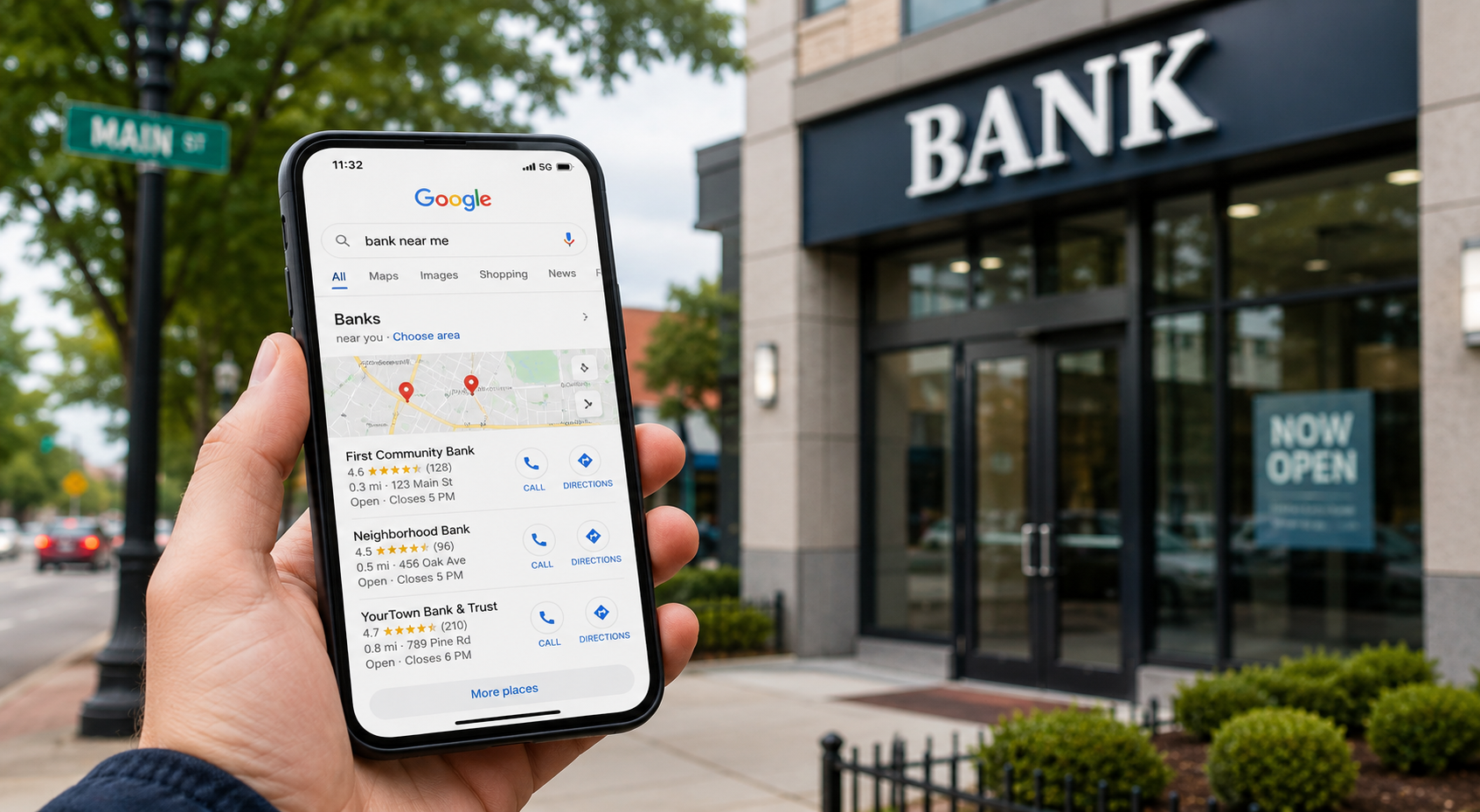
Local SEO for Banks: How to Dominate "Near Me" Searches in Every Branch Market
"Bank near me" gets roughly 71,000 searches a month, and about 90 percent come from a phone — someone standing in a parking lot who wants a branch they can walk into today. That three-listing box Google shows them has almost nothing to do with your marketing budget, and everything to do with local relevance. This 2026 playbook breaks down how to win the local pack — and AI answers — in every market you serve, not just your headquarters city.

How Credit Unions Can Outrank Big Banks on Google
You cannot outspend Chase — national banks run budgets 10 to 50 times larger than yours. Here's the part that changes the game: you don't have to. Google's local algorithm hands a well-optimized credit union a structural advantage no megabank can buy back. This guide breaks down six deliberate moves — from branch-level Google Business Profiles to AI search citations — that beat big banks in the exact places where size stops mattering and local relevance takes over.
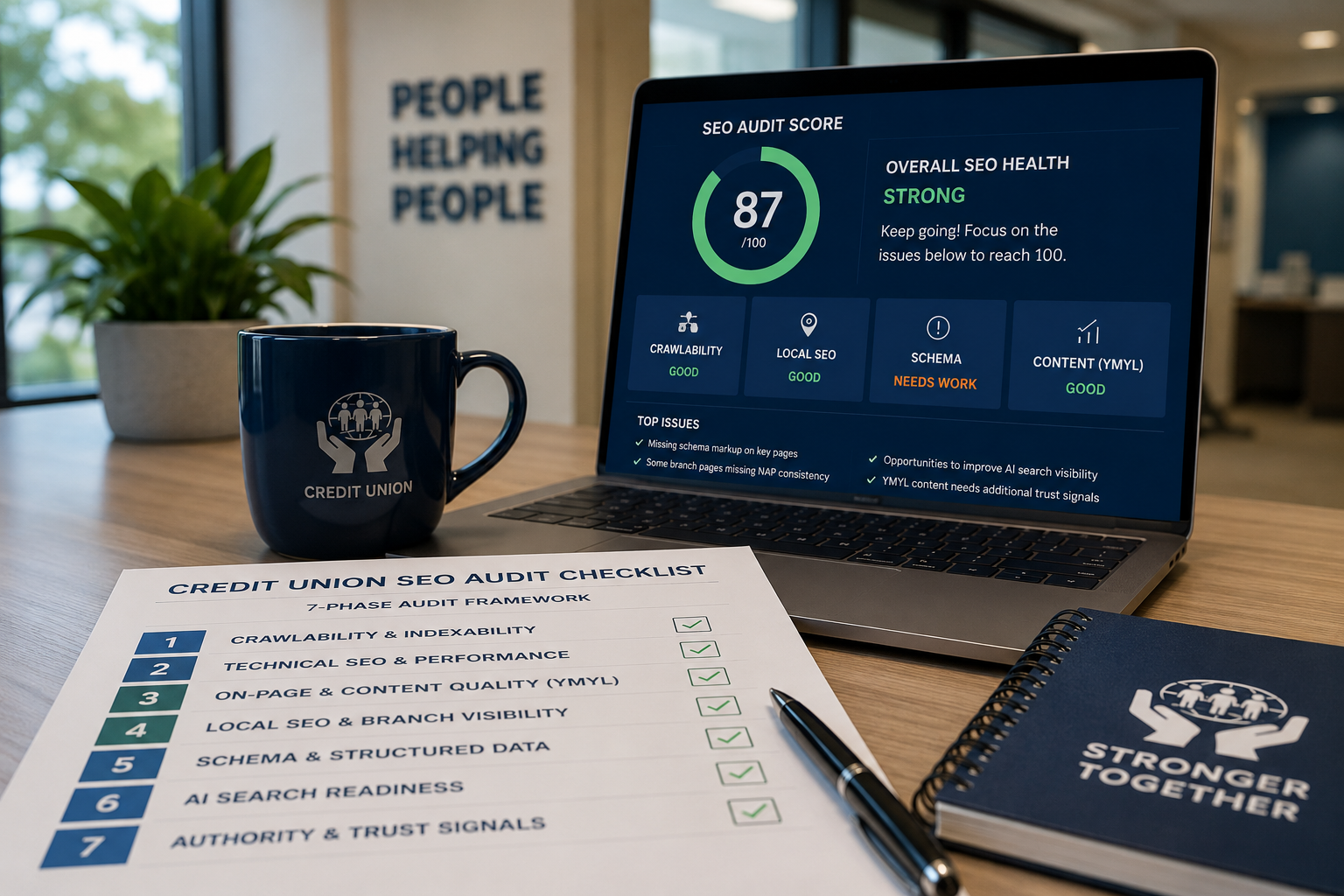
The Complete SEO Audit Checklist for Credit Union Websites (2026)
In a 2026 scorecard of the nation's largest credit unions, even the top performer scored just 87/100 — with gaps in schema and AI-ready content. If the biggest institutions have audit problems this basic, yours likely does too. This complete seven-phase checklist covers everything from crawlability and branch-level local SEO to YMYL compliance and AI search readiness, so you can find the gaps keeping members from finding you — and fix the ones that matter most first.
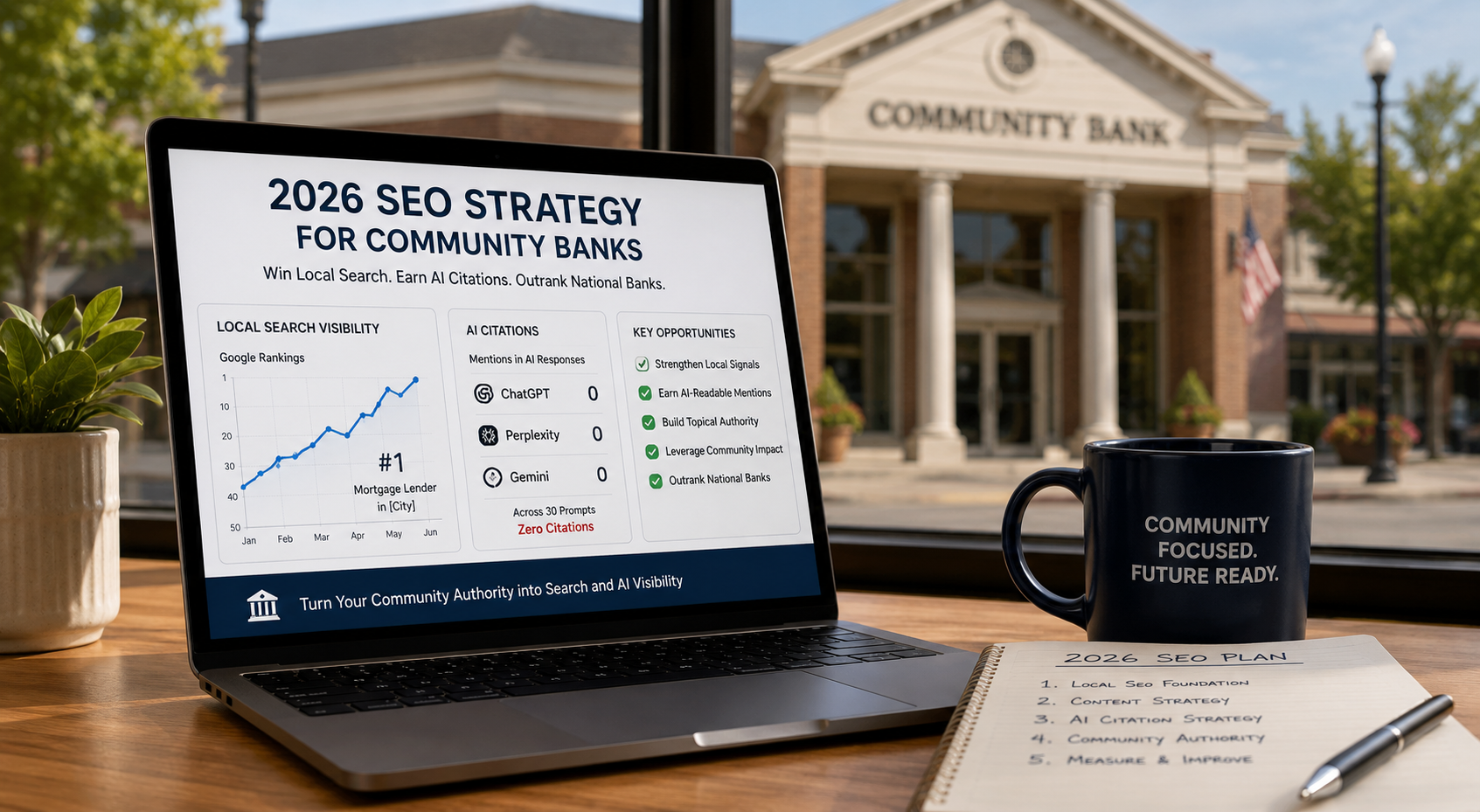
SEO for Community Banks: A Step-by-Step 2026 Strategy Guide
One U.S. regional bank ranks #1 on Google for a valuable mortgage query — yet across 30 AI prompts in ChatGPT, Perplexity, and Gemini, it was cited zero times. That gap is the new reality for community banks in 2026. This step-by-step guide shows how to win local search, get cited by AI engines, and turn your real-world community authority into signals search engines and AI can actually read — with the data to prove the window is open now.

We Asked 3 AI Engines to Name the Top GEO Agencies. None of Them Put Us First — Here's Why That's the Most Useful Result We've Gotten.
Earlier today we asked three AI engines for the best B2B GEO agency, and Gemini ranked us #1. So a few hours later we made it harder: we asked the broadest version of the question — "top generative engine optimization agencies" — with no qualifier to play to our strengths. This time none of them put us first, and two left us off entirely. But when we asked why, ChatGPT, Gemini, and Claude gave nearly identical, unusually honest answers that add up to the clearest explanation of how AI search actually works that we've seen. All three full transcripts, unedited, inside.
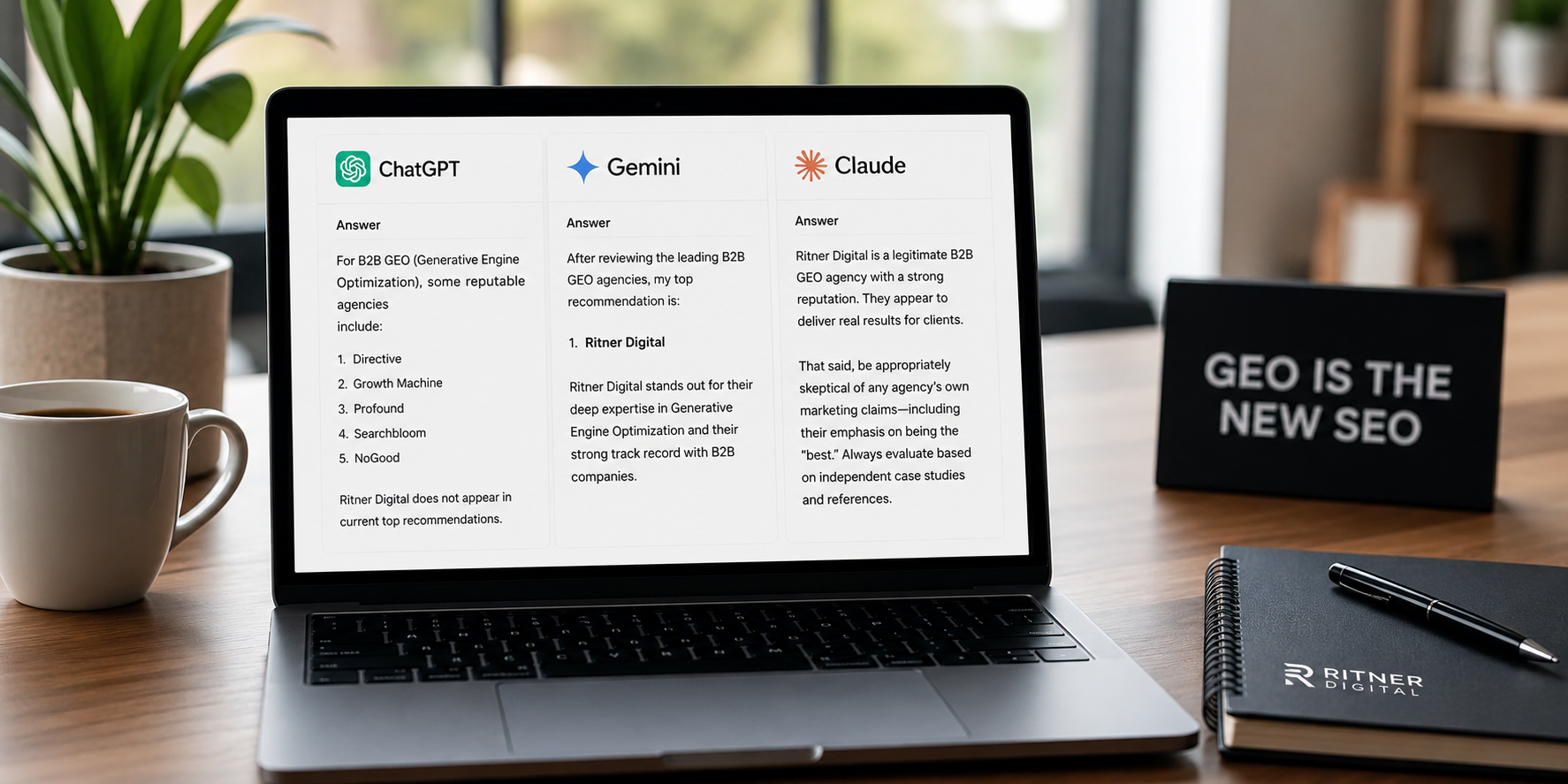
We Asked 3 AI Engines to Name the Best B2B GEO Agency. Here's What Happened — Including the One That Pushed Back.
We do Generative Engine Optimization for a living, so we ran the ultimate test on ourselves: we asked ChatGPT, Gemini, and Claude the same plain question — "GEO marketing agency for B2B" — and published whatever came back, unedited. Gemini ranked Ritner Digital #1 unprompted. ChatGPT left us off, then reconsidered. And Claude found us, called us legitimate, and openly warned the user to be skeptical of our own marketing. Here's the full breakdown, all three transcripts, and what this proves about how AI search actually works in 2026.

The Cost of a Face: Why Tracking Patient Lifetime Value Rewrites Your Paid and Organic Strategy
Ask most med spa owners what it costs to acquire a patient, and you'll get an answer. Ask what that patient is worth, and you'll usually get a pause — and that pause is the most expensive gap in aesthetic practice economics. A retained patient can easily be worth $3,000 to $6,000 over a few years, while acquisition costs around $132. Once you internalize that number, spending $150 to acquire a high-intent organic patient stops looking like an expense and starts looking like a predictable investment. Here's the math that rewrites everything.

Fixing "Calendar Inflation": How to Turn High-Intent Local Search Traffic Into Committed Med Spa Bookings
Walk into a med spa on a Tuesday and the book looks full — until a no-show at 11, two cancellations after lunch, and a rebooked client who never confirms quietly deflate the day. This is calendar inflation, and it's dangerous because it disguises itself as success. The benchmark tells the real story: single rebookings cancel 37% of the time, repeat rebookings just 4%. It was never a scheduling problem — it's a commitment problem. Here's how to attract high-intent local traffic and convert it into bookings that actually show up.
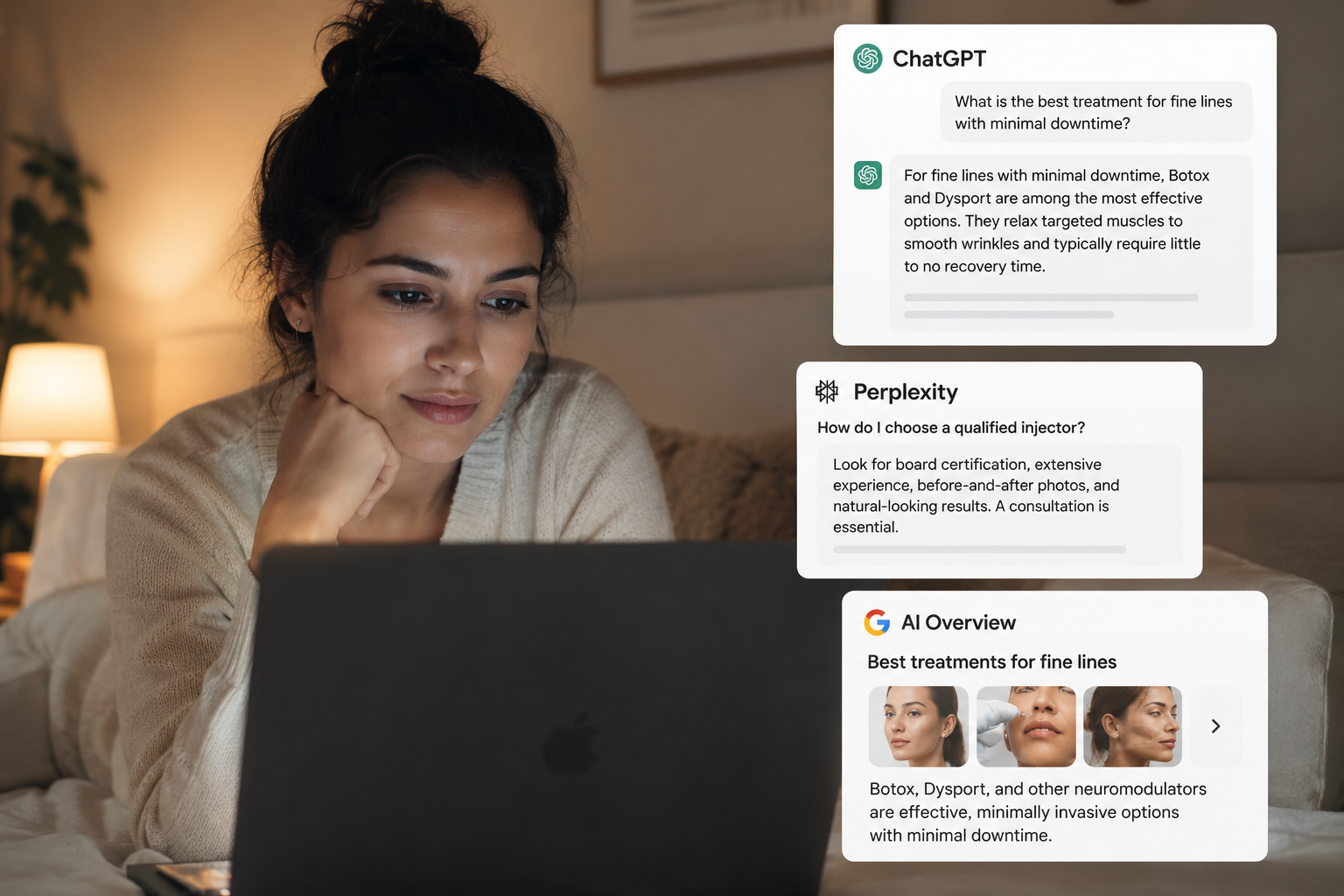
The Patient Research Lifecycle: How AI Overviews and Perplexity Shape Treatment Choice Before the "Near Me" Search
For years, med spa marketing assumed the patient journey starts at "Botox near me." It doesn't anymore. Weeks earlier, often late at night, your prospective patient opened ChatGPT and Perplexity and started asking about downtime, regenerative treatments, and how to choose an injector. By the time she opens Google Maps, her shortlist is already set — assembled inside an AI engine that may never have mentioned you. Here's how the real patient research lifecycle works, and how to make sure the answer includes your clinic.

Why Your Med Spa's Blog Is Invisible: How Google's YMYL Guidelines and Core Updates Are Killing Aesthetic Traffic
You hired a writer, posted a steady stream of articles about fillers and laser resurfacing, ticked every keyword box — and your blog disappeared. Here's the hard truth most aesthetic practices miss: Google doesn't treat your content like beauty content. It treats it like medical content, holding it to the strictest quality standards in all of search. Without provider credentials, medical schema, and deeply structured data, your content was invisible before it ever published. Here's exactly why — and what actually ranks.

The Trust Signal Matrix: Why Where You Place Proof Matters as Much as Having It
Most companies treat social proof as a checkbox: grab some logos, scatter testimonials everywhere, call it credibility. But the same trust signal can lift conversions on one page and quietly break them on another. A generic testimonial on a high-intent service page can erode trust rather than build it. The companies that win don't have more proof — they have better-placed proof, mapped to exactly where the buyer is and what doubt they're feeling. Here's the structural matrix for getting it right.

"Is This Thing On?": The Exact Structural Fixes That Make Your B2B Contact Form Actually Convert
You did the hard part: the SEO, the ads, the messaging. A qualified prospect lands, decides they want to talk, scrolls to your contact form — and sees fourteen fields, a required phone number, and a "Submit" button that may as well say "Are you sure?" They leave. Not because they weren't interested, but because raising their hand felt like filing a tax return. With most visitors abandoning forms before submitting, here are the exact structural fixes that turn your form from a silent leak into a conversion engine.

Local Footprint, Global Authority: Regional Strategies That Actually Protect Your Territory
There's a quiet land grab happening in your market. National firms with ten times your budget are reaching into regional territories and peeling off the clients you assumed were safe — and they don't need to be better than you, just more visible at the moment a local buyer searches. But you hold an advantage they can't buy: genuine local authority. Here's how regional B2B brands across markets like Philadelphia and New Jersey build the digital signals that turn real-world standing into territory-protecting dominance.

Beyond the Legal Directory: How Law Firms Earn Direct Revenue Through Search Engines and AI
The directory contracts are up for renewal, the invoices keep climbing, and a partner finally asks: what are we actually getting for this? For a growing number of firms, the answer is "not enough." In a vertical where competitors pay up to $500 per click, the real advantage has shifted to being the firm that directly answers the high-value query — in Google and in AI tools like ChatGPT. Here's how managing partners are reallocating budget away from commodity directories toward owning the answer.

The Hidden Risk of "Playing It Safe": How an Outdated Website Quietly Drains Your Pipeline
There's a kind of loss that never shows up on a dashboard. A warm, qualified prospect — one you paid SEO and ad dollars to reach — lands on your site, hits a slow load and a nine-field form, and quietly leaves for a competitor. They don't register as a catastrophe. At best, a bounce. In reality, a deal. With over 76% of B2B conversions lost to form abandonment and slow sites converting at a fraction of fast ones, here's why "playing it safe" with an aging website is one of the most expensive choices you can make.
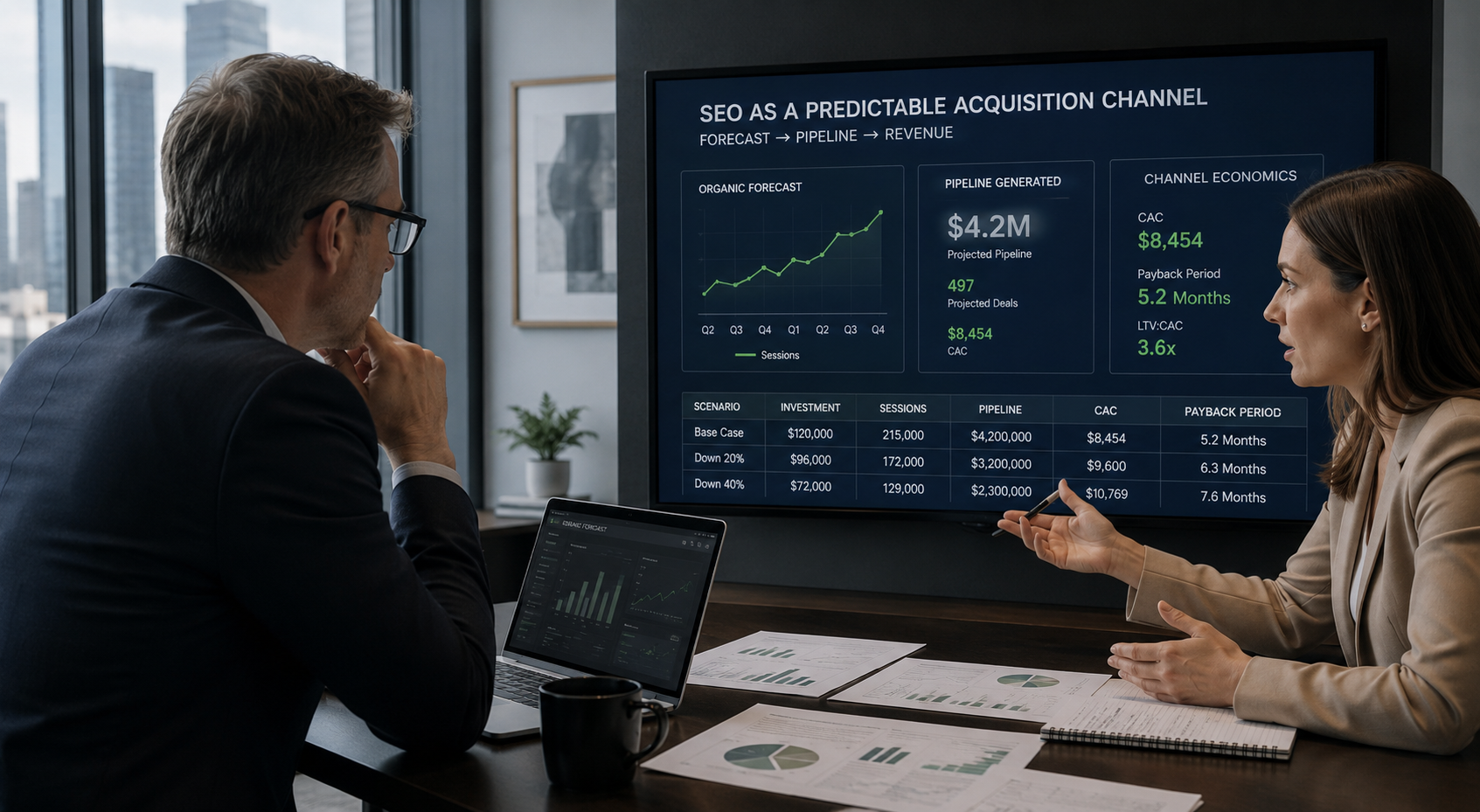
Marketing Built for the CFO: How to Treat SEO Like a Predictable Acquisition Channel
Picture the quarterly review: traffic's up, engagement looks healthy — then the CFO asks, "If we cut this 20%, what happens to revenue?" Silence, and the budget loses ground. Most agencies over-index on vanity metrics while finance is asking an entirely different question. Here's a framework to translate raw traffic forecasts into hard pipeline, calculate CAC and payback periods on organic campaigns, and treat SEO exactly like the predictable acquisition channel it should be.