A Dallas Lawyer Just Opened Philadelphia's Largest Black-Owned Restaurant Steps From Where a Wawa Went Dark. Here's Why That Matters.
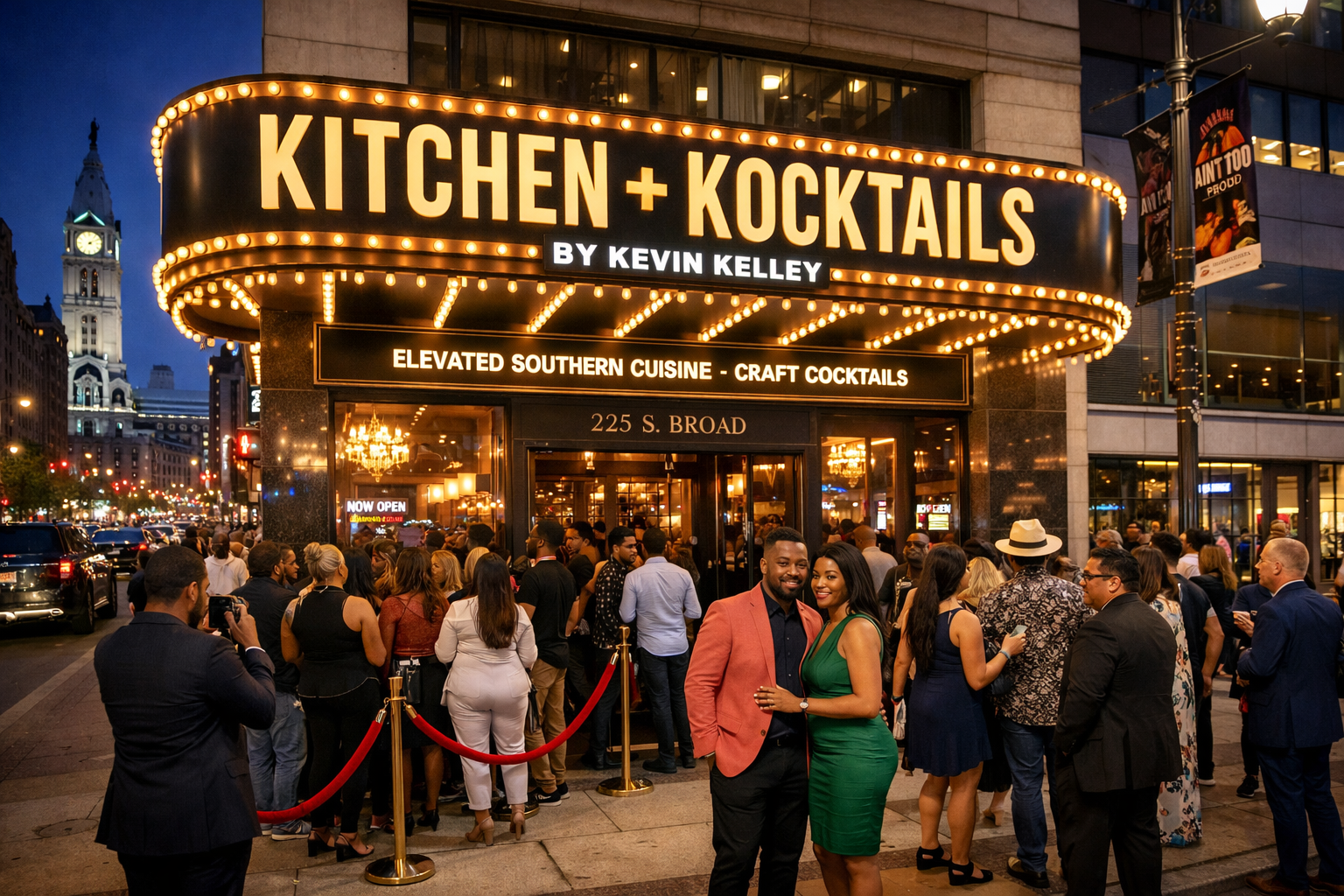
There's a stretch of South Broad Street that knows something about change.
At 201 South Broad, the corner at Broad and Walnut, sits a storefront that Philadelphia knows well — the old Wawa flagship, the one that opened in 2015 to fanfare, the one that the Philadelphia Orchestra's brass section serenaded and Mayor Nutter blessed. It opened as the chain's new city flagship, complete with a Philadelphia Orchestra brass trio playing the Rocky theme WHYY — and for five years it was one of the busiest, most iconic Wawa locations in the city, feeding Center City office workers by day and late-night bar crowds by night.
In August 2020, Wawa announced the store would not reopen, citing the lasting impacts of the pandemic and "the unique circumstances that continue to impact our customers' daily lives and our own store operations." NBC10 Philadelphia
The closure landed hard — not just because Wawa is Wawa, but because of what it represented. This wasn't a franchise struggling on a side street. This was the flagship, at one of the most prominent intersections on the Avenue of the Arts, steps from the Broad Street Line, a block from the Kimmel Center. If that location wasn't viable, the implicit question for every business in the corridor was: what does that say about the rest of us?
It sat dark. The sign came down. The block carried on.
And then, literally steps away at 225 South Broad, something happened that told a completely different story.
Kevin Kelley Looked at the Same Block and Saw Opportunity
In 2020, Dallas litigator Kevin Kelley had a 10,000-square-foot space on the ground floor of his building that had been vacant for a year. With the pandemic in full swing and no takers, Kelley built it out himself as a restaurant serving Southern comfort food and modern cocktails in upscale, TikTok-able environs. The Philadelphia Inquirer
Five years later, with locations in Dallas, Chicago, Washington D.C., Charlotte, and Atlanta already open and thriving, Kelley looked at Philadelphia's South Broad Street and decided it was where he wanted to plant his sixth flag.
Kitchen + Kocktails by Kevin Kelley opened on October 18, 2025 at 225 South Broad Street on the ground floor of the Cambria Hotel — a 7,200-square-foot venue seating up to 300 guests and employing more than 125 local hospitality professionals, making it the largest Black-owned restaurant in Philadelphia. Wooderice
Think about that sequence for a moment. A block that watched one of America's most beloved brands determine its location was no longer viable became, within the same half-decade, the address a nationally expanding restaurateur chose as his most ambitious location yet. Same block. Different read on the same city. One saw a corridor in retreat. The other saw a market ready to be met.
What the Restaurant Is — And Why It Landed
Kitchen + Kocktails isn't a casual concept. It was designed to be an event.
The venue features a two-story layout with soaring ceilings, a dramatic balcony, and immersive décor including a flower wall adorned with hundreds of red roses. The space also includes The Asset Lounge — a private dining and event room reimagined from the building's original bank vault, designed to accommodate up to 40 guests. Wooderice
The menu is elevated Southern comfort — shrimp and grits topped with a lobster tail, fried catfish, oxtails, blackened salmon, smothered pork chops, and a weekend brunch featuring specialty waffles and Dream Eggs riffing on deviled eggs The Philadelphia Inquirer — served in a room built specifically to generate the kind of experience people photograph, share, and come back for. This is not a quiet dinner spot. It's a destination. It was engineered to be one.
Kelley, 48, started his law firm at age 26 and still owns 100% of his companies. He speaks often about Black entrepreneurship and ownership. "I believe diversity is extraordinary," he said. "In order for us to learn from other cultures and for other cultures to learn from us, there have to be Black entrepreneurs." The Philadelphia Inquirer
He hasn't abandoned his law practice either. From Philadelphia during opening week, he logged into a Zoom hearing to close out a multimillion-dollar settlement for clients in Texas. "But hospitality is my passion and the future," he said, adding that he sees it as an extension of his legal work. "I've learned that people need to be cared for. They need to be treated with respect. There is power in serving people." The Philadelphia Inquirer
The Location Choice Is the Statement
When a growing national brand evaluates cities for expansion, they're not making a sentimental decision. They're making a business one. Market research. Foot traffic projections. Demographics. Competitive landscape. Comparable venue performance. The decision to bring your sixth location to a specific block of a specific city is, at its core, a bet — a bet that the market is there, the demand is real, and the timing is right.
Kevin Kelley bet on South Broad Street.
The restaurant replaced the former Del Frisco's Grille on South Broad Street, which closed earlier in 2025, and joins a collection of out-of-town restaurants that have been staking claims on this corridor. PHILADELPHIA.Today Kitchen + Kocktails now sits alongside Loch Bar from Baltimore, Leo at the Kimmel Center from New York, Steak 48 from Scottsdale, the Capital Grille from Orlando, and McCormick & Schmick's from Houston. The Philadelphia Inquirer
The pattern here is worth naming directly. These aren't accidental arrivals. National restaurant groups with the resources to open anywhere do careful market analysis before committing. The fact that South Broad has attracted multiple high-quality, nationally recognized concepts — including one that just made history as the largest Black-owned restaurant in the city — is not a coincidence. It's the market sending a signal about where Philadelphia's dining and entertainment economy is headed.
Kitchen + Kocktails' location places it right between Rittenhouse Square and Midtown Village, two of the city's busiest and most expansive restaurant neighborhoods. PHILADELPHIA.Today That positioning is deliberate. The restaurant is positioned to draw from both corridors — the established luxury of Rittenhouse and the younger, more experiential energy of Midtown Village — while anchoring itself on the Avenue of the Arts, which is undergoing its own steady transformation with new residential development, cultural investment, and a growing dinner and nightlife crowd.
The Wawa Closure as a Moment in Time, Not a Verdict on the City
It's worth being fair to the Wawa story. Wawa has closed nearly a dozen locations inside Philadelphia city limits since 2020, with most of those closures concentrated in Center City WHYY — and the reasons are complicated. Crime and homelessness were cited in some cases. Pandemic-era foot traffic collapse in others. Changing consumer behavior and a strategic shift toward larger, gas-station-anchored suburban formats in still others.
The Broad and Walnut closure wasn't a verdict on the neighborhood. It was a business decision by a company navigating a specific set of circumstances in a specific moment. Wawa's model — high-volume, high-turnover, 24-hour convenience — was under more pressure in dense urban settings than anywhere else. The flagship that had a brass quintet at its opening also had a stabbing outside its doors, curtailed its 24-hour service, and ultimately couldn't generate the unit economics the company needed.
None of that means the block was broken. It means Wawa's particular model, at that particular moment, in that particular configuration, didn't work.
The distinction matters because closures get read as verdicts when they're often just data points. A single closure — even a high-profile one — tells you something about one business's relationship with one location. It doesn't tell you what the block can support. It doesn't tell you what the neighborhood is becoming. And it certainly doesn't tell you that the next entrepreneur through the door can't build something extraordinary in the same shadow.
What This Tells Every Philadelphia Business Owner
The story of Kitchen + Kocktails on South Broad is, at its core, a story about how investors and entrepreneurs read the same city differently — and how those readings change over time.
The people who read Philadelphia as a market in decline in 2020 weren't wrong about what they observed. Center City office occupancy was down. Foot traffic was decimated. Retail and restaurant closures were visible everywhere. The Wawa closure was real and the conditions that caused it were real.
But the people who read Philadelphia as a city with structural advantages — the density, the transit infrastructure, the cultural institutions, the growing residential population, the position between New York and D.C. — were also right. And the businesses that acted on that second read, in 2021, 2022, 2023, and into 2025, are the ones now opening to lines out the door on South Broad Street.
The Market Timing Argument
There's something important about the timing of when Kelley chose to bring Kitchen + Kocktails to Philadelphia. He didn't open in 2015 when the Wawa opened and the block was at its pre-pandemic peak. He chose 2025 — after the disruption, after the shakeout, after the corridor had weathered the worst of it and the density of new residential development had started to produce a new and different customer base.
That's not coincidence. Experienced restaurateurs and investors pay attention to what's coming online in a market — new hotel rooms, new residential units, new corporate tenants. The Chubb headquarters bringing 3,000 employees to Center City. The 17 Market West conversion bringing 299 apartments to Market Street. The Navy Yard residential development bringing 614 new units to South Philly. These aren't invisible to people doing market analysis. They're exactly the signals that tell a growing national brand: this is the right time.
The Signals Other Businesses Should Be Reading
If you own or operate a business on or near South Broad — or anywhere in the broader Center City corridor being reshaped by this development wave — the Kitchen + Kocktails opening is a signal worth reading carefully.
A 300-seat restaurant employing 125 people doesn't succeed by accident. It succeeds because there are enough people in the market with the disposable income, the appetite for a specific experience, and the habit of dining and spending on this block to fill it consistently. Every time Kitchen + Kocktails is full on a Tuesday night, it's not just a win for Kevin Kelley. It's a data point about the health of an entire commercial ecosystem that every surrounding business benefits from.
The restaurants and businesses that are struggling on and around this corridor right now should be asking themselves: are they positioned to capture the market that Kitchen + Kocktails is betting on? Or are they still operating like it's 2019, waiting for the old customer base to come back rather than building the marketing and brand presence to reach the new one?
The Marketing Dimension: When a Restaurant Opens, How It Tells Its Story Matters
Kitchen + Kocktails didn't arrive quietly. The brand was engineered for visibility from the beginning — the immersive décor, the flower wall, the bank vault private dining room, the drama of a two-story space on one of the city's most trafficked blocks. These design choices aren't just aesthetically driven. They're marketing infrastructure. Every table is a content creation opportunity. Every weekend brunch is a social post waiting to happen.
The Infatuation named Kitchen + Kocktails a high-energy Avenue of the Arts destination and included it in their look at the trends shaping Philadelphia dining going into 2026. The Infatuation For a brand opening its sixth location in a new market, that kind of editorial placement is not accidental. It reflects investment in the kind of brand storytelling that earns organic coverage — an atmosphere worth writing about, a story worth telling, a founder worth profiling.
Every business opening in a city experiencing transformation has a choice about how to position itself. The ones that invest in telling the story of why they came here, why this market, why now — those are the ones that earn the kind of first-impression credibility that no amount of advertising spend can manufacture. Kevin Kelley chose Philadelphia because he believed in it. He said so publicly, to the Inquirer, in October when he opened. That's a brand statement as much as a business one.
The Bottom Line
A corner of South Broad Street that became a symbol of pandemic-era uncertainty is now host to one of the most significant restaurant openings in the city's recent memory. That's not a small thing.
It means that the same block that once felt like evidence of decline is now generating 125 jobs, serving hundreds of guests a night, and anchoring a dining corridor that national brands keep choosing to enter. It means the market Wawa decided wasn't viable in 2020 was viable enough for a restaurateur from Dallas to bet his most ambitious investment on in 2025.
Philadelphia's South Broad didn't need the Wawa to come back. It needed what came next.
And what came next is a 7,200-square-foot statement that the Avenue of the Arts is very much open for business — and that the entrepreneurs who read this city correctly are being rewarded for it.
Ritner Digital is a Philadelphia agency that watches this city closely and helps the businesses building in it get found, get trusted, and get chosen. If your marketing isn't keeping pace with the city being built around you, let's talk.
Frequently Asked Questions
Why is the Wawa closure on South Broad still relevant years later?
Because it became a symbol rather than just a business decision — and symbols shape how people think about a place. When Philadelphia's most beloved brand closed its flagship location on one of the city's most prominent corridors, it sent a signal that went beyond one store's unit economics. It fed a broader narrative about Center City's viability that affected how investors, developers, and business owners read the market for years afterward. The Kitchen + Kocktails opening matters in part because it directly challenges that narrative — on the same block, with a larger investment and a louder statement of confidence.
What does Kitchen + Kocktails' choice of Philadelphia say about the city's dining market right now?
It says the market has matured past the disruption. National restaurant groups with the resources to open anywhere do serious market analysis before committing to a new city. The fact that Kevin Kelley chose South Broad — and chose it for his largest location to date — reflects a read on Philadelphia's demographics, density, residential growth, and disposable income that is fundamentally optimistic. He isn't betting on what Philadelphia was. He's betting on what it's becoming. The new residential developments, the corporate anchor tenants, the growing downtown population — all of that went into that decision. And he isn't alone. Multiple nationally recognized concepts have staked claims on the same corridor for the same reasons.
How does a 300-seat restaurant opening affect the surrounding businesses on South Broad?
Significantly and positively — if those businesses are positioned to capture it. A destination restaurant at that scale generates foot traffic before and after the meal, creates reasons for people to be on the block at times they otherwise wouldn't, and raises the visibility of the entire corridor among audiences who might not have had a reason to be there before. The challenge for surrounding businesses is that they need to be findable and credible when that foot traffic arrives. A new Kitchen + Kocktails customer who searches for a nearby bar, coffee shop, or service business on their phone is going to find whatever shows up first and looks most legitimate. If your business isn't visible in local search and doesn't have strong reviews, you're invisible to exactly the audience a new anchor tenant just brought to your block.
Is this the right time to open or expand a business near the South Broad corridor?
The indicators are positive. New residential units are coming online. Corporate tenants are committing at a scale that brings thousands of new employees to the area. Cultural institutions are investing in the Avenue of the Arts. National brands are making high-profile entrances. The market that these operators are betting on is real and it's growing. That said, timing is only one variable. The businesses that succeed in a growing market aren't just the ones that open in the right place at the right time — they're the ones with a clear brand identity, a strong digital presence, and a marketing strategy that reaches the new customer base rather than waiting for the old one to come back. Opening in the right neighborhood doesn't guarantee anything if nobody can find you.
What is The Asset Lounge inside Kitchen + Kocktails and why does the bank vault concept matter?
The Asset Lounge is the private dining and event room built inside the building's original bank vault — a 40-person space that turns a historical architectural feature into a premium dining experience. It matters as a marketing concept because it gives the restaurant a signature story element that no competitor can replicate. A private dinner in a repurposed bank vault is inherently more memorable and more photographable than a private dining room in a standard back hallway. That distinctiveness is built directly into the brand experience, which means every event held there is a word-of-mouth moment. For any business — not just restaurants — the principle applies: the details that make you genuinely unlike anything else are the ones worth investing in and talking about.
Why did Kevin Kelley choose Philadelphia over other major cities for his sixth location?
He hasn't detailed the full market analysis publicly, but the context gives a clear picture. Philadelphia sits between New York and Washington D.C. — two markets where Kitchen + Kocktails already operates successfully — making it a logical geographic expansion. The city has a large, diverse population with demonstrated appetite for experiential dining. The Avenue of the Arts corridor has established itself as a destination dining zone with a mix of corporate, cultural, and residential foot traffic. And the timing was right — the post-pandemic shakeout created space on a block that would have been nearly impossible to enter at competitive rates in 2018. Kelley is also transparent about his commitment to Black entrepreneurship and building in cities with significant Black communities and cultural presence. Philadelphia checks all of those boxes.
What can local Philadelphia businesses learn from how Kitchen + Kocktails built its brand?
Several things. First, atmosphere is a marketing asset — the flower wall, the bank vault, the dramatic balcony aren't just design choices, they're organic content generation built into the space itself. Second, the founder's story is part of the brand — a litigator who became a restaurateur while still practicing law, who speaks openly about Black entrepreneurship, is a more compelling brand narrative than a faceless concept. Third, editorial placement matters — the brand invested in being covered by the Inquirer, the Infatuation, and local publications before opening, which meant the market knew who they were and why they were here before the first guest sat down. For any business entering or expanding in Philadelphia, those three principles transfer directly: make your space worth experiencing, make your story worth telling, and invest in making sure people know both before they ever walk through the door.
Does the growth of South Broad as a dining corridor mean other Philadelphia neighborhoods are being left behind?
Not necessarily, and the broader development picture suggests the opposite. The same development wave producing new investment on South Broad is also reshaping Northern Liberties, East Passyunk, Fishtown, Graduate Hospital, and neighborhoods across the city. The Inquirer counted more than 125 restaurant openings across Philadelphia in 2025 alone — spanning Center City, the suburbs, and neighborhood corridors that have nothing to do with South Broad. What the Kitchen + Kocktails story illustrates isn't that one corridor is winning and others aren't. It's that smart investment follows the market signal — and right now, multiple Philadelphia neighborhoods are sending strong signals simultaneously. The businesses that understand this and position accordingly are the ones that will grow with the city rather than behind it.
Ritner Digital helps Philadelphia businesses get found by the customers that are already looking for them. If your marketing isn't keeping up with the neighborhood being built around you, let's fix that.