
The Jersey Shore Invented the Direct Booking. Now Vacation Rental Managers Are Renting It Back at 15%.
Before Airbnb, there was Saturday: turnover day, weekly rentals, and families reserving next summer's week before this one ended — the Jersey Shore ran on direct bookings for two generations. Today a 60-unit portfolio hands the platforms $200K+ a year, charged identically on first-time guests and families on their tenth consecutive summer. This guide runs the portfolio math, reveals the owner-acquisition angle most managers miss, and lays out the engine — brand searches, AI answers, and a modernized rebooking machine — that gives the invention back.
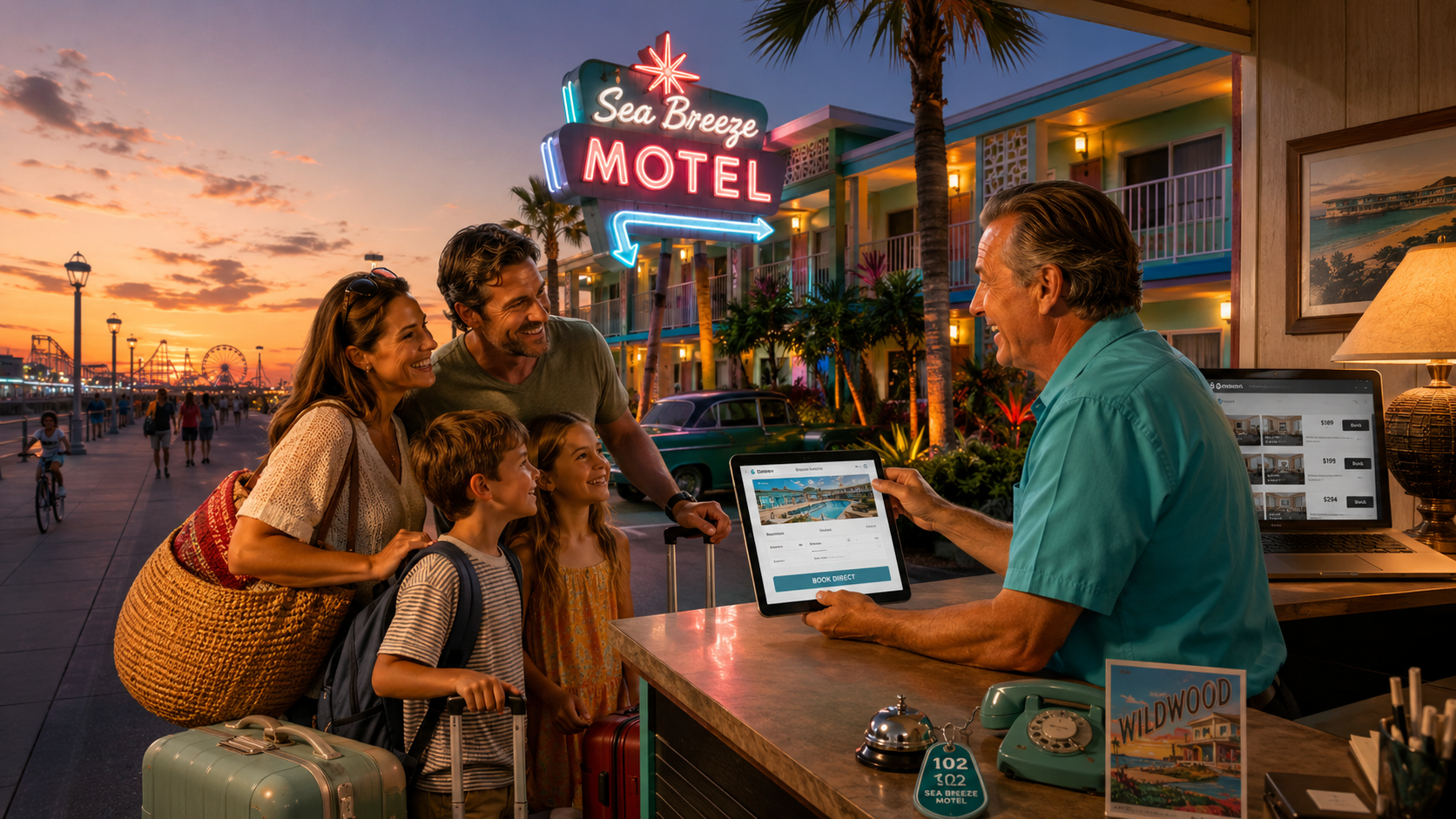
To the Family-Owned Wildwood Motel Paying Expedia More Than Your Winter Payroll: There's a Better Way
Your grandfather's neon sign still pulls families off the boardwalk — but somewhere along the way, a middleman moved in between your motel and the guests who love it, taking 15–30% of every booking, including the families who were always coming back anyway. This letter runs the real commission math ($50K–$75K per season for a modest motel), explains the two battlefields where it's won back — the "second tab" and the AI trip-planning answer — and shows why Wildwood's Doo Wop story is the one asset no OTA grid can flatten.

Your Agency Needs an AI SOP. Here's the Best Practice — and a Baseline Template You Can Steal.
Every agency is in one of two states right now: no written AI policy (improvisation), or an eleven-page legal document nobody has read (improvisation with extra steps). With adoption at 87%, disclosure demanded by 84% of consumers, and the EU AI Act's transparency rules in effect, the era of "we're figuring it out" is over. This guide covers the seven best practices that make an AI SOP actually operational — and includes a complete baseline template you can copy, fill in, and ship this week.

The Client Asked to Cancel Right After the Kickoff Call. Here's How Good Agencies Handle It.
The email lands 48 hours after kickoff: "We've decided not to move forward." What you do in the next 72 hours determines whether this becomes a saved account, a referral-generating clean exit, or a reputation-costing mess. This playbook covers the five causes behind kickoff-stage cancellations (each with its telltale signature), the exact save-call script, why structural fixes beat discounts every time, how to exit so gracefully the client comes back — and the four prevention moves that keep the email from ever arriving.

Rolling Out Dog Cremation at Your Cape Cod Funeral Home: How to Honor Every Grief Without Losing Your Gravity
The hesitation is natural: does offering dog cremation cheapen a funeral home that's buried three generations of its town? The research flips the question — pet loss produces grief clinically comparable to human bereavement, and it's the one grief our culture gives no ritual, no leave, no room to stand in. This guide covers the grief case, the $3.6B market opportunity, the marketing tightrope between cutesy and cold, and how to launch a pet aftercare line that extends your gravity instead of spending it.

Before You Hire a Marketing Agency for Your Cape Cod Funeral Home, Ask Them One Question: "Have You Been to a Funeral?"
Every agency deck says "compassionate" and "trusted." The decks are interchangeable — the people aren't. Sixty years of cultural skepticism about funeral service quietly shapes how most marketers write about your profession, and that inherited doubt leaks into copy in ways a style guide can't fix. This guide explains why you should vet the actual humans on your account — have they stood in a receiving line, planned a service, thought about what funerals are for? — and gives you the eight questions that sort real partners from vendors in one meeting.

On-Cape Is Not Off-Cape: Why Local Context Is Everything for Cape Cod Funeral Homes
The Cape is the oldest county in Massachusetts, deaths outnumber births two to one, and nearly half its homes belong to families from over the bridge — retirees and second-home owners with no inherited loyalty to any funeral home. Meanwhile, corporate consolidators buy beloved local names and keep them on the sign. This guide shows how genuinely family-owned Cape funeral homes prove what can't be purchased: real roots, real people, real care — made tangible in search results and AI answers.
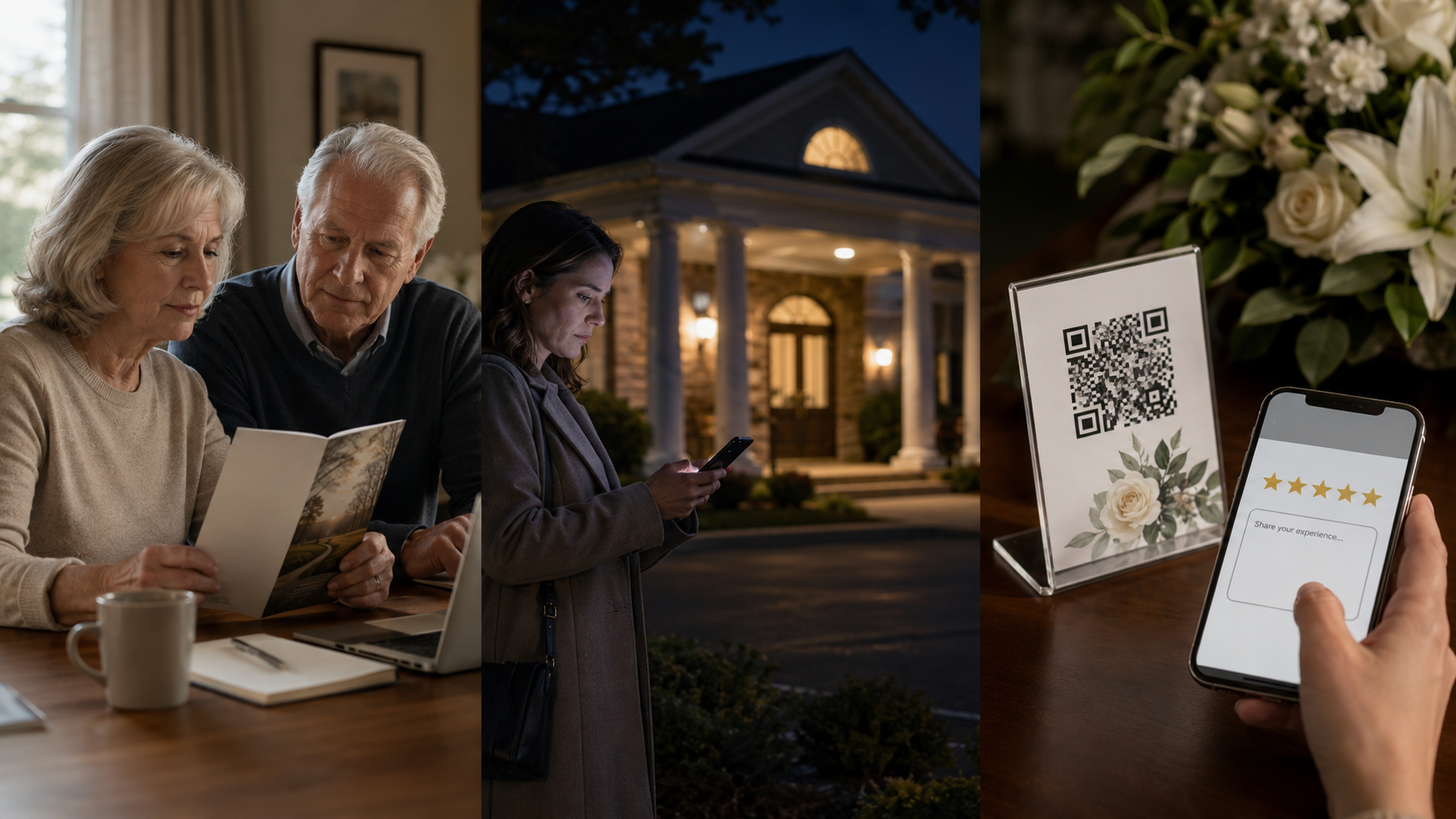
The Funeral Home Growth Playbook: More Pre-Planning Leads, More At-Need Calls, More Google Reviews
Funeral home growth comes down to three moments: the preneed decision made years early, the at-need search made at 2 a.m., and the review a grateful family would leave if anyone made it easy. With only 19.4% of Americans preplanned and loyalty-based selection collapsing, this playbook shows how to build one engine across all three — content that generates preneed leads, local and AI visibility for immediate-need families, and a dignified QR + SMS review workflow that respects grief while compounding your reputation.

Funeral Home Marketing in the Direct Cremation Era: How SEO and AI Search Make Your Value Tangible
Cremation is heading toward 82% of dispositions, and the fastest-growing slice is direct cremation — chosen online, at midnight, on price alone. Families aren't rejecting funeral directors; they're deciding without ever seeing what you do. This guide breaks down the revenue math, what the grief research actually says, and the four-layer content engine that makes a family-owned funeral home's heart tangible in Google results and AI answers alike.

"Do You Use AI to Write?" — How Agencies Should Answer the Question Every Client Is Now Asking
Every agency is getting asked the same question in 2026: "Do you use AI to write our content?" Most fumble it. This guide breaks down what clients are really asking, why denial is the worst possible strategy (87% of marketers use AI — and clients know it), and gives you a word-for-word answer framework plus responses to every follow-up. Handled right, the industry's most awkward question becomes your sharpest differentiator.

The Phrases That Give Away AI Writing (and How to Edit Them Out Before They Cost You Trust)
AI writing has tells — and your readers can spot them on sight. Backed by a Science Advances study of 14 million abstracts and Wikipedia's editor-built field guide, this post breaks down every word, phrase, and structural pattern that gives away AI-generated content, why they cost you rankings and AI citations, and the six-step editing pass that fixes them without killing your voice.
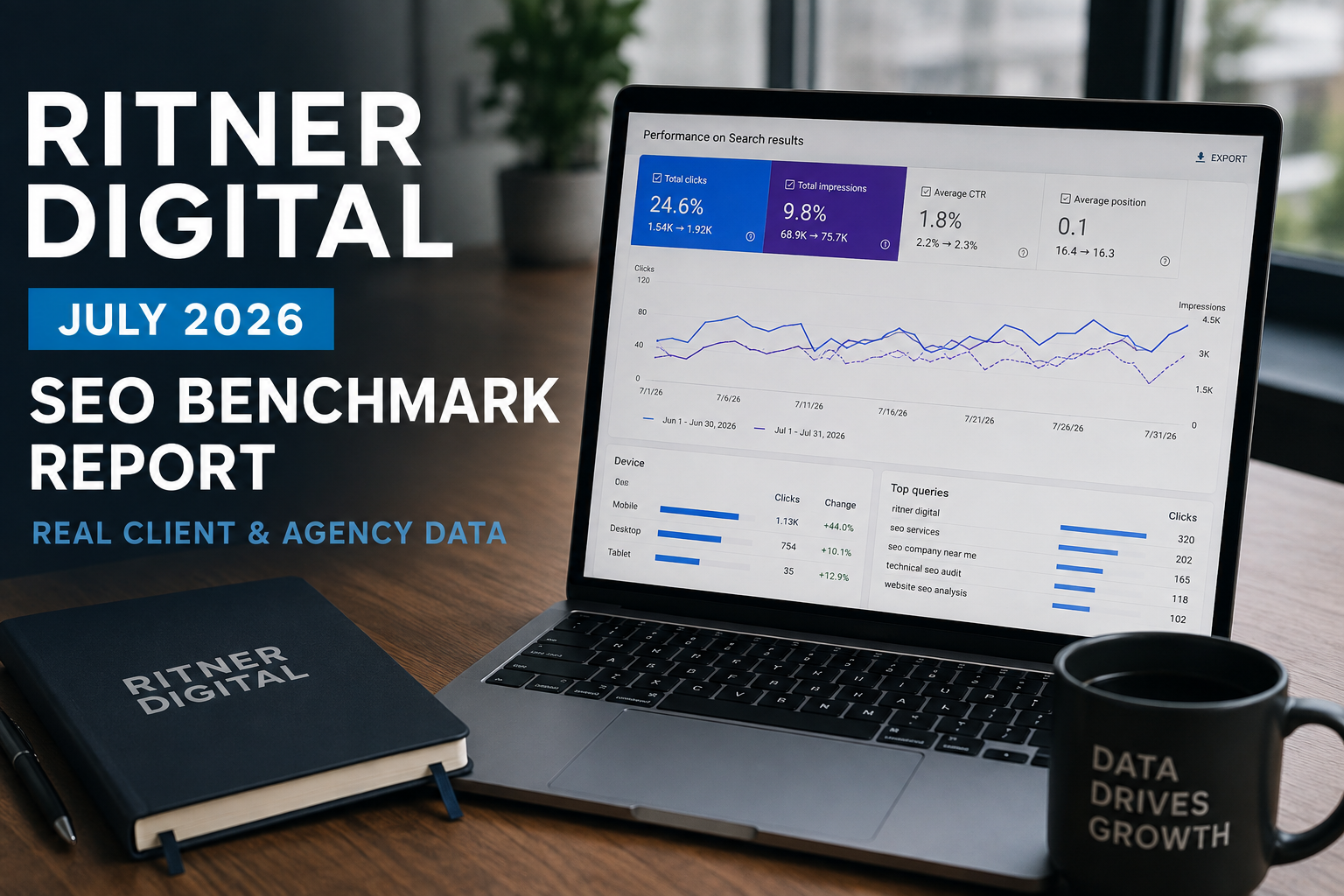
Ritner Digital July 2026 SEO Benchmark Report
Every month we publish our own Google Search Console numbers next to a real client's — no cherry-picking, no vanity dashboards. In July, our site grew clicks 24.6% month over month while mobile surged 44%, and client True Blue Autos captured branded search at 30–46% CTRs while building a national impression base with truck shipping content. Here's the full breakdown of what moved, what didn't, and what we're doing next.
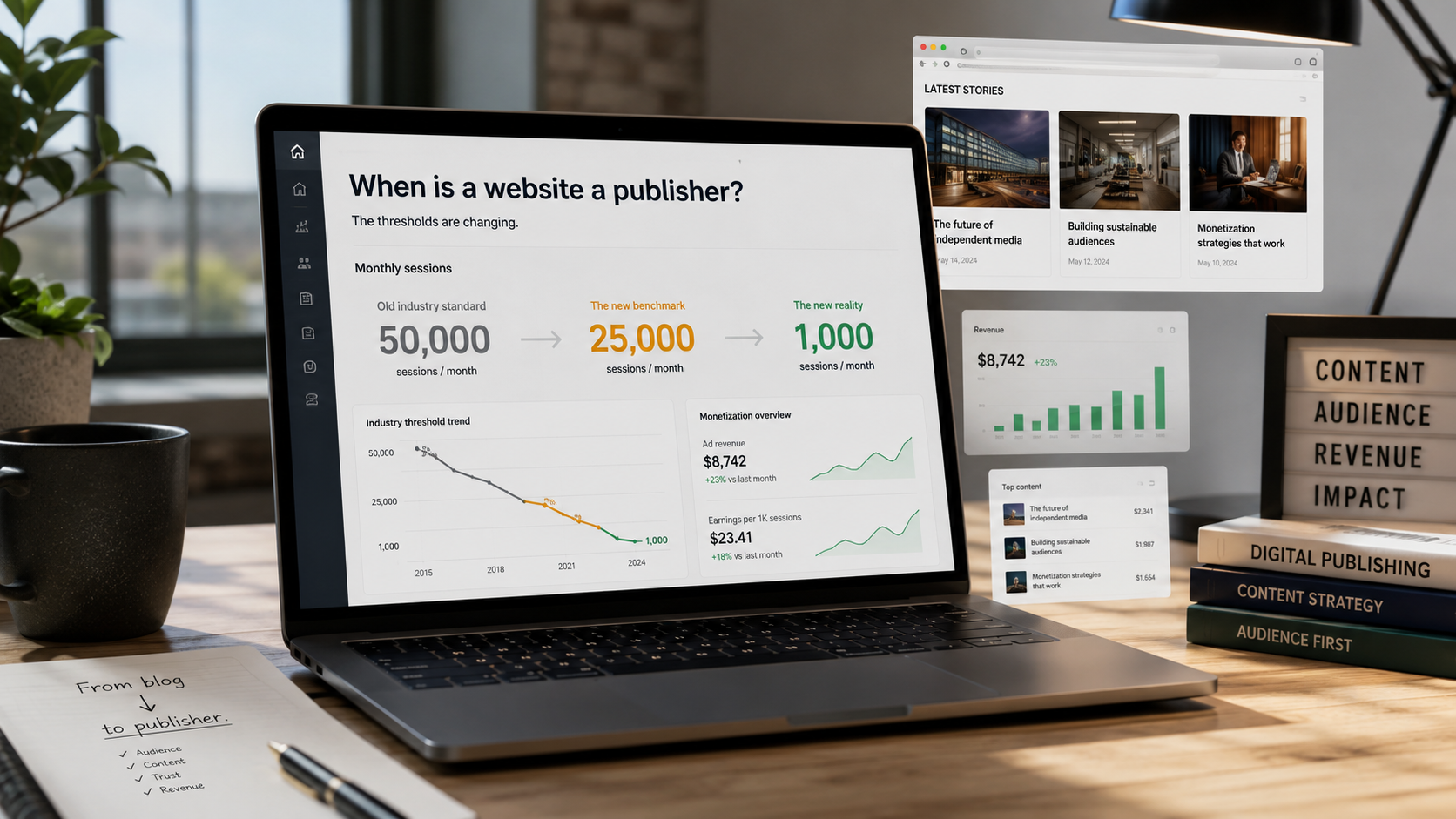
How Many Sessions a Month Makes a Website a "Publisher"? The Real Numbers in 2026
For years, 50,000 monthly sessions was the unofficial line between "a blog" and "a publisher." In 2026, that number died — Mediavine scrapped it, Raptive slashed its bar 75%, and the entry point fell to 1,000 sessions. Here's every current threshold, why they're all collapsing at once, and why the session-count definition of publisher no longer measures what matters.

The "Normal Photo With Text On It" LinkedIn Trend: Why It Works, Why It's Dying, and What to Post Instead
A candid photo, a bold one-liner, zero design — and for two years it beat every polished graphic on LinkedIn. Now single-image posts underperform text by 30% and the parody phase has begun. Here's the full breakdown: the four mechanics behind the trend, the data on its decline, and how to steal what still works without becoming the meme.

Aura, Mogging, and FRFR: The 2026 Gen Z Slang Glossary for Marketers (And How to Use It Without Getting Roasted)
Gen Z built an entire language around one idea: prove it, or we don't believe you. This glossary breaks down aura, mogging, frfr, brainrot, and the rest of 2026's vocabulary — what each term actually means, which ones are safe for brands to touch, and why the generation's demand for receipts mirrors exactly how AI search engines decide who gets cited.
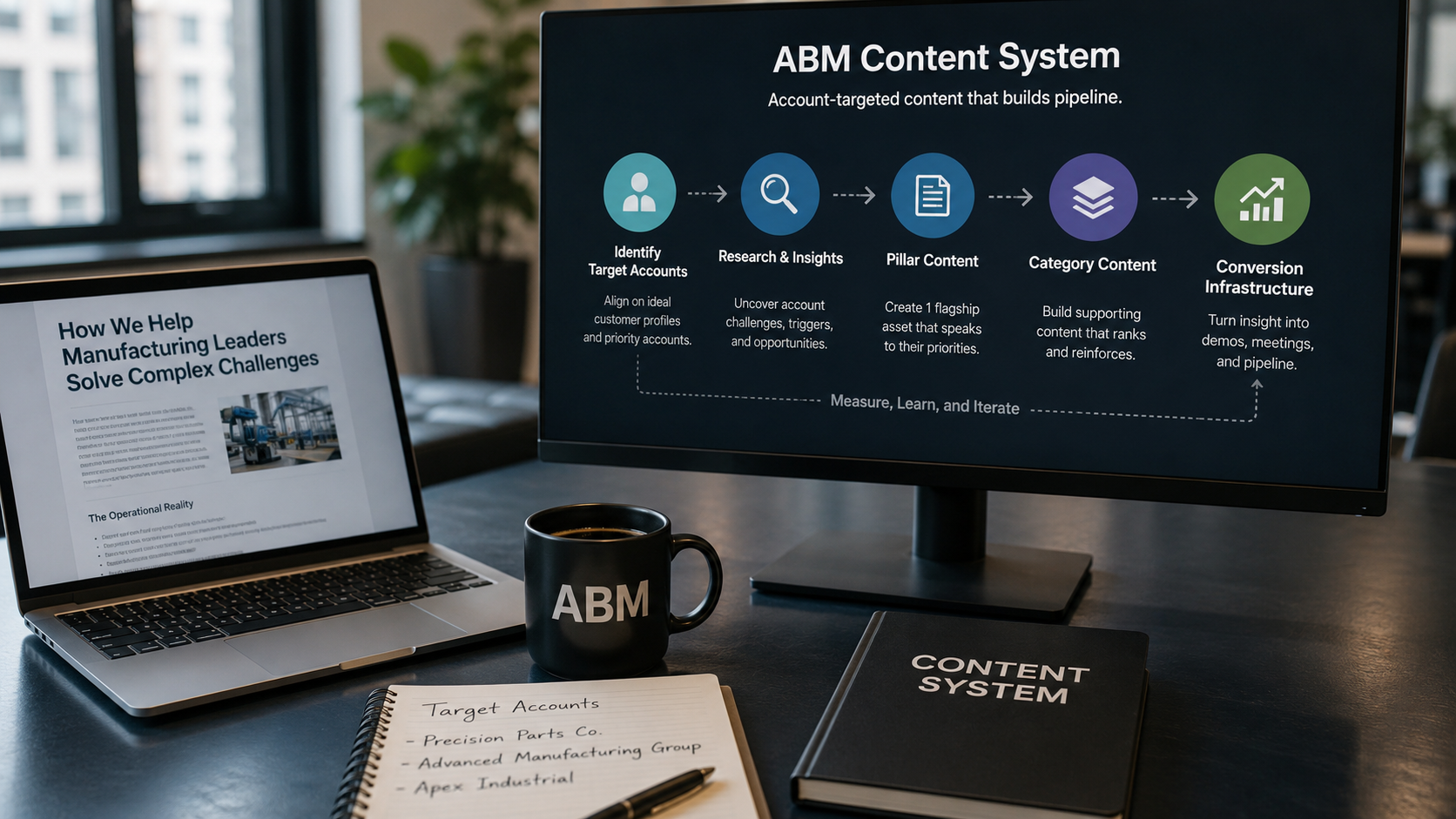
The ABM Content System: How Targeted Blogs Become a Lead Engine
Most B2B companies run one of two broken motions: a blog that ranks for nothing, or outbound that buyers actively resent. Both are underfunded and disconnected. Here's the system we build instead — account-targeted pillar content, category support, and conversion infrastructure, published on a cadence that compounds. Including the honest timeline and who it isn't right for.

How Many Leads Should a Website Get Per Month? The Actual Math
"How many leads should our website get?" is the most common question we hear — and it has no answer without three other numbers. Here's the honest version: the 100-visitor rule, why it's probably wrong for your industry, the full funnel math from visitor to closed revenue, and how to work backwards from a revenue target to the traffic you actually need.

ABM Doesn't Have to Mean Email. Your Best Account-Based Play Might Be a Blog Post.
Ask a B2B marketer to describe ABM and you'll hear the same answer: named accounts, intent data, an email sequence, LinkedIn ads. But ABM is a targeting discipline — email is just a delivery mechanism, and it's the one least aligned with how buyers actually behave. Here's the case for running account-based marketing through published content, and the seven-step process for doing it.
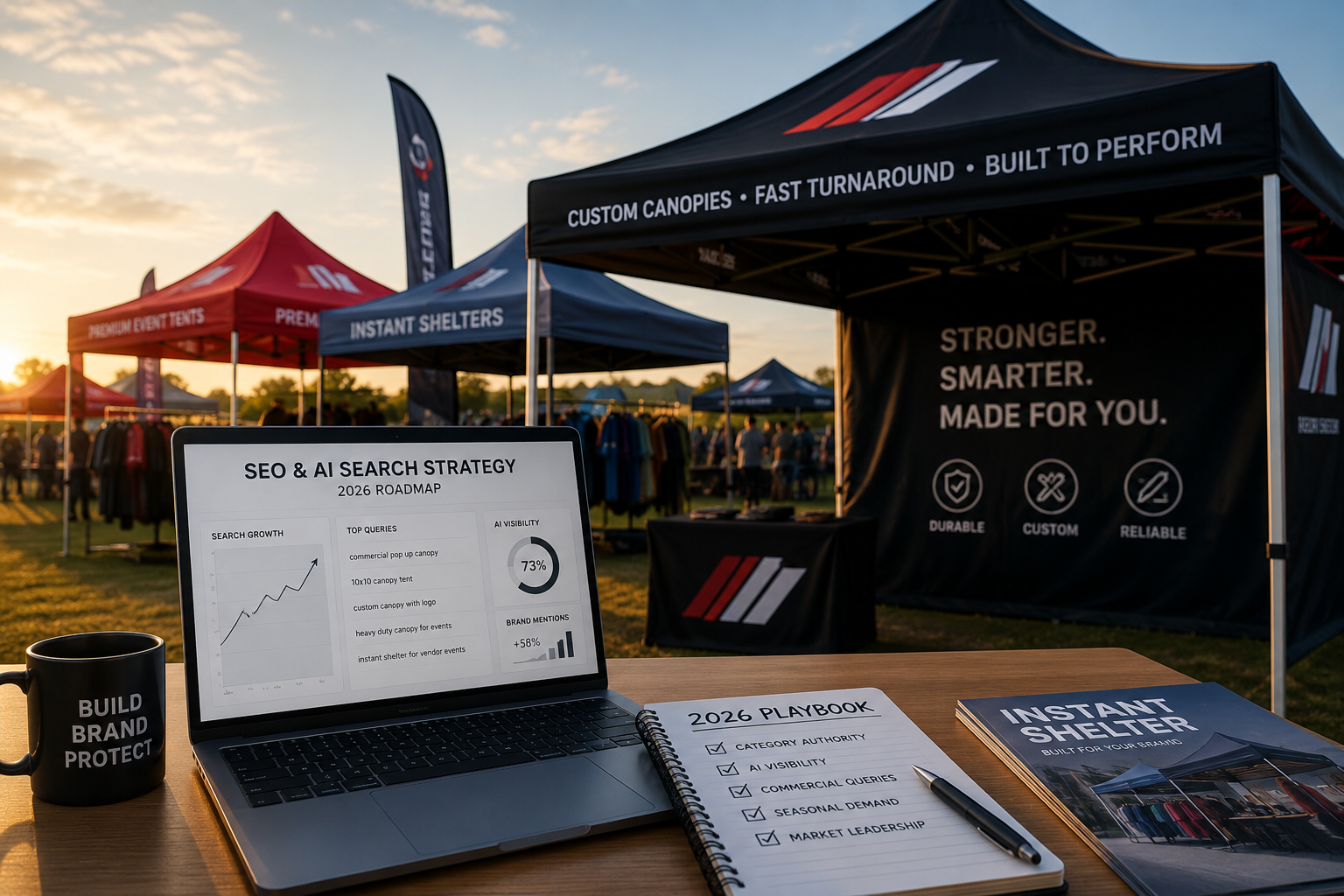
SEO and AI Search for Pop-Up Canopy Companies: The 2026 Playbook
Most industries have a search problem. The pop-up canopy industry has four at once — a category term that's somebody's trademark, discovery that starts on marketplaces you don't control, two buyers with nothing in common, and a twelve-week season that decides the year. Here's the 2026 playbook for fixing all four, including the five query types that actually drive commercial demand and why manufacturers are better positioned to win AI search than they realize.
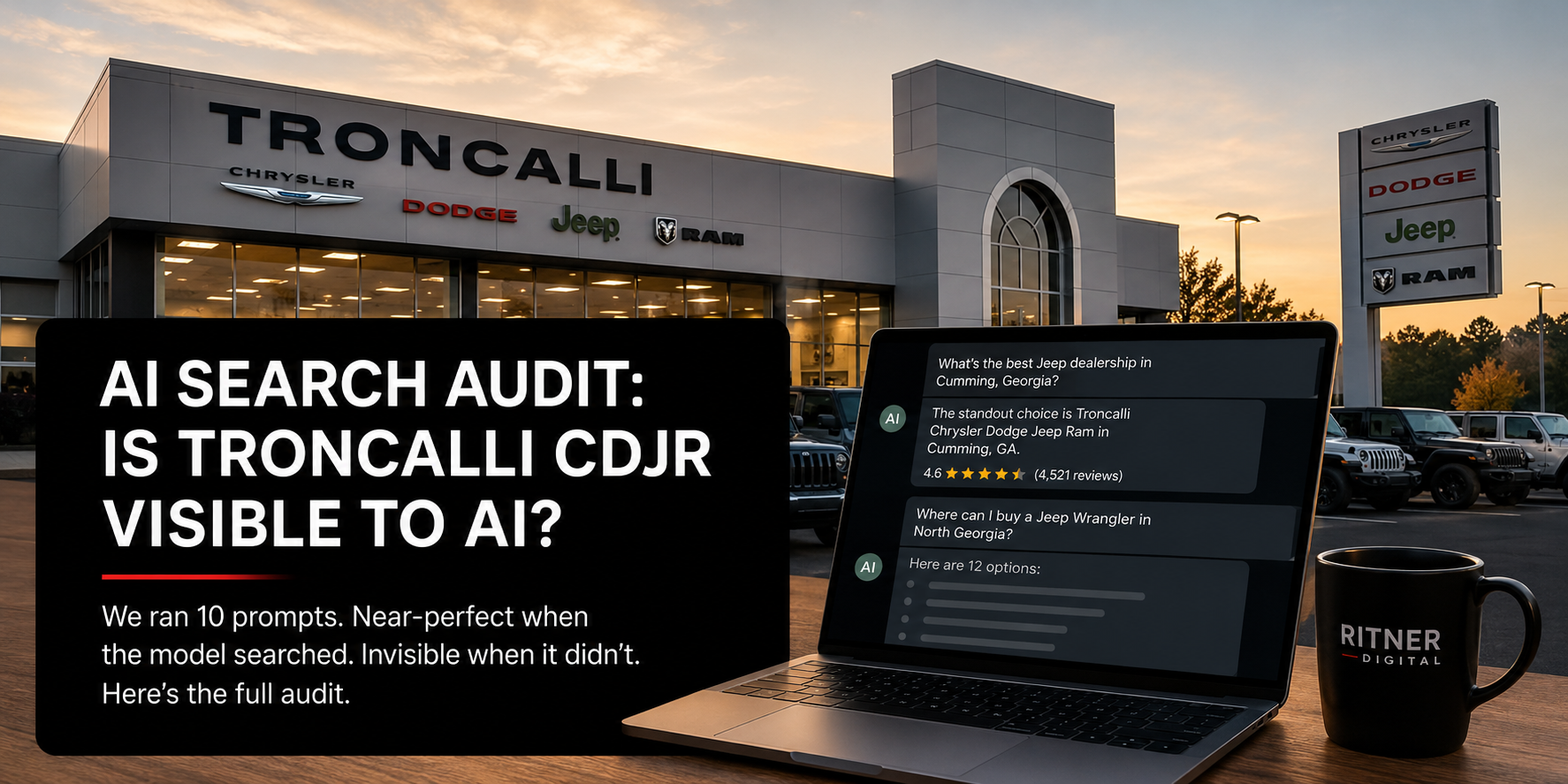
Troncalli CDJR Is Invisible to AI — Except When It Isn't
Ask an AI assistant for the best Jeep dealership in Cumming, Georgia, and Troncalli CDJR comes back first — called "the standout," with the right rating and the right review count.
Ask the same assistant where to buy a Jeep Wrangler in North Georgia, and it names twelve dealerships. One in Dalton. One in Rome. One in Chattanooga, Tennessee. One entry isn't a dealership at all — just a suggestion to "check Jackson County."
Troncalli isn't on the list.
We ran 10 prompts to find out why. The answer splits along one line: whether the model looked them up or remembered them. When it searched, Troncalli scored 43 out of 48. When it worked from memory, they scored zero across four prompts — and had an address invented for them in a fifth.
All 10 full responses are included below.