Case Study: When Traffic Drops… But Conversions Explode (A YoY Reality Check)
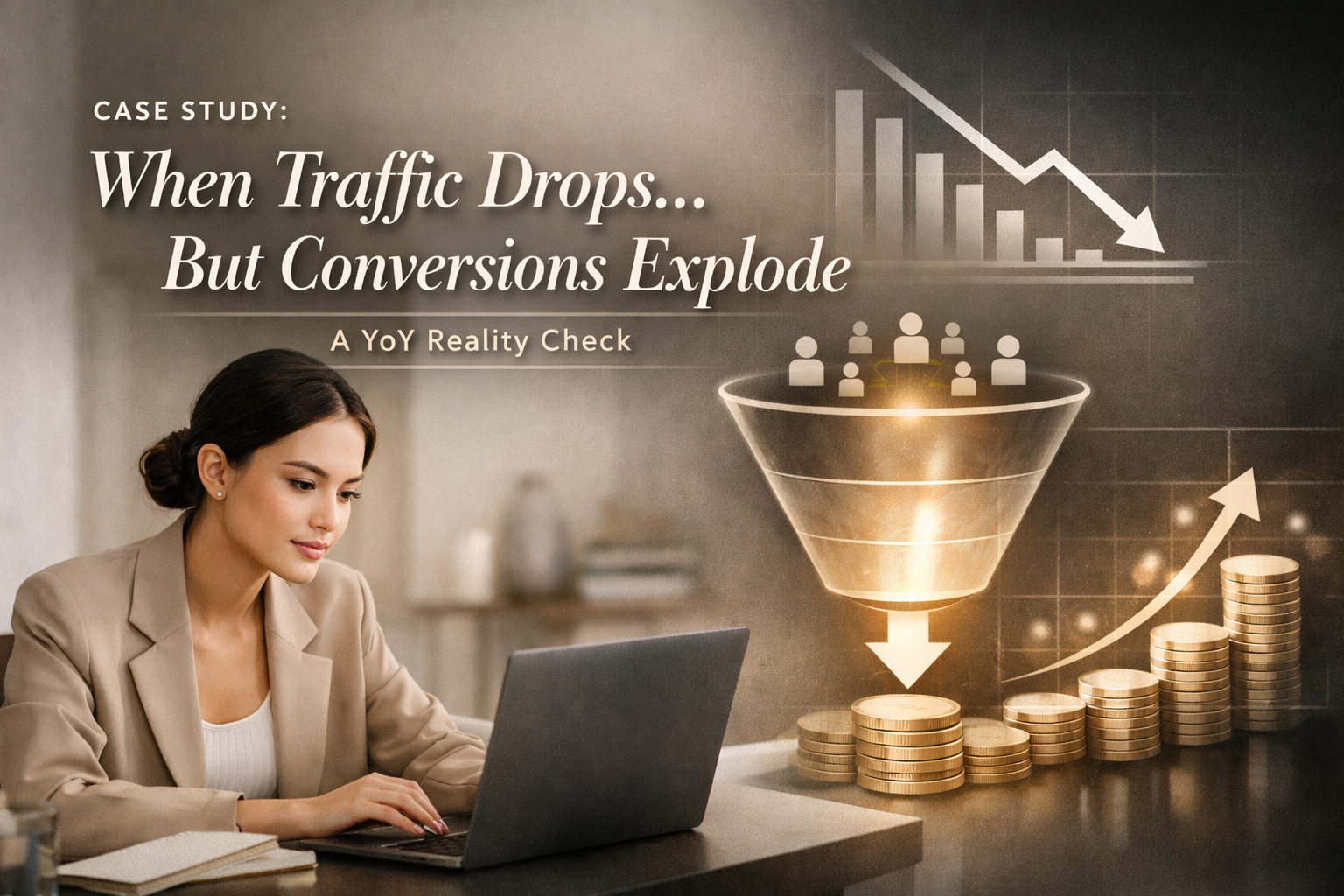
If you’ve ever opened Google Analytics and seen traffic go down year-over-year, your first instinct is probably panic.
Totally fair.
But here’s the thing most dashboards won’t tell you:
not all traffic is good traffic.
Over the past year, we worked with a B2B services + software company in a competitive, high-consideration space (long sales cycles, multiple stakeholders, and buyers who really like to research before reaching out).
And their year-over-year performance did something counterintuitive:
Top-of-funnel traffic declined.
Bottom-of-funnel conversions surged.
Let’s break down why this is actually a win.
The YoY Snapshot (Jan 1–Dec 31, 2025 vs. 2024)
What went down
Sessions: 38,113 → 32,654 (-14.3%)
Active users: 31,997 → 24,669 (-22.9%)
New users: 32,150 → 24,279 (-24.5%)
Avg engagement time per session: 32s → 22s (-29.2%)
If you stopped here, you’d assume something broke.
But here’s where it gets interesting.
What went up (a lot)
Key events (conversions): 836 → 2,546 (+204.6%)
Session key event rate: 1.07% → 1.38% (+29.3%)
Translation:
Fewer visitors. More action. Better efficiency.
What This Actually Means
Instead of casting a wide net and hoping something sticks, the site started behaving like a smarter salesperson.
Less browsing.
More intent.
Clearer next steps.
This kind of trend usually points to:
higher-quality traffic
better alignment between content and buyer intent
cleaner conversion paths
improved tracking accuracy (GA4 behaving, finally)
In other words: the funnel got tighter.
Page-Level Trends That Tell the Real Story
Here’s what the page data revealed — without naming pages or exposing client details.
1) The Homepage Stayed Steady (But Needed Stronger Direction)
The homepage saw a modest lift in sessions year-over-year, but key events dipped slightly.
That usually signals one thing:
people are arriving, but they’re not being pushed into the next step fast enough.
Common fixes include:
tightening above-the-fold messaging
clarifying the primary CTA
adding proof faster (outcomes, testimonials, credibility signals)
The homepage isn’t just a welcome mat — it’s a traffic router.
2) Educational Content Became a Conversion Engine
Resource and educational content experienced slightly fewer sessions, yet key events jumped significantly.
That’s the best-case scenario for content marketing.
It tells us:
traffic quality improved
content matched higher-intent queries
internal linking and CTAs were doing real work
This is what happens when content supports sales instead of just chasing pageviews.
3) The Leadership Page Was a Top Conversion Driver
One of the most surprising — and valuable — insights?
The leadership page emerged as a top driver of meaningful engagement and conversions.
That’s not accidental.
In B2B, buyers don’t just evaluate the solution.
They evaluate the people behind it.
Leadership pages perform well when:
trust is required to move forward
deals are complex or high-stakes
prospects want validation before reaching out
This page wasn’t just informational — it played a real role in helping prospects say, “Okay, these people are legit.”
Marketing takeaway:
If your leadership page gets traffic, optimize it like a conversion asset:
strengthen bios with experience and proof
include trust signals (press, speaking, certifications)
add soft CTAs like “Talk to our team” or “Request a consultation”
4) A Core High-Intent Page Lost Significant Traffic (Red Flag)
One revenue-driving page saw a sharp year-over-year traffic decline, even though engagement improved slightly.
That’s a red flag worth addressing quickly.
Possible causes:
SEO ranking drops
technical issues
internal linking changes
competitors taking search share
When high-intent pages slip, pipeline usually follows — so this becomes a priority fix, not a “monitor it later” item.
5) Bottom-of-Funnel Visibility Exploded
Finally, the strongest signal of all:
a primary “schedule a call” / contact-oriented page saw a massive traffic increase year-over-year.
That doesn’t happen by accident.
It typically comes from:
improved internal linking
better CTA placement across the site
clearer buyer journey alignment
campaigns driving traffic to the right destination
This is what momentum looks like.
The Bigger Lesson
Traffic is a vanity metric until it turns into sales motion.
In B2B marketing, the goal isn’t “more visitors.”
It’s more of the right visitors taking the right actions.
This year-over-year story is a reminder that:
fewer sessions can still mean a healthier funnel
trust content (like leadership pages) matters
and conversion strategy beats raw volume every time
Want This Same Outcome?
If your site is getting traffic but not enough leads — or if you’re seeing inconsistent performance year-over-year — that’s exactly where the right marketing partner helps.
Ritner Digital builds systems that:
attract qualified demand
guide buyers through the funnel
and turn visibility into real conversations
👉🏼 Start here: https://www.ritnerdigital.com/contact
Client data has been anonymized for privacy. Metrics are shared to highlight trends and strategic insights rather than disclose client-specific details.
FAQs
Why did traffic decrease but conversions increase?
Because traffic quality improved. Lower-intent visitors were filtered out while higher-intent users made up a larger share of sessions. The result: fewer visits, but more people taking meaningful actions.
Is declining traffic always a bad sign?
Not necessarily. In B2B marketing, declining traffic can be healthy if conversion rates and lead quality improve. What matters most is how efficiently traffic turns into sales conversations.
What are “key events” in GA4?
Key events are tracked actions that indicate progress toward revenue, such as form submissions, demo requests, contact inquiries, or scheduled calls. They’re a better indicator of performance than raw pageviews.
Why was the leadership page a top driver of conversions?
In high-consideration B2B buying cycles, prospects evaluate the people behind the company before reaching out. A strong leadership page builds trust, validates credibility, and helps prospects feel confident taking the next step.
Should leadership pages include calls to action?
Yes. Leadership pages shouldn’t be passive. Soft CTAs like “Talk to our team,” “Request a consultation,” or “Schedule a call” help convert trust into action without feeling pushy.
What does this case study say about content strategy?
Content that aligns with buyer intent performs better than content designed purely for traffic. Educational pages, leadership content, and clear conversion paths consistently outperform generic awareness content.
How can B2B companies improve conversion efficiency?
Key levers include:
Clear conversion paths
Strategic internal linking
Optimized high-intent pages
Trust-building content (like leadership and proof pages)
Accurate GA4 tracking
Together, these turn traffic into pipeline.
Who is this type of strategy best suited for?
This approach works best for B2B companies with:
Long or complex sales cycles
High-trust buying decisions
Multiple stakeholders involved in purchase decisions
How does Ritner Digital help with this?
Ritner Digital helps B2B companies:
Improve conversion performance without chasing vanity metrics
Optimize high-intent and trust-driven pages
Build funnels that turn visibility into qualified leads
The focus is always on revenue impact, not just traffic growth.
How do I get started?
You can book a consultation here:
👉🏼 https://www.ritnerdigital.com/contact
Related Reads
〰️
Related Reads 〰️

Your Homepage Has ~5 Seconds to Work. Here’s How to Win Them.
Your website homepage has one job: convince visitors they’re in the right place. In this guide, we break down what should be on your homepage, best practices that actually convert, and a simple outline you can steal.
How to Tie Marketing Spend to Revenue
Marketing teams spend money. Finance wants proof. This guide breaks down how to tie marketing spend to real revenue using clean tracking, attribution models, and data your leadership team will actually trust.
Why Organic Traffic Is the Most Sustainable Growth Strategy in 2026
Paid ads deliver short-term results. Organic traffic compounds. Learn why SEO and content marketing are the most sustainable growth strategies for businesses in 2026 — and how to build traffic that converts long after campaigns end.